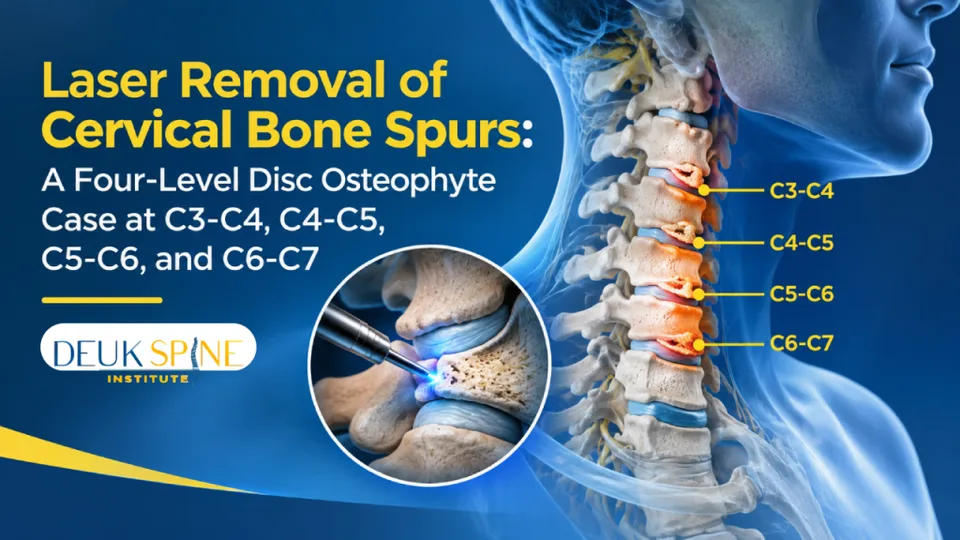
A Case Of Disc Osteophytes C3-C4, C4-C5, C5-C6, C6-C7
By Dr. Ara J. Deukmedjian, MD
Board Certified Neurosurgeon
Published: Oct 1, 2026
Disclaimer on health matters: This is purely for educational purposes and is not meant to be taken as medical advice. There can be individual variations. Please always seek expert medical advice before taking any decision regarding your medical condition and treatment.
Key Points
- Cervical bone spurs (osteophytes) are the end stage of disc degeneration. They form when the body tries to stabilize a torn, inflamed disc with calcium.
- Multi-level disease at C3-C4, C4-C5, C5-C6, and C6-C7 is the pattern most patients are told requires a two- or three-level fusion.
- Open fusion surgery (ACDF) carries a published complication rate approaching 48% when all perioperative events are counted.¹
- A 0.5 mm laser fiber delivered through a 4 mm incision can vaporize calcified disc material and bone spurs in 0.05 mm increments. ACDF removes disc and bone in roughly 5 mm bites with a rongeur or burr. That makes the laser approximately 100 times more precise than standard open surgical equipment.
- Deuk Laser Disc Repair® treats the source of cervical bone spur pain and radiculopathy with 99% pain relief, a 0.01% complication rate, and no narcotics on discharge.
- Multi-level cases can typically be addressed in a single outpatient session.
If you have been told you need an anterior cervical discectomy and fusion for bone spurs at multiple cervical levels, you deserve to know what the laser can actually do before anyone cuts out your discs and bolts plates to your spine. Modern endoscopic laser surgery has moved cervical spine care beyond the fusion-or-nothing choice. But most patients are never told the option exists.
The laser does not cut bone. It vaporizes it. One tenth of a millimeter at a time.
Watch Dr. Ara Deukmedjian Vaporize The Disc Osteophytes at C3-C7
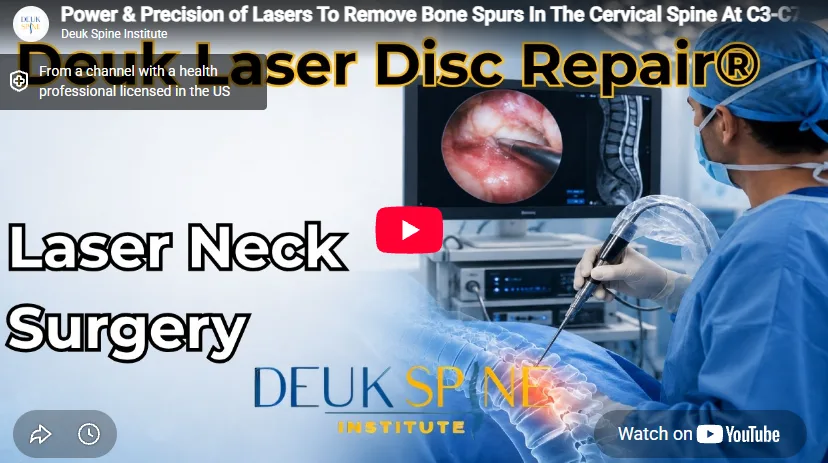
Video Transcript
Tuesday, 29th, 2026. I’m Dr. Deukmedjian, CEO and founder of the Deuk Spine Institute. Our patient has had cervical spine issues for one year. He’s from Pennsylvania. He traveled to Deuk Spine Institute because he did not want the traditional ACDF, anterior cervical discectomy and fusion. He wanted a less invasive, better surgery with better results. So he traveled here to Florida for this procedure.
The endoscopic surgery we perform here at Deuk Spine Institute is one of a kind. There are other surgeons who claim to perform endoscopic surgery, and they may perform some type of endoscopic surgery, but it’s typically going to be an invasive procedure far worse than our treatment because it involves cutting through muscles, ligaments, bones, and joints in the back of the spine — a posterior cervical laminotomy, foraminotomy, and partial facetectomy. This is a posterior approach to the back of the neck, and it is the wrong approach to fix a herniated disc. You cannot reach the herniated disc through the back of the neck.
Surgeons who don’t know how to do what we do — the most advanced, most sophisticated, and most difficult endoscopic spine surgery in the world — go through the front of the neck. Surgeons that can’t do this go through the back. Don’t compromise. Always go for the best.
We’re going to get started. To treat C3-4, C5-6, and C6-7, we need to first place our needles. Sean, I’m going to place the needle at C3-4 first. Are we relaxed? Full dose. So when can I expect maximal relaxation? All right, very good.
We’re going to treat C3-4, C5-6, C6-7, so I have to place the needle. All right, there’s C3-4 way up there. Let me see if I can get a little further up. I have to move the voice box, or The Adam’s apple, over using my fingers. This technique you’re seeing me do was developed in South Korea by Dr. Sang-Ho Lee. He is the pioneer. Dr. Sang-Ho Lee pioneered this anterior cervical endoscopic technique. I learned the technique from him and his assistant neurosurgeon Dr. Gun Choi.
All right, looking good. AP looks pretty good. We want to be in the center of the spine on the AP view, which we are. That’s looking good. It’s C3-4. Everyone agree? All right, so I’m going to leave that there at C3-4 and I’m going to go down to C5-6, C6-7, starting at C6-7, and place the needle at C6-7. Let’s go ahead and just gently hold that. Don’t push it in. Any questions? Type them up and I’ll do my best to answer for you.
In the meantime, let’s show the audience the 30 different causes of neck pain.
I’m Dr. Deukmedjian, CEO and founder of the Deuk Spine Institute. We’re going to talk about the 30 causes of chronic neck pain. Chronic neck pain is neck pain that lasts longer than six weeks. There are 30 causes of chronic neck pain. The most common cause is the disc. There are six discs in the neck. These discs can become injured. The first disc is C2-3. Next is C3-4, C4-5, C5-6, C6-7, and C7-T1. The most common disc to be injured and cause neck pain is C5-6, followed by C6-7, followed by C4-5. The other discs rarely cause pain. Discogenic pain represents 85% of chronic neck pain.
Next, the facet joints cause 10% of chronic neck pain. Facet joint pain is very common in patients with neck and spine injuries. Facet joint pain is usually located on the sides of the spine, either right, left, or both. Facet joint pain gets worse with rotation of your head and neck, and worse with extension. The most common facet joints to be injured are C5-6, C6-7, and C4-5. C7-T1 is another common facet joint to be injured. These joints, after injury to the capsule, will develop arthritis. It is the arthritis in and around the facet joint that causes the neck pain and stiffness with movement.
Deuk Plasma Rhizotomy is the best treatment in the world available for painful facet joints. Deuk Laser Disc Repair is the best treatment in the world available for painful discs. Other causes of chronic neck pain include fractures, tumors, infections, and muscle spasms. These other causes represent less than 1% of chronic neck pain.
Thank you for joining us for the 30 causes of chronic neck pain.
Welcome back. You can see from our video the 30 different causes of neck pain. The number one cause by far is a disc injury — a herniated disc, bulging disc, ruptured disc, protruded disc, degenerated disc, slipped disc, extruded disc. All those different names really mean the same thing.
Count the vertebrae for us. We’re at C6-7. All right, we’ve got 2, 3, 4, 5, 6, 7. So our needle at the bottom is at C6-7. I’m injecting a little bit of our dye. You can actually see the dye in the disc space. It’s coming out through the back of the disc where there’s a tear. The tear runs along the top of the disc, along the top of the annulus posteriorly. At C3-4, we’re going to come back to that later. I’m going to start with C6-7, then go to C5-6, and finally the last disc we’re going to repair, C3-4.
Let’s show the audience how these discs can become so painful for patients.
Disc injuries start with an annular tear. Damaged nucleus pulposus herniates into the annular tear. The herniation triggers an inflammatory response within the annular tear. The inflamed annular tear generates pain signals.
For more details, please visit our website at www.deukspine.com or call us at 1-800-FIX-MY-NECK (349-6963).
Welcome back. You can see from our video that neck pain, when it’s a disc injury, comes from a tear in the back of the disc called a posterior annular tear. “Posterior” means back. The annulus is the ligament that wraps around the bones and holds the jelly in the center, called the nucleus pulposus. So the nucleus pulposus is held in place by the annulus fibrosus, or round ligament. Once that ligament is torn through trauma — like people get when they have a car accident — then that annular tear becomes a path of least resistance. It’s a way for the jelly to get out of your disc and move outside the disc. We call that a herniation. When the herniation happens in the back of the disc, it can pinch nerves located in the back of your disc. Those nerves are called nerve roots. It can also pinch your spinal cord.
In his case, both nerves are being pinched and the spinal cord is being pinched. At C3-4, the spinal cord is being pinched. At C5-6 and C6-7, it’s mostly pinched nerves. At C3-4, you can see the disc space is well preserved — nice and tall. But at C5-6 and C6-7, you’ve got some degenerative disc disease.
Look at that — the dilator came back. You guys see that? The tip of the dilator at C6-7 moved backwards about a centimeter. So I’ve got to put it back. What made it move? Basically, there’s so much inflammation happening in this disc that it’s pushing my tools out. It’s saying, there’s so much pressure in here, get out. That’s called hydrostatic pressure. The hydrostatic pressure in the disc — look at that — pushed it all the way back. I can feel it. It’s like a rubber band. Every time I push this dilator forward, it’s coming backwards.
You just have to be super careful because we’re working right above the spinal cord and the nerves. We don’t want to damage either of those. That’s why you really should be a neurosurgeon to do this. But you’ve got to have some patience, obviously. Any questions? No questions.
All right, I’ve got to use one of my tricks now. Basically, I put a little tension and bow the dilator so that it doesn’t slip backwards. All right, that looks really good. We’re in perfect position. Show the audience where the tip of the tube is. The tip of the tube is there. We’re right inside the annular tear. We’re going to remove the herniation just beyond it. There’ll be a little bit of calcium too — some bone spur. We’re going to get rid of that as well. Whatever needs to be gotten rid of.
If you have questions, type them up. In the meantime, let’s show the audience how the Deuk Laser Disc Repair procedure actually works.
Disc injuries are a common cause of chronic neck pain. The inflamed annular tear causes neck pain. A 4 mm skin incision is made. A small tube is inserted with no damage to the bones or soft tissues. The laser removes herniated disc fragments and debrides the posterior annular tear. The annular tear heals on its own after the procedure, which can take up to 12 months.
For more details, please visit our website at www.deukspine.com or call us at 1-800-FIX-MY-NECK (349-6963).
Welcome back. Here we are inside the tube that goes to the herniation. The tube creates a pathway. It allows the surgeon to put instruments from where we are in the operating room, slide them down the tube right to where the herniation is. The tube allows the surgeon to bypass the disc. So we are leaving the patient’s disc where it is. We’re not removing the disc. Because we’re not removing the disc, we don’t have to put a cage or spacer where the disc was.
Doctors are somewhat disingenuous when they talk to patients about fusion in the neck. What they tell you is: look at your MRI, look at your X-ray, the disc is collapsed, so you need a fusion or a cage or an artificial disc. The truth is, you don’t need an artificial disc even when the disc is collapsed, and the surgeons know that. The only time you need an artificial disc is when the surgeon takes your disc away to do your fusion. They go in there and scrape your normal disc away. Sometimes they leave the herniation there, too — they don’t even take your herniation out. They just scrape your normal disc away. When they do that, now you’ve got no disc left between your bones. Your spine suddenly becomes unstable. So it’s actually the surgeon who makes your spine unstable during an ACDF, not your body.
Half of a millimeter — that’s a piece of herniation being cooled. People talk about, well, can’t you start a fire with the laser? No, not if you use it properly. I’ve been using this laser for 20 years now.
Instead of doing what’s best for you, they want to do what’s best for themselves. So doctors who tell you that Deuk Laser Disc Repair — first of all, nobody says Deuk Laser Disc Repair doesn’t work, because we’ve never had a failure in 20 years. We’ve never had a single patient where it did not work. We have had patients who got the laser and have a different problem that needs to be addressed, such as facet pain. That’s the most common additional problem. But the laser surgery you’re watching right now has never had a failure. We’ve had 100% success, and our average pain relief is 99.6%.
Any questions? No questions.
These are bone spurs, by the way. See that right there? That’s a bone spur that I’m zapping away with the laser. There’s the foramen right there. You guys see that hole? That is where the nerve lives. It’s exiting the spine right there. It’s called the neural foramen. It’s where the nerve root leaves. That’s the nerve root just underneath where I’m zapping. It’s the last bit of ligament right there that was squeezing on the nerve. So this is going to fix the right arm symptoms he has. I just opened up the foramen.
Remember, that fiber is half a millimeter — 0.5 millimeters. That’s how skinny and small it is. You’re seeing it like this only because we have a special scope — a very high-resolution, high-definition endoscope. Otherwise, you’d never be able to see this much detail back where the herniation is. Most surgeons that do this type of surgery, ACDF, don’t do the endoscopic — they do the ACDF. They can’t see back here. They have no idea what it looks like. They’ve never seen this in their life unless they watch my surgery.
Any questions?
Yes, we have a question from Lanu on YouTube. Yes, Lanu. Can a herniated disc cause cancer?
Herniated discs do not cause cancer. Never. Not in my knowledge or experience. I don’t see how a herniated disc could cause cancer.
I’m going to flip it. Remember, we’re at C6-7. We’re about to finish C6-7. We’re going to move on to C5-6 next, and then C3-4.
It’s impossible for a herniated disc to cause cancer. Never heard of it, never seen it. It doesn’t make scientific sense. So if somebody told you a herniated disc caused cancer, they’re lying to you, or they clearly have no clue what they’re talking about. That would be the same as, does a unicorn cause cancer? The chance a herniated disc causes cancer is the same as the chance of a unicorn causing cancer. It doesn’t happen because, number one, a unicorn doesn’t exist, and there’s no mechanism by which a unicorn can actually cause cancer.
Cancer comes from a variety of things that have to happen. Cancer is your own body’s cells growing and dividing out of control. In our bodies, we have genetic mechanisms that control how much a cell will grow and divide. Cancers come from out-of-control cellular growth and division. Then, to spread to other parts of your body — to metastasize — the cancer cells must stop sticking to the cells nearby. So they lose their ability to stick.
One big issue is growing out of control. Second is they lose their cohesion, their ability to stick to the cells nearby. The third problem is they have to be able to invade your blood vessels so they can spread throughout your body.
So there are three types of steps, or mutations, that have to occur to your own normal cells. For example, colon cancer is in the colon. What people don’t necessarily know is that colon cancer is a cancer found inside the wall of your colon, but it actually comes from cells that are in the wall of your colon — the endothelial cells. What happens is first those cells start to grow too much. They’re growing out of control. Instead of growing and dividing every three days, those cells will start to grow and divide every six hours. They have a genetic mutation that allows reproduction of two new cells every six hours instead of every 72 hours. So you get a mass of cells growing — it’s called a tumor.
Then the next mutation is they can invade your blood vessel, which means they’re going to eat through the wall of your blood vessel so they can spread throughout your body — whether it’s the blood vessel or the lymphatic system. Those are the two highways in your body. They have to eat through cellular walls like those of the blood vessels or lymphatics so they can gain entrance to that highway. It’s like a car getting on a highway through an on-ramp.
Once they’re on the highway, they have to have another mutation where they no longer stick together. Cohesion is what holds them together — gap junctions, tight junctions, and so on that hold cells together in a tissue. They lose the ability to produce gap junctions and tight junctions, so they lose the ability to stick together, and they break off. Like this piece of herniation right here is broken off from the main herniation — I use a laser to break it off. In your body, when you have cancer, your cells lose their ability to stick together. They invade blood vessels, grow out of control, and no longer stick together or stay where they’re supposed to be. That’s what causes cancer — those three changes.
We’re starting to understand better what causes those changes. They’re genetic mutations in the expression of different genes.
Any other questions?
Yes, we have a question from Mark on YouTube. Does the gel in the disc replenish?
Great question, Mark. Does the gel in the disc, called the nucleus pulposus, replenish? The answer is: the gel does not replenish. There is no way to replenish the gel. Scientists have tried for years to replenish the gel — it doesn’t work. It always escapes and then it hits your nerves and causes huge problems. So there is no reason to have the gel. You don’t need it. That’s the biggest misconception probably in the entire spine world. People think you need the gel in your disc, the jelly. You don’t. I’m the one who discovered you don’t.
The purpose of the jelly — first of all, it’s called the nucleus pulposus. It’s a remnant, or residual, of your notochord, which is needed during embryology. The developing fetus in the first trimester has a neural plate and a notochord, which is a round tube. That round tube, the notochord, causes the induction of the three germ layers — the endoderm, mesoderm, and ectoderm. That’s a bone spur I just took out, by the way. The endoderm, mesoderm, and ectoderm eventually become your muscles, ligaments, bones, brain, nerves, spine — everything. Everything in your body comes from — my gosh, it’s like a never-ending herniation — everything in your body comes from the induction of the notochord to form the three germ layers in your first trimester.
Once the notochord is done inducing those germ layers, which later on as an adult differentiate into all kinds of tissues, everyone thinks it just disappears. But it doesn’t. It actually becomes the nucleus pulposus — the jelly in the middle of the disc. Everyone thinks, oh, you’ve got to have the nucleus as a cushion. But you don’t. The reason the notochord is hidden away in the middle of your disc is because there’s no blood supply to the middle of your disc in an adult. No blood supply normally to the middle of your disc.
So this nucleus pulposus is extremely inflammatory. It basically causes inflammation once it’s seen by your vascular system. Your vascular system responds to it and creates inflammation. That inflammation causes neck pain, headaches, and arm symptoms. That only happens when that nucleus escapes and goes through the annular tear — which is what I’m fixing right now. I discovered that.
The nucleus is not needed as a cushion. It’s not needed to produce height, because there are tens of millions of people out there with no nucleus left. They have bone-on-bone in their neck, in their back, and they have perfectly normal lives. We all know that. That’s why doctors have been so confused about disc injuries and how they cause symptoms. It’s not a structural problem. It’s a physiological problem. The physiological problem is inflammation, like we showed you on that video. Great question.
Any other questions? We’re done at C6-7.
We just finished the Deuk Laser Disc Repair at C6-7. We’re going to move up to C5-6. Remember, our patient is from Pennsylvania. He came here because where he lives, all they want to do is fusions. That’s true for most people. Wherever you live around the world, surgeons are recommending fusions more and more. I’ll tell you why: it is the highest-paying treatment in medicine. There is virtually no treatment that pays doctors more than a fusion. So you have all these spine surgeons wanting money, and they recommend fusions. Or they do things like laminectomy or discectomy first, and then after that, patients are going to have so much pain afterwards because they’ve just destabilized the spine, and the patients come back.
Luis, the cable — you still haven’t moved it.
If you go to your spine surgeon and they recommend discectomy or laminectomy, they’re going to be drilling out bone that holds your spine together. They’re going to be cutting and hurting the muscles that hold your spine together. They’re cutting your ligaments, muscles, and bones so that your spine becomes weak and unstable. Then when you come back a year later and tell them you’re in so much pain, after they send you to all their pain management doctor friends, they tell you you need a fusion. So they end up setting you up for a fusion by doing all that invasive surgery.
Let’s get another AP. I want to see where I am. I need that spine straight. I’ve got to see where I am. Bernes, can you de-rotate the neck, please? Keep it straight. I need to see where we are.
All right, that looks pretty damn good. Still not centered. Can you try to center that up, Jordan? I need to be right in the dead center of the spine. A little more. That was a good correction. Perfect.
So we’re dead center. You can see the tip of the dilator is right where the spinous process is. I’m in the center of the spine. I want to be in the center. I’m literally sliding up the spine along what’s called the anterior longitudinal ligament. The ALL is a ligament that holds your spine together from the front.
All right, I’ve got to get over this bone spur. Give me an AP again. I think I slid to the side. Any questions? No questions.
Give me a true AP. That’s worse. Come on. It’s going to be a long day, boys. All right, back to a lateral. I think this is the hardest part of the entire surgery — getting over these bone spurs. All right, that looks good. Give me an AP.
Whenever you move your dilator tip along the spine, you must check both AP and lateral — front, back, and lateral views. Never ever assume that just because you checked the other view before you moved, that it’s okay — because it probably is not okay. Give me another AP.
I go back and forth, back and forth, checking, checking, checking, because a mistake here could mean the patient loses their life. This is very, very delicate surgery. A millimeter or two off and you could end up hurting the patient in a way that is irreversible.
All right, 2, 3, 4, 5, 6. We are at C5-6. That’s the next disc. We’ve got this one to do and then C3-4. Any questions? No questions.
All right, I’m going to do my discogram and we’ll do the laser surgery here.
How many laser surgeries have we done, Anthony? 2,812. Is this number 2,812? Yes. All right.
We get a lot of patients from Pennsylvania. It’s one of our top. We get a lot from Texas, California, a fair amount from New York.
I’m going to place this little tube. Oh, the dilator came back again. Take it off. All right, again, we have the same problem — so much inflammation in the annular tear, it’s pushing my dilator back.
Any questions? No questions.
If you proceed to move this tube forward without the dilator being in there, all you’re going to do is biopsy the disc. We don’t want to biopsy the disc. That means we’re going to take a core sampling. We don’t want a core sampling. We want to remove the herniation. That’s why you need the X-ray machine. It’s absolutely essential to doing this type of surgery.
All right, we’re now at the back of the disc, right where the herniation is. I’m going to use the laser to remove it.
Folks, look at this. Anthony, show the audience how small the incisions are. See this? 4 mm band-aids. And we’ve got a second one we’re going to make. This is how much blood we’ve lost. We’ve literally lost three drops of blood. Three. This entire surgery. Three drops of blood. You can’t do better than that, folks. No blood loss, and this is outpatient.
Patients go home. In the case of traveling patients, which is most of our patients, they go to a hotel for the night, come in in the morning for a quick checkup, then get on with their lives. There’s no downtime. I have patients asking me to give them downtime even though they don’t need it, because they don’t want to go back to work or do dishes just yet. They want to enjoy themselves for a little while after having the surgery. They say, “Oh, we want to check Florida out. We want to go see the beaches.” Okay, go. We’ll give you some more time off. No problem.
If you have a fusion surgery, you’re going to look at months out of work. A lot of people never even make it back to work. Fusions also require people to take narcotic pain medication.
Hey, Anthony, do we have a nice blog on our website outlining the difference between the DLDR and a fusion? Yes, we do. Can you put a link to that blog in the dialog box so people can go read more about how this surgery is so much better than a fusion? Yes, I will.
All right. Once again, the laser — you can see it at 12 o’clock. It’s a skinny little glass fiber. That fiber is 0.45 millimeters. It’s less than half a millimeter. That gives you an idea of how precise the work is we’re doing. Far more precise than open surgery. When you have an ACDF, the most precise your surgeon can be is 1 millimeter, and that’s with a special microscope.
This is a bone spur here. You see this bone spur? I just melted it away with the laser. Goodbye, bone spur. I have to take that away because it’s literally pushing right on the nerve. This guy’s got some calcification of his herniation. It makes my job much harder when I have to remove calcified herniation. That’s my foot moving on the water — the floor is a little wet.
See that right there? Look how the calcium builds up right on the posterior longitudinal ligament. This is called OPLL — ossification of the posterior longitudinal ligament. If this guy waited another few years, he’d have a solid mass of calcium pressing on his nerves and spinal cord. He’d have no other choice but to do a fusion. But he got to us with enough time. This is the last stage of disc degeneration right before everything turns to calcium and it becomes a much more dangerous surgery for the patient.
So don’t wait, folks. If you have a herniated disc that’s causing you symptoms, don’t put it off. It’s not going to go away on its own, I promise you. You may get better for a little while, feel better, but you’re going to need that thing operated on. Not every disc herniation causes symptoms. About 90% of people with disc herniations have no symptoms at all — maybe 85%. But there’s about 15% of people with herniated discs who have symptoms. If you’re one of those 15%, I hate to break the news to you, but you’re going to need surgery done. Otherwise your lifestyle, your quality of life, is going to be miserable, dealing with: how do I avoid hurting my neck? I’m not going to do anything. I’m going to stay home, just watch TV all day, be on my phone. If that’s the kind of life you want, fine, do it. But if you want an active lifestyle — go out hiking, jogging, canoeing, running, pickleball, golfing — then you need to get your problem fixed. There’s no better place to get your back pain or neck pain fixed than Deuk Spine Institute. We have the most advanced treatments in the world.
This is all scarred up, calcified. This has been here for probably 60 years. He says his symptoms have gotten bad in one year. Well, this is not one year old. This is at least 40, 50 years old. He probably hurt his neck when he was a kid. Like so many people, they just work through it. He works a lot with HVAC. He’s a tough guy. He’s in the HVAC business. You’ve got to put food on the table. You’ve got to support your family. So what do they do? They go out there and work through the pain. But now we have a way to fix it. You don’t have to work through the pain anymore. You can get it fixed.
Any questions? No questions.
You see me bringing the laser out from time to time. What I’m doing is literally floating out the herniations, getting them to leave the patient’s body. That’s how we get rid of all these pieces of herniation. They actually come out of your body at the time of surgery.
Look at this bone spur. Wow. This is at C5-6. It’s literally sitting on top of his nerve, pinching the nerve right there. That’s amazing. So I’m peeling it away. Remember, the laser is half a millimeter — 0.5 millimeters. A millimeter is the smallest space between your fingers. I’m peeling this bone spur away in his foramen, sitting right on top of his nerve root. There is no other surgery in the world that can do this. None. And it must use a laser. There’s no other way to do it besides a laser. When people tell you, “Oh, lasers” — that’s because they don’t want to lose your business. They don’t want to lose you as a customer. But the reality is this is the best for you. You’ve just got to go get it done. Make it happen.
All right, just behind the nerve root. That’s beautiful. This is the entry of the foramen. You can see all the calcium sitting on top of the posterior longitudinal ligament. But I’ve opened this foramen up.
Go to the other side. We’re just about done at C5-6. I’m going to do C3-4 next — that would be my last one.
There’s a big piece of herniation right there. See it? Come on. How’s my irrigation? Good, thank you.
Any questions from our audience?
Yes, we have a question from Mark on YouTube. Yes, Mark. Are you constantly flushing the surgical area to remove the debris? It seems to come up the tube by itself and vanish.
Yeah, because we’ve got it under pressure. How much pressure, Luis? 600 PSI. So we’ve got a cuff squeezing the cold sterile saline bag, and that cuff is putting 600 pounds per square inch of pressure on the bag to force this irrigation — this liquid — out of the bag, down the IV line, and into the surgical field. So it flushes everything out. You’re right, if we didn’t have the irrigation, you couldn’t see anything. I couldn’t do the surgery. It would just be a tube full of junk, herniated disc. So I have to have constant irrigation to move this tissue out of here.
All right, we’re almost done here at C5-6. We’re going to move on to C3-4. There it is. That was such a tight foramen. His nerve was getting pinched so bad. We just unpinched it. I’m going to take one more look.
Any more questions while I’m here at C5-6? At C5-6, the exiting root is going to be C6. It goes to your biceps and a few other muscles in your arm.
Any questions?
Yes, we have a question from Mohit on Facebook. Yes, welcome, Mohit. Same procedure works in C4-C5 cervical myelopathy with AP diameter 4.6 mm?
Yes, Mohit, this is your best option. Mohit’s saying, what about a C4-5 disc herniation where the AP diameter is 4.6 mm? That is severe stenosis. You can become paralyzed if you don’t get that fixed. You need to get it fixed. But every doctor you talk to is going to tell you fusion, fusion, fusion, ACDF — disc replacement, same thing. Except us. We have the most advanced technology in the world right here. I can peel that herniation right off your spinal cord.
Wait, before you come in, back off. Take a look, folks. Here, we finished C5-6, C6-7. Look at the incision. Can you guys see the incision here? Yes, we can. Right there. It’s 4 mm. Tiny. It’s going to look like he got bitten by a vampire when he came to Florida.
We’re going to go do C3-4 next. We finished C5-6 and C6-7 herniations. Now we’re going to treat C3-4. By the way, there was more than a herniation at C5-6 and C6-7. There was severe stenosis, bone spurs crushing the nerves and spinal cord. I used the laser to peel it all off. Literally 0.05 millimeters at a time. That’s how precise the laser is. There is no other tool in the world in medicine as precise as the laser.
All right, questions? No questions.
Wait. It’s pulling my guide wire up. I don’t know why. Let me feel it. Let go. I think we bent the guide wire a little bit. Yeah, we bent the needle. We’ve just got to be careful when we push it to the side. All right, guide wire is in perfect position.
How’s blood pressure? Just relax. Let me have it, I’ve got to feel it.
Any questions, folks? No questions.
I’m just keeping an eye on — put a little pressure there. Little venous bleeding. I’m keeping an eye on my guide wire because I don’t want it advancing.
All right, that’s good. I’m going to get a quick AP of the spine. I want to see where my tip is. Watch the guide wire. Let me know when you’re going to take the shot. Go. Perfect. Lateral — looks good. I’m pretty much just a hair left of midline.
All right, so it’s good. Leave it. Let me see. All right, we’re at C3-4. Everyone agrees we’re at C3-4. We’re doing C3-4 as part of the surgery. Yes, everyone agrees. All right, remove the guide wire. Pressure.
This is a big herniation pressing on his spinal cord. Right, Jordan? This is exactly what Mohit — this is what Mohit has, except his is at C4-5. Mohit’s is the next disc down, but he has the same thing we’re fixing right now at C3-4: a huge herniation pushing on the spinal cord.
Now, for the surgeons out there — whenever you have a herniation pushing on the spinal cord, you must talk to your anesthesiologist. You must tell your anesthesiologist, please keep the blood pressure with a mean arterial pressure at 65 or higher. Because when the spinal cord is being crushed by a herniation or anything — a fracture, a tumor, whatever it is — it doesn’t get enough blood flow and it can become ischemic. Like a pressure ulcer. You know, if you put pressure on your skin with your finger, it turns white. It’s white because there’s no blood flow to the tissue. If you keep the pressure on your skin long enough — about four to six hours — that white area with pressure on it, no blood supply, is going to die. It becomes what’s called a pressure ulcer. A pressure ulcer means pressure created an ulcer or defect in your epithelium, because the cells in the epithelium need oxygen and glucose to survive.
When you push hard on part of your body, like your tailbone or your hip, for a long period of time, that tissue is not getting any blood supply, no circulation. Look at this piece of herniation. Keep that one. When your tissues in your body do not get oxygen or glucose, they die. The cells die. They must have oxygen and glucose. Certain tissues are more susceptible to this than others. The brain is the most susceptible of all tissues in your body. Your neurons must have blood flow. Neurons can go about five minutes without any circulation or oxygen and glucose before they die. There are ways to change that — you can put a patient in a coma, pentobarbital coma.
I have a tube at my heel. If somebody could move that, please. Are you there? You see it? It’s like a vacuum suction tube. Get it out of there. Thanks.
So the brain is the most sensitive to no oxygen, no glucose for the shortest period of time. All you need is about five minutes and then the neurons start to die. Certain types of neurons are more susceptible than others, but the spinal cord is very susceptible. It’s part of your central nervous system. So if you have pressure on your spinal cord from a mass like a herniated disc or a tumor, and the surgeon goes in to take it out, the patient could wake up and be paralyzed. The reason is that there wasn’t enough blood pressure from the anesthesiologist during the surgery. So you’ve got to talk to your anesthesiologist when you do spine surgery, especially the kind that Mohit needs. Make sure your anesthesiologist is going to keep your mean arterial pressure high.
I’m going to take good care of you. Dr. Bernes says he’s ready for you when you’re ready to come. He’s going to take the best anesthesia care of you. So come here to Florida and we’ll fix your neck. No fusion needed. Outpatient. Go home right after your surgery.
Look at all these pieces of herniation I’m taking out. Where is Mohit from? See if he can answer. Let me have a grabber.
Any other questions? No questions.
So many pieces of herniation here. You guys see all this? I just keep loosening them up with the laser, freeing them up because they’re scarred down. Then I float them up. Sometimes I have to bring the grabber. There’s another one. The herniations are under pressure. They want to escape. Before I put my tube here, the only place they could escape to was the spinal canal, right where the spinal cord is. Like Mohit’s problem, where they’re pushing on his spinal cord.
I’ve got five minutes left. Watch the fiber. Any other questions, folks? Mohit says he’s from India. All right, Mohit — we’re ready for you. We take patients from India.
How’s my pressure? Pressure 67. I don’t mean that — I’m talking about my fluid pressure. These pieces of herniation don’t want to float out. They’re giving me a hard time because — anybody know why? Luis probably knows. They’re calcified. Calcium is a metal. It’s very dense. So when you get calcified tissue, the herniation gets weighed down. It’s dense, so it doesn’t want to float. It wants to sink.
Wow, this guy’s spine is so difficult. Everything is bone spur, bone spur, bone spur. Herniation, old herniation, calcified, stuck down. This is as hard a case.
Okay, give him his reversal. Yeah. For sure. Give him his reversal. Don’t do the long-acting in the future unless we discuss it. Unless you really want to, but I was worried about having to give them a lot. No, I only need it in the beginning when I put the needles in. I always do the needles all at the beginning.
Look at this piece of herniation here. This thing’s a beast.
Any other questions or comments? No questions.
All right, we have a full schedule today. This patient has cervical, but we’ve got lumbar coming up. We have three patients with lower back pain. We’re going to do the cervical first, then three lumbar patients. We’ve got a full day in the operating room. Grab yourself some popcorn.
Thursday we only have three, right? Because we have a short day since I’m going out of town. Yeah, Thursday we’re capped at three.
What is going on? Come on. Luis, help me get that in there properly.
I know it’s hard to believe, but I actually have other responsibilities outside of this, which is why I don’t start earlier. When I can, I start earlier, but I can’t neglect my other duties. Someday I will start earlier routinely.
Any other comments or questions? No comments or questions.
Let’s show the audience how the Deuk Laser Disc Repair compares to other treatments.
I’m Dr. Ara Deukmedjian, CEO and founder of the Deuk Spine Institute. I’m here to talk to you today about neck pain and its common treatments.
Neck pain has different causes. The most common cause of neck pain is a herniated disc. Herniated discs account for about 85% of chronic neck pain. The second most common cause of chronic neck pain is the facet joints. There are facet joints on both sides of the spine, left and right. There is one facet joint for every disc. Facet joint pain requires a different kind of treatment targeted at the facet joint itself.
For disc pain, which accounts for 85% of neck pain, the best treatment in the world is the Deuk Laser Disc Repair. It is the most advanced treatment — the safest and with the highest chance of successfully eliminating symptoms.
Let’s talk for a moment about what’s important for patients considering treatment for neck pain coming from an injured or damaged disc. The most important thing for patients, number one, is getting rid of their symptoms. The type of symptoms disc herniations or disc injuries can cause include neck pain, headaches, and symptoms down the arm, such as weakness, numbness, tingling, or pain shooting from the neck down into the arm. Disc herniations are the most common cause, and patients want those symptoms gone. That is their number one priority.
The second most important goal for most patients is to avoid a complication from the treatment. Medical treatments do have complications, and the more invasive the treatment, the more likely a complication will occur. Complications from surgery can include blood clots, pneumonia, heart attack, infection, failure of the spine to heal properly after surgery. There can be implant migration or implant failure, adjacent segment disease, and vascular complications such as injury to the blood vessels or nerves in the neck, including the trachea and esophagus. Nobody wants a complication from spine surgery on their neck. Less invasive is typically going to be a better option to avoid those complications.
The third thing patients really want when they’re looking at treatment options for curing their neck pain is a quick recovery. People want to get back to a normal life as quickly as possible. They want to go back to their activities, be active, play sports, and go back to work.
Finally, the next thing to consider is long-term results. For example, if you have a treatment today and it works, how long will that treatment last, and will it create additional problems down the road? Treatments like spinal fusion that are invasive typically result in the need for additional treatment, such as pain management, physical therapy, and possibly additional surgery.
We’re going to look at each of these individually. We’re going to start with more invasive treatments typically recommended for patients with herniated discs or degenerated discs in their neck.
The most common treatment recommended around the world is anterior cervical discectomy and fusion. That is a surgical treatment where the entire disc is removed surgically through a large incision. It is very risky — there’s bleeding and risk of injury to surrounding structures such as the esophagus, trachea, and blood vessels in your neck. Complications are very common with this type of surgery. The complication rate is accepted at 48%, a very high number. The success rate of the surgery at eliminating neck pain is very low — somewhere on the order of 25%. That is the generally accepted success rate at eliminating neck pain.
An additional treatment is artificial disc. Artificial discs are very similar to ACDF. The difference is that instead of fusing two bones together with a metal plate and a cage, we’re putting in a mobile disc made out of metal and plastic that moves. The problem with the movement is that these discs do pop out of the disc space over time. They can fail. They can cause collapse of the vertebral body above and below through fracturing — especially in patients with weak bones such as osteopenia or osteoporosis. Those patients are at high risk for complications from both ACDF and artificial discs. Another complication from artificial disc is that you can develop facet joint pain and adjacent segment disease. Very common with artificial disc and fusion, and they typically have the same rate of adjacent segment disease. There’s also a long recovery associated with both ACDF and artificial disc. Recovery can take months to years, if recovery even happens at all. There’s tremendous scarring in the wound associated with ACDF and artificial disc — lots of scar tissue, pain, and problems after these invasive surgeries.
An alternative treatment is to go in the back of the neck and do a cervical laminectomy and fusion. Again — large incision, high chance of complications, very long recovery taking years.
All three of these surgeries — ACDF, artificial disc, and posterior cervical laminectomy and fusion — require the use of post-operative narcotic painkillers. Narcotic painkillers are opioids. They are dangerous. People get addicted to them. They can be abused, and people can overdose. It’s easy to overdose on narcotics because you want to keep taking them to treat the severe pain you’re going to have after these invasive surgeries. The severe pain can last weeks or even months, and the addiction can happen very quickly.
Let’s move into less invasive treatments, such as epidural steroid injections. This is a treatment commonly recommended by pain management doctors. They stick a needle into your spine and inject the steroid medicine to reduce inflammation. While this treatment can be effective at temporarily giving you relief for a few days or even a few weeks, the pain always comes back from a herniated disc because the source of pain is never being treated. The annular tear and the inflammation within the annular tear is not treated by an epidural steroid injection. The steroid goes throughout your body and causes systemic side effects such as high blood pressure and elevated blood sugar. In patients with diabetes, this could put your sugar up into the 300s and 400s, which is very dangerous. Steroids should be avoided as much as possible.
Next, let’s turn to spinal cord stimulators. The problem with spinal cord stimulators is they are highly invasive, and they are frequently put into patients by untrained doctors who are not surgeons. These doctors are typically pain management specialists. They’re putting these stimulators in patients not because they can cure the pain, but because it’s another treatment they have up their sleeves. These stimulator treatments pay these doctors obscene amounts of money. The profit for the doctor can be in the tens of thousands of dollars. Avoid spinal cord stimulators. They do not work. They’re dangerous. They put you at tremendous risk. In the end, you’re taking this device, sticking it on top of your spinal cord, and putting a pacemaker under your skin that you’re going to have to live with for the rest of your life. They cause scar tissue and they frequently migrate out of position.
Next, let’s talk about physical therapy. While physical therapy has many benefits — such as keeping you toned and fit while you’re struggling through the pain and trying to stay mobile — physical therapy will never cure pain in the neck from a herniated disc. It will just try to keep you active and prevent you from becoming more sedentary and developing deconditioning of your muscles because you’re sitting around.
Finally, let’s talk about the Deuk Laser Disc Repair. The Deuk Laser Disc Repair is the solution for neck pain. If you have a herniated, bulging, extruded, ruptured, protruded, or degenerated disc, the Deuk Laser Disc Repair works by minimally invasive treatment going to the back of the disc where the problem is coming from. This is the tear in the back of the disc that has inflammation. Using a laser that is extremely precise — the laser fiber itself is 0.5 mm, or half a millimeter wide — and the endoscope allows me to see 1/12 of a millimeter. I can directly see the nerves and spinal cord. It is an extremely safe treatment.
As far as results go, the Deuk Laser Disc Repair has the highest success rate of all the treatments we’ve discussed. We have a 99% cure rate of neck pain coming from herniated discs. The Deuk Laser Disc Repair has zero surgical complications to date. Our patients have an immediate recovery in one hour. They’re leaving our facility and going back to their hotel room. They usually drive themselves in the next morning for a quick checkup, and then it’s back to a normal life.
I’ve enjoyed talking to you, and thanks for taking the time to listen to our video. I’m Dr. Ara Deukmedjian. You’ll also find this on our podcast at Deuk Spine Institute Podcast. Thank you.
Welcome back. We’ve just completed C3-4 decompression. The patient had severe ossification of the posterior longitudinal ligament and dura, and we zapped out 80% of the herniation. It’s impossible for anyone to get 100% — there are no doctors who get 100% of any herniation because of the anatomy of patients — but I got about 80% of that.
His spinal cord was getting crushed so badly by this calcified, dense herniation at C3-4. It was literally squashed all the way down. So I zapped all the herniation out. I left a thin shell of bone on the dura, because if you try to take that, you’re going to end up with a dural leak, which you don’t want. Surgery went about as good as it could go. He’s asleep. He’s waking up. We’ve got two tiny little cuts. They’re both 4 mm.
Any questions? We’re going to put a steri-strip and close this up. No questions. All right, thanks for joining us. We’ll be back in 30 to 45 minutes for the next case.
Good morning. I’m Dr. Deukmedjian, CEO and founder of the Deuk Spine Institute. I’m here with one of my patients who traveled from California with a problem in his neck. He’s been having pain radiating down into his left arm. He has some other issues as well, like pinched nerves in the elbow and palm, which he’s treating in California. But the herniated discs at C5-6 and C6-7 — we did the Deuk Laser Disc Repair yesterday. You can see me going in with the endoscope and the laser. It’s all done with a 4 mm incision, bloodless surgery, and outpatient. And here he is less than 24 hours later, and he wants to share his story with you. So go ahead.
Okay, the first thing I want to do is give Dr. Deuk a joke that I wrote last night. He’s going to understand this. We might have to look some of these things up.
“A neurosurgeon was performing several radiofrequency ablations on patients when he started hearing loud shouts and screams in the recovery room. Shocked, he walked into the room to see what happened. The nurse ran up to him. ‘Doctor, things got pretty heated up for a while, but no one had the nerve to say anything. That one over there seems especially nerveless.'”
All right, so I got him to laugh. Good stuff. I like it — just a little nerve-centered humor there. I love it.
What happened for me was: ever since I was a kid, I was the young kid that fell off the high chair when I was two years old, fell down the staircase when I was four, got tripped and hit the back of the sandbox at six. I went in the military. I parachuted out of planes, hit my head more than once with a Kevlar helmet. Then served in the military wearing Kevlar helmets, sometimes banging my head against heavy artillery pieces. Sometimes I didn’t have my helmet on. Sometimes just the weight of the helmet was hurting my neck and back.
That part about banging your head in the plane against heavy artillery pieces — sometimes you hear in the military like a helicopter went down, suddenly exploded, went down. Now I know why. [Laughter]
Well, people will say, why would you jump out of a perfectly normal airplane? But let me just tell you, low-contour flying by sea in some of the jets makes things a little bit tough.
After that, I started to notice my muscles in the back just became really severely tense and stressed out. I kind of thought it was work. Then when I’d go to things like the dentist and lean my head back, my entire left arm would just start tingling and sparks shooting out like crazy. When I got back up, things were better. Then I went on a trip back in early May, and it was happening all the time. At that point, I got an MRI done.
I went to my primary care, and I had options. There were five options really. One was do nothing. Just, hey, I’m getting older, deal with it, stop being a baby, life goes on. Number two, maybe seek physical therapy or chiropractic care, which I did and it helped for some things. I had really bad posture — that was one of my issues. But it wasn’t taking away the problems I was having with the tingling, Doc.
Then I started to seek out medical expertise in Los Angeles. First choice was full disc replacement for both of the discs. The way I was thinking about disc replacement was: it’s kind of like having a car. The tires are halfway worn down. You’re having problems with one of the tires in the back and you decide to replace it with a bigger tire that’s different — different tread, different braking system. It’s going to work if you’re riding on a regular road or highway, but it’s something different that’s working there. And it was never made for the car.
You’d be replacing it not with a different tire, but a metal tire. — Yeah, a metal tire. Even worse. Exactly. Tank tread. — And then you can’t do MRIs, or you’ve got to find the ceramic one, which you can’t.
Okay, so that was disc replacement. That didn’t sound attractive. ACDF — I’ve got some dear friends that have done ACDF. The problem there was I was thinking of that same car analogy. Now you’ve got the rear tires locked in — they only go straight, they brake at the same time, the suspension is the same, and only the front two are moving around. I was worried about the effect on the disc above and below. My mom had this problem. She had lumbar fusion with rods in her back, and then she ended up having lumbar fusion on the upper ones when she was alive. That poor woman went through a lot of pain for it.
So I figured, I’m a guy who works in technology — there’s got to be a better solution. I just started doing research online. There’s got to be someone. I was very grateful that I came across Deuk Spine Clinic. I must have watched about 15 of his videos. I started to watch some of the procedures before I started freaking out just looking at that stuff — just not my thing, I’ll stay in technology. One of the things I found immediately that endeared me to Dr. Deukmedjian was the people that sat in this chair. You could just see what he was doing and how he was helping them. I knew I’d found the right person who could help me. It was that easy, Doc.
Awesome. Well, you persevered. You were uncompromising. You wouldn’t settle for what you were being told, which is: let’s go in and put metal in your neck. We’ve talked about this. You’re aware that there’s a big problem in spine with the industry that produces metal pushing these implants on the patients through the surgeons. The surgeons are the ones that recommend it, and the surgeons are rewarded financially in several ways for doing that. The problem is, it is not the best treatment. It used to be the best treatment, but now we’ve made progress. We do the laser surgery — that is the best treatment. You’ve had it. I told you before surgery it may not work because you’ve got some bone spurs, but you told me this morning that you don’t have that pain anymore.
Yeah, I do not. I can’t even describe it, because it’s a sort of an ease that I haven’t had probably for more than 10 years, Doc, at least. I don’t even know how long I’ve been dealing with the electroshock and everything else. It’s been a blessing, and certainly having you take care of me. I’ll tell you what, Doc, one of the things I’m going to try to do is see what we can do with the government. It doesn’t matter what side of the aisle you’re on, but maybe there’s ways to talk to folks in the government to get more attention to these kinds of things. What I’m afraid of — I found you because I looked really hard and I did all the research. There are a lot of wonderful people out there that just don’t know. They’re really limited on their options.
Of course, the problem is the absolute truth, which people don’t want to hear: the government is controlled by big business. And there is no business in the world bigger than insurance companies. They are the most powerful. They’ve brought the pharmaceutical industry to its knees. They brought the medical industry to its knees. The insurance companies just sit in the back. They take your money every month with premium payments, and then they don’t pay their bills. They keep the money and they become richer and richer and more powerful. The insurance companies do not want my surgeries out there, because they work, and they know what’s going to happen: everybody is going to want it, and that is going to be like a run on the market. Everyone’s going to want it. They’re going to get all these bills and they’re going to have to pay them. It’s going to be in the center of attention. All these people are going to be complaining they’re not paying the bills.
Insurance companies do not want new technologies that work. They want patients to only have old technology that doesn’t work, that they’re afraid of — because there’s nothing better for an insurance company than a patient who’s scared to have a medical treatment. The patient won’t get it done. There won’t be a bill for the insurance company to pay. They get to keep the money, and they don’t have to be the bad guy denying payment.
Yeah. And Doc, you were saying also that overseas folks have embraced technologies like what you’re able to provide, right?
That’s correct. If you go to China, India, Korea, they don’t do much fusion. They do mostly endoscopic surgery because it’s better. In the United States, there are only probably five surgeons in the whole United States that do true endoscopic surgery. Some of them advertise it, but they don’t actually do it. A lot that needs to happen. We’re probably 30 to 50 years ahead of the rest of the spine surgeons out there in terms of treating spine issues that are degenerative, and joint issues that are degenerative.
I appreciate you sharing your perspective. Thanks so much. Congratulations.
What Cervical Bone Spurs Actually Are
A cervical osteophyte is no chance phenomenon. It is an expected late consequence in the context of a particular disease process known as cervical spondylosis. The osteophyte is usually found along with the diseased disc at the corresponding level, making up what is referred to as a disc osteophyte complex, which is a mixture of soft and hard calcium material pressing on the spinal cord or the nerve root exiting the spine.²
This sequence is the same for every individual:
- The outer ligament of the disc (annulus fibrosus) tears, usually from trauma or decades of cumulative micro-injury.
- The inner gel (nucleus pulposus) extrudes into the tear. Because this gel has never been exposed to the vascular system since embryologic life, the immune response is intense and chronic.³
- Pain is caused within the disc because of inflammation, each and every year.
- Gradually, there are efforts by the body to splint the unstable part by depositing calcium on the posterior longitudinal ligament and vertebral end plates. That calcium becomes a bone spur.
- In the most advanced form, the posterior longitudinal ligament itself ossifies. This is called ossification of the posterior longitudinal ligament (OPLL), the terminal stage of degenerative cervical disc disease.⁴
Once the symptoms begin affecting the patient’s ability to perform day-to-day activities, there will be involvement of four consecutive levels. The lowest levels of the cervical spine, that is C5-C6 and C6-C7, will become degenerated first as they support the most weight. This is followed by C4-C5 and C3-C4.⁵
Symptoms of a Multi-Level Disc Osteophyte Complex
Patients with disease at C3-C4 through C6-C7 usually present with a combination of:
- Chronic axial neck pain lasting longer than six weeks
- Occipital headache and spasm of upper trapezius
- Pain, numbness, tingling, or weakness in one or both arms
- Electrical sensations traveling down the spinal column during neck flexion
- Difficulty with fine movements of the hands
- Gait disturbances, indicating cervical myelopathy due to cord compression⁶
When the anteroposterior canal diameter approaches 4 to 5 mm, the risk of acute spinal cord injury from even minor trauma rises sharply. This is the point at which most surgeons recommend urgent fusion.⁷
Why Open Fusion Is the Wrong Answer for Bone Spurs
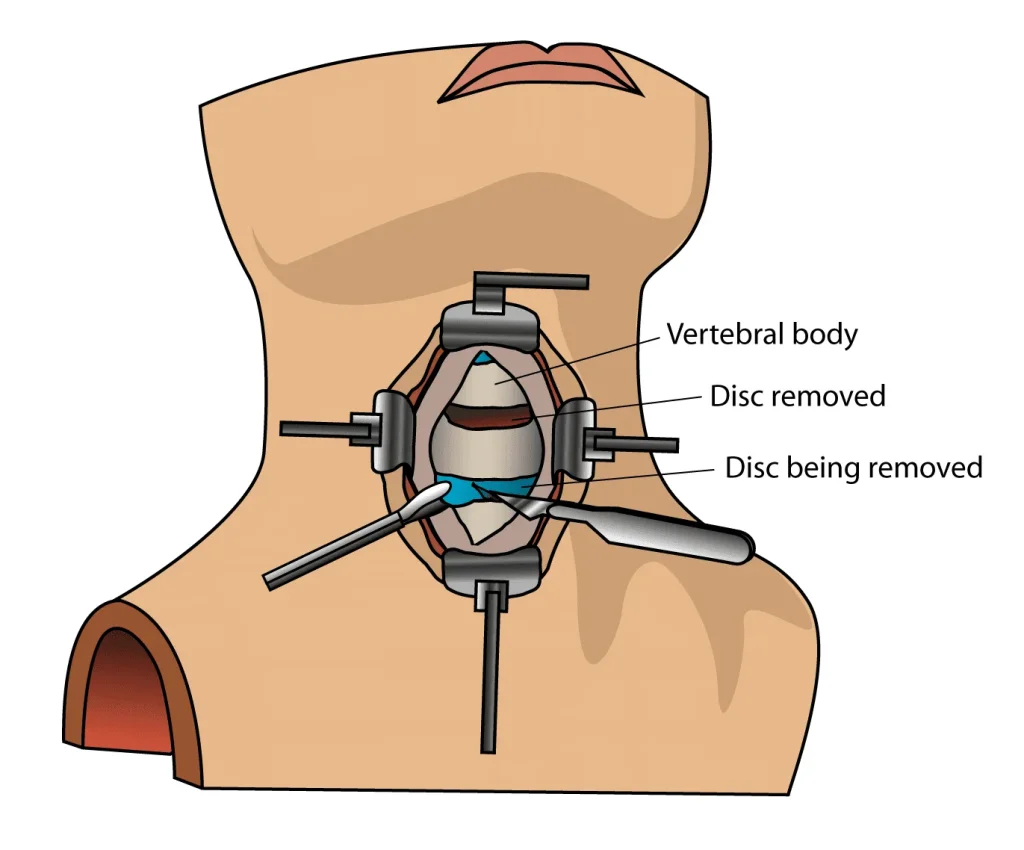
Anterior Cervical Discectomy and Fusion (ACDF)
ACDF removes the entire disc. Including the healthy portion. And replaces it with a cage, a plate, and screws. The surgeon then relies on the body to fuse two vertebrae into one solid block of bone.
The published complication profile is not what most patients are shown in the office:
- Complications that occur in perioperative setting at an incidence of 48%.¹
- Adjacent segment disease occurring at an annual rate of about 2.9%, translating to 25% of the ACDF patients requiring surgery on another adjacent area within a period of 10 years.⁸
- Pain management through opioids for several weeks to months after the procedure.
- Loss of movement on the fused segment.
Artificial Disc Replacement
Artificial discs maintain mobility but create failure modes of their own. Migration, subsidence into osteopenia bone, heterotopic ossification, and facet overloading.⁹ They are far from being biologically neutral.
Posterior Cervical Laminectomy and Foraminotomy
Approaching the neck from behind requires cutting through muscle, ligament, lamina, and part of the facet joint. For an anterior bone spur or herniation, this approach cannot physically reach the pathology. It can only indirectly decompress the cord by removing bone from the back of the canal. The posterior tension band is destroyed in the process, and many of these patients ultimately require a second surgery for instability.¹⁰
Epidural Steroid Injections and Spinal Cord Stimulators
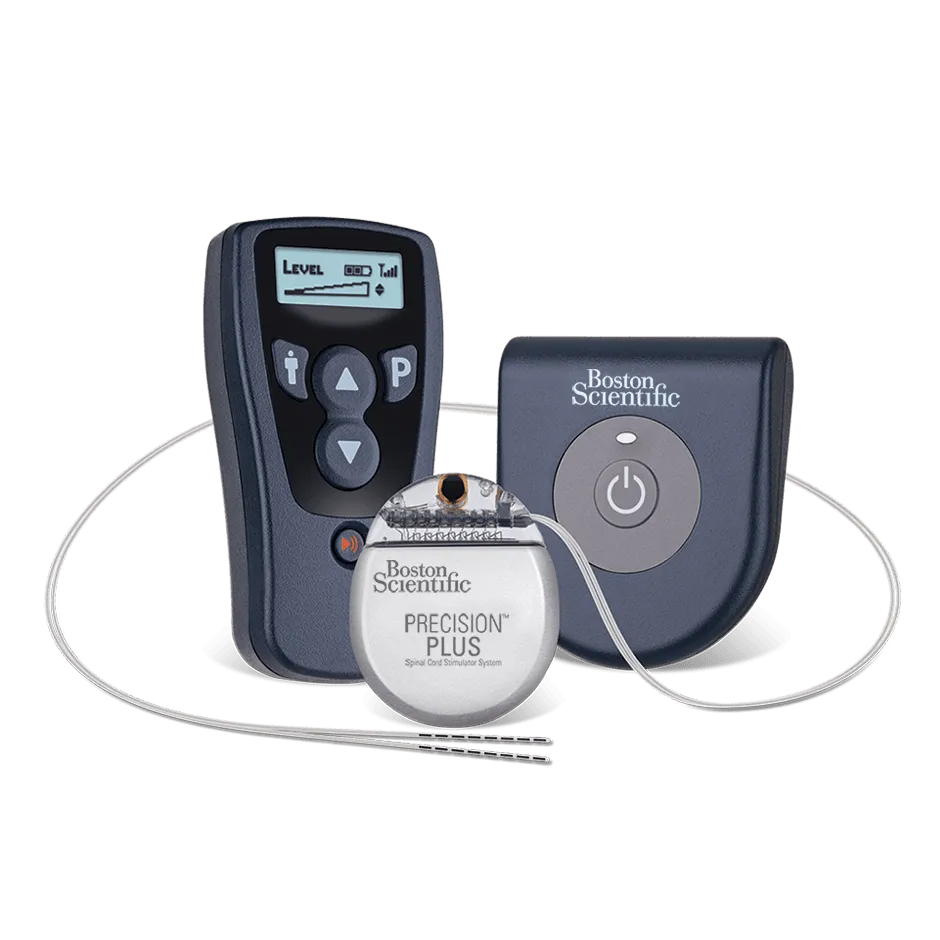
Epidural steroid injections and spinal cord stimulators manage pain signals. They do not touch the bone spur. A systematic review in the Annals of Internal Medicine demonstrated only “small” short-term effects and no long-term benefit from epidural steroids in cervical radiculopathy.¹¹ The spur continues to compress the nerve regardless of how much steroid is deposited around it.
How the Laser Removes Cervical Bone Spurs
The Deuk Laser Disc Repair® is an anterior endoscopic approach refined over more than 2,800 cervical procedures. It was built on the pioneering endoscopic cervical work of Dr. Sang-Ho Lee and Dr. Gun Choi in South Korea.¹² What makes it uniquely suited to multi-level disc osteophyte disease:
1. A 4 mm Skin Incision Per Level
Access is established under live fluoroscopic guidance in both anteroposterior and lateral views. Adam’s apple is gently retracted by hand to open a safe corridor between the carotid sheath and the trachea-esophagus complex. There is no muscle cutting. No ligament release. No bone removal from the posterior elements.
2. A High-Definition Endoscope
A specialized cervical endoscope delivers HD visualization of structures as small as one twelfth of a millimeter. No microscope used in open ACDF comes close to this resolution at the back of the disc.
3. A 0.5 mm Laser Fiber is 100 Times More Precise Than ACDF Instruments
The laser fiber is half a millimeter wide. It vaporizes calcified herniation and sculpts bone spurs in 0.05 mm increments. For context, the Kerrison rongeurs, pituitary graspers, and high-speed burrs used in a conventional ACDF remove disc and bone in bites of approximately 5 mm at a time. That is the physical limit of what a surgeon can safely take through an open corridor with mechanical tools under a microscope.
The arithmetic is straightforward. A 5 mm bite is one hundred times larger than a 0.05 mm laser pass. The Deuk Laser Disc Repair® removes tissue with roughly 100 times the precision of standard open cervical surgery. When the structure you are working next to is the spinal cord, that difference is not academic.
4. 600 PSI Continuous Irrigation
Sterile cold saline is pumped at around 600 pounds per square inch to clean out particles, cool the tissues, and ensure an optical field. In its absence, viewing inside the disc space would not be possible, and the laser might have the potential to cause damage to the cord.
5. The Disc Is Preserved
As a result, since the process takes place via the pre-existing tear in the posterior annulus, there is no need to take away the intact disc. This makes any form of fusion, cage, plate, or screw unnecessary.
A Live Case: C3-C4, C4-C5, C5-C6, C6-C7
The patient, who is in his working age, suffered from a history of cervical injury due to his profession. He came from Pennsylvania after being advised by various doctors at his place for multi-level ACDF. Imaging revealed:
- C3-C4: large calcified disc osteophyte complex with spinal cord compression and ossified posterior longitudinal ligament
- C4-C5: early degeneration with foraminal narrowing
- C5-C6: Herniated disc with foraminal osteophyte compressing C6 nerve root
- C6-C7: Posterior tear, herniated disc, and osteophyte calcification compressing C7 nerve root
Decompression at all levels was achieved in one visit with two 4 mm incisions.
Estimated blood loss: approximately three drops. The patient was discharged to a local hotel the same day and seen for a brief follow-up the next morning.
What the Laser Accomplished at Each Level
- C6-C7: posterior herniation vaporized, right neural foramen opened, C7 exiting nerve root decompressed.
- C5-C6: dense foraminal bone spur sitting directly on the C6 nerve root peeled away. Calcified posterior longitudinal ligament cleared.
- C3-C4: approximately 80% of a long-standing calcified OPLL mass removed from the dura, with a deliberately preserved thin bony shell to prevent a durotomy and cerebrospinal fluid leak.
Why not 100%? When calcium is directly adherent to the dural layer, vigorous stripping leads to CSF leakage. It’s all about maximizing decompression, as much as safely possible, enough to re-establish perfusion and alleviate neurological signs. It’s not about perfection on the imaging scan.¹³
The Physiology: Why Pain Resolves Even When Bone Remains
Discogenic neck pain is not primarily a structural problem. It is an inflammatory and physiological problem.
When the nucleus pulposus herniates through the tear in the annulus fibrosus, it interacts with the vascular and immune systems for the first time since its embryonic development. The nucleus is made up of the embryonic notochord and is located in an area free of the vasculature. Once exposed, it initiates severe inflammatory changes within the tear. This is what causes the pain signal.
Removing the extruded nucleus and debriding the inflamed annular tear eliminates the pain generator. The annulus then heals on its own over the following 6 to 12 months. This is why patients with bone-on-bone collapsed discs can be completely asymptomatic and why restoring disc height is not required for pain relief.
Safety Considerations for Multi-Level Cervical Decompression
Operating adjacent to the spinal cord demands specific intraoperative protocols:
- Mean arterial pressure maintained at ≥ 85 mmHg throughout the case. A compressed cord is already ischemic. Low perfusion pressure during decompression can cause the patient to wake with a new neurologic deficit. This is a thoroughly studied concept in the context of acute spinal cord injuries.¹⁴
- Continuous fluoroscopy to confirm each step of the procedure on both AP and lateral images.
- Anesthesia that allows for rapid reevaluation of neurological condition after the extubation.
- Laser used in controlled pulses with constant saline cooling.
In more than 2,800 Deuk Laser Disc Repair® procedures to date, there have been zero reported surgical complications and the reported cervical pain cure rate is approximately 99%.
The laser does not cut bone. It vaporizes it. One tenth of a millimeter at a time
Who Is a Candidate for Laser Bone Spur Removal?

Most symptomatic patients with cervical disc osteophyte complexes including multi-level disease and OPLL are good candidates. Reasons for preferring laser decompression to open spinal fusion include:
- Preserved overall cervical alignment on standing X-rays
- Symptoms that correlate with identifiable levels on MRI
- Desire to preserve motion and avoid permanent hardware
- Patient fitness for brief general or MAC anesthesia
Patients who will still need to undergo surgery include patients with gross instability of the cervical spine, fixed kyphotic deformity, and tumor of the vertebral body.
What You Should Do If You Have Been Told You Need a Fusion
Before deciding to proceed with a multilevel ACDF or posterior laminectomy, take into consideration the following:
- Diagnosis. Are there specific pain generators? Which anatomical structures on your MRI correspond to your symptoms?
- Objective. Is the surgical procedure performed to alleviate pain? Is it performed due to radiculopathy or in order to avoid the consequences of spinal cord compression? They are different conditions that require different approaches and have different rates of success.
- Statistics. What is the rate of success among the patients with your diagnosis having gone through the proposed procedure?
- Stop loss. What is the number of failed treatments that you would be ready to undergo until you reconsider your approach?
- A second opinion should be obtained from the surgeon who offers the entire spectrum of treatment options. The surgeon who offers only fusion and laminectomy will offer only these procedures.
Told you need a multi-level fusion for bone spurs? There’s a 100× more precise option
The laser doesn’t cut bone.
It vaporizes it. 0.05 mm at a time.
ACDF removes the entire disc and bolts plates to your spine. Deuk Laser Disc Repair® vaporizes only the calcified spur and damaged disc material through a 4 mm incision—preserving the disc, the motion, and the stability of your cervical spine. Multi-level cases from C3 to C7 in a single outpatient session.
open-surgery bite
with 0 surgical complications
pain relief rate
- Removes entire disc, replaces with cage + plate + screws
- 48% perioperative complication rate
- ~25% need adjacent-level surgery within 10 yrs
- Permanent motion loss at fused segments
- Opioids for weeks to months post-op
- 0.5 mm laser fiber vaporizes spur + damaged tissue only
- 0.01% complication rate across 2,800+ cases
- Disc preserved—no adjacent segment disease trigger
- Full cervical motion maintained
- No narcotics on discharge
Deuk Spine Institute · Board-certified neurosurgeon · Multi-level cases in one session · No plates, no screws
FAQ’s
Can a laser really remove calcified bone and bone spurs?
Answer
Yes. Lasers used for endoscopic spine surgery vaporize the disc and bone tissues in small sub-millimeter fractions. The physics involved in this process are similar to that of laser lithotripsy applied in removing kidney stones; only that the process is modified to suit the spine. In the Deuk Laser Disc Repair® procedure, a 0.5 mm fiber removes tissue in 0.05 mm passes. The rongeurs and burrs used in ACDF remove disc and bone in roughly 5 mm bites. That makes the laser approximately 100 times more precise than standard open surgical equipment. A precision no mechanical instrument can match this close to the spinal cord.
Can one surgery really treat C3-C4 through C6-C7 in a single session?
Answer
Yes. Because each level is accessed through a 4 mm skin incision with no muscle cutting, no bone removal from the posterior elements, and no hardware placement, multi-level disease can be addressed in one outpatient session. The published blood loss for a four-level case is on the order of a few drops. The patient is typically discharged the same day.
What is the difference between a disc herniation and a bone spur?
Answer
A disc herniation is soft tissue. Nucleus pulposus extruding through a tear in the annulus. A bone spur, or osteophyte, is calcified bone laid down by the body in an attempt to stabilize a chronically unstable, inflamed segment. In most multi-level cervical cases they coexist and form what is called a disc osteophyte complex. The laser addresses both components in the same procedure.
Will the bone spurs grow back after laser removal?
Answer
Recurrence at a treated level is uncommon because the underlying inflammatory driver, the exposed nucleus pulposus in the annular tear, is removed at the same time the spur is vaporized. The annular tear heals over 6 to 12 months and the stimulus for new calcium deposition is eliminated. Degeneration can continue at untreated levels, which is why patients are evaluated for every symptomatic segment at the time of surgery.
Will I need another surgery later?
Answer
Long-term reoperation rates after endoscopic cervical procedures are substantially lower than after fusion. Adjacent segment disease after ACDF occurs at approximately 2.9% per year, with roughly 25% of ACDF patients requiring additional surgery within ten years.⁸ Because Deuk Laser Disc Repair® preserves the disc and does not fuse adjacent vertebrae, this specific failure mode is avoided.
Can a herniated disc cause cancer?
Answer
No. There is no biological mechanism by which a herniated disc causes cancer and no such association exists in the medical literature. Herniated discs cause pain, radiculopathy, and in severe cases myelopathy. Not malignancy.
Sources
View Sources
1: Perioperative complications of anterior cervical discectomy and fusion — Epstein NE, Surgical Neurology International
2: Cervical spondylotic myelopathy: a review — Baron EM, Young WF, Neurosurgery
3: The inflammatory cascade of the intervertebral disc — Risbud MV, Shapiro IM, Nature Reviews Rheumatology
4: Ossification of the posterior longitudinal ligament: natural history — Matsunaga S, Sakou T, Spine 5: Multi-level cervical degenerative disc disease: patterns and progression — Lee MJ et al., Spine Journal
6: Degenerative cervical myelopathy: epidemiology and diagnosis — Nouri A et al., Spine
7: Spinal canal diameter and risk of acute spinal cord injury — Torg JS et al., Journal of Bone and Joint Surgery
8: Radiculopathy and myelopathy at segments adjacent to the site of a previous cervical arthrodesis — Hilibrand AS et al., Journal of Bone and Joint Surgery
9: Cervical total disc replacement: complications and failure modes — Nunley PD et al., International Journal of Spine Surgery
10: Instability and reoperation after posterior cervical laminectomy — Kaptain GJ et al., Journal of Neurosurgery Spine
11: Epidural corticosteroid injections for radiculopathy and spinal stenosis: systematic review — Chou R et al., Annals of Internal Medicine
12: Percutaneous full-endoscopic anterior cervical discectomy — Ruetten S et al., European Spine Journal
13: Surgical management of ossification of the posterior longitudinal ligament — Head J et al., Global Spine Journal
14: Blood pressure management after acute spinal cord injury — Hawryluk G et al., Journal of Neurotrauma