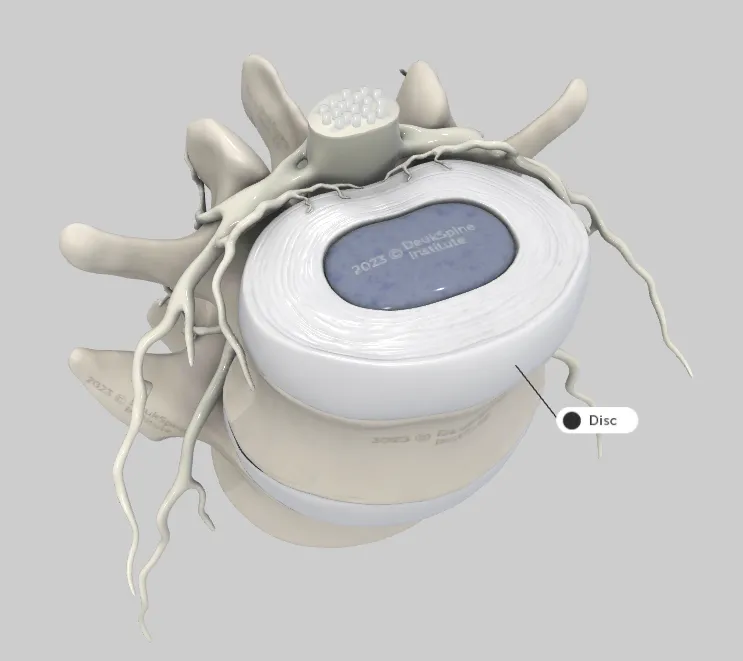
Spacer located between two adjacent vertebral bodies. The disc has a soft, compressible core called the "Nucleus pulposus" surrounded by a firm, elastic outer ring-like wall called the "annular fibrosus". The nucleus puplosus is normally an avascular, water-rich compressible semi-solid (think raw shrimp meat) that acts as hydraulic fluid distributing spinal compression forces outward towards the annulus fibrosus. In an injured disc, the herniated nucleus pulposus causes a severe inflammatory response within the outer annulus fibrosus. Herniated discs are the most common cause of chronic back pain and can be treated best with Deuk Laser Disc Repair
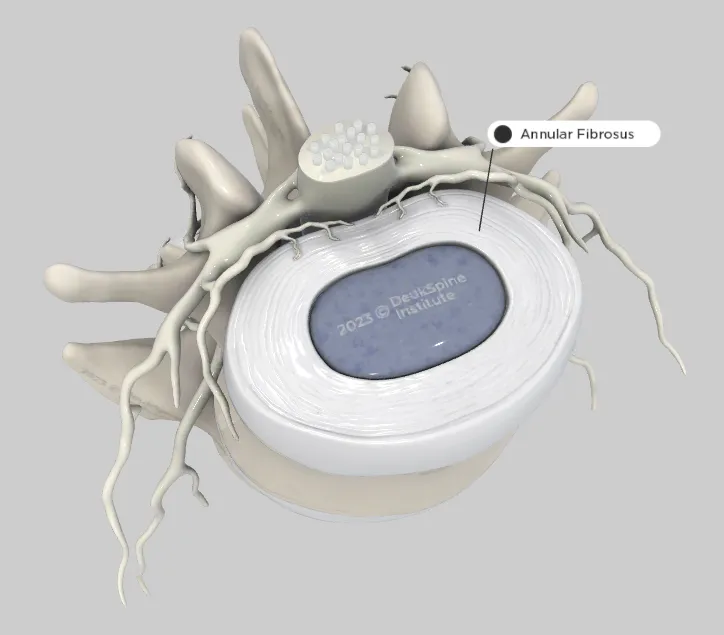
Outer ring of dense, circular connective tissue making up the spinal disc. The AF is composed of 20 layers of concentric collagen fibers wrapped around a soft nucleus pulposus core. Inner half of AF is normally without blood vessels or nerves. Outer half of AF has blood vessels and pain nerves. Inflammation of a spinal disc occurs when the AF is torn by trauma (annular tear) and nucleus pulposus fragments herniate (extrude) into the annular tear with normal physiological loading of the disc. Inflammation within an injured disc's posterior annular tear is the most common source of back pain or neck pain worldwide. The best treatment is Deuk Laser Disc Repair.
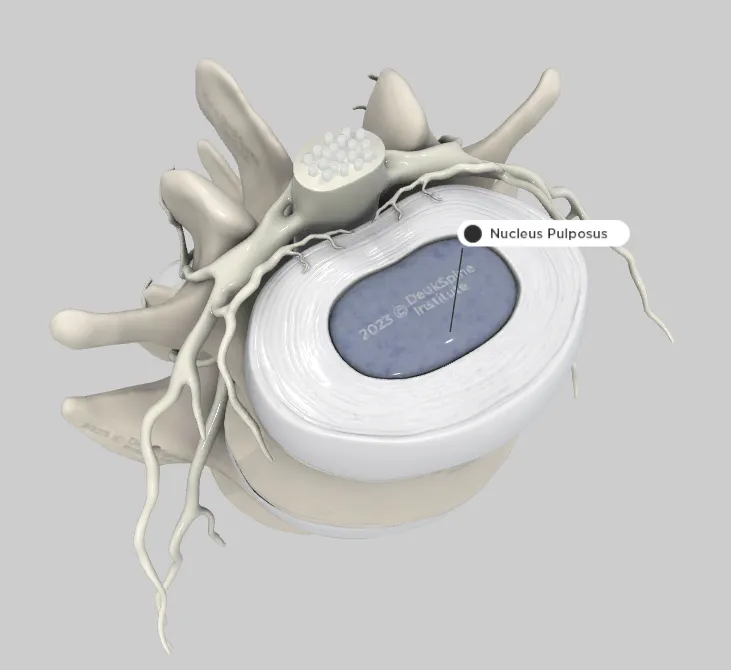
Centrally located hydraulic soft tissue contained within the middle of the spinal disc derived embryologically from the notochord. Functions to absorb and redistribute mechanical forces generated during spinal motion. When the outer annulus fibrosus tears the nucleus pulposus fragments escape the interior of the disc causing a bulging or herniated disc. Bulging discs are the most common cause of chronic lower back pain. The best treatment is Deuk Laser Disc Repair.
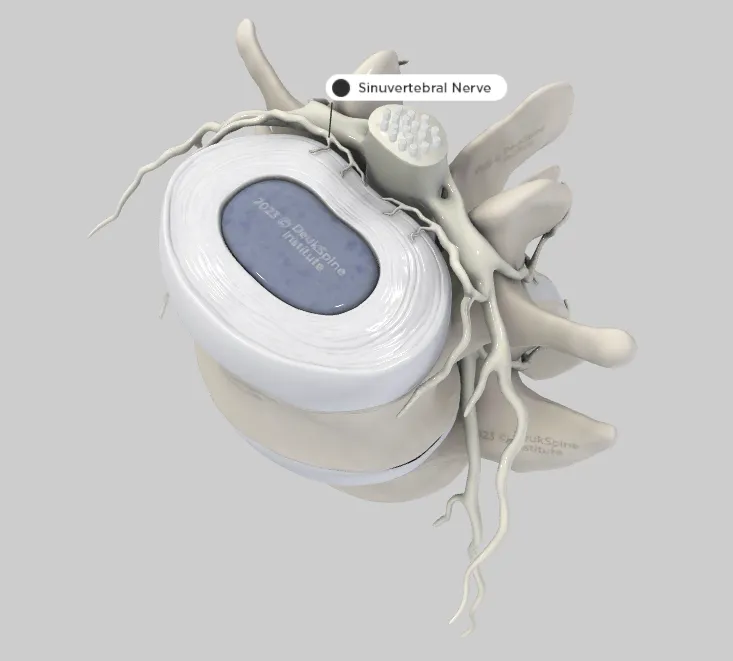
Sensory nerve to the back of the disc (posterior annulus fibrosus) and posterior longitudinal ligament. Carries pain signals from an injured or inflamed disc to the dorsal root ganglion, then the dorsal horn of the spinal cord, then the spinothalamic tract, thalamus and somatosensory cortex of the brain. Discogenic pain is only possible because of this nerve carrying pain signals from the injured disc to the brain.
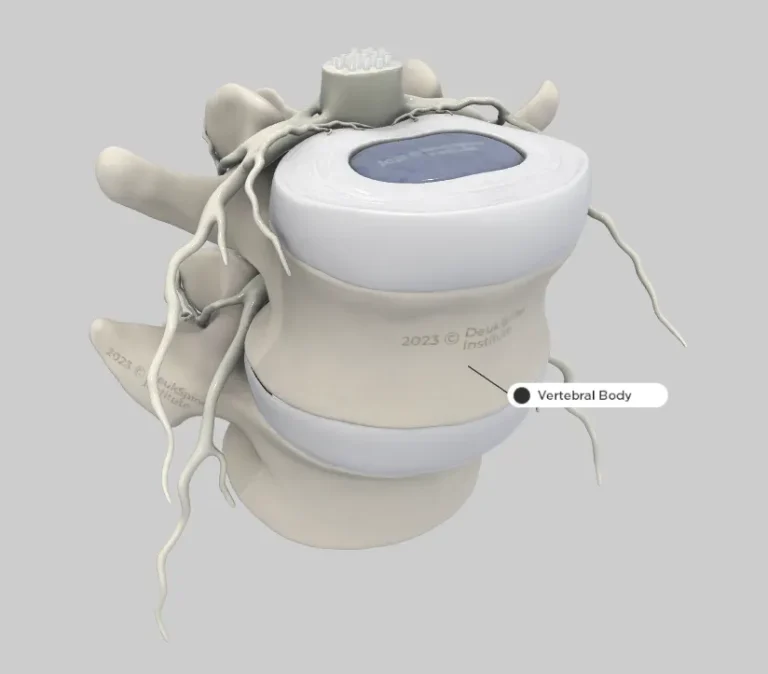
Large weight bearing rectangular bone located in the front of the spine between spinal discs. May fracture with osteoporosis or spinal trauma.
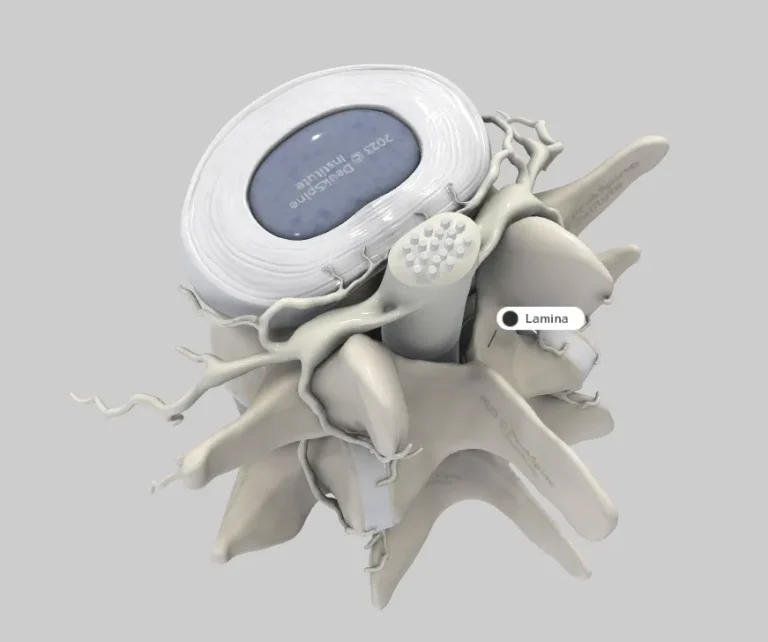
Vertebral flat bony plate-like projection in the back of the spine where paraspinal muscles and stabilizing ligaments attach. Commonly damaged and/or removed during laminectomy, discectomy, microdiscectomy, fusion and foraminotomy open spine surgeries. Deuk Laser Disc Repair does not damage the lamina or any other normal spine structures.
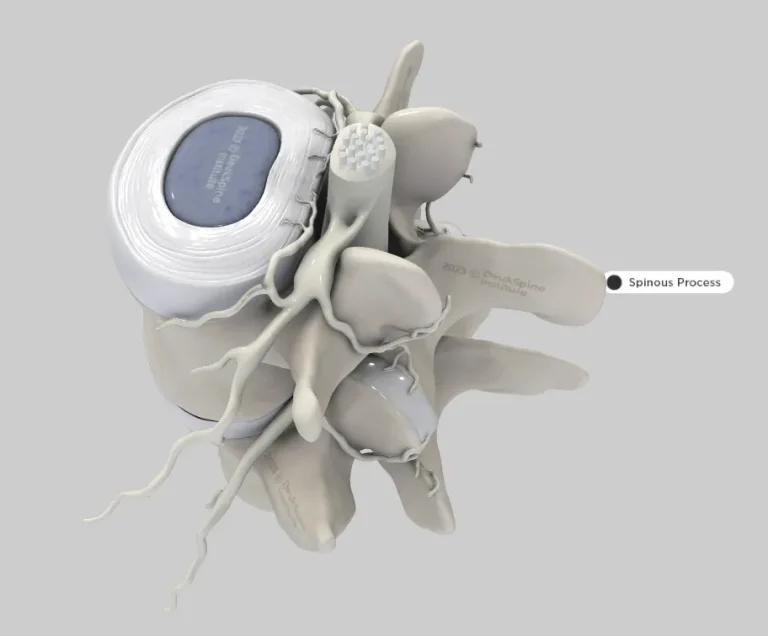
Vertebral bony projection in the back of the spine where paraspinal muscles and ligaments attach for postural movement and spinal stabilization. Commonly damaged during laminectomy, discectomy, microdiscectomy, fusion and foraminotomy open spine surgeries. Deuk Laser Disc Repair does not damage the spinous process or any other normal spine structures.
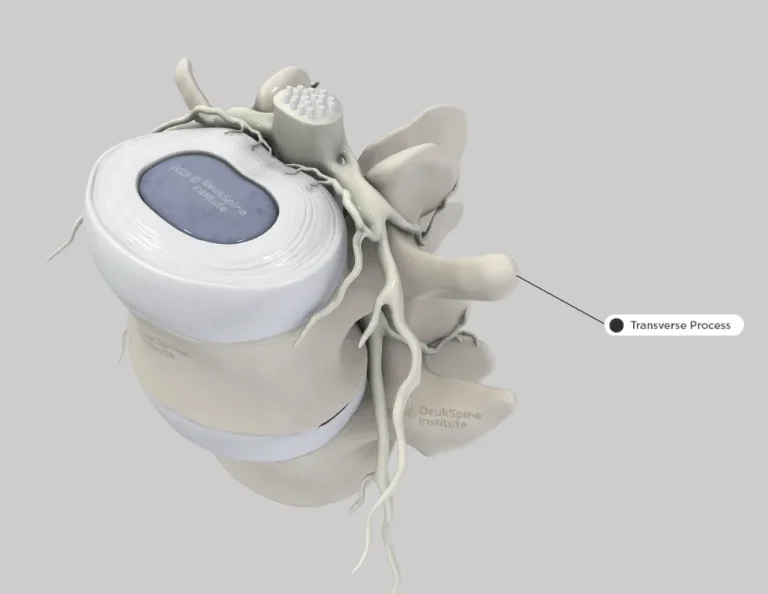
Vertebral bony projection on the side of the spine where paraspinal muscles or ribs attach allowing postural movement.
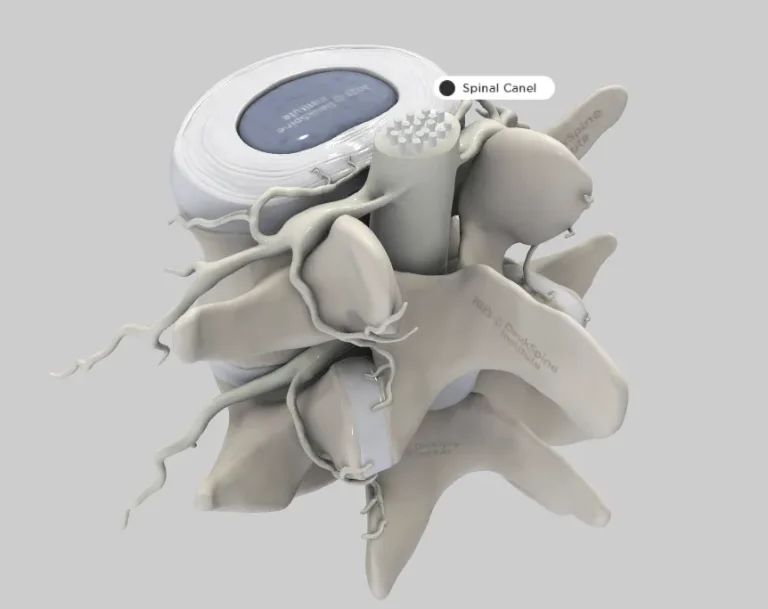
The space in the center of the spine where the spinal cord and nerve roots pass through protected from outside forces as they course to their target locations. Located behind the vertebral body and discs, in front of the lamina and ligaments, the spinal canal is filled with spinal fluid bathing delicate neural structures. Narrowing of the spinal canal is called central stenosis.
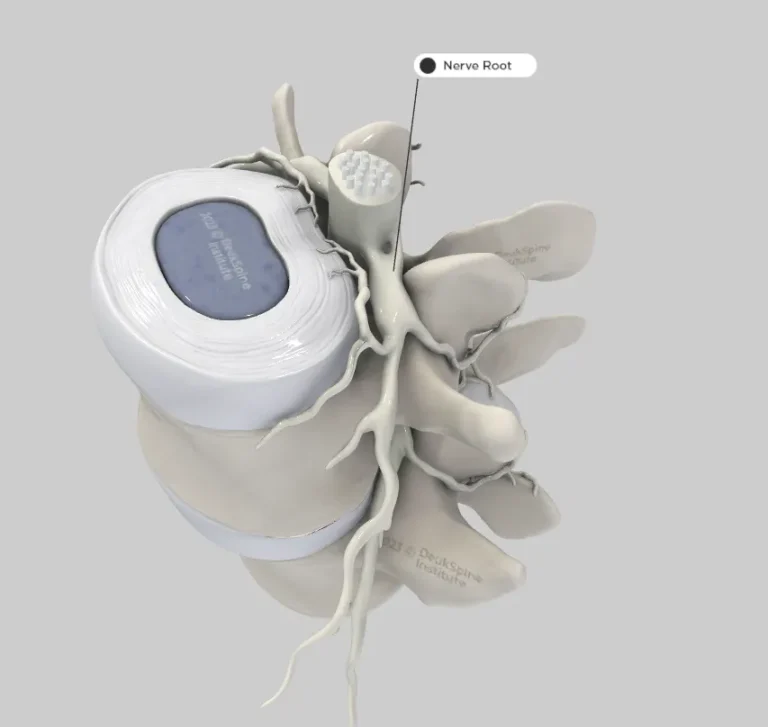
A bundle of nerve fibers responsible for transmitting motor and sensory data between the brain and extremities. Connects brain and spinal cord to muscles for movement and sensors located in skin, joints and muscles. Nerve roots pass behind the spinal discs through natural openings in the spine called neuroforamen. Disc herniations can easily irritate or pinch nerve roots within the neuroforamen. Spinal stenosis typically affects nerve roots with pressure causing arm or leg weakness, numbness, or tingling (radiculopathy). Inflammation of the nerve root typically causes arm pain or leg pain (radiculitis). Nerve root compression or irritation never causes back pain or neck pain.
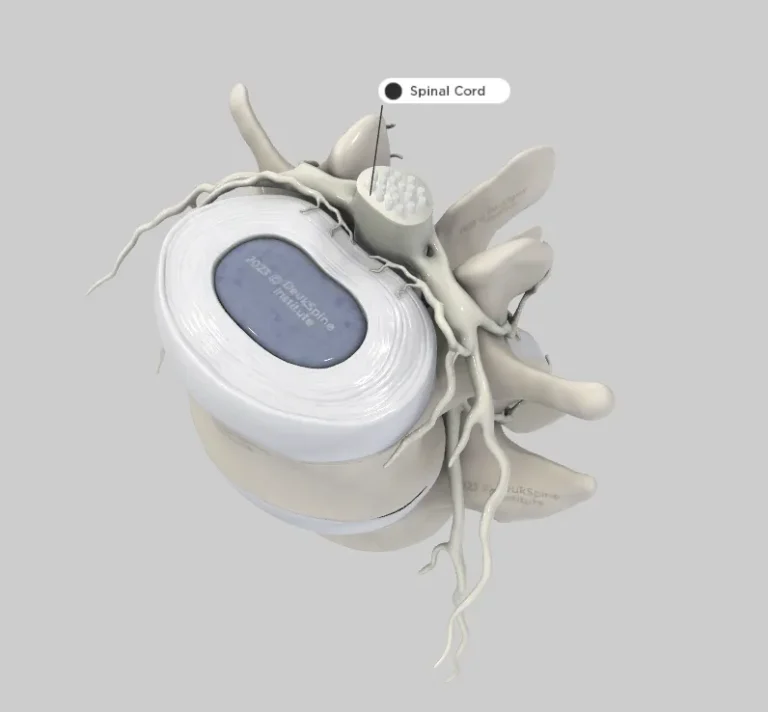
Large bundle of nerves connecting the brain with the rest of the body. Herniated cervical discs can damage the spinal cord causing myelopathy. Myelopathy is spinal cord dysfunction and may manifest as balance difficulty, decreased coordination of the hands or urinary urgency.
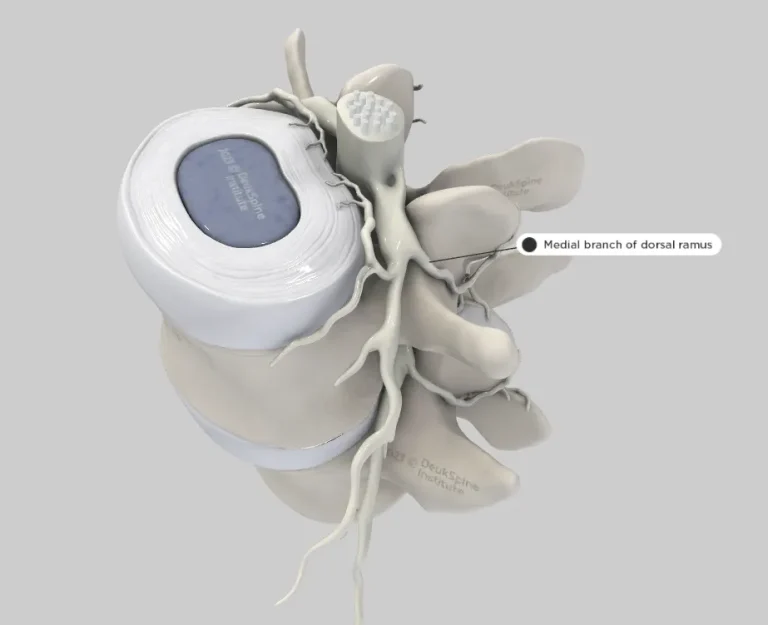
The normal sensory nerve to the facet joint and facet joint capsule that transmits pain signals from injured or inflamed facet joints to the brain. This nerve is the target of the patented Deuk Plasma Rhizotomy procedure. Deuk Plasma Rhizotomy is the first permanent treatment for facet joint pain.
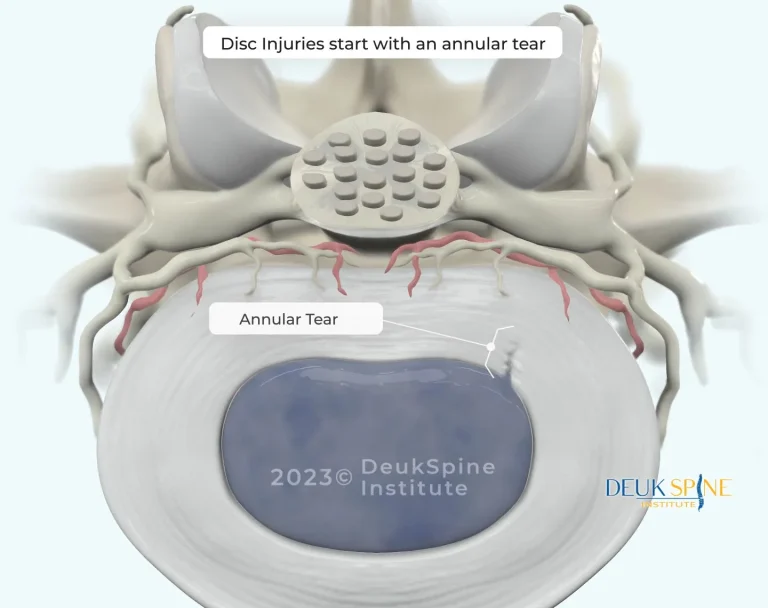
All disc injuries begin with a traumatic tear of the annulus fibrosus ring. An annular tear occurs when traumatic forces on the disc exceed its elastic property limits and cause structural failure of the annulus fibrosus and nucleus pulposus. At the moment of structural failure, linear annular tears occur in the wall of the disc while the adjacent nucleus pulposus is crushed into multiple fragments. Although not all annular tears immediately result in a disc herniation, the tear is a weakened area of the disc wall prone to herniations of the adjacent fragmented nucleus pulposus.
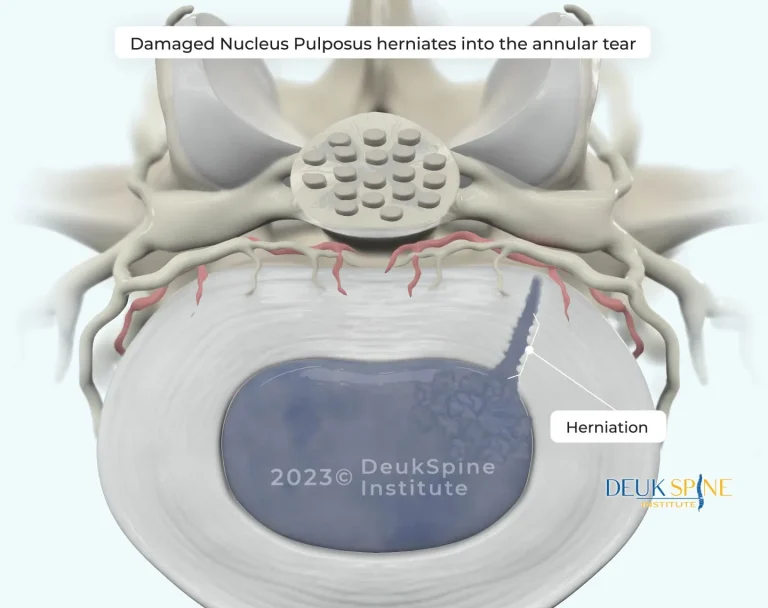
Disc herniations occur when fragments of damaged nucleus pulposus are pushed into the annular tear during physical activities like bending, lifting, twisting, sports, and work. Once herniation of a fragment of nucleus pulposus into the annular tear occurs, the annular tear can no longer heal itself closed. In fact, fragments of nucleus pulposus embedded within the annular tear prevent healing and closure of the annular tear. Over time more pieces of the damaged nucleus pulposus push out into the non-healed annular tear and the herniation gets bigger.
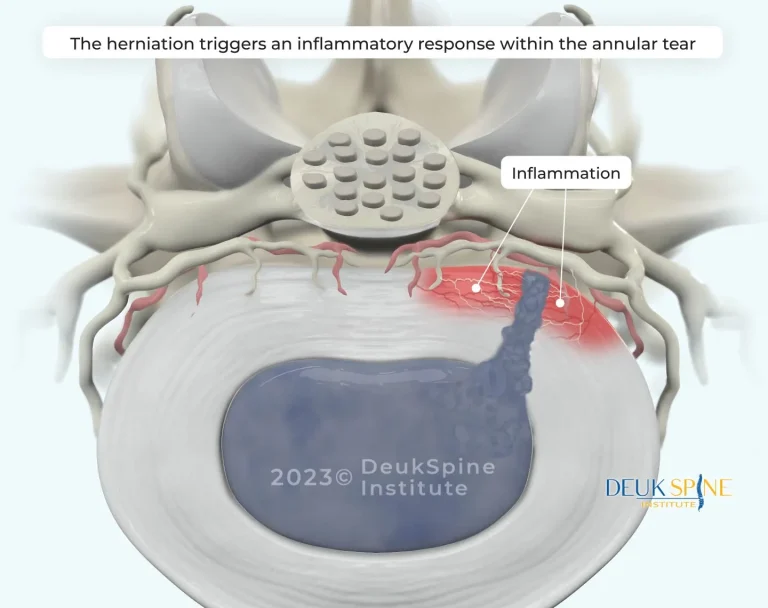
Annulitis occurs when the annulus fibrosus — the tough, layered outer wall of an intervertebral disc — becomes inflamed. Under normal conditions, the inner 2/3 of the annulus fibrosus contains no blood vessels, no blood supply, and no nerve endings. When an annular tear develops and extends into the outer 1/3 of the disc wall, the body detects the damaged tissue and exposed nucleus pulposus fragments as foreign material. This activates the inflammatory defense system, sending immune cells, inflammatory proteins, and new blood vessel growth (neovascularization) into the tear site. The resulting chronic inflammation within the annulus fibrosus is known as annulitis. Annulitis sensitizes the surrounding nerve fibers in the outer annulus, lowering the threshold for pain signals and producing persistent discogenic back pain — even in the absence of significant nerve root compression. When the inflammation extends beyond the disc wall and reaches adjacent spinal nerve roots, it produces radicular pain (sciatica) and radiculitis. Left untreated, annulitis perpetuates a cycle of ongoing tissue degradation, further weakening the annular wall, increasing susceptibility to reherniation, and sustaining chronic pain that can persist indefinitely.
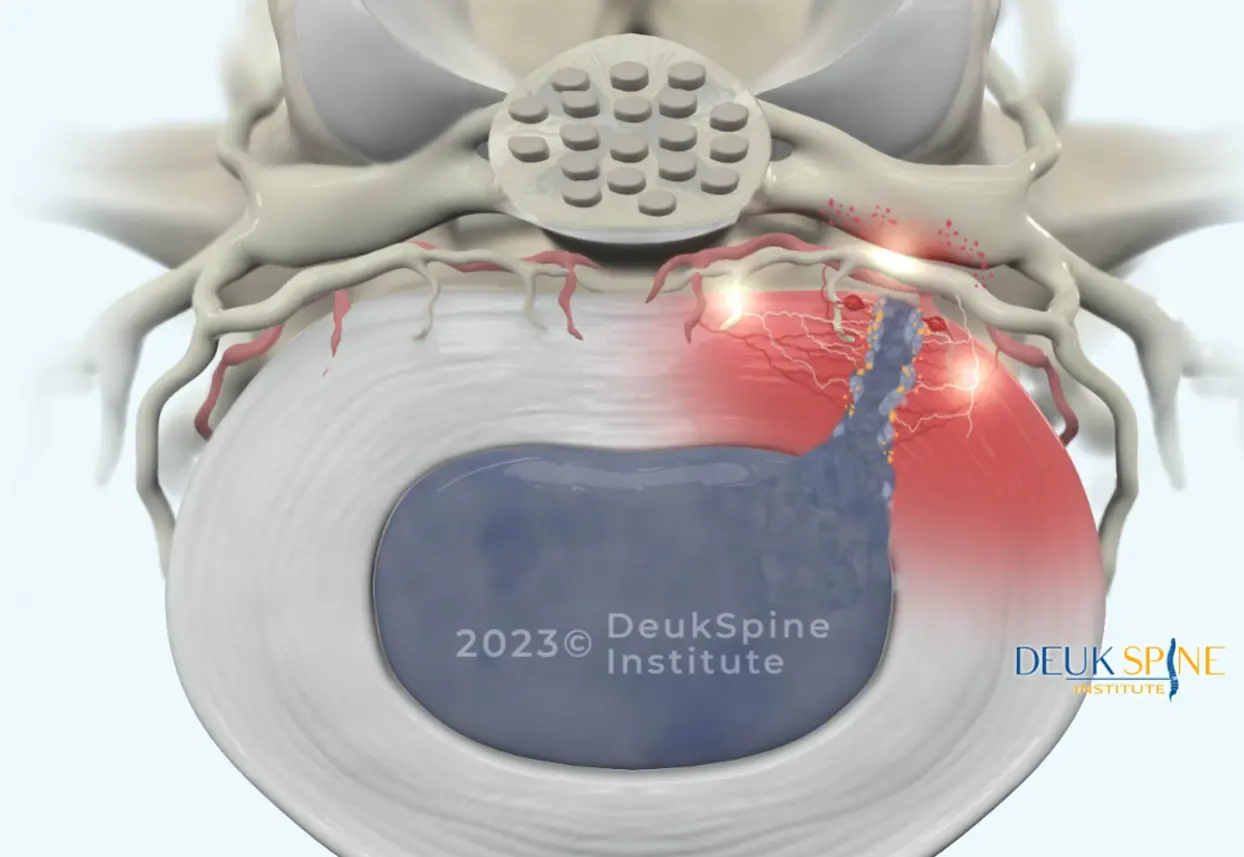
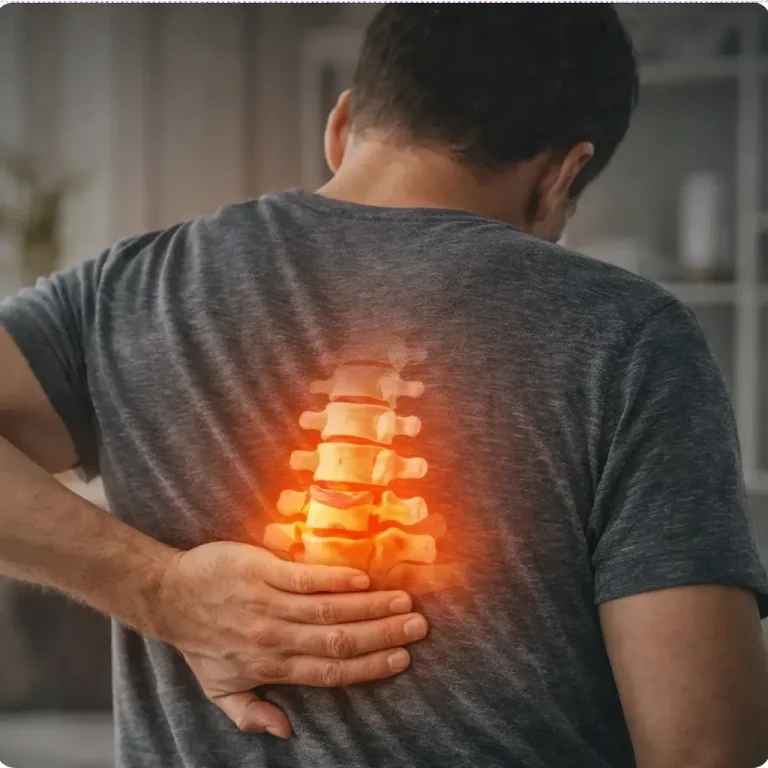
Discogenic back pain may occur once the herniated fragments of nucleus pulposus reach the outer 1/3 of the posterior annulus fibrosus. The inner 2/3 of the annulus fibrosus normally has no blood vessels, no blood supply and no innervation. Nucleus pulposus fragments present within the outer 1/3 of the annular tear will trigger the body's inflammatory defense system to turn "on" and begin to attack the pieces of herniated nucleus pulposus. The resulting inflammation within the walls of the posterior annular tear of an injured disc is the source of discogenic back pain (pain generator). When the inflammation spreads to nearby nerve roots it causes sciatica (radiculitis). Inflammation lasting weeks or months within the annular tear further weakens the wall and makes the disc more susceptible to reherniation. Untreated, the annular tear remains open and vulnerable to additional herniation, inflammation and pain occurring in cycles over a lifetime.