
By Dr. Ara J. Deukmedjian, MD
Board Certified Neurosurgeon
Updated: October 30, 2026.
Disclaimer: This article is for educational purposes only and is not a substitute for a formal medical evaluation. Please consult a professional, for personal advice.
What Is Disc Desiccation?
The disc desiccation meaning is simple: it is the gradual loss of water from one or more intervertebral discs in the spine. Each disc sits between two vertebrae and absorbs the load from every step and bend. At the center of each disc is a soft gel called the nucleus pulposus, and most of that gel is water.

A tough outer ring called the annulus fibrosus holds the gel in place. As the water content drops, the disc loses height and some of its springiness. For a closer look at each part, spine anatomy covers how the whole structure fits together.
Some reports use the term disc dehydration for this change. Radiologists use either term for the same finding. A drier disc absorbs less shock, which can shift more load onto the outer ring and the small joints behind it.
What Disc Desiccation Looks Like on an MRI Report
On a T2-weighted MRI, a healthy disc looks bright white at its center. A desiccated disc looks gray or black on the same images. Water shows up bright on T2 images, a standard sequence in spine MRI. Readers can check this difference on their own scan.
The report may phrase this change in a few ways.
Disc desiccation ranks among the most common findings on adult spine MRI, and it shows up in people with no pain at all. A 2015 systematic review from Brinjikji and colleagues in the American Journal of Neuroradiology found disc signal loss in pain-free adults across every age group studied. The finding alone says little about how much a disc hurts.
Other phrases tend to sit beside it in the findings section. A short guide to other terms on your MRI report covers that wider vocabulary. Readers who spot a disc bulge or herniation at the same level can find that difference explained on a separate page.
Mild, Moderate, or Severe? Types of Disc Desiccation and How They Are Graded
Radiologists grade disc degeneration on the Pfirrmann scale, from Grade I for a normal disc to Grade V for a collapsed one. The scale comes from a 2001 study published in the journal Spine.
The types of desiccation on a report come down to two details. One is the grade of each disc. The other is the number of levels involved, which the next section covers. Together, these two details describe the type of desiccation a report shows.
Reports that mention mild disc desiccation usually describe a Grade II disc or an early Grade III disc. The label moderate tends to match Grade III or Grade IV. The label severe usually points to Grade V, where loss of disc height has reached the point of collapse.
Plenty of reports skip the Pfirrmann name and simply say mild, moderate, or severe. The grade describes how the disc looks, with no direct link to how much it hurts. A Grade II disc can be painful. A Grade IV disc can stay silent.
What “Multilevel Disc Desiccation” Means
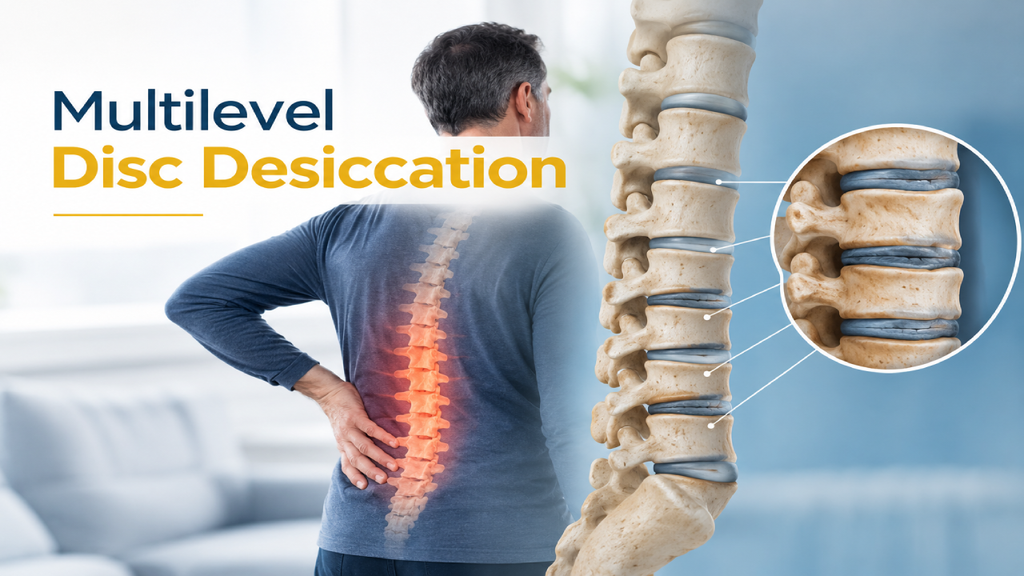
Multilevel disc desiccation means two or more discs show signs of water loss. The term describes how many levels are involved. It says nothing about the severity of any single disc. A report might list L3-L4, L4-L5, and L5-S1 together, for instance.
Reports that show lumbar disc desiccation frequently list several levels at once. The lower back carries a large share of body weight along with daily bends and lifts. Neighboring discs share that daily load, which may explain why adjacent levels tend to change together.
A report that lists several levels carries no automatic need for surgery. The finding gives no sign that every level causes pain. The real clinical question is which level matches the symptoms. More detail on that pattern appears in this guide to multilevel degenerative disc disease.
Endplate findings such as Modic changes and Schmorl’s nodes sometimes appear beside these dried discs on the same report. Each one involves the bony endplate above or below the disc.
Symptoms and Why Many Dried-Out Discs Cause None
A dried disc on its own frequently causes no pain, so disc desiccation symptoms may never appear. Pain usually begins with an annular tear in the outer ring, a bulge, or height loss that irritates a nerve. The region involved shapes the symptom pattern.
In the Neck (Cervical Discs)
Cervical desiccation tends to show up as neck stiffness with a dull ache. Long stretches with the head bent over a screen can make that ache worse. When a nerve root is involved, pain or pins and needles can spread into the shoulder, arm, or hand. Grip in that hand may feel weaker as well. Stiffness may feel strongest in the morning.
In the Mid-Back (Thoracic Discs)
Thoracic discs are the least common source of symptoms from desiccation. The rib cage braces the mid-back and limits movement at these levels. Symptoms include stiffness with a band-like discomfort around the chest wall. Separate guides on upper back pain and middle back pain cover the T1-T6 and T7-T12 levels.
In the Lower Back (Lumbar Discs, Including L5-S1)
Lumbar disc desiccation is the most common pattern on spine reports. The ache tends to grow worse after long hours in a chair, forward bends, or time on the feet in one spot. Position changes usually ease it.
L4-L5 and L5-S1 are the levels named most frequently on these reports. L5-S1 disc desiccation affects the lowest lumbar disc above the sacrum and may relate to pain low in the back or buttocks. Leg pain or numbness can follow when a nerve root there becomes irritated. This pain can travel from the buttock down the back or side of the leg into the foot, a pattern commonly called sciatica.
New weakness, saddle-area numbness, or loss of bladder or bowel control needs emergency care right away. Fever with back pain or unexplained weight loss needs prompt medical assessment.
What Causes a Disc to Dry Out and Can You Slow It?
Age is the main driver of disc desiccation. The change forms a normal part of how every spine ages. A 2015 review from Brinjikji and colleagues found disc degeneration in 37% of pain-free adults at age 20, a share that rose to 96% at age 80. Some degree of disc water loss is an expected part of aging, even in people who feel well.
Several factors can speed up that process:
- Genetics, which can shape how quickly discs lose water
- Cigarette use, which reduces blood flow to the endplates that supply each disc with nutrients.
- Repeated heavy loads at work, in sport, or at the gym
- Long hours in a chair combined with slumped posture at a desk
- A previous injury to the back or neck that strained the disc
- Extra body weight that adds load to every disc in the lower back
Desiccation is usually the earliest imaging sign of degenerative disc disease. It forms one early stage of that same process.
Certain habits support general spine health. These include a smoke-free routine, a healthy weight, regular movement, and a better workstation setup. No treatment or habit has been shown to stop age-related water loss in the discs. These steps help the spine as a whole and carry no promise to prevent disc aging.
Can a Desiccated Disc Be Rehydrated or Reversed?

No treatment has been shown to restore water to a degenerated disc and keep it there. The dark signal on an MRI usually remains on later scans of the same disc.
Symptoms are a separate question with a hopeful answer. Pain from a dried disc can ease with the right care, even when the scan looks the same. The image records the structure of the disc. Pain usually comes from an irritated nerve or a damaged disc wall. Patients tend to blend these two questions into one.
Readers who research disc desiccation online will meet several repair claims. Stem cell shots are marketed as a way to regrow disc tissue. A closer look at stem cell injections explains why that claim remains unproven for back pain.
One injection product uses a fibrin sealant intended to close tears in the disc wall. An analysis of the Discseel procedure reviews the evidence behind that approach. Spinal decompression tables are marketed as a way to draw fluid back into the disc through gentle traction. Evidence for long-term rehydration from these tables remains limited so far.
A steady water intake supports general health. Extra glasses of water still leave the water content of a degenerated disc unchanged.
Treatment Options for Disc Desiccation
Disc desiccation treatment follows a step-by-step path for a painful dried disc. Care starts with conservative steps and moves to the next stage only when symptoms call for it. Some steps can also overlap.
Conservative Care First
Conservative care forms the first stage for a dried disc. Physical therapy builds core strength so the muscles around the spine share more of the load. Short changes to daily activity give an irritated disc time to settle. Posture habits and a better workstation setup cut daily strain on the neck and lower back.
Short-term anti-inflammatory medicine can ease pain with a doctor’s guidance. A healthy weight lowers the load on each disc. A smoke-free routine supports blood flow to the tissue around the spine.
A home exercise plan from a physical therapist helps keep progress going between sessions. Many people notice improvement within six to twelve weeks of this stage of disc desiccation treatment.
Injections and Pain Management
Epidural steroid injections reduce inflammation around an irritated nerve, and nerve blocks calm the pain signal from that nerve. These shots ease symptoms and leave the disc itself unchanged. A specialist guides the needle with imaging to reach the right level. Relief may last for weeks or months, with repeat injections in some cases.
The injections serve a diagnostic purpose as well. Clear relief after an injection at one level helps pinpoint which disc or nerve produces the pain. A specialist can use that result to plan the next stage of care.
When the Disc Itself Is the Pain Generator
Some people complete a full course of conservative care and still feel pain from the dried disc itself. For this group, a minimally invasive step exists between conservative care and open-back surgery. This middle step offers a targeted option that many patients have yet to hear about.
Deuk Laser Disc Repair® uses an endoscope with a laser to treat the inflamed tissue inside the damaged disc. The procedure removes no bone and fuses no vertebrae. The natural structure of the spine stays intact throughout the treatment. Treatment focuses on the specific disc that the MRI and exam point to as the pain source.
A specialist review of the MRI can show whether a disc fits this approach.
What to Ask About Your MRI Report
A report is a description, so the useful question is whether it explains the symptoms. The finding becomes useful once it connects to where pain is felt. A few questions help guide that conversation at the next appointment:
- Which disc levels does the report name?
- Does anything press on a nerve or narrow the spinal canal?
- Do the findings match where the symptoms are felt?
- Is this finding typical for a person of this age?
- Would a specialist review of the images be worthwhile?
Conclusion
Disc desiccation is a common finding that describes how a disc looks on imaging. It carries no final verdict on pain or health. Symptoms and a careful exam fill in the rest of the picture for each patient. The level that matches the symptoms is what matters most. Readers with a report in hand can request a free MRI review for a clear, specialist read of their images.
Disc desiccation appears in 96% of adults by age 80 — fusion removes the entire disc and locks the segment for a finding that may cause no pain
A dark disc on your MRI is not a verdict.
Don’t let anyone turn it into a fusion.
Disc desiccation means the disc has lost water—a change that shows up in pain-free adults at every age. When a dried disc does cause pain, it’s usually from an annular tear or nerve irritation, not the water loss itself. Fusion responds by removing the disc entirely, implanting hardware, and locking the segment. DLDR targets only the damaged tissue with a precision laser, preserves the healthy disc, and sends you home the same day.
show disc degeneration on MRI
by age 80 — most pain-free
2,800+ procedures
- Entire disc removed & replaced with hardware
- Segment permanently locked
- Adjacent-segment disease risk over time
- Extended recovery & prolonged opioid use
- No proven reversal of desiccation-related pain
- Only damaged tissue treated; healthy disc preserved
- No bone removed, no vertebrae fused
- 95% success rate, 2,800+ procedures
- 0.01% complication rate
- 30-min outpatient procedure, same-day discharge
Board-certified neurosurgeon review · No insurance approval required · 100,000+ procedures performed
Frequently Asked Questions
Is Disc Desiccation the Same as Degenerative Disc Disease?
Answer
They are related terms with different scope, since desiccation is usually the earliest imaging sign of degenerative disc disease. The broader term covers water loss along with height loss, annular tears, and bone spurs. A dried disc forms one part of that wider process.
How Serious Is Disc Desiccation?
Answer
A dried disc is usually a common, age-related finding with little risk on its own. It becomes a concern when the disc irritates a nerve or causes long-term pain. New weakness or loss of bladder or bowel control calls for emergency care.
Does Drinking More Water Rehydrate a Dried-Out Disc?
Answer
Extra water intake leaves a degenerated disc unchanged, since no evidence shows it restores disc hydration. Water still matters for general health, so a steady daily intake remains a sensible habit.
Can You Get Disc Desiccation in Your 20s or 30s?
Answer
Yes, early water loss can appear on MRI scans of adults in their 20s and 30s. Injury, heavy loads, cigarette use, and genetics can bring these changes on sooner. Many younger adults with these findings have no pain at all.
Does Disc Desiccation Always Get Worse Over Time?
Answer
Water loss tends to progress slowly, though the pace varies from person to person. Symptoms follow their own course and can ease with care even as the scan changes. A later MRI can show further change in a person whose pain has eased.
Can You Exercise or Lift Weights With Disc Desiccation?
Answer
Regular exercise suits many people with a dried disc and supports spine health. Core work and low-impact activity fit a wide range of plans. Heavy lifts are best cleared with a doctor or physical therapist first, especially when nerve symptoms are present.
Does Disc Desiccation Show Up on an X-Ray?
Answer
X-rays show bone and leave disc water content unseen, so they miss desiccation itself. They can reveal a narrowed space between vertebrae, which hints at height loss. MRI remains the test that shows disc hydration clearly.