Summary
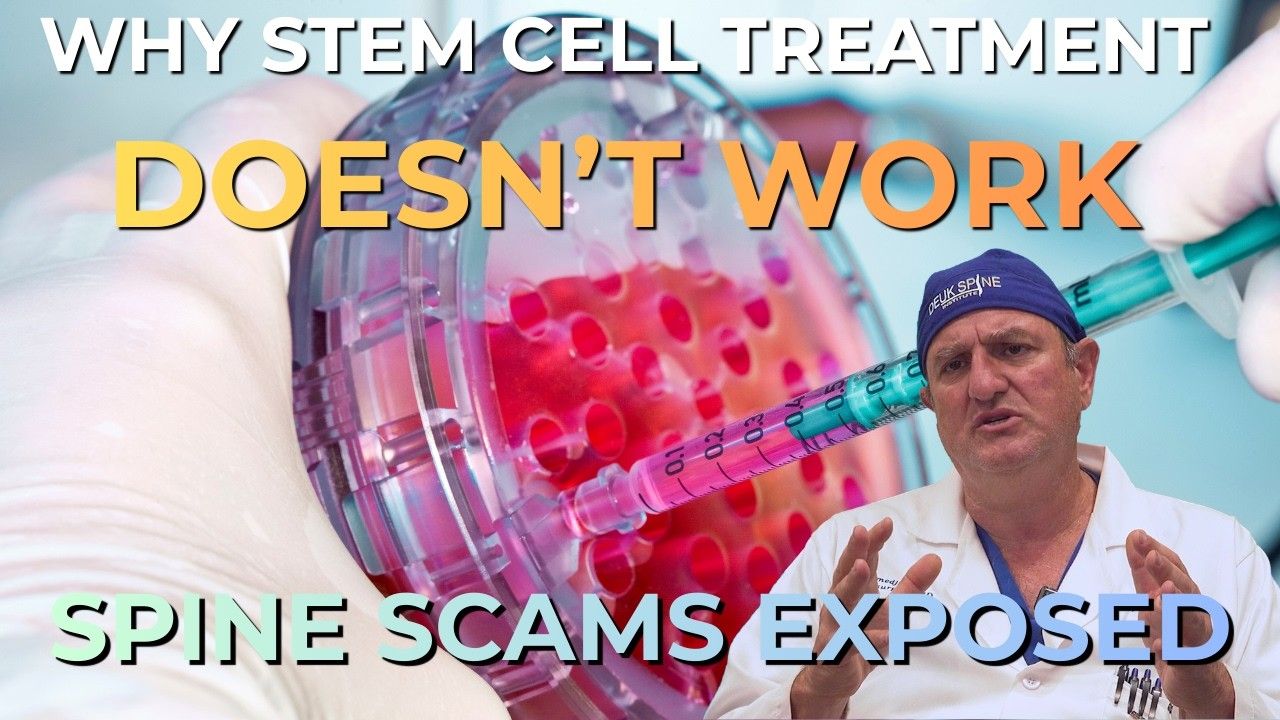
In this edition of Spine Scams Exposed, Dr. Ara Deukmedjian, CEO and founder of Deuk Spine Institute, breaks down why stem cell therapy is ineffective for treating chronic back pain. He explains that the two most common causes of back pain — disc injuries and facet joint injuries — are both driven by inflammation, and that stem cells actually promote inflammation rather than reduce it, making pain worse rather than better. Dr. Deukmedjian contrasts these ineffective treatments with Deuk Spine Institute's minimally invasive procedures, which directly target the source of pain and provide relief for an average of 99.6% of patients.
Transcript
Dr. Ara Deukmedjian: I'm Dr. Ara Deukmedjian, CEO and founder of the Deuk Spine Institute, and today's version of Spine Scams is related to stem cells. The title of this is Why Stem Cell Treatment Doesn't Work for Back Pain. So to understand why stem cell treatments don't work for back pain, we first have to understand the causes of back pain.
At Deuk Spine Institute, we've discovered that there are 30 causes of chronic debilitating lower back pain. Those 30 causes can be categorized into disc injuries, facet joint injuries, sacroiliac joint pain, piriformis muscle pain, and then other categories. Within the other categories, you have things like muscle spasms, tailbone pain such as coccydynia, fractures, tumors, and infections involving the spine.
So if you take all of those causes, you're looking at about 99.9% of all causes of chronic back pain. The most common cause of chronic back pain by far — accounting for 85% of patients with chronic back pain as their primary cause — are disc injuries. We know these injuries as herniated disc, bulging disc, ruptured disc, extruded disc, slipped disc, protruding disc, damaged disc, and spondylitic degenerated disc.
Any of those disc injuries, they're the number one cause of chronic debilitating back pain. Stem cell treatments don't work on disc injuries. Doctors have tried for years to inject either your own stem cells, fetal stem cells, umbilical stem cells, you name it — placental stem cells — into the disc to try to get rid of discogenic back pain.
It doesn't work. Stem cells work actually by increasing inflammation, and back pain is caused from inflammation. So by putting stem cells into your back to get rid of back pain, it actually does the opposite. It makes the back pain worse because stem cells promote inflammation, and inflammation is the cause of back pain.
So let's look at the number two cause of chronic back pain. That's going to be your facet joints. Facet joints basically are small diarthrodial joints located in the back of your spine. And for every disc, there's a pair of facet joints located in the back of the spine. Those facet joints have a synovial covering. They have a synovial membrane along with innervation by nerve fibers. And when you injure a facet joint through trauma, you can get a tear in the capsule. That tear over time doesn't heal, and you keep reinjuring it by getting up and moving around and doing your regular daily activities.
By having a non-healing capsule, your body keeps sending inflammatory tissue in there to heal it, and it just creates this vicious cycle of inflammation. So stem cells targeted at the facet joints have no way to heal your capsule. They have no way to get rid of the inflammation that's causing your pain when it comes to facet joint pain.
That's because stem cells promote inflammation rather than get rid of inflammation. So if you look at the two most common causes of back pain — disc injuries such as herniated discs and bulging discs, or facet injuries such as facet arthropathy, facet hypertrophy, facet capsule abnormalities — neither of those causes or conditions is amenable to stem cell therapy.
If we look at the third and fourth most common causes of back pain, such as piriformis muscle tears and sacroiliac joint inflammation, none of those causes will respond to stem cells either, because they're both painful due to inflammation.
Once again, you're trying to put out a fire using stem cells — which promote inflammation — to get rid of inflammation. That's why stem cells do not work to treat back pain or neck pain or thoracic pain.
Deuk Spine Institute, on the other hand, has pioneered the most minimally invasive treatments available in the world to get rid of the exact source of back pain located in the disc — the posterior annular tear inflammation — or located in the facet joint — the capsule inflammation — or located in the SI joint — the SI joint inflammation — or located in your piriformis muscle, which is piriformis muscle inflammation causing scar tissue, which is very painful.
We have minimally invasive treatments for all of these conditions, and they are completely effective at relieving 99.6% on average of people's pain related to those injuries. So don't waste your time and money on stem cell treatments. Don't fly down to Mexico. It's totally unnecessary to go there to get these stem cell treatments for your back pain.
Stem cell treatments may help in people who have arthritic hip joints, arthritis in their knee, arthritis in their shoulder. Those are really the only joints that we've seen some improvement — albeit temporary — when it comes to stem cells.
So thanks for joining us today. This is another edition of Deuk Spine Institute Spine Scams Exposed. This is a focus on stem cells and why they don't work to treat chronic back pain.
The Better Way: Deuk Laser Disc Repair® & Deuk Plasma Rhizotomy
In this Spine Scams Exposed segment, Dr. Ara Deukmedjian explains why stem cell therapy fails to address the root causes of chronic back pain — including herniated discs, facet joint injuries, sacroiliac joint pain, and piriformis muscle syndrome — all of which are inflammation-driven conditions that stem cells worsen rather than improve. As an alternative, Deuk Spine Institute offers proven minimally invasive treatments including the Deuk Laser Disc Repair (DLDR)® and the Deuk Plasma Rhizotomy that directly eliminate the source of pain with an average 99.6% patient relief rate.