


By Dr. Ara Deukmedjian
Board Certified Neurosurgeon
Reviewed on July 23, 2026
Medical Disclaimer: This content is for educational purposes only and does not constitute medical advice. Individual results may vary. Always consult with your healthcare provider about your specific condition and treatment options.
Key Points
✓ Multilevel degenerative disc disease (DDD) is disc breakdown at two or more spinal levels, most commonly cervical or lumbar. ¹
✓ It creates a “cascade effect”: load transferred from one degenerated disc accelerates wear at adjacent levels. ²
✓ Pain generators are usually a mix of discogenic pain (from annular tears) and facet arthritis. Both must be diagnosed and treated. ³
✓ 87% of asymptomatic adults show disc degeneration on MRI. Imaging alone does not justify surgery. ⁴
✓ Most patients improve with 6–12 weeks of guideline-based conservative care. ⁵
✓ Multi-level fusion carries a 22–26% rate of symptomatic adjacent-segment disease within 10 years, and reoperation risk rises with each additional fused level. ⁶ ⁷
✓ Multi-level artificial disc replacement beyond two levels is not FDA-approved and long-term data remain limited. ⁸
✓ Full-endoscopic decompression is motion-preserving, outpatient, and shown to be equivalent or superior to open surgery for appropriately selected patients. ⁹ ¹⁰
✓ Deuk Laser Disc Repair®: 99% pain relief for treated pain sources, 0.01% complication rate, 2,700+ procedures. Safely addresses multiple levels in a single outpatient session.
What Is Multilevel Degenerative Disc Disease?
The spine has 24 mobile vertebrae. 7 cervical, 12 thoracic, and 5 lumbar separated by intervertebral discs that act as shock absorbers. ¹ Each disc has a soft, gelatinous nucleus pulposus surrounded by a fibrous outer ring called the annulus fibrosus.
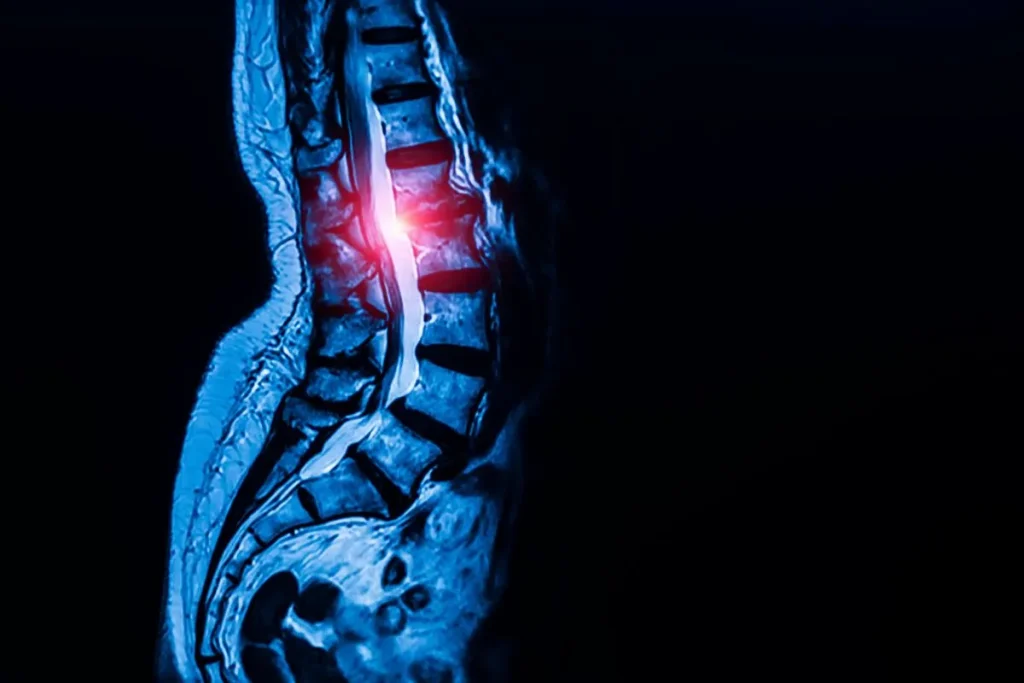
Multilevel DDD describes progressive disc breakdown at two or more spinal levels. These spinal discs in the cervical and lumbar parts of the spine are the most frequently injured as they bear the largest amount of physical weight. ¹ ²
Multilevel disease is distinct from single-level disease in three important ways:
- Pain is not additive. It is combinatorial. A patient may have neck-and-arm pain from a cervical level plus back-and-leg pain from a lumbar level, and each pain pattern requires its own diagnostic and treatment logic.
- The degenerative cascade compounds it. Once one disc fails, the adjacent discs absorb more load and degenerate faster. ² This is the same mechanism responsible for adjacent-segment disease after fusion.
- Treatment decisions become higher-stakes. Every additional level fused amplifies the biomechanical trade-offs of fusion; every additional level not addressed leaves an unresolved pain generator.
The Conditions That Fall Under Multilevel DDD
1. Multi-level herniated and bulging discs
A herniated disc is a tear in the annulus that allows nucleus material to protrude. A bulging disc is a broad, contained protrusion without a full-thickness tear. When either occurs at multiple levels, the primary pain driver is often not nerve compression. It is inflammation inside the annular tear itself, which produces chemical pain even when no nerve is pinched. ³
2. Multilevel spinal stenosis
Progressive disc collapse contributes to central-canal and foraminal narrowing through bulging, osteophyte formation, and ligamentum flavum hypertrophy. Multi-level stenosis produces overlapping radicular patterns that can mimic peripheral neuropathy.
3. The degenerative cascade
Load transferred from a degenerated segment accelerates wear at adjacent discs. ² A patient who arrived with a single-level problem often returns years later with two or three additional levels involved.
4. Combined disc and facet degeneration
Facet joints are paired synovial joints at the back of the spine. When discs collapse, the facets are subjected to abnormal loads and become arthritic. This “three-column” pain: discogenic from the front, facetogenic from the back, radicular into the limbs. Is one of the most under-diagnosed patterns in multilevel disease, and it is why treating discs alone often leaves patients in continued pain.
Symptoms of Multilevel Degenerative Disc Disease
Symptoms fall into four categories. Recognizing which apply to you is the first step toward the right treatment.
1. Axial pain in more than one region
Severe achy pain in the neck and low back region. The symptoms may be on the same day or may be alternating. The discogenic pain typically increases in flexion position and improves with recumbency (lying down).

2. Radicular symptoms in both upper and lower extremities
- Pain, tingling, or numbness radiating to the shoulder, arm, and hand (cervical involvement)
- Pain, tingling, or numbness radiating to the buttocks, thighs, calves, or feet (lumbar involvement)
- Pain in both arms and legs together is indicative of multilevel disease
3. Prolonged morning stiffness and reduced range of motion
Multilevel inflammation produces stiffness that lasts 30–60 minutes on rising and returns after any prolonged period of inactivity. Progressive loss of rotation, flexion, and extension is common.
4. Red-flag symptoms
- Weakness of a limb progressively
- Inability to coordinate movements with hands, dropping things or loss of fine motor skills (Cervical Myelopathy)
- Inability to maintain balance
- Problems related to controlling the bowels or bladder (known as Cauda Equina syndrome which is an emergency condition)
Any of these signs should be investigated immediately and referred to a specialist.
What Causes Multilevel DDD?
- The common reason among adults older than 40 years is wear and tear due to aging rather than an isolated trauma.
- Mechanical loading: forward head position, sitting in front of the computer, and repeated lifting put the strain on C5-C6, C6-C7, L4-L5, and L5-S1 levels.
- Genetics: research done on twins reports that between 34–74% of disc degeneration is genetically determined. ¹¹
- The cascade of degeneration: as soon as the one disc starts deteriorating, other ones follow.
- Cigarette smoking: nicotine lowers disc metabolism and increases disc degeneration rate.
- Previous spine surgeries: specifically fusion procedures causing adjacent segment disease. ⁶
- Obesity and metabolic factors: additional mechanical loading and inflammatory environment.
Diagnosing Multilevel DDD: Why the MRI Alone Is Not Enough
The MRI trap in multilevel disease
Imaging studies of population samples have proven time and again that degeneration of the disc occurs even in the absence of pain. Around 87% of asymptomatic adults demonstrate disc bulge or degeneration on MRI, and its incidence increases every decade. ⁴ In multilevel pathology, this trap is further magnified; having degeneration at four levels on an MRI scan doesn’t necessarily mean that four levels are causing pain. This is how unnecessary fusions occur through treating all abnormal discs.
The right diagnostic sequence
- History and physical exam. A dermatomal and myotomal exam maps each pain generator to a specific level.
- MRI of the affected regions. MRI is the imaging test of choice for soft-tissue detail discs, nerves, cord.
- CT or CT myelogram when MRI is contraindicated or bony pathology dominates.
- EMG / nerve conduction studies when radiographic findings do not match clinical symptoms, or to exclude peripheral entrapment (carpal, cubital, or tarsal tunnels).
- Provocative discography or diagnostic injections when necessary to confirm which disc or facet is actually generating pain.
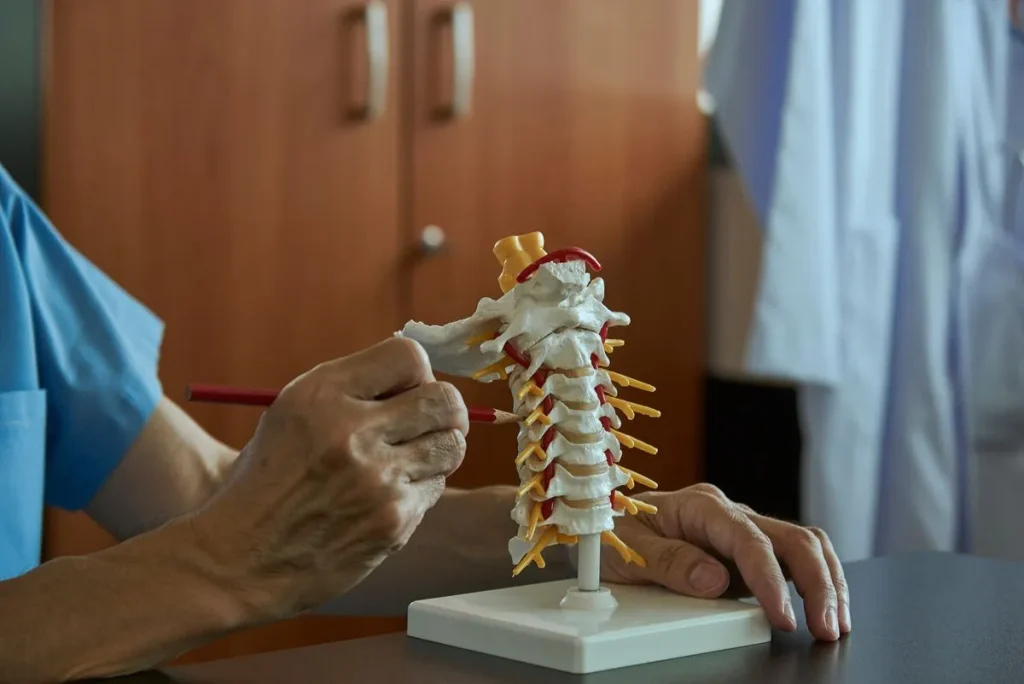
The core principle: symptomatology, exam, and imaging must all converge on the same level before any surgical decision is made; especially in multilevel disease.
Non-Surgical Treatment of Multilevel DDD
For most patients without red flags, a 6–12 week trial of guideline-based conservative care is appropriate. ⁵
Physical therapy
Deep-neck-flexor and core stabilization training, load-management education, and postural correction. For multilevel disease, the program must be staged. Flooding a deconditioned patient with global exercise typically flares one region while helping another.
Medications
- NSAIDs are considered the first line. There are risks associated with long-term use including GI, renal, and cardiovascular effects.
- An acute radicular flare can be treated with a short course of oral steroids (i.e. Medrol Dose Pack).
- Neuropathic pain can respond to treatment with neuropathic pain medications (i.e. gabapentin and pregabalin) but will result in cognitive dulling. ¹²
Epidural and facet injections
Image-guided steroid injections at each symptomatic level can provide meaningful short-term relief and importantly help confirm the pain generator before surgery. ⁵ Repeated steroid exposure has been associated with disc tissue weakening over time and is not a long-term strategy.

Lifestyle modification
Ergonomic optimization, weight management, smoking cessation, and avoidance of provocative loading. These slow progression but do not reverse structural degeneration.
When conservative care is not enough
Non-operative care fails when:
- Symptoms persist beyond 6–12 weeks of appropriate treatment
- Weakness is present or progressing
- Pain is disabling
- Any myelopathy or cauda equina red flags emerge
At that point, decompression should be discussed but the type of decompression matters more than in any other spinal condition.
The Case Against Defaulting to Multi-Level Fusion
Multi-level fusion has been the traditional default for multilevel DDD. It works for the operating levels. But it has three durable costs that compound with every additional level fused:
1. Permanent loss of motion at each fused level
A three- or four-level fusion converts a mobile spine into a stiff column. Rotation, flexion, and extension are all reduced.
2. Adjacent-segment disease scales with construct length
- After ACDF, symptomatic adjacent-segment degeneration develops at approximately 2.9% per year, affecting ~25.6% of patients within 10 years. ⁶
- After lumbar fusion, radiographic ASD occurs in up to 34% of patients, with 8–36% requiring reoperation within 10 years and rates are higher for multi-level constructs. ⁷
- Every additional fused level moves stress further onto the remaining mobile discs.
3. Recovery, hardware, and revision risk
Multi-level fusion requires inpatient stay, months of restricted activity, and carries risks of pseudarthrosis (failure to fuse), hardware loosening, infection, dural tears, and blood loss requiring transfusion. Revision surgery for adjacent-segment disease is technically more difficult than the index procedure.
Multi-level artificial disc replacement
Cervical disc arthroplasty (CDR) preserves motion at the operated level and has better adjacent-segment outcomes than ACDF at one and two levels. Beyond two levels, however, CDR is not FDA-approved as a standard indication, long-term (>7-year) data are limited, and complication rates: subsidence, heterotopic ossification, device migration. Compound with each additional device. ⁸ CDR also requires complete removal of the native disc and a lifetime commitment to a prosthesis.
Multi-level laminectomy
Laminectomy addresses compression but does not repair the discs that caused it. Multi-level laminectomy without fusion carries a significant risk of postoperative instability, and multi-level laminectomy with fusion carries all the fusion trade-offs above.
The critical question is not whether these procedures work. It is whether your specific pattern of multilevel DDD actually requires this much surgery. In the absence of documented instability, cord compression with myelopathy, deformity, tumor, or fracture, the answer for most patients is no.
Fusion vs. Motion-Preserving Endoscopic Repair for Multilevel DDD
When degenerative disc disease affects more than one level, the differences between fusion, artificial disc replacement, and endoscopic repair compound with every added segment. Here is how each approach performs across the metrics that matter.
The Endoscopic Alternative: Deuk Laser Disc Repair® for Multilevel Disease
Deuk Laser Disc Repair® is an ultra-minimally-invasive endoscopic-laser decompression developed by Dr. Ara Deukmedjian and refined over more than 15 years. It is designed to treat the actual pain generator. The inflamed annular tear; rather than the whole spinal segment.
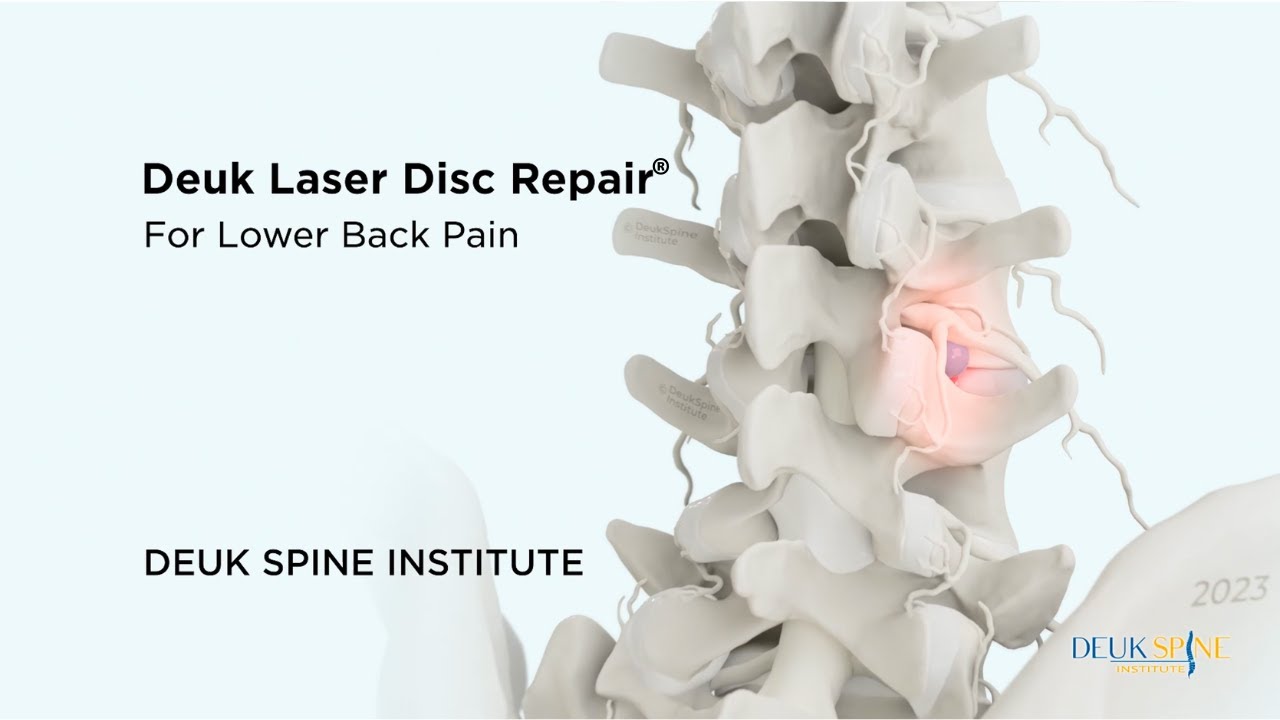
How it works
- A 4–7 mm skin incision is made under fluoroscopic guidance at each symptomatic level.
- A tubular dilator spreads the paraspinal muscles apart. No muscle is cut.
- An HD endoscope with a working channel is inserted with continuous saline irrigation.
- Under magnified live visualization, a side-firing holmium laser ablates only the inflamed nucleus tissue extruded into the annular tear.
- The lamina, facet joints, ligaments, and 90–95% of the disc are preserved. No implants are placed.
- The wound is closed with a single suture or skin adhesive.
Because no bone is cut and no structural element is removed, the procedure is motion-preserving at every treated level.
Why this matters for multilevel disease
- Multiple levels in one session. Three, four, or more discs can be repaired in a single outpatient procedure because each level adds only minutes and no incremental biomechanical liability.
- No cascade of hardware. No screws, cages, or prostheses at any level. Nothing to loosen, subside, or migrate.
- No adjacent-segment disease. Every disc retains its motion, so no level is asked to absorb stress it was not designed for.
- Same-day outpatient. Patients walk out within an hour and typically return to desk work in about a week. Regardless of how many levels were treated.
What the evidence supports
- Full-endoscopic spine surgery has clinical success rates in the 85–95% range for appropriately selected patients, with outcomes equivalent or superior to open surgery and significantly lower blood loss, hospital stay, and 30-day readmission rates. ⁹ ¹⁰
- Deuk Laser Disc Repair® reports 99% pain relief for treated pain sources and a 0.01% complication rate across more than 2,700 procedures.
Adding Deuk Plasma Rhizotomy® for facet pain
When multilevel DDD includes facet arthritis. The Deuk Plasma Rhizotomy® can be performed in the same session to stop the pain nerves caused by the facets. Unlike conventional radiofrequency ablation, which heat-injures nerves that then regenerate within months. Deuk Plasma Rhizotomy® uses plasma energy to physically cut the medial branch sensory nerves at multiple points, providing durable relief with the facet joint’s motion preserved.
Who Is a Candidate?
Best-suited candidates
- Symptomatic DDD at two or more levels (cervical, thoracic, and/or lumbar)
- Discogenic pain from annular tears, contained bulges, or focal herniations
- Combined disc and facet-mediated pain
- Failure of 6–12 weeks of appropriate conservative care
- MRI-confirmed pathology that matches the clinical exam
- Patients seeking to avoid multi-level fusion or multi-level arthroplasty
Less-appropriate candidates
- Severe cord compression with progressive myelopathy
- Documented segmental instability or spondylolisthesis with slip progression
- Significant spinal deformity (severe scoliosis, kyphosis)
- Fracture, tumor, or active infection
- Severe osteoporosis (relevant for any arthroplasty comparison)
Patients in the second group may still require a more traditional decompression, arthroplasty, or fusion. An honest surgeon will tell you which category you fall into.
How to Choose the Right Surgeon for Multilevel DDD
If you have been offered a multi-level fusion. Ask these questions before agreeing to surgery.
- Are you board certified and fellowship trained in neurological surgery or orthopedic spine surgery?
- How many multi-level endoscopic decompressions have you personally performed in the last 12 months? Recent volume matters more than lifetime totals.
- What is your own published success rate and complication rate? A high-volume specialist can quote their own outcome data, not just journal averages.
- Why do you recommend fusion at this many levels over a level-by-level decompression? The plan should be proportional to the pathology.
- Which of my levels are you certain are pain generators, and how did you confirm each one? Multilevel MRI abnormalities are not, by themselves, a surgical indication. ⁴
- What is your reoperation rate for adjacent-segment disease at 10 years?
- What will you not do? A surgeon who recommends multi-level fusion for every multilevel MRI is not the right surgeon for a focal, level-by-level problem.
- Have I gotten a second opinion? If a multi-level fusion has been recommended, get one. A phone call can prevent an irreversible surgical decision.
Treat multiple levels without multi-level fusion.
Multi-level fusion compounds the trade-offs of single-level fusion — about 22–26% of patients develop symptomatic adjacent-segment disease within 10 years, and reoperation risk rises with each additional fused level. Before you consent, send your MRI for a free review by Dr. Deukmedjian and learn whether Deuk Laser Disc Repair® can address multiple painful levels in a single outpatient session — no fusion, no hardware, and the natural motion of every segment preserved.
- 99%
- Pain relief
- 0.01%
- Complication rate
- 2,700+
- Procedures performed
FAQs
What is the difference between single-level and multilevel degenerative disc disease?
Single-level DDD involves one disc. Multilevel DDD involves two or more, most commonly in the cervical or lumbar spine. Multilevel disease produces more widespread and combinatorial symptoms. For example, arm symptoms from a cervical level and leg symptoms from a lumbar level in the same patient. And it makes surgical planning higher-stakes because every additional level fused compounds the biomechanical trade-offs of fusion. ⁶ ⁷
Can multilevel DDD be reversed?
The disc itself does not regrow, but the inflammatory annular tear that generates pain can heal after the inflamed tissue is removed. Conservative treatments manage symptoms without repairing structure. Deuk Laser Disc Repair® ablates only the inflamed tissue inside the annular tear. and preserves 90–95% of the disc, which allows the annulus to heal in place. Providing durable pain relief without removing the disc.
Is multi-level fusion the standard of care for multilevel DDD?
For decades, it has been the default but “default” and “best evidence” are not the same. Multi-level fusion has a documented adjacent-segment disease rate of ~25.6% at 10 years for the cervical spine ⁶ and up to 34% for the lumbar spine ⁷, and reoperation rates rise with each additional fused level. In the absence of instability, myelopathy, deformity, tumor, or fracture, a level-by-level focal decompression is a more evidence-consistent approach for most patients.
Is multi-level artificial disc replacement a better option than multi-level fusion?
At one or two cervical levels, arthroplasty has better adjacent-segment outcomes than ACDF. Beyond two levels, it is not FDA-approved as a standard indication, long-term data remain limited, and complication rates (subsidence, heterotopic ossification, device malposition) compound with each additional device. ⁸ It also requires complete removal of the native disc.
How many levels can Deuk Laser Disc Repair® treat in one session?
There is no biomechanical ceiling because no motion is eliminated at any treated level. Three, four, five, or more levels can be treated in a single outpatient session, each through its own 4–7 mm incision, with the same 99% pain relief and 0.01% complication profile.
How long is recovery from multilevel Deuk Laser Disc Repair®?
Most patients walk out within an hour, drive home the same day, and return to desk work within 5–7 days. Full activity is typically restored within 2–4 weeks regardless of the number of levels treated. Dramatically shorter than the 3–6 months required after multi-level fusion.
What if I have both disc pain and facet arthritis at multiple levels?
Both can be treated in the same session. Deuk Laser Disc Repair® addresses the discogenic component; Deuk Plasma Rhizotomy® permanently transects the sensory nerves of the arthritic facet joints while preserving joint motion. Treating one and ignoring the other is a common reason patients report incomplete relief after conventional surgery.
Does insurance cover endoscopic multi-level decompression?
Most major U.S. insurance plans, Medicare, and workers’ compensation cover medically necessary endoscopic spine procedures, though coverage for specific advanced techniques varies by carrier. Deuk Spine Institute verifies benefits during the free MRI review.
When should I get a second opinion?
If a multi-level fusion has been recommended, or if conservative care has failed after 6–12 weeks, or if you have unexplained pain at more than one spinal region; get one. An irreversible multi-level surgical decision deserves independent review.
References
View References
- Fardon DF, et al. Lumbar disc nomenclature v2.0. Spine J. 2014.
- Kirnaz S, et al. Fundamentals of disc degeneration. World Neurosurg. 2022.
- Peng B, et al. Pathogenesis of discogenic low back pain. JBJS Br. 2005.
- Nakashima H, et al. Cervical MRI findings in 1,211 asymptomatic adults. Spine. 2015.
- Kreiner DS, et al. NASS guideline: lumbar disc herniation with radiculopathy. Spine J. 2014.
- Hilibrand AS, et al. Adjacent-segment disease after ACDF. JBJS Am. 1999.
- Lawrence BD, et al. Adjacent segment pathology after lumbar fusion. Spine. 2012.
- Gornet MF, et al. Multilevel cervical disc arthroplasty: long-term outcomes at 3 and 4 levels. Int J Spine Surg. 2020.
- Ruetten S, et al. Full-endoscopic cervical foraminotomy RCT. Spine. 2008.
- Ahn Y. Endoscopic spine discectomy outcomes. Int Orthop. 2019.
- Battié MC, et al. Twin Spine Study. Spine J. 2009.
- Chou R, et al. ACP pharmacologic therapies for low back pain. Ann Intern Med. 2017.