
By Dr. Ara J. Deukmedjian, MD
Board-Certified Neurosurgeon
Medically reviewed on June 4, 2026
Medical Disclaimer: This content is for educational purposes only and does not constitute medical advice. Individual results may vary. Always consult with a qualified spine specialist about your specific condition and treatment options.
Key Points
✓ Both neurosurgeons and orthopedic spine surgeons operate on the spine. The title alone does not tell you who should be treating your condition or whether either is recommending the right procedure.
✓ Neurosurgeons complete a 7-year residency centered on the nervous system. Orthopedic spine surgeons complete a 5-year musculoskeletal residency plus an optional 1–2 year spine fellowship. Different foundations. Meaningful overlap in practice. ¹ ²
✓ For disc herniations, disc bulges, and discogenic pain, neither fusion nor open decompression is the only option. Both are frequently over-recommended for conditions that do not require removing the disc or eliminating motion.
✓ The Deuk Laser Disc Repair® addresses herniated discs, bulging discs, and annular tears through a 4–7 mm incision. No fusion, no hardware, no disc removal. The disc is repaired, not replaced. Motion is fully preserved. It is the same result most patients are told they need fusion or major decompression to achieve. ³
✓ Specialty matters less than most patients assume. What matters is whether the recommended procedure matches your actual pathology and whether a less invasive, motion-preserving option was offered before a permanent operation was put on the table.

Why This Question Matters More Than You Think
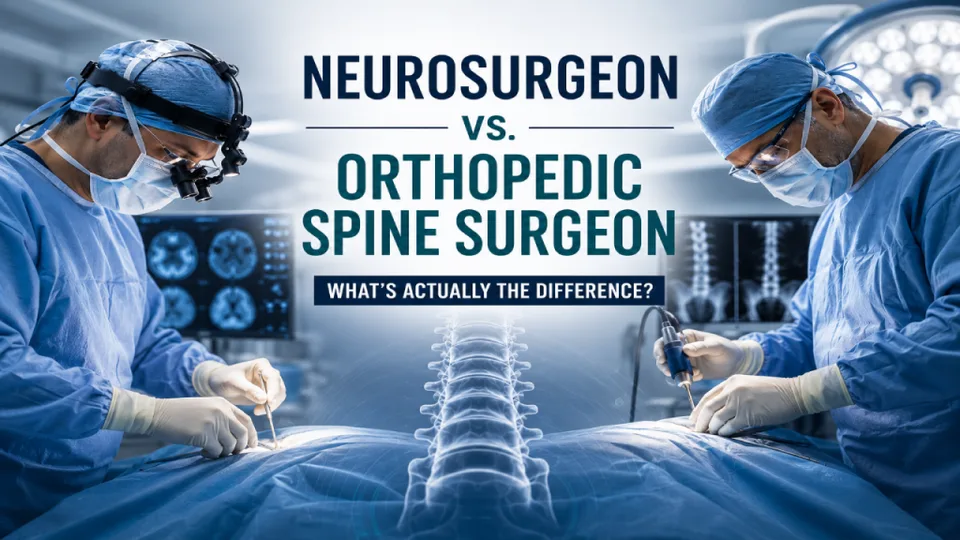
Most patients arrive at a spine surgeon consultation without knowing whether they are sitting across from a neurosurgeon or an orthopedic surgeon. They know the person is a “spine doctor.” They know surgery has been recommended. What they often do not know is that the two specialties represent fundamentally different training philosophies. And in certain conditions, that difference is meaningful.

It is also a question the medical community has spent years trying to answer with data, with inconsistent results. Studies comparing outcomes between the two specialties have been published across national databases, trauma centers, and single-institution reviews. The findings are nuanced. Sometimes neurosurgeons come out ahead. Sometimes orthopedic surgeons do. Most of the time, the differences are statistically small and clinically insignificant. ³
What the data consistently shows is that the question itself is incomplete. The relevant variables are not just specialty. They are surgical volume, fellowship training, institutional experience, and most importantly; whether the recommended procedure is the right one for the problem being treated. A highly experienced orthopedic spine surgeon with 2,000 posterior fusions is not the right person to remove an intradural spinal cord tumor. A neurosurgeon who splits their time evenly between brain and spine is not the same as one who has spent 20 years exclusively on spine. Titles create categories. Categories are not always clinically useful.
The goal of this article is to give you an understanding of what separates these two specialists at the level of training, clinical strengths, and procedure-specific outcomes, so that when you are given a recommendation, you can ask the right questions.
How Each Surgeon Is Trained: The Foundation of the Difference
Before comparing who is “better” for spine surgery, it is worth understanding what each surgeon actually spent their training years doing. Because the differences start earlier, run deeper, and are largely influenced by the number of procedures that a surgeon has done for that exact condition.
1. Neurosurgical Training: The Spine Is Central From Day One
A neurosurgeon completes medical school followed by a 7-year residency in neurological surgery. The entire residency is oriented around the nervous system: the brain, the spinal cord, the peripheral nerves, and the complex anatomy that either protects or compresses them. Spine surgery is not a rotation within a broader musculoskeletal training; it is a core domain of every neurosurgical training program in the country.
A 10-year analysis of ACGME case logs found that neurosurgery residents performed an average of 433.8 spine procedures during residency. Over that same period, spine cases represented 33.5% of all surgical cases performed by neurosurgery residents. ¹ From the first year, neurosurgery residents are learning to work with the delicate neural structures that orthopedic training is not designed to prioritize: the dura, the spinal cord itself, the nerve roots, the microsurgical environment inside the spinal canal.
Intraoperative neuromonitoring the real-time tracking of spinal cord and nerve function during surgery. Is standard practice in neurosurgical training. So is microsurgical technique: operating under high magnification in confined spaces where a millimeter of error can change a patient’s neurological status permanently. These are not skills that can be acquired from a structural-alignment training program. They are the result of years of repetition in the right environment.
After residency, many neurosurgeons complete an additional 1–2 year spine fellowship, narrowing their focus further to complex spinal pathology, minimally invasive techniques, or specific anatomical regions.
2. Orthopedic Spine Training: Structural Mastery as the Core Discipline
An orthopedic spine surgeon completes medical school followed by a 5-year orthopedic residency. The focus of that residency is the musculoskeletal system in its entirety: bones, joints, tendons, ligaments, cartilage, and the mechanical architecture of the body. Spine is one component of their training, a meaningful one, but not the exclusive focus.
ACGME data shows orthopedic surgery residents averaged 119.5 spine procedures during residency. Far fewer than their neurosurgical counterparts, with spine representing only 6.2% of all orthopedic cases logged over the same 10-year period. ¹ What orthopedic residency provides that neurosurgical training does not is deep immersion in structural biomechanics: how bones align, how hardware interfaces with bone, how deformities develop and how they can be corrected through instrumentation and reconstruction.
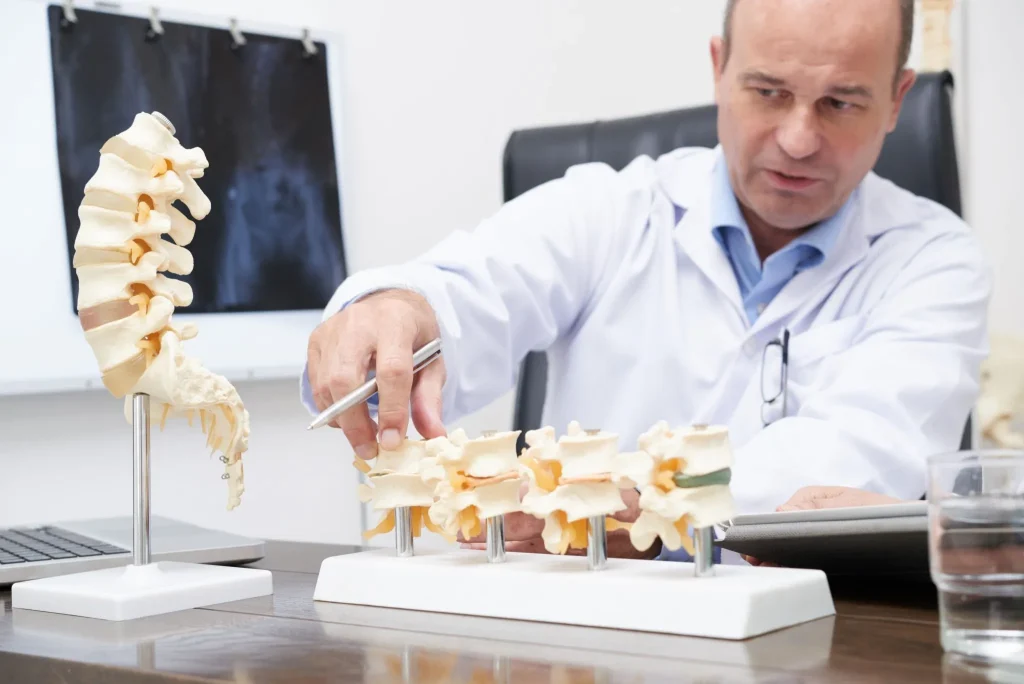
Because the general orthopedic residency provides limited spine exposure by volume, most orthopedic surgeons who pursue spine as their clinical focus complete an additional 1–2 year spine surgery fellowship after residency. Fellowship is optional, but among serious spine practitioners, it is nearly universal. That fellowship is where complex spinal reconstruction, multilevel instrumented fusion, and deformity correction techniques are developed to a clinical level. ²
The practical result of this training structure is an orthopedic spine surgeon who enters independent practice with deep expertise in the structural spine: alignment, hardware, fusion mechanics, and deformity. And relatively less immersion in the neural anatomy and microsurgical environment that forms the core of neurosurgical training.
What the Outcomes Data Actually Shows
The question of whether neurosurgeons or orthopedic surgeons produce better spine surgery results has been studied repeatedly in large national databases. The consensus is more nuanced than either specialty’s advocates tend to acknowledge.
A systematic review and meta-analysis reviewing published studies across PubMed and Scopus found that neurosurgeons and orthopedic spine surgeons have similar readmission, complication, and reoperation rates for spine surgery overall, regardless of procedure type. ³ A scoping review of 10 comparative studies similarly concluded that surgeon specialty alone shows no significant association with short-term spine surgery outcomes, and that surgical volume and fellowship training are the variables most likely to explain performance differences. ⁵
These findings are important. They mean patients should not assume that seeing a neurosurgeon automatically produces better results for back pain than seeing an orthopedic spine surgeon, or vice versa. For the procedures that dominate spine surgery volume: lumbar decompression, single-level fusion, microdiscectomy. A fellowship-trained, high-volume surgeon in either specialty is likely to produce comparable outcomes for the right patient.
Where the data gets more specific and more actionable for patients is at the level of individual procedure types. A study analyzing anterior cervical discectomy and fusion (ACDF) outcomes found that neurosurgeons perform approximately three times as many ACDF procedures as orthopedic surgeons and showed statistically shorter hospital stays, lower perioperative blood transfusion rates, and lower sepsis rates in the neurosurgical cohort. ⁶ A matched analysis of TLIF outcomes found that after controlling for surgical experience (only surgeons with at least 250 procedures were included), both specialties produced similar surgical complications, but neurosurgeons had higher all-cause medical complication rates. ⁷
Neither specialty dominates across all procedures. Both perform spinal surgery safely at high rates in experienced hands.
Where the Specialties Genuinely Differ
For the large overlap in conditions: herniated discs, spinal stenosis, degenerative disease, single-level fusion. The data supports the conclusion that experience and volume matter more than specialty. But there are clinical domains where the training difference is not trivial and where specialty genuinely guides who should be operating.
Conditions Where a Neurosurgeon’s Training Carries More Weight
Intradural spinal surgery operations that take place inside the dura mater, the membrane that directly encloses the spinal cord and nerve roots. It is almost exclusively the domain of neurosurgeons. Spinal cord tumors, arachnoid cysts, tethered cord, and intradural arteriovenous malformations require microsurgical technique and a level of familiarity with neural anatomy that orthopedic residency does not provide at the same depth. Neurosurgeons perform the substantial majority of intradural spine surgeries in the United States. ⁴
Craniocervical junction surgery is the region where the skull meets the top of the cervical spine. Similarly demands the kind of neural anatomy expertise that is core to neurosurgical training. The proximity to brainstem structures, the complexity of stabilization without damaging the cord, and the need for neuromonitoring throughout make this a neurosurgical domain.
Acute spinal cord injury with neurological deterioration is typically managed by neurosurgeons at Level I trauma centers. Where nerve preservation and decompression timing are as important as structural stabilization, neural expertise carries direct clinical weight. ⁸
Conditions Where an Orthopedic Spine Surgeon’s Training Carries More Weight
Complex spinal deformity: adult and pediatric scoliosis, kyphosis, flatback syndrome, pelvic obliquity. Has historically been the domain of orthopedic spine surgeons with fellowship training in deformity correction. The instrumentation strategies, the understanding of sagittal balance and alignment parameters, and the multi-level fusion mechanics involved in deformity correction represent a specialized body of knowledge that develops most completely in orthopedic spine fellowship training. Orthopedic spine surgeons perform over 70% of spinal fusion surgeries annually in the United States. ⁴
Spinal trauma with significant structural instability: burst fractures, fracture-dislocations, high-grade spondylolisthesis. Often favors the orthopedic surgeon’s structural reconstruction training, particularly for the long-segment instrumented constructs these cases require.
Pediatric spine surgery: including congenital deformities and growth-directed instrumentation, has more procedural volume in orthopedic training than in neurosurgical training, where pediatric spine cases represent a smaller proportion of residency exposure. ²
What Both Specialties Do and Do Equally
What These Categories Don’t Tell You
Fellowship Training Is the Variable That Closes the Gap
A board-certified orthopedic surgeon without fellowship spine training and a fellowship-trained orthopedic spine surgeon are not clinically equivalent for complex spine pathology. The same is true in neurosurgery: a neurosurgeon who divides their practice equally between brain surgery and spine is not the same as one who has devoted 15 years exclusively to spine surgery. The title on the door does not capture that distinction. Asking specifically whether the surgeon is fellowship-trained in spine, how many of your specific procedures they perform per year, and what their personal complication and reoperation rates are will give you more useful information than any specialty label.

Surgical Volume Is the Most Consistent Predictor of Outcome
The relationship between surgical volume and outcome is one of the most replicated findings in surgical outcomes research. It applies across specialties, procedure types, and institutional settings. A high-volume spine surgeon whether neurosurgeon or orthopedic. Can consistently outperform a low-volume surgeon in the same specialty for the same procedure. Before consenting to spine surgery with any surgeon, ask specifically how many times they have performed your recommended procedure in the past 12 months. Not how many spine surgeries they do. But how many times they’ve done the specific spine surgery recommended for you. ⁵
The Procedure Being Recommended Is a Separate Question Entirely
The debate between neurosurgeons and orthopedic spine surgeons is a question about who performs a procedure. The more important question. One that is almost never asked is whether the procedure being recommended is the correct one for your specific pathology. A fellowship-trained, high-volume surgeon in either specialty recommending a fusion for a condition that does not require motion elimination is not a better option than a less-decorated surgeon who recommends the correct operation. Specialty confers training. It does not guarantee that the recommendation you are receiving is the right one for what is actually wrong with your spine.
What You Should Do
There is no universally superior choice between a neurosurgeon and an orthopedic spine surgeon for spine care. The question is too broad. For the large category of degenerative spine conditions: herniated discs, stenosis, degenerative disc disease the outcomes in experienced, fellowship-trained hands are comparable between specialties. For intradural pathology, cord tumors, and complex neural conditions, neurosurgical training carries more weight. For spinal deformity, scoliosis, and structural reconstruction, orthopedic spine fellowship training typically represents deeper expertise.
What both specialties share is the capacity to recommend procedures that may not be the most appropriate for a given patient’s anatomy. A second opinion is ideally from a surgeon in the same specialty or the complementary one is not a delay in care for a stable degenerative condition. It is the most clinically justified step available to you before committing to a permanent structural change to your spine.
Before any spine surgery, ask your surgeon two questions. First: are you fellowship-trained in spine surgery, and how many of this specific procedure have you performed in the last year? Second: is there a motion-preserving or less-invasive alternative to what is being recommended for my specific MRI findings? The answers will tell you more than the specialty label ever could.

Frequently Asked Questions
Is a neurosurgeon or orthopedic spine surgeon better for back surgery?
For most common degenerative conditions: herniated discs, spinal stenosis, and single-level fusion the outcomes are statistically similar between fellowship-trained, high-volume surgeons in either specialty. The more relevant variables are the surgeon’s experience with your specific procedure and whether the recommended operation is actually indicated for your condition. For conditions involving the spinal cord, intradural pathology, or the craniocervical junction, a neurosurgeon’s training carries more clinical weight. For complex spinal deformity and multi-level structural reconstruction, an orthopedic spine surgeon with deformity fellowship training is typically the more appropriate choice.
Do neurosurgeons do more spine surgery than orthopedic surgeons during training?
Substantially more. A 10-year analysis of ACGME case logs found that neurosurgery residents averaged 433.8 spine procedures during residency, compared to 119.5 for orthopedic surgery residents. A 3.6-fold difference that widened over the study period. ¹ Spine represented over 33% of all surgical cases in neurosurgical training, versus less than 7% in orthopedic training. This training-volume gap is partially closed for orthopedic surgeons who complete a 1–2 year spine fellowship, but the raw residency exposure remains significantly higher for neurosurgery.
Should I see a neurosurgeon or orthopedic surgeon for a herniated disc?
Both specialties routinely treat herniated discs and perform the associated procedures: microdiscectomy, laminotomy, and decompression. For a standard lumbar or cervical herniated disc without spinal cord compression, either a fellowship-trained neurosurgeon or fellowship-trained orthopedic spine surgeon is an appropriate choice, and your decision should focus on the surgeon’s specific experience and complication rate rather than their specialty. If your herniated disc involves significant spinal cord compromise, myelopathy, or intradural involvement, a neurosurgeon’s training in neural anatomy and microsurgical cord decompression carries more direct relevance.
Can an orthopedic surgeon do spinal cord surgery?
Orthopedic spine surgeons routinely operate within the spinal canal for decompression, fusion, and structural reconstruction. What they do not typically perform is intradural surgery. Procedures that open the dura and operate directly on the spinal cord, nerve roots, or intradural tumors. Intradural spine surgery, cord tumor resection, and surgery at the craniocervical junction remain primarily within the neurosurgical domain, reflecting the depth of neural anatomy and microsurgical training that neurosurgical residency provides and orthopedic training does not. ⁴
Who performs more spinal fusions? Neurosurgeons or Orthopedic surgeons?
Orthopedic spine surgeons perform the majority of spinal fusion surgeries in the United States. Approximately 70% annually by some estimates. Reflecting their training emphasis on structural stabilization, instrumentation, and biomechanical reconstruction. ⁴ Neurosurgeons also perform fusion procedures routinely, but their proportionally higher volume skews toward decompressive and nerve-related procedures. For multilevel fusion, complex deformity correction, and instrumented reconstruction, orthopedic spine fellowship training typically represents the deeper concentrated experience.
What questions should I ask a spine surgeon before agreeing to surgery?
Ask five. First: are you fellowship-trained specifically in spine surgery? Second: how many of this specific procedure have you performed in the past 12 months; not total spine surgeries, but this operation? Third: what is your personal reoperation rate for this procedure at two and five years? Fourth: is there a motion-preserving or minimally invasive alternative to what you are recommending for my MRI findings? Fifth: what happens if I choose not to have surgery. What is the natural history of my condition without intervention? A surgeon who cannot answer all five questions with specific numbers and evidence deserves a second opinion before you consent.
Sources
- Pham MH, et al. Trends in spine surgery training during neurological and orthopaedic surgery residency: a 10-year ACGME analysis. J Bone Joint Surg Am. 2019;101(22):e122.
- Daniels AH, et al. Variability in spine surgery procedures during orthopaedic and neurological surgery residency: an ACGME case log analysis. J Bone Joint Surg. 2014;96:e196.
- Bhullar A, et al. Spine surgical subspecialty and patient outcomes: a systematic review and meta-analysis. Spine. 2023.
- Princeton Brain, Spine & Orthopedics. The Electrician vs. The Carpenter. princetonbrainandspine.com.
- Manickam A, et al. Spine surgeries between specialties: neurosurgeons versus orthopedic surgeons — a scoping review. Int J Res Med Sci. 2023.
- Alomari S, et al. Early outcomes of elective ACDF for degenerative spine disease correlate with surgeon specialty. Neurosurgery. 2022.
- Shukla GG, et al. Matched analysis of TLIF outcomes: no difference between experienced neurosurgeons and orthopedic surgeons. Spine. 2024;49(11):772–779.
- Sedighim S, et al. Neurosurgery vs. orthopedic spine consultation at a Level I trauma center. Brain Spine. 2024;4:102808.