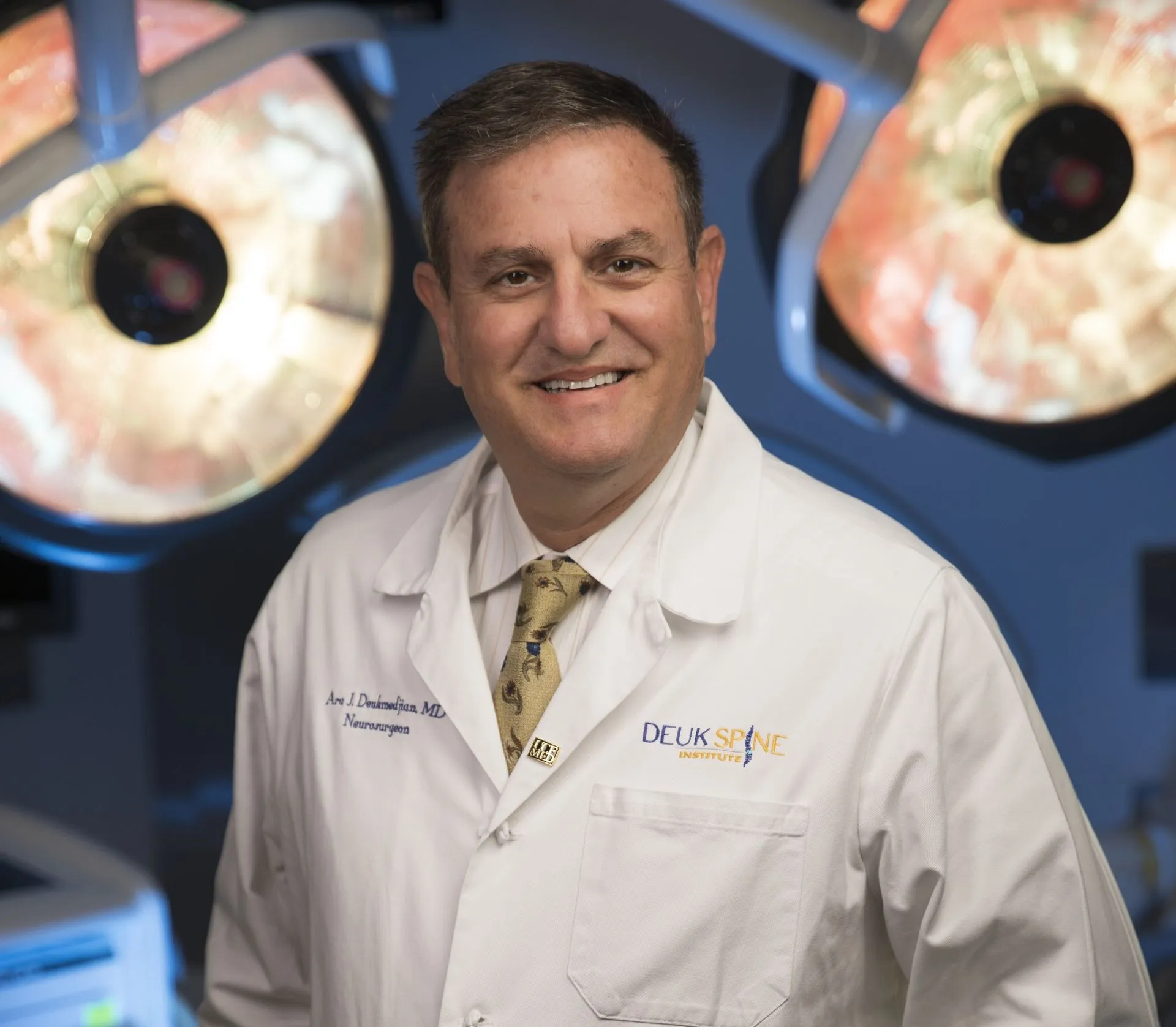
By Dr. Ara Deukmedjian
Board-Certified Neurosurgeon, Deuk Spine Institute
Medically reviewed on April 30, 2026
Medical Disclaimer: This content is for educational purposes only and does not constitute medical advice. Individual results may vary. Always consult with your healthcare provider about your specific condition and treatment options.
Key Points
✓ Minimally invasive spine surgery uses a small incision, no muscle cutting, and no bone removal to treat the source of back or neck pain.
✓ There is no single success rate for minimally invasive spine surgery. Results depend on the specific procedure, the patient, and whether the diagnosis identified the true source of pain.
✓ Deuk Laser Disc Repair® is an endoscopic form of minimally invasive spine surgery that uses a 4mm to 7mm incision and a surgical-grade laser to treat damaged discs from the inside.
✓ It treats herniated discs, bulging discs, and sciatica, plus some cases of spinal stenosis and spondylolisthesis where a damaged disc is the pain source, without fusion or hardware.
✓ Recovery is typically measured in days, not months. Most patients walk within about an hour and return to desk-based work within 3 days.
✓ Across more than 2,700 Deuk Laser Disc Repair® procedures, the practice reports 99% average pain relief for treated pain sources, published as a peer-reviewed abstract, and a 0.01% complication rate.
What Is Minimally Invasive Spine Surgery?
Minimally invasive spine surgery is a category of procedures designed to treat spinal pain without the large incisions, muscle stripping, and bone removal of traditional open surgery. Done correctly, these procedures preserve the natural anatomy of the spine while treating the actual source of pain.
A working definition includes three things.
- An incision smaller than a dime, typically 4mm to 7mm
- No cutting, drilling, or removal of bone
- No stripping of muscle from the vertebrae
The term is used loosely, and many procedures described as minimally invasive do not meet this standard. Laminectomy, microdiscectomy, and most fusion variations involve cutting or drilling bone, even when performed through a smaller incision. A small skin opening does not change what happens underneath.
Deuk Laser Disc Repair® meets all three criteria. It uses a tubular retractor, an endoscopic camera, and a surgical-grade laser to reach the damaged disc through a single small incision, with no permanent destruction of healthy spinal anatomy.
Types of Minimally Invasive Spine Surgery
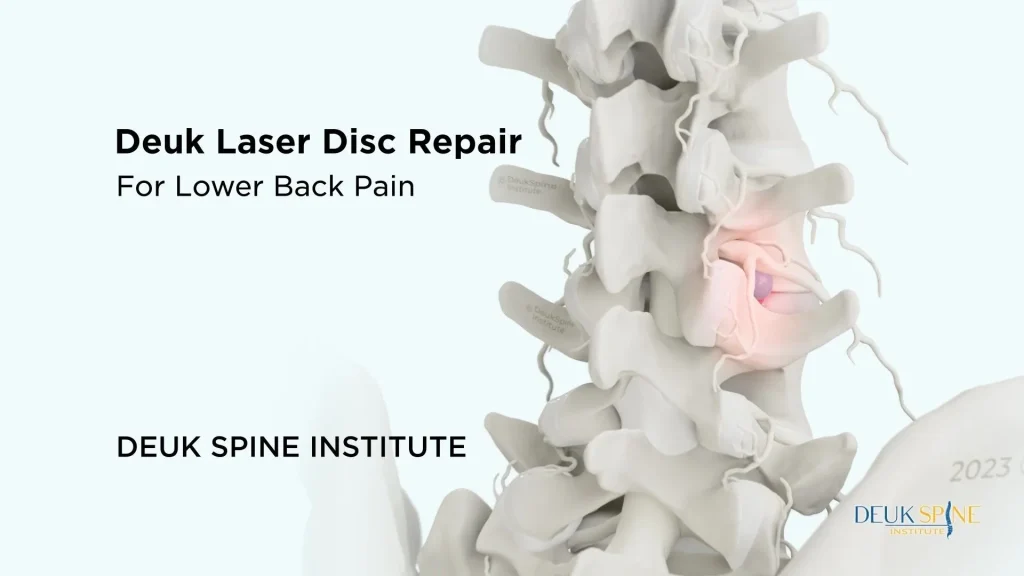
- Deuk Laser Disc Repair® (DLDR®): Combines full endoscopic visualization with a Holmium:YAG laser to debride the painful annular tear and remove herniated material. Preserves bone, muscle, and motion.
- Percutaneous Laser Disc Decompression (PLDD): FDA-approved since 1991. Uses a needle to deliver laser energy into the disc, reducing internal pressure. Suited to contained herniations with an intact outer wall.⁴
- Microdiscectomy: Often labeled minimally invasive but involves muscle retraction and partial bone removal. Treats nerve compression but does not treat the annular tear itself.
- Minimally Invasive Fusion (TLIF, XLIF, PLIF): Performed through smaller incisions but still involves bone removal, hardware implantation, and loss of motion at the fused level.
Endoscopic procedures are the least disruptive group in this category. Our guide to how endoscopic spine surgery works and who qualifies covers them in detail.
Conditions Minimally Invasive Spine Surgery Can Treat
- Herniated discs causing back, neck, arm, or leg pain
- Bulging discs with contained displacement of disc material
- Annular tears producing chronic discogenic pain
- Sciatica and cervical radiculopathy from nerve root compression
- Some cases of spinal stenosis where disc material is narrowing the canal
- Stable, low-grade spondylolisthesis with disc-related pain
- Degenerative disc disease with discogenic pain as the primary symptom
Deuk Laser Disc Repair® does not treat facet joint arthritis, sacroiliac joint pain, or piriformis syndrome. The Deuk Plasma Rhizotomy® deactivates the pain-carrying nerves inside an arthritic facet or sacroiliac joint, and the Deuk Piriformis Release® addresses piriformis syndrome.
How Deuk Laser Disc Repair® Works
- Performed in an outpatient surgery center under local anesthesia with light sedation
- Small incision (4mm to 7mm) is made, less than a quarter inch long
- A dilator separates the paraspinal muscles rather than cutting them
- A tubular retractor is positioned at the painful disc using imaging guidance
- An endoscope and Holmium:YAG laser are introduced through the tube
- The laser vaporizes inflamed tissue, removes herniated nucleus pulposus, and debrides the annular tear
- Total time is approximately 20 minutes per disc
- No bone drilling, no muscle cutting, no hardware implantation
The annular tear then heals naturally over the next 9 to 12 months, with the disc retaining its height, hydration, and range of motion.
What Is the Success Rate of Minimally Invasive Spine Surgery?
There is no single success rate for minimally invasive spine surgery. It is a category that covers several different operations, and each one has its own outcome data. The number that matters is the published result for the specific procedure you are being offered, in patients with your diagnosis.
The published evidence for procedures in this category includes the following.
- Endoscopic versus microscopic discectomy. A 2026 meta-analysis of 4,186 patients in The Spine Journal found both approaches safe and effective. The endoscopic approach was associated with a faster return to work, shorter hospital stays, and fewer wound infections, along with a higher risk of postoperative dysesthesia (abnormal skin sensation).¹
- Cervical Deuk Laser Disc Repair®. A study of 66 consecutive patients published in Surgical Neurology International in 2013 reported an average symptom resolution of 94.6%, with no perioperative complications.²
- Deuk Laser Disc Repair® across all levels. Across more than 2,700 procedures, the practice reports 99% average pain relief for treated pain sources, published as a peer-reviewed abstract, with a 0.01% complication rate and a 0% infection rate.
These are separate data sets that measure different procedures in different patient groups, so they should not be compared head to head. For the longer view, see what five-year outcome data shows about minimally invasive surgery.
Accurate diagnosis matters more than surgical technique. A technically perfect procedure performed on the wrong structure produces no benefit.³ That is why the Deuk Spine Exam® correlates your MRI with a physical exam and your pain history before any procedure is recommended.
Minimally Invasive Spine Surgery for Stenosis
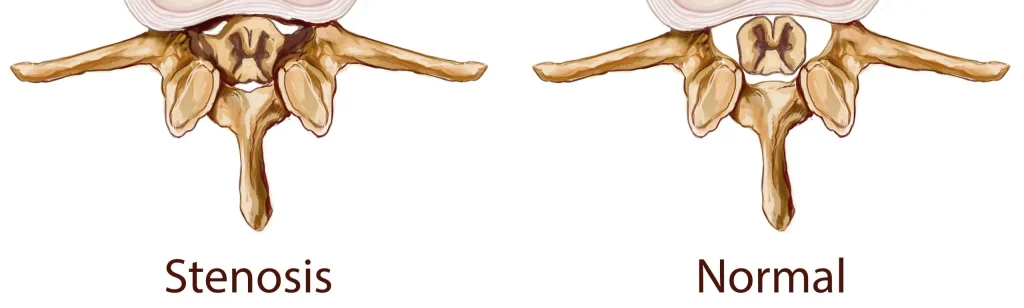
Spinal stenosis is the narrowing of the spinal canal or neural foramen, which puts pressure on the nerves running through the spine. In the lower back it typically produces leg symptoms, such as heaviness, cramping, and weakness with walking that ease with rest. In the neck it can cause numbness or weakness in the arms and hands.
The traditional treatment is laminectomy, which removes the lamina bone on the back of the vertebra to open up space for the nerves. Bone that is removed does not grow back, and in some patients the loss of supporting bone leads to instability that later requires a fusion.
For stenosis caused by disc material, Deuk Laser Disc Repair® takes a different approach.
- The laser removes the inflamed tissue and herniated disc material that is narrowing the spinal canal
- The nerves are decompressed from the front rather than by removing structural bone from the back
- The lamina, ligamentum flavum, and facet joints all stay intact
- Spinal stability is preserved, and no level is fused
Stenosis caused by bone spurs, a thickened ligament, or other bony narrowing is not treated by Deuk Laser Disc Repair®. When a herniated or bulging disc is the main cause, treating the disc can relieve the pressure on the nerves without removing bone.
Minimally Invasive Spine Surgery for Spondylolisthesis
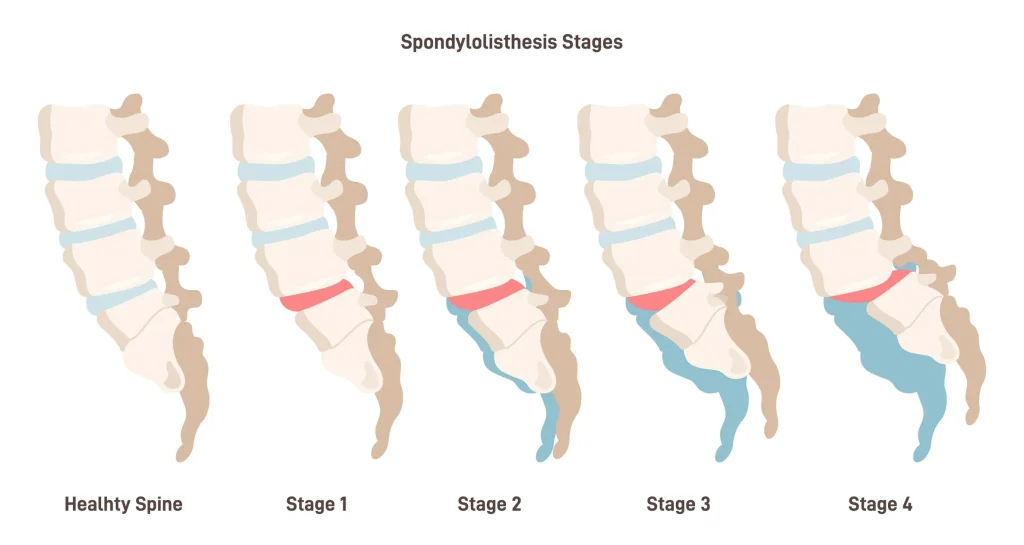
Spondylolisthesis is the forward slippage of one vertebra over another, graded from 1 to 4 based on severity. The usual surgical recommendation is fusion, but it is not always needed.
For low-grade slips, the picture is often different.
- Grade 1 and stable Grade 2 slips often do not cause pain by themselves
- The pain often originates from a damaged disc at the level of the slip
- Deuk Laser Disc Repair® (DLDR®) treats the disc directly, addressing the pain source without locking the vertebrae together
- The slip itself remains unchanged, but pain from the inflamed annular tear can resolve once the tear has been debrided
For high-grade, progressive, or unstable spondylolisthesis, fusion may genuinely be required, and an honest surgeon will say so. For patients with stable low-grade slips and disc-related pain, Deuk Laser Disc Repair® treats the actual pain generator without permanent loss of spinal motion.
Minimally Invasive Spine Surgery Recovery Time
Recovery time is one of the clearest dividing lines between minimally invasive surgery and traditional open procedures.
Typical recovery after Deuk Laser Disc Repair® follows this timeline.
- Within about 1 hour: Most patients walk
- Within 2 to 3 hours: Discharged home
- Same day: Showering resumes; walking encouraged
- Within 3 days: Return to desk-based work with lifting restrictions
- Weeks: Low-impact activities (swimming, cycling, walking)
- Several months: High-impact activities (running, jumping, contact sports)
- 9 to 12 months: Annular tear completes natural healing
Pain is typically managed with over-the-counter ibuprofen or acetaminophen. Opioids are usually not needed because no muscle is cut and no spinal bone is removed.
Traditional surgery typically involves a longer recovery.
- Laminectomy with fusion: A larger incision, a hospital stay of several days, opioid pain medication in many cases, and 6 to 12 months of restricted recovery
- Microdiscectomy: Muscle retraction, partial bone removal, and weeks to months of recovery
What Is the Cost of Minimally Invasive Spine Surgery?

Cost depends on the facility, geographic location, and insurance coverage. The largest cost drivers in traditional spine surgery are the hospital stay, implanted hardware, and extended rehabilitation.
- Deuk Laser Disc Repair® is an outpatient procedure with no hospital stay
- No implanted hardware (no screws, rods, or cages)
- No extended rehabilitation in a typical recovery
Insurance coverage varies by procedure code and insurer. Deuk Spine Institute offers free MRI reviews so patients can understand their specific options before making any decision.
Finding a Minimally Invasive Spine Surgeon Near You
Many clinics use the term minimally invasive for a wide range of procedures, including some that still involve bone removal and hardware. A few direct questions make the difference clear.
- Will any bone be cut, drilled, or removed?
- Will any hardware, screws, plates, or cages be implanted?
- What is the actual incision size? Endoscopic procedures typically use a 4mm to 7mm incision.
- How many of this specific procedure has the surgeon personally performed?
- Is there published, peer-reviewed outcome data for this procedure?
- What are the documented complication and infection rates, as specific numbers?
When to See a Spine Specialist
See a spine specialist if you have any of the following.
- Back or neck pain radiating into arms or legs
- Numbness, tingling, or muscle weakness
- Symptoms that have not improved after several weeks of conservative care
Go to an emergency room immediately for any of the following.
- Sudden loss of bladder or bowel control
- Saddle anesthesia (numbness in the groin or inner thighs)
- Rapidly progressive weakness in both legs
These are signs of cauda equina syndrome, a surgical emergency.
If you have been living with chronic back or neck pain, send your MRI for a free review. Dr. Deukmedjian will review it and tell you honestly whether a minimally invasive procedure fits your condition.
Frequently Asked Questions
What does minimally invasive spine surgery mean?
Minimally invasive spine surgery is a category of procedures that treat spinal pain through a small incision without cutting muscle or removing bone. Deuk Laser Disc Repair® is one endoscopic example, using a 4mm to 7mm incision and a surgical-grade laser to treat damaged discs from the inside while preserving the natural anatomy of the spine.
What is the success rate of minimally invasive spine surgery?
There is no single success rate, because minimally invasive spine surgery covers several different procedures. A 2013 study of cervical Deuk Laser Disc Repair® reported 94.6% average symptom resolution,² and across more than 2,700 procedures the practice reports 99% average pain relief for treated pain sources, published as a peer-reviewed abstract. Results depend heavily on accurate diagnosis.³
Is minimally invasive spine surgery safe?
When performed by an experienced surgeon on a properly selected patient, endoscopic spine surgery has low complication rates. A 2026 meta-analysis found fewer wound infections with endoscopic discectomy than with microscopic discectomy.¹ Deuk Laser Disc Repair® documents a 0.01% complication rate and a 0% infection rate.
What is minimally invasive spine surgery for stenosis?
For stenosis caused by disc material, Deuk Laser Disc Repair® uses a laser to remove the herniated material and inflamed tissue narrowing the spinal canal, without removing the lamina. Stenosis caused by bony narrowing is not treated this way.
What is minimally invasive spine surgery for spondylolisthesis?
For stable, low-grade spondylolisthesis, the pain often comes from a damaged disc at the level of the slip. Deuk Laser Disc Repair® treats that disc directly, addressing the pain source without fusing the slipped vertebra to the one below it. The spine retains its natural motion.
What is the recovery time for minimally invasive spine surgery?
After Deuk Laser Disc Repair®, most patients walk within about an hour, go home the same day, and return to desk-based work within 3 days. The annular tear completes its natural healing over 9 to 12 months, and opioids are usually not needed.
Sources
- Yong JH, Wang E, Chin BZ, Hey HWD. Full-endoscopic versus microscopic lumbar discectomy for lumbar disc herniation: a systematic review and meta-analysis of 4,186 cases. The Spine Journal. 2026;26(5):981-995.
- Deukmedjian AJ, Cutright STJ, Cianciabella A, Deukmedjian A. Deuk Laser Disc Repair® is a safe and effective treatment for symptomatic cervical disc disease. Surgical Neurology International. 2013.
- A systematic review of treatment guidelines for lumbar disc herniation. Neurospine. 2025;22(2):389-402.
- Comparative Efficacy of Percutaneous Laser Disc Decompression (PLDD) and Conservative Therapy for Lumbar Disc Herniation: A Retrospective, Observational, Single-Center Study. J Clin Med. 2025;14(12):4235. doi:10.3390/jcm14124235
Medical Disclaimer: This content is for educational purposes only and does not constitute medical advice. Individual results may vary. Always consult with your healthcare provider about your specific condition and treatment options.