

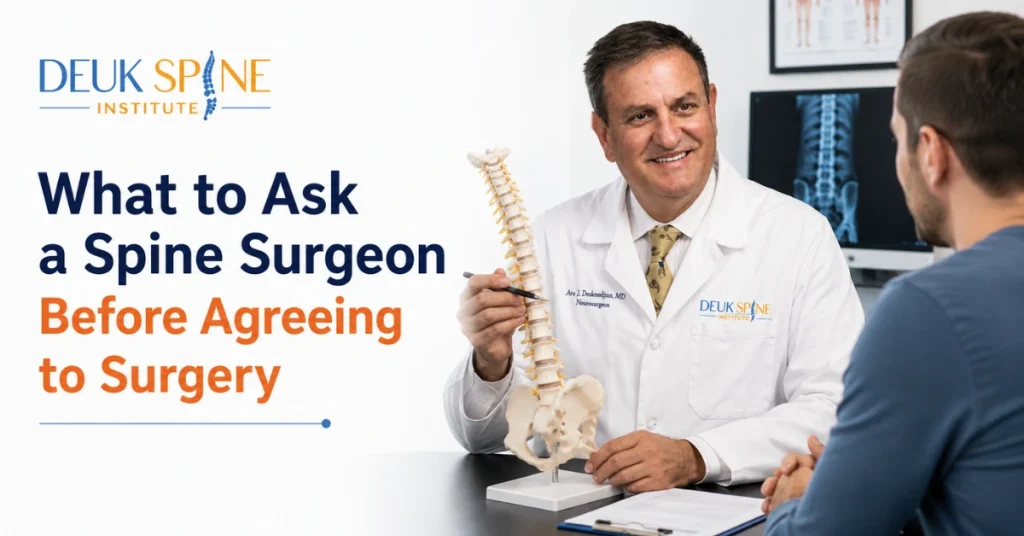
You’ve been told you need spine surgery. Maybe more than one surgeon has told you the same thing, in the same rushed fifteen-minute consultation, without ever asking what your daily pain actually looks like. The questions to ask a spine surgeon before you consent to anything are not complicated, but almost no patient gets a straight answer to them, because almost no patient asks. After over 30 years performing spine surgery, I’ve sat across from thousands of people who assumed a recommendation for surgery meant the surgeon had already done the diagnostic work. Often, that work never happened.
Below are the 12 questions that separate a surgeon who’s identified your actual pain source from one who’s reacting to a single finding on an MRI. Many of these questions exist because patients rarely get shown what Deuk Laser Disc Repair® actually looks like before agreeing to something more generic.

No cost · No obligation
Live Pain Free
Upload your MRI for a free expert review by Dr. Ara Deukmedjian, M.D. — board-certified neurosurgeon. Ten minutes can change your life.
Why Most Patients Never Ask These Questions
Patients research cars, mattresses, and contractors more thoroughly than they research the person about to operate on their spine. Part of that is trust in the white coat. Part of it is that spine surgery consultations move fast, and pain makes people want a fix, not a cross-examination. But a surgical recommendation should survive scrutiny. If it can’t, that’s information too.
1. Are You Board-Certified in Neurological Surgery, Not Orthopedic Surgery?
Both neurosurgeons and orthopedic surgeons perform spine surgery, but their training differs substantially. Neurosurgery residency devotes roughly 70% of case volume to spine, while orthopedic residency spends closer to 10%, with the bulk of training in knees, hips, and shoulders. Neither credential guarantees a good outcome, but the training difference is real and worth asking about directly. You can verify board certification yourself through Certification Matters, the public verification tool maintained by the American Board of Medical Specialties, rather than relying on what’s printed on a business card.
2. How Many of This Specific Procedure Have You Performed?
Total years in practice tells you less than you’d think. What matters is volume in the specific procedure being recommended for you. A surgeon who’s performed a technique twenty times carries a different risk profile than one who’s performed it two thousand times, and that distinction gets lost when the conversation stays general. Ask for the number tied to your exact procedure, not a career total.
3. Do You Have Published Peer-Reviewed Outcomes Data I Can Review?
Marketing claims and published research are not the same thing. A surgeon confident in their outcomes should be able to point you to peer-reviewed literature, not just patient testimonials on a website. If a technique is genuinely new or proprietary, published data demonstrating its safety and effectiveness should exist somewhere you can independently verify, not just take on faith.
4. What Is Your Documented Complication Rate?
This question makes surgeons uncomfortable, which is exactly why it matters. Traditional open spine surgery carries reported complication rates ranging from 5% to 50% depending on the procedure and patient population. A surgeon who can state their own complication rate, and explain how it’s tracked, is operating with a level of transparency that a vague “very safe” answer doesn’t provide.
5. Will You Personally Perform My Surgery, or Will It Be Delegated?
At high-volume surgical centers, it’s common for residents, fellows, or physician assistants to perform significant portions of a procedure under the attending surgeon’s supervision. There’s nothing inherently wrong with that model, but you deserve to know it before you’re on the table, not after. Ask directly who will have their hands on you during the procedure.
6. Is This Procedure Patented and Proprietary, or a Generic Technique Any Center Offers?
Some procedures marketed as advanced or minimally invasive are the same technique performed at dozens of centers under different brand names. Others are genuinely proprietary, developed and refined by a single surgeon or team over years of clinical research. Neither is automatically better, but knowing which one you’re being offered changes how you should evaluate the outcomes data behind it. Not every center advertising laser spine surgery is performing the same procedure, and the differences matter more than the marketing suggests.
7. How Long Is Recovery, and When Can I Return to Work or Activity?
Get a specific, week-by-week answer, not a general range. Recovery timelines vary enormously depending on how much bone, muscle, or ligament tissue is disturbed during the procedure. A surgeon who can walk you through what week one, week four, and week twelve actually look like has done this enough times to know. If you want a detailed example of how that timeline breaks down and where it commonly stalls, our laminectomy recovery timeline walks through it stage by stage.
8. Is Bone Drilling Required? Will Hardware Be Implanted?
This question gets at what the surgery physically does to your spine’s architecture. Removing bone, such as the lamina, or implanting screws, rods, and cages changes the mechanical structure of your spine permanently. Some procedures avoid this entirely by targeting the disc directly rather than the surrounding bone. Ask specifically what gets removed, what gets added, and whether either is reversible.
9. What Happens If the Surgery Doesn’t Work? Do You Offer Any Guarantee?
Spine surgery is not always necessary in the first place. A 2025 Lown Institute analysis of Medicare claims found that hospitals performed more than 200,000 medically unnecessary back surgeries on older adults over a three-year period. That’s part of why this question matters so much: a surgeon confident in their diagnosis and technique will have a clear answer for what happens if the expected relief doesn’t materialize, whether that’s a revision protocol, a surgical guarantee, or simply an honest acknowledgment of the odds. The financial incentives behind unnecessary spine surgery are worth understanding before you consent to anything.
10. Is This an Outpatient Procedure, or Will I Be Hospitalized?
Hospitalization length is a rough proxy for invasiveness. Procedures requiring multiple days of inpatient recovery generally involve more cutting and tissue trauma than same-day outpatient surgery. Ask what determines whether you go home the same day versus staying overnight, and what would change that plan mid-procedure.
11. Can I Review Your Published Clinical Outcomes Before Committing?
This overlaps with question three, and that’s intentional. If a surgeon can’t produce their own outcomes data on request, twice, that’s worth sitting with. Ask for the actual numbers: success rate, complication rate, infection rate, and the sample size behind them. Round, unqualified percentages without a stated sample size are a marketing number, not a clinical one.
12. What Alternatives to This Procedure Exist, and Why Are You Recommending This One?
Every legitimate surgical recommendation should be able to withstand the question “compared to what?” If a surgeon only offers one path forward and can’t walk you through why less invasive alternatives were ruled out, that’s a gap worth pressing on. A second opinion exists for exactly this reason, and no surgeon confident in their diagnosis should discourage you from getting one.
Getting a Second Opinion Before You Commit
None of these 12 questions require you to be adversarial. A surgeon with nothing to hide will answer all of them directly, usually without hesitation. If you leave a consultation with vague answers, deflected numbers, or a sense that the recommendation was made before your MRI was fully reviewed, that’s reason enough to get a second opinion before scheduling anything.
At Deuk Spine Institute, we offer a free MRI review so you can get a specific, no-obligation answer about what your imaging shows and which structure is actually driving your pain, before you commit to any procedure. Start with a no-obligation expert evaluation and bring these same 12 questions with you.
This article is for informational purposes only and does not constitute medical advice. Always consult a qualified spine specialist before making any treatment decisions.

Diagnosis. Answers. Relief.
Submit your MRI for a free expert review by Dr. Ara Deukmedjian, M.D. —
board-certified neurosurgeon. No obligation. Real answers.