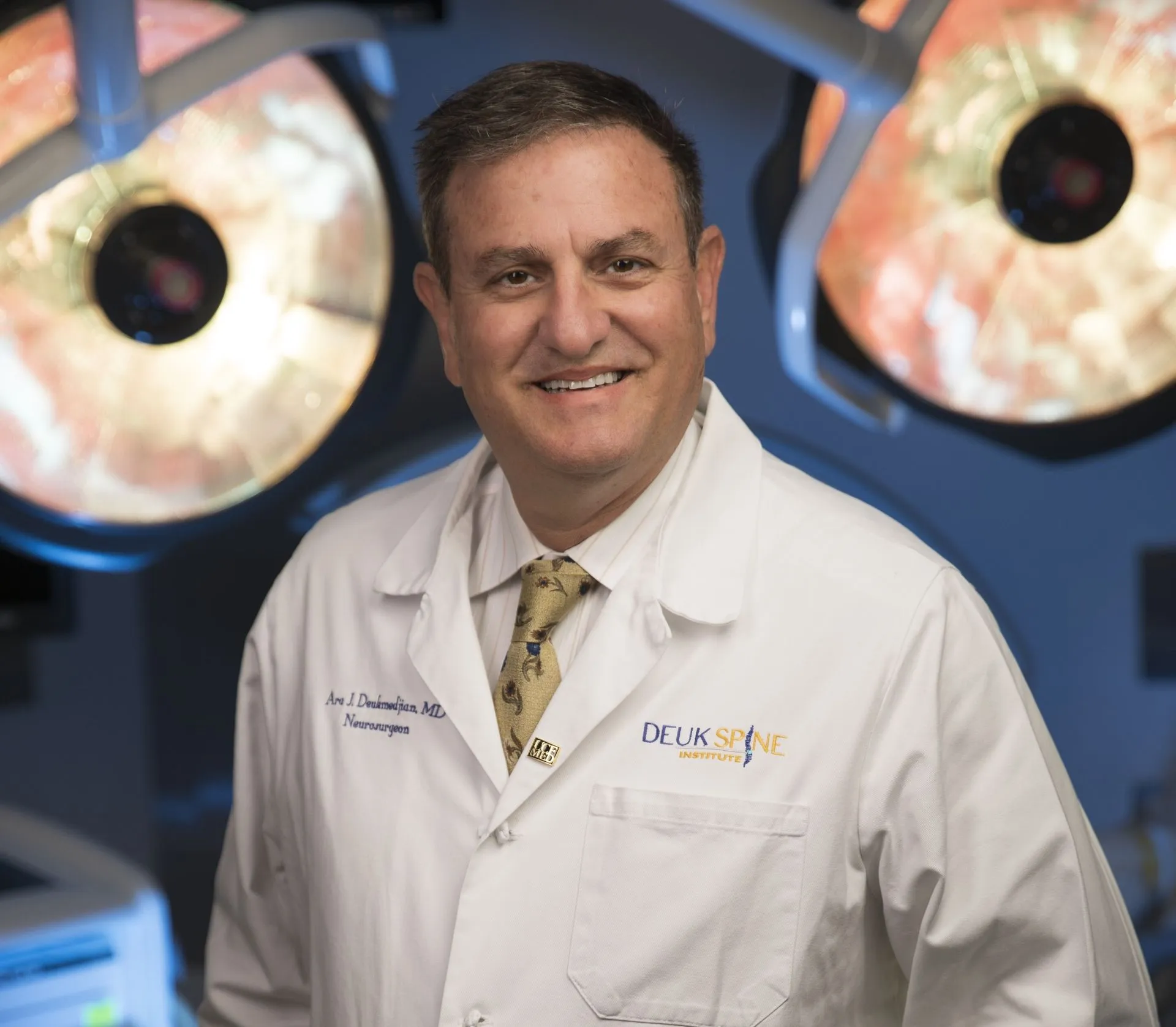
By Dr. Ara Deukmedjian, MD
Board-Certified Neurosurgeon, Deuk Spine Institute
Medically reviewed on January 20, 2026
Medical disclaimer: This content is for educational purposes only and does not constitute medical advice. Individual results may vary. Always consult with your healthcare provider about your specific condition and treatment options.
If you’re researching spine surgery options and have come across advertisements for “laser spine surgery,” you’re likely feeling both hopeful and confused. The truth is, while genuine laser spine surgery exists and can be highly effective, the vast majority of centers advertising this procedure aren’t actually performing true laser-assisted disc repair. This guide will help you understand the difference, identify authentic laser spine surgeons, and make an informed decision about your spinal health.
Key Points
Before diving into the details, here’s what you need to know about finding real laser spine surgeons:
- ✓ Real laser surgery uses lasers INSIDE the disc to vaporize herniations and repair annular tears
- ✓ True incision size is 4-7mm (pencil eraser-sized), not 1-inch or larger
- ✓ Only a handful of surgeons nationwide actually specialize in authentic laser disc repair with published outcomes
- ✓ Board certification matters – Look for neurosurgeons or orthopedic spine surgeons, not pain management specialists
- ✓ Peer-reviewed publications are proof – Search PubMed/Google Scholar for the surgeon’s name with “laser discectomy” or “PLDD”
- ✓ Success rates of 90-95% have been documented when procedures are performed by specialized laser-assisted surgeons on appropriate candidates
- ✓ Endoscopic visualization is essential – The laser must be used through a camera system for precision
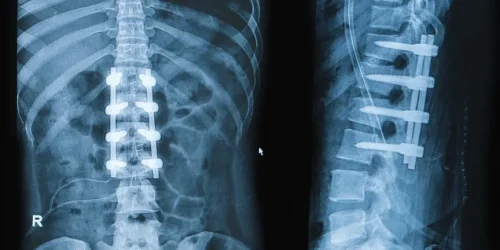
- ✓ No fusion hardware – Authentic laser disc repair preserves spinal motion and avoids screws, rods, and cages
- ✓ Ask specific questions – Vague answers about laser type, technique, or outcomes are red flags
- ✓ Get a second opinion – Especially from surgeons who publish research on their specific techniques
Understanding Authentic Laser Spine Surgery
What True Laser Spine Surgery Actually Is
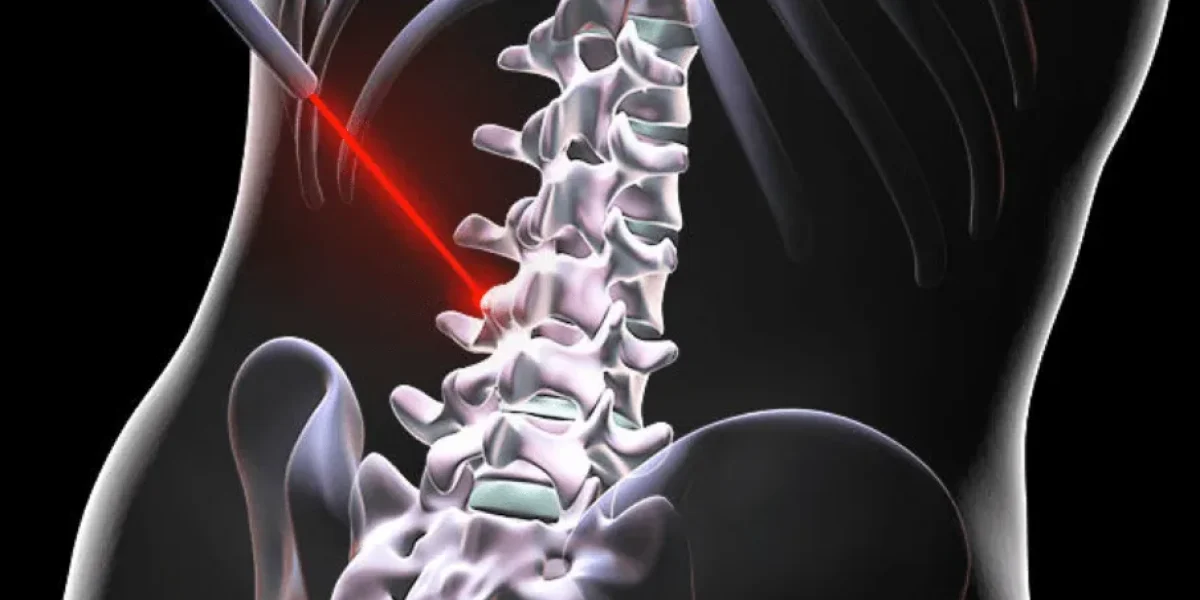
Authentic laser spine surgery uses a surgical-grade laser as the primary tool to repair damaged spinal discs from the inside. The laser works endoscopically, through a tiny incision typically 4-7mm (about the size of a pencil eraser), to vaporize herniated disc material and debride the painful annular tear that causes chronic back and neck pain.
During genuine laser disc repair, surgeons use specialized lasers, such as the Holmium:YAG laser, which can precisely ablate soft tissue with minimal heat penetration to surrounding structures.1 The laser energy vaporizes a controlled amount of nucleus pulposus tissue, reducing intradiscal pressure and allowing the herniation to retreat from compressed nerve roots.
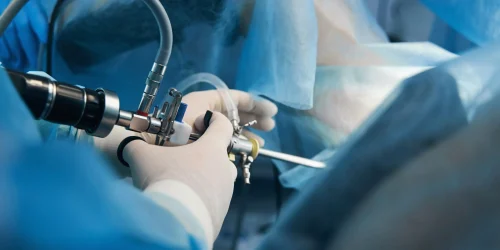
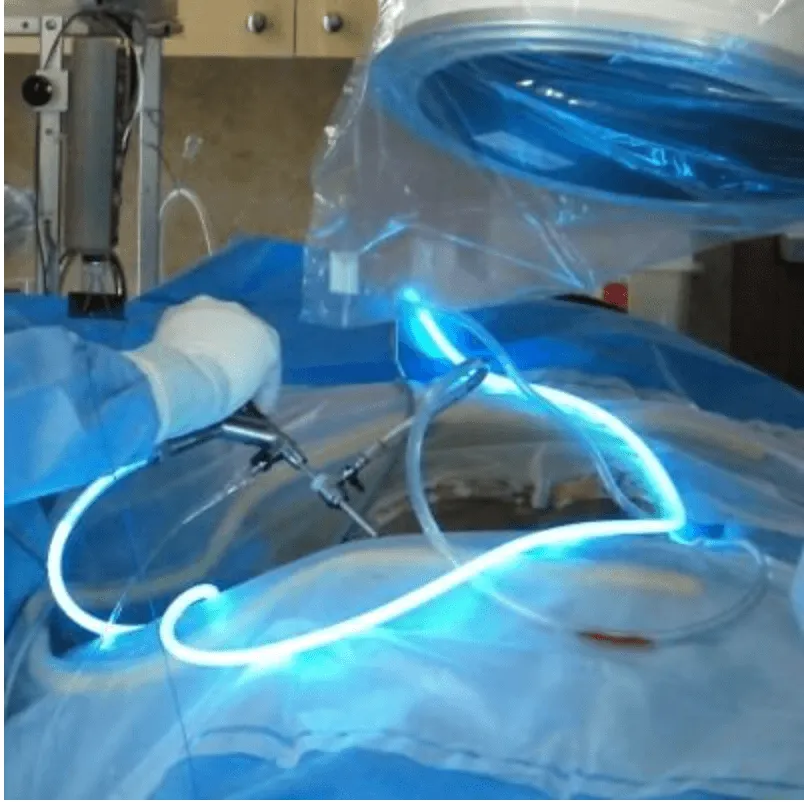
The procedure is performed through an endoscope, a tiny camera that allows the surgeon to see exactly what they’re doing inside the spinal canal. This combination of laser technology with endoscopic visualization is what separates authentic laser spine surgery from marketing claims.
The Two Main Types of Authentic Laser Procedures
1. Percutaneous Laser Disc Decompression (PLDD)
PLDD has been FDA-approved since 1991 and uses a needle-based approach, delivering laser energy directly into the disc to create a decompression effect.3 Studies have shown PLDD can provide effective pain relief for properly selected patients with contained disc herniations.4
A systematic review found that PLDD reduced pain and improved function in patients with lumbar disc herniation, with recent studies showing approximately a 30% reduction in pain scores at 6-month follow-up.5 However, research also indicates PLDD works best for contained herniations and may require secondary surgery in some cases.
2. Endoscopic Laser Disc Repair
This advanced technique, pioneered by surgeons like Dr. Ara Deukmedjian, combines full endoscopic visualization with laser ablation to not only decompress the disc but also debride the annular tear—the source of discogenic pain. The Deuk Laser Disc Repair procedure has been published in peer-reviewed journals, showing a 94.6% success rate in treating cervical disc disease with no perioperative complications in a prospective study of 66 patients.6 Current findings (to be published soon) show a 99.6% success rate at eliminating pain.
The Marketing Problem: How “Laser Surgery” Gets Misrepresented
The Uncomfortable Truth About Most “Laser Spine Centers”
Many facilities that advertise laser spine surgery use the term as a marketing tool rather than an accurate description of their surgical technique. Here’s what often happens instead:
The Laser is Only Used for the Skin Incision
In many cases, surgeons use a laser like a LightScapel to make the initial skin cut, then perform standard open or minimally invasive surgery using traditional mechanical tools. The laser plays no role in the actual disc repair.
“Minimally Invasive” Doesn’t Mean “Laser”
Centers may advertise “minimally invasive laser surgery” when they’re actually performing microdiscectomy or other standard procedures through small incisions. While these can be legitimate minimally invasive techniques, they don’t involve using a laser to repair the disc itself.
Combining Standard Fusions with “Laser” Claims
Some surgeons perform traditional spinal fusions with hardware (screws, rods, cages) but claim it’s “laser surgery” because they used a laser for a minor aspect of the procedure, such as tissue cauterization.
Red Flags to Watch For
When researching potential surgeons, be cautious if you encounter:
- Incision size of one inch or larger – True laser disc procedures use incisions of 4-7mm
- No published research – Authentic specialists publish their techniques and outcomes in peer-reviewed journals
- Pain management specialists performing “surgery” – Laser-assisted disc repair requires board-certified neurosurgeons or orthopedic spine surgeons, not interventional pain specialists7
- Guaranteed fusion avoidance claims – If they’re still recommending fusion or hardware, the laser isn’t serving its intended purpose
- Vague descriptions of laser use – Authentic laser spine surgeons will clearly explain exactly how the laser is used inside the disc
Finding Genuine Laser Spine Surgeons
What to Look For
Finding a surgeon who actually performs true laser spine surgery requires careful research. Here are the key markers:
1. Peer-Reviewed Publications
Authentic laser spine surgeons publish their techniques and outcomes in medical journals. Search PubMed or Google Scholar for the surgeon’s name alongside terms like “laser discectomy,” “PLDD,” “endoscopic laser,” or “Holmium YAG laser spine.”
For example, Dr. Ara Deukmedjian has published multiple studies in Surgical Neurology International specifically documenting the safety and efficacy of his laser disc repair technique.6
2. Board Certification
Verify the surgeon is board-certified in either:
- Neurological Surgery (neurosurgeon)
- Orthopedic Surgery with spine fellowship training
Pain management specialists, interventional radiologists, and physiatrists may perform PLDD, but comprehensive laser disc repair requires surgical training.
3. Specialized Equipment
True laser spine surgery requires:
- Surgical-grade lasers (Holmium:YAG or similar)
- Full endoscopic visualization systems
- Specialized training in endoscopic techniques
The surgeon should be able to clearly explain what type of laser they use and how it’s integrated into the procedure.
4. Technical Specificity
When you consult with a surgeon, they should be able to explain:
- The exact laser wavelength and type (e.g., Holmium:YAG)
- Whether the laser is used inside the disc or just on the skin
- The specific disc pathology the laser addresses (herniation, annular tear, etc.)
- Their success rates and complication rates have been published to support claims

The Elite Few: Surgeons Who Actually Perform Laser Spine Surgery
Based on published medical literature, documented expertise, and verifiable surgical techniques, here are surgeons who perform authentic laser spine surgery where the laser serves as the primary repair tool:
Dr. Ara Deukmedjian, MD (Deuk Spine Institute, Florida)
Dr. Deukmedjian is a board-certified neurosurgeon who developed the proprietary Deuk Laser Disc Repair® technique.8 He completed his neurosurgical training at the University of Florida’s top-ranked program under renowned neurosurgeon Dr. Albert Rhoton and graduated from USC School of Medicine with “Highest Distinction” as the top-ranked student in his class.
He has published multiple peer-reviewed studies in Surgical Neurology International documenting his specific laser-assisted endoscopic approach, showing a 94.6-95% success rate in eliminating pain with no major complications across thousands of procedures.9 Upcoming publications are expected to demonstrate even higher success rates approaching 99.6%.
His technique uses a Holmium:YAG laser endoscopically to vaporize disc herniations and debride annular tears, addressing the root cause of discogenic pain rather than simply removing the herniation. Dr. Deukmedjian has performed over 2,700 DLDR® procedures to date.
Dr. Anthony T. Yeung, MD (Desert Institute for Spine Care, Arizona)
Dr. Anthony Yeung is a retired board-certified orthopedic surgeon who pioneered the Yeung Endoscopic Spine System (YESS™), one of the foundational techniques in endoscopic spine surgery.10 His YESS™ method established the technical approach for visualizing spinal joints and placing instruments through minimal access points.
The YESS™ technique specifically incorporates the use of a Holmium:YAG laser alongside other microsurgical tools for selective endoscopic discectomy and thermal annuloplasty. Dr. Yeung has authored several publications on endoscopic spine surgery techniques and trained numerous surgeons worldwide in these advanced methods.
While Dr. Yeung has retired from active practice, the YESS™ method continues to be performed at the Desert Institute for Spine Care in Arizona by surgeons he trained.11
Dr. Tony Mork, MD (California and Florida)
Dr. Tony Mork is a spine surgeon with practices in both California and Florida who transitioned from sports medicine to advanced minimally invasive spine surgery.12 With thousands of minimally invasive procedures performed, he has extensive experience with endoscopic techniques.
While Dr. Mork does incorporate laser technology into his practice, his approach differs from pure laser disc repair. His website indicates he primarily uses lasers for rhizotomy procedures (nerve ablation for pain relief) and has developed alternative endoscopic techniques for discectomies that don’t rely primarily on laser ablation. This represents a hybrid approach rather than laser-primary disc repair.
Dr. Jonathan Hall, MD (Florida Surgery Consultants)
Dr. Jonathan Hall is a board-certified neurosurgeon who specializes in Percutaneous Laser Disc Decompression (PLDD), one of the original FDA-approved laser spine procedures.13
PLDD represents a needle-based laser approach where laser energy is delivered directly into the disc nucleus to create a decompression effect without requiring endoscopic visualization. This technique has decades of international research supporting its use for contained disc herniations.14,15
Dr. Hall’s practice of traditional PLDD differs from full endoscopic laser disc repair but represents one of the authentic applications of laser technology for disc treatment rather than marketing-based “laser” claims.
Dr. Scott Katzman, MD (Orthopedic and Laser Spine Surgery, Multiple US Locations)
Dr. Scott Katzman is a board-certified orthopedic surgeon practicing at Orthopedic and Laser Spine Surgery centers with multiple locations across the United States.16 He has been performing minimally invasive spine procedures since 1996.
Dr. Katzman uses laser-assisted techniques for outpatient endoscopic discectomies and has been involved in efforts to move spine surgery out of hospital settings into specialized outpatient centers equipped with advanced laser technology. His approach focuses on same-day discharge procedures that avoid fusion when possible.
Important Context: Technique Variations Matter
It’s important to understand that even among these legitimate practitioners, techniques vary significantly:
- Full endoscopic laser disc repair (like Deuk Laser Disc Repair®) uses the laser as the primary tool for both removing herniations and debriding annular tears under direct endoscopic visualization
- PLDD (Percutaneous Laser Disc Decompression) uses needle-based laser delivery without endoscopic cameras, relying on fluoroscopic guidance
- Laser-assisted endoscopic surgery incorporates lasers alongside mechanical tools rather than using the laser as the primary instrument
- Laser rhizotomy/ablation uses lasers to treat nerve pain rather than to repair disc pathology
When consulting with any of these surgeons, ask specifically which technique they use and whether it’s appropriate for your particular disc pathology. The fact that a surgeon uses lasers doesn’t automatically mean their approach is right for your case.
Why So Few Surgeons Offer True Laser Surgery
The scarcity of authentic laser spine surgeons isn’t accidental. Several factors limit its availability:
Training and Equipment Costs
Surgical-grade lasers are expensive, and mastering endoscopic laser techniques requires years of specialized training beyond a standard spine surgery fellowship. Most surgeons trained in traditional open surgery aren’t equipped to perform these advanced procedures.
Insurance Resistance
Major insurance companies often label laser spine procedures as “investigational” or “experimental,” despite FDA approval for PLDD since 1991. This forces many specialized surgeons to operate outside traditional insurance networks.17
Academic Conservatism
Large academic medical centers have been slow to adopt laser techniques. A 2015 randomized controlled trial found PLDD to be non-inferior to conventional surgery but noted the higher reoperation rate has made many institutions hesitant.18
However, critics of these studies point out that older PLDD techniques used blind needle placement, while modern laser spine surgery uses direct endoscopic visualization, a critical difference in precision and outcomes.
Understanding the Academic Debate
What Critics Say
It’s important to understand that laser spine surgery has faced legitimate criticism in medical literature:
The Brouwer Trial (2015)
This landmark randomized controlled trial comparing PLDD to conventional microdiscectomy found that while disability scores were similar at one year, PLDD patients experienced slower recovery and higher reoperation rates; 38% for PLDD versus 16% for conventional surgery.18
The study concluded that PLDD, followed by surgery if needed, resulted in “non-inferior” outcomes but slower initial improvement.
Systematic Reviews
Multiple systematic reviews have concluded there is “limited evidence” to support laser discectomy, citing a lack of large-scale randomized controlled trials.19
A 2016 editorial in Surgical Neurology International questioned whether pain management specialists should perform these procedures at all, noting success rates of only 60-70% compared to 90% for conventional microdiscectomy.7
Thermal Injury Concerns
Critics cite the theoretical risk of heat damage to nerves and vertebral endplates from laser energy. However, modern techniques use continuous irrigation and precise laser settings to minimize thermal spread.20
The Context Behind the Criticism
Proponents of advanced laser techniques argue these criticisms don’t apply to all laser procedures equally:
Technique Differences Matter
The Brouwer study examined blind needle-based PLDD without endoscopic visualization. Modern full-endoscopic laser disc repair with direct visualization represents a significant technical advancement.
Patient Selection is Critical
Studies showing poor outcomes often included patients with large, extruded herniations, cases not appropriate for percutaneous laser approaches. When properly selected for contained herniations, outcomes improve significantly.4
Experience and Specialization
Research indicates that outcomes vary dramatically based on surgeon experience and specialization in endoscopic techniques. Surgeons performing these procedures occasionally have worse results than those who specialize exclusively in laser spine surgery.21
Questions to Ask During Your Consultation
When meeting with a surgeon who claims to perform laser spine surgery, come prepared with these specific questions:
About the Procedure
- Will you use the laser inside my disc, or just to make the incision?
- The laser must be used for internal disc repair, not just skin cutting.
- What type of laser do you use, and what is its wavelength?
- Look for specific answers like “Holmium:YAG” or “Nd:YAG,” not vague “medical-grade laser” responses.
- “Will you be working through an endoscope with direct visualization?
- Authentic procedures use endoscopic cameras for precision.
- What is the expected incision size?
- True laser disc procedures use 4-7mm incisions, not 1-inch or larger.
- “Will I need any hardware, screws, or fusion as part of this procedure?
- Real laser disc repair preserves motion and avoids fusion.
About Experience and Outcomes
- How many of these specific procedures have you performed?
- Look for surgeons with hundreds or thousands of cases.
- What are your complication rates, and can you provide published data?
- Legitimate specialists have documented outcomes in medical journals.
- What is your success rate for pain relief at one year?
- Published studies show success rates of 80-95% for properly performed procedures.
- Have you published research on your technique?
- Peer-reviewed publications demonstrate expertise and accountability.
About Your Specific Case
- Am I a good candidate for laser surgery, or would conventional surgery be better?
- Honest surgeons will acknowledge when traditional surgery is more appropriate.
If the surgeon becomes defensive, vague, or cannot answer these questions with specifics, that’s a significant red flag.
Why This Matters for Your Health
The distinction between authentic laser spine surgery and marketing-driven procedures isn’t just academic; it directly impacts your outcomes and recovery.
Benefits of True Laser Disc Repair
When performed by qualified specialists on appropriate candidates:
- Outpatient procedure with same-day discharge
- Minimal tissue trauma (4-7mm incision)
- Preservation of spinal motion and disc integrity
- Rapid recovery (often walking within hours)
- Low complication rates in published studies
- No need for fusion hardware
- Treatment of the pain source (annular tear), not just the herniation
Research has documented these advantages in peer-reviewed medical journals.
Risks of Choosing a “Laser” Center That Isn’t Authentic
- Undergoing standard surgery while paying premium “laser” prices
- Missing out on genuinely minimally invasive options
- Potential complications from open surgery disguised as laser surgery
- Failed treatment requiring revision surgery
The defunct Laser Spine Institute, which declared bankruptcy in 2019 after paying out nearly half a billion dollars in lawsuit settlements, exemplifies the dangers of laser marketing without surgical substance.11
Getting a Second Opinion from Dr. Ara Deukmedjian
Before committing to any spine surgery, marketed as “laser” or traditional, getting a second opinion from a specialist in advanced minimally invasive techniques is crucial.
Dr. Ara Deukmedjian offers a free virtual consultation and MRI review for patients considering spine surgery. During this consultation:
- Dr. Ara Deukmedjian personally reviews your MRI images
- You perform movement tests via video to help with diagnosis
- He provides an honest assessment of whether you’re a candidate for laser disc repair
- He’ll recommend his technique, other approaches, or even conservative pain management if surgery isn’t necessary
This consultation provides a valuable perspective from a surgeon who has published peer-reviewed research on his specific laser technique and has performed thousands of these procedures with documented outcomes.
Get your free MRI review: https://deukspine.com/free-mri-review/
Making Your Decision
Choosing a spine surgeon is one of the most important healthcare decisions you’ll make. When it comes to laser spine surgery, knowledge truly is power.
Your Action Plan:
- Research thoroughly – Use PubMed and Google Scholar to verify surgeon credentials and published research
- Ask the hard questions – Use the question list above during consultations
- Verify board certification – Confirm neurosurgery or orthopedic surgery credentials
- Check for red flags – Watch for vague answers, marketing-heavy language, or defensive responses
- Get multiple opinions – Consult with both traditional and advanced minimally invasive specialists
- Review actual studies – Don’t rely solely on center websites, read the published research
Remember: the goal isn’t to avoid all surgery or to seek out laser surgery at any cost. The goal is to find the most appropriate, effective treatment for your specific condition from a qualified specialist who uses proven techniques backed by published research.
If true laser spine surgery is right for your case, finding one of the few surgeons who actually perform it, rather than just market it, could mean the difference between ongoing pain and genuine relief.
Sources
1: https://www.spine.org/Portals/0/Documents/KnowYourBack/LaserSurgery.pdf
2: https://pmc.ncbi.nlm.nih.gov/articles/PMC7976096/
3: https://pubmed.ncbi.nlm.nih.gov/25614151/
4: https://www.mdpi.com/2077-0383/14/12/4235
5: https://pmc.ncbi.nlm.nih.gov/articles/PMC12128808/
6: https://pubmed.ncbi.nlm.nih.gov/23776754/
7: https://pubmed.ncbi.nlm.nih.gov/28144489/
8: https://deukspine.com/physician/dr-deuk/
9: https://pmc.ncbi.nlm.nih.gov/articles/PMC3515925/
10: https://www.sciatica.com/our-team/anthony-t-yeung-m-d/
13: https://floridasurgeryconsultants.com/procedures/neurosurgeons/pldd/
14: https://pubmed.ncbi.nlm.nih.gov/10204439/
15: https://pmc.ncbi.nlm.nih.gov/articles/PMC7976096/
16: https://www.orthopedicandlaserspinesurgery.com/doctors/dr-scott-katzman/
17: https://deukspine.com/blog/laser-spine-institute-review/
18: https://pubmed.ncbi.nlm.nih.gov/25614151/
19: https://www.sciencedirect.com/science/article/abs/pii/S2173578623000732
20: https://deukspine.com/blog/minimally-invasive-spine-surgeons/
21: https://pmc.ncbi.nlm.nih.gov/articles/PMC7736942/
22: https://deukspine.com/blog/history-ultra-minimally-invasive-endoscopic-spine-surgery/
Frequently Asked Questions
-
How can I tell if a surgeon actually does laser spine surgery?
Look for three key indicators: First, check if they've published peer-reviewed research specifically on laser techniques (search PubMed for their name with 'laser discectomy' or 'PLDD'). Second, verify they use 4-7mm incisions, not 1-inch or larger cuts. Third, ask if the laser is used inside the disc or just on the skin. Real laser surgery vaporizes disc material internally through an endoscope.
-
What’s the difference between real and fake laser spine surgery?
Real laser spine surgery uses a surgical-grade laser (like Holmium:YAG) as the primary tool to vaporize herniated disc tissue and repair annular tears from inside the spinal canal. Fake 'laser' surgery uses the laser only to cut skin or cauterize tissue, then performs standard open surgery with traditional tools. The laser plays no role in the actual disc repair in marketing-based procedures.
-
How much does real laser spine surgery cost?
Costs vary significantly, but authentic laser disc repair typically ranges from $15,000 to $40,000 per level. Many insurance companies label these procedures as 'investigational,' despite FDA approval for PLDD since 1991, which means genuine laser specialists often operate out of network. Always verify what's included in the quoted price and whether insurance pre-authorization is possible.
-
Is laser spine surgery FDA-approved?
Yes, Percutaneous Laser Disc Decompression (PLDD) received FDA approval in 1991. The Holmium:YAG and Nd:YAG lasers used in these procedures are FDA-cleared medical devices. However, specific techniques like the Deuk Laser Disc Repair represent advanced applications of this approved technology, and individual surgeon techniques may vary in their evidence base.
-
What is the success rate of laser disc repair?
Published studies show success rates of 90-95% for pain elimination when performed by specialized surgeons on properly selected patients. Dr. Deukmedjian's peer-reviewed research documented a 94.6% success rate with no major complications across multiple studies. However, success depends heavily on patient selection, surgeon experience, and whether you're seeing a true specialist versus a marketing-based center.
-
Why don’t most surgeons offer laser spine surgery?
Several factors limit availability: First, surgical-grade lasers are expensive and require specialized training beyond a standard spine fellowship. Second, major academic medical centers have been slow to adopt the technique due to conservative approaches and reliance on older studies. Third, insurance resistance forces many specialists to operate outside traditional networks. Finally, mastering endoscopic laser techniques requires years of dedicated practice that most traditionally-trained spine surgeons haven't pursued.
-
Can laser spine surgery fix all types of disc problems?
No. Laser disc repair works best for contained disc herniations and annular tears. It's not appropriate for large extruded herniations, severe spinal stenosis, spondylolisthesis requiring fusion, or cases with significant bone compression. Honest surgeons will tell you when traditional surgery is more appropriate for your specific condition.
-
What questions should I ask during a consultation?
Ask these specific questions: 'Will you use the laser inside my disc or just on the skin?' 'What type of laser do you use and what's its wavelength?' 'What's the expected incision size?' 'Will I need fusion hardware?' 'How many of these specific procedures have you performed?' 'What are your published complication rates?' Vague or defensive responses are red flags.
-
How long is the recovery from real laser spine surgery?
Most patients undergoing authentic endoscopic laser disc repair walk within hours of the procedure and go home the same day. Many return to light activities within 1-2 weeks and full activities within 4-6 weeks. This is significantly faster than traditional open surgery, which typically requires hospital stays and 6-12 weeks of recovery.
-
Are there risks unique to laser spine surgery?
The main theoretical risk is thermal injury to nerves from laser heat. However, modern techniques use continuous irrigation and precise laser settings to minimize thermal spread. Studies show complication rates comparable to or lower than conventional surgery when performed by experienced specialists. The Brouwer trial (2015) found higher reoperation rates for older PLDD techniques, but modern endoscopic approaches with direct visualization have addressed this concern.