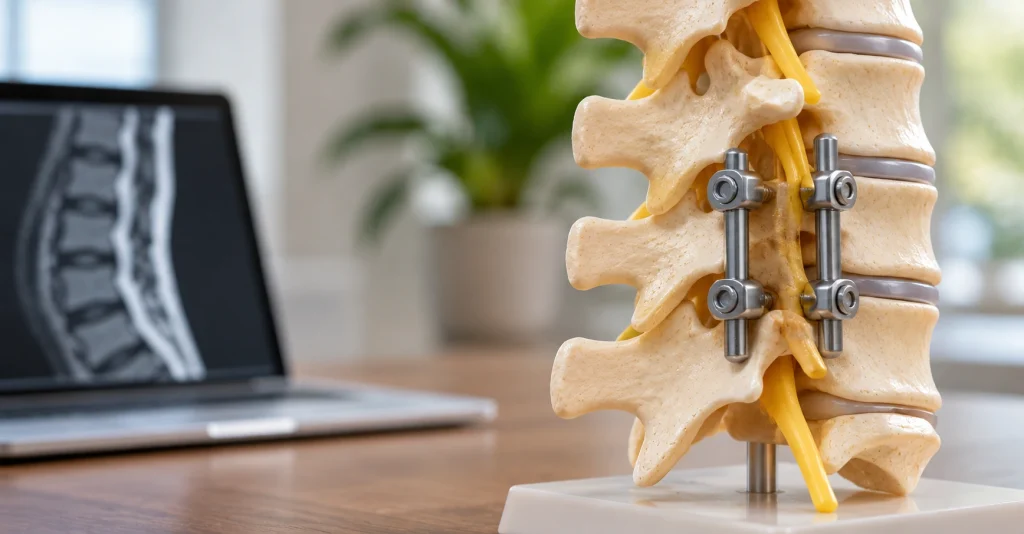
A laminectomy with fusion is two operations done in one sitting. The laminectomy removes part of the bony roof of the spinal canal to take pressure off compressed nerves, and the fusion joins the vertebrae at that level so the segment no longer moves. A surgeon adds the fusion when the segment is unstable before surgery, or when the amount of bone removed would leave it unstable afterward.
Those two reasons are not the same situation. In the first, the fusion treats a problem your spine already has, while in the second it compensates for the decompression, and how much bone comes out is part of the surgical plan rather than a fixed fact. Below, we cover how to tell which reason applies to you, the questions worth asking, what the fusion changes now and ten years from now, and when decompression alone may be enough.
If you have been offered both operations and want to understand why, a Free MRI Review gives you a specialist’s read of what your imaging does and does not show before you consent. Here is how the combination works and what to ask along the way.
No cost · No obligation
Live Pain Free
Upload your MRI for a free expert review by Dr. Ara Deukmedjian, M.D. — board-certified neurosurgeon. Ten minutes can change your life.
What Does a Laminectomy With Fusion Involve?
A laminectomy with fusion combines a decompression and a stabilization at the same spinal level, usually through one incision in the back. The laminectomy comes first, and the fusion is built once the nerves are free.
In the laminectomy, the surgeon removes the lamina, the thin plate of bone that forms the back of the spinal canal, along with thickened ligament and bone spurs. This widens the canal for nerves pinched by spinal stenosis, which typically causes aching, heaviness, numbness, or tingling in the buttocks and legs when you stand or walk.
In the fusion, the surgeon places bone graft so the vertebrae grow into a single solid segment. A spinal laminectomy and fusion usually includes:
- Pedicle screws and rods that hold the vertebrae still while the bone heals
- Bone graft from your own bone, donor bone, or a graft substitute
- Sometimes an interbody cage placed in the disc space to restore height
The decompression half is explained step by step in our guide to laminectomy surgery.
Why Does a Fusion Get Added to a Decompression?
A fusion is added to a decompression for one reason: instability, meaning a segment that moves more than it should. Decompression alone frees the nerves but does nothing to hold a loose segment still.
That instability can come from two places. It can be present before surgery because of the condition itself, or it can be created by the surgery because of how much bone and joint has to come out to free the nerves.
Both are legitimate reasons, but they are different situations with different questions attached. The next two sections take them one at a time, and the stabilization itself is covered in more depth on our spinal fusion surgery page.
When Does Instability Already Exist Before Surgery?
Instability exists before surgery when a vertebra already slips or shifts abnormally as you move. In that case, the fusion treats a problem you already have, and it is appropriate on its own merits.
The most common example is degenerative spondylolisthesis, where one vertebra slides forward over the one below it, often at L4-L5. Many people researching a laminectomy and fusion at L4-L5 have exactly this combination: stenosis and a slip at the same level.
Other situations that can mean instability is present before surgery include:
- A slip that visibly moves when you bend forward and back
- Scoliosis or another deformity that is progressing
- A fracture that has left a segment unable to hold its position
- A level that was operated on before and has since loosened
The key word is moving. A slip that appears on an MRI is not the same as a slip that shifts, which is why standing flexion and extension X-rays matter. Our guide to how spondylolisthesis is diagnosed explains how that motion is measured.
When Does the Decompression Itself Create the Instability?
The decompression creates instability when enough bone, facet joint, or ligament is removed that the segment can no longer hold itself steady. Here the fusion is added to compensate for the first operation, not because the original problem required it.
The lamina is only part of what holds a segment together. The facet joints, small paired joints at the back of each vertebra, carry load and limit twisting, and removing a large share of them to free a nerve can leave the level loose.
Put simply, the more bone and facet joint that comes out, the more support the segment loses. That makes the extent of the decompression one of the most important details in the whole plan.
Sometimes a wide decompression is unavoidable. Severe narrowing, nerves trapped in the side channels of the spine, or scar tissue from earlier surgery can leave no safe way to free the nerves without removing more.
So the fair question to put to your surgeon is this: is the fusion for instability that exists now, or instability the decompression will create? Either answer can be reasonable, and knowing which one applies tells you what you are agreeing to.
What Should You Ask Before Consenting to Both?
Before consenting to a laminectomy with fusion, ask questions that confirm the diagnosis behind each half of the plan. These are diagnostic questions, not challenges, and a clear answer to each one helps you understand what you are agreeing to.
- How much bone and facet joint are you removing, and at which levels?
- Is the segment unstable now, and which test shows it?
- If you removed less bone, would the fusion still be needed?
- What is the fusion meant to fix that the decompression alone would not?
- Which of my symptoms is this expected to help: leg, back, or both?
- How was my pain source confirmed beyond the MRI?
Write the answers down. If the reasoning still feels unclear, a second opinion on the same imaging is a reasonable step before a permanent operation.
How Does Adding a Fusion Change Recovery?
Recovery from a laminectomy with fusion follows the fusion timeline, measured in months rather than weeks, because the vertebrae have to grow together. A laminectomy alone mainly asks soft tissue to heal, while a fusion asks bone to heal as well.
Compared with decompression alone, adding a fusion usually means:
- A longer hospital stay
- Limits on bending, lifting, and twisting while the fusion heals
- Follow-up X-rays to check that the bone is joining
- A more gradual return to work and exercise
The added operation also adds risk. In a study of more than 32,000 Medicare patients who had surgery for lumbar spinal stenosis in 2007, both simple and complex fusion were associated with higher rates of major complications, 30-day mortality, and resource use than decompression alone.
That is a trade worth making when a segment is unstable. It is also a trade worth confirming before you make it.
What Does a Fusion Change Ten Years Out?
A fusion permanently removes motion at the fused level, and that change carries forward for the rest of your life. A decompression alone leaves the segment’s motion in place.
When one level stops moving, the levels above and below take on more of the bending and load. Over years, that added stress can contribute to adjacent segment disease, where neighboring discs and joints wear faster and sometimes need surgery of their own.
Long-term considerations after a fusion include:
- Motion at the fused level does not return
- Neighboring levels carry more stress
- Screws and rods stay in place and can occasionally loosen or need revision
- A fusion that does not fully heal can leave ongoing pain
These trade-offs come with every fusion, whatever the reason for it. That is why the reason deserves a clear answer before surgery.
When Is Decompression Alone Enough?
Decompression alone is often enough when the segment is stable before surgery and the nerves can be freed without removing much bone or facet joint. In that case, there is no instability to treat and none created.
This is most common in spinal stenosis that causes leg symptoms, where standing X-rays show no abnormal motion. Surgeons can often use more limited techniques, such as removing bone on one side or opening a smaller window in the lamina, to free the nerves while leaving more of the supporting structure in place.
Some patients with a mild slip also do well with decompression alone, while others later need a fusion. Ask your surgeon which group your imaging puts you in, and why.
What If the Pain Source Was Never Confirmed?
If the source of your pain was never confirmed, neither half of the operation can be counted on to relieve it. Imaging shows anatomy, but it does not show which structure is producing your pain.
Narrowing and slips are common on MRIs of people with no symptoms at all. A plan built on what the scan shows, rather than on a confirmed match between your symptoms, your exam, and your imaging, risks treating the wrong thing.
Pay attention to which symptom bothers you most. Spinal stenosis typically produces leg symptoms with standing and walking, so if your main complaint is back pain, ask which structure the surgery is expected to address.
Sometimes the confirmed source turns out to be a damaged disc. Deuk Laser Disc Repair® (DLDR®) is a disc procedure that may be worth discussing in that case.
DLDR® does not treat stenosis that requires bony decompression, and it does not stabilize an unstable segment. When either of those problems is present, it is not a substitute for a laminectomy with fusion.
Bottom Line
A laminectomy with fusion pairs a decompression with a stabilization, and the fusion is there to handle instability. Sometimes that instability is already present, as with a slip that moves, and the fusion is appropriate on its own merits.
Other times, the instability would be created by the decompression itself. Either way, the question worth asking is which one applies to you, and whether your pain source has been confirmed before you consent to a laminectomy and fusion.

Diagnosis. Answers. Relief.
Submit your MRI for a free expert review by Dr. Ara Deukmedjian, M.D. —
board-certified neurosurgeon. No obligation. Real answers.
Frequently Asked Questions
Is a Laminectomy With Fusion a Major Surgery?
Yes, a laminectomy with fusion is a major surgery. It is usually performed under general anesthesia, involves a hospital stay, and adds bone healing and hardware to the decompression. Recovery is measured in months rather than weeks.
What Is the Recovery Time for a Laminectomy With Fusion?
The recovery time for a laminectomy with fusion is measured in months, because the vertebrae need time to grow together. Most patients follow a staged plan, with early walking and limits on bending and lifting, then a gradual return to normal activity. Your surgeon sets your timeline based on the levels treated, your health, and how the fusion is healing.
Can You Have a Laminectomy Without a Fusion?
Yes, you can have a laminectomy without a fusion, and many patients with spinal stenosis do. A fusion is generally added only when the segment is unstable before surgery or when the decompression would remove enough bone to destabilize it. Standing flexion and extension X-rays help show which applies.
How Successful Is a Laminectomy With Fusion?
How successful a laminectomy with fusion is depends mostly on whether the problems it treats are the ones causing your pain. When stenosis is confirmed as the source of leg symptoms and instability is confirmed at the same level, the operation is aimed at the right target. When the pain source is uncertain, ask what the surgery is expected to improve before you agree to it.
What Can You Never Do Again After Spinal Fusion?
What you can never do again after spinal fusion is move the fused level, since that motion is permanently gone. Most people return to daily activities, walking, and many forms of exercise once the fusion heals, though some surgeons advise limiting high-impact activity or heavy lifting. Ask your surgeon which limits apply to your fusion and for how long.
Can DLDR® Replace a Laminectomy With Fusion?
DLDR® cannot replace a laminectomy with fusion when stenosis needs bony decompression or a segment is unstable. DLDR® is a disc procedure, so it does not remove bone to widen the canal and it does not stabilize a segment. It may be worth discussing when a damaged disc is the confirmed source of pain.
Medical disclaimer: The information in this article is educational and is not a substitute for personalized medical advice, diagnosis, or treatment. Always consult your surgeon or a qualified healthcare provider about your symptoms and treatment options.