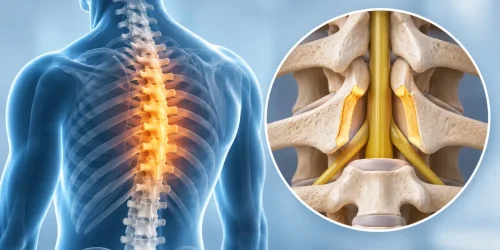
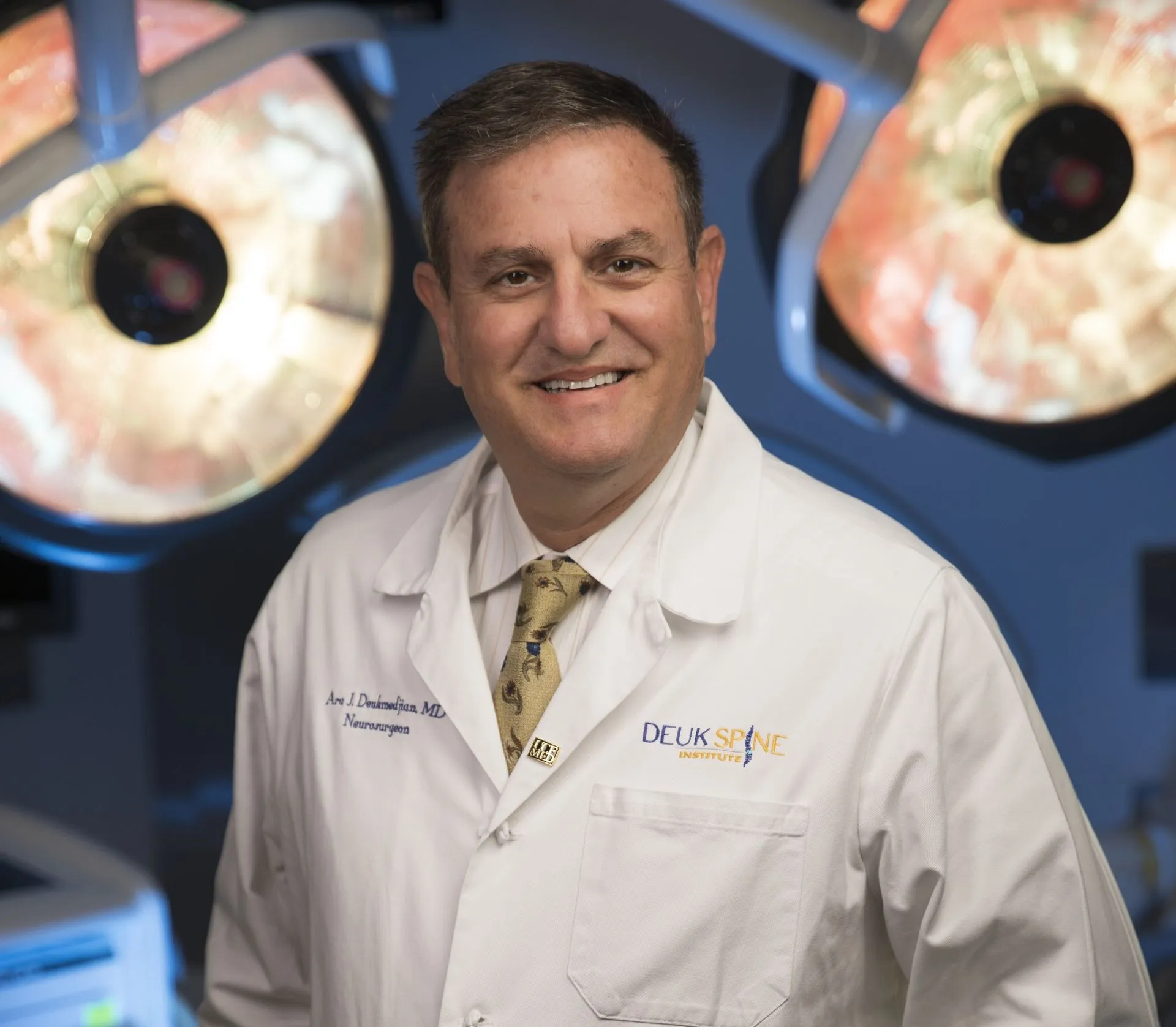

By Dr. Ara J. Deukmedjian, MD
Board Certified Neurosurgeon
Published: November 24, 2026
Key points
✓ Deuk Laser Disc Repair® (DLDR) treats chronic back and neck pain caused by a herniated, bulging or torn disc.
✓ The procedure is transforaminal and endoscopic, performed through a quarter-inch incision with a 1 mm laser fiber: no bone, muscle or ligament is cut, and no fusion is used.
✓Surgery is outpatient, nearly bloodless, and requires no narcotic painkillers afterward.
✓ Dr. Ara Deukmedjian has performed nearly 3,000 DLDR surgeries at Deuk Spine Institute since 2006.
✓ First-year recovery: no forward bending for at least six weeks, individualized lifting limits, and low-impact activity for roughly 12 months while the disc tear seals.
Video Transcript
Tuesday, November 10th, Deuk Spine Institute. We're streaming0:13 13 seconds live spine surgery, so you can ask questions. This This is small.0:20 20 seconds This is If you have questions, feel free to ask.0:27 27 seconds Who pulled it? me the only one. I'm the only one. What's the size?0:35 35 seconds This is tight here. You want another one? I want to know why it's tight.0:46 46 seconds I don't understand. It's the wrong size. Yeah. Yeah. Yeah. Usually extra large.0:51 51 seconds Ah, large. Okay. So, you just grabbed the wrong one. No problem. No problem. I was thinking, did I eat that many burritos for lunch?1:00 1 minute All right, we're just getting squared away here in the operating room. Our patient is from Melbourne. Melbourne, Florida.1:11 1 minute, 11 seconds Or Melbourne, Australia. No, Florida.1:14 1 minute, 14 seconds Melbourne, Florida. He has had back pain for 20 years. We're going to get these needles in and then we're going to do a discogram. Right, Dr. Burns does.Chapter 2: Causes of chronic back pain1:29 1 minute, 29 seconds We're going to start by showing all of you the 30 different causes of back pain that we commonly see here at Deuk Spine.1:46 1 minute, 46 seconds [music]1:50 1 minute, 50 seconds [music]1:54 1 minute, 54 seconds I'm Dr. Ara Deukmedjian with the Deuk Spine Institute and we're going to discuss 30 causes of chronic back pain. Chronic2:02 2 minutes, 2 seconds back pain is back pain that lasts longer than 6 weeks and there are 30 causes of chronic back pain. The most common cause2:09 2 minutes, 9 seconds is going to be a disc injury. Disc injuries such as disc herniations, disc bulges, disc ruptures, degenerative disc2:16 2 minutes, 16 seconds disease account for 86% of chronic debilitating back pain and they are totally fixable with the proper2:24 2 minutes, 24 seconds treatment. The best treatment for disc injuries is Deuk Laser Disc Repair®.2:29 2 minutes, 29 seconds Let's take a look at the five lumbar discs that can be injured. The most common disc to be injured is L4-52:36 2 minutes, 36 seconds followed by L5-S1 then L3-4. The L1-2 and L2-3 discs are far less commonly affected. Next, we have facet joints.2:46 2 minutes, 46 seconds Facet joints are small joints located behind the discs in the back of the spine. There are 10 facet joints, each2:53 2 minutes, 53 seconds paired left and right, L1-2, L2-3, L3-4, L4-5, and L5-S1. The most common facet3:01 3 minutes, 1 second joints to cause chronic back pain are L4-5 followed by L5-S1 followed by L3-4. In3:09 3 minutes, 9 seconds that order, after the facet joints, which account for approximately 10% of chronic back pain, we move on to the3:16 3 minutes, 16 seconds sacroiliac joint. The sacroiliac joint accounts with the piriformis muscle for approximately 4% of chronic back pain.3:25 3 minutes, 25 seconds The sacroiliac joint is a joint located between the tailbone or sacrum and the iliac bone. There is a left and right3:33 3 minutes, 33 seconds sacroiliac joint. In this diagram, you can see the joints turning red indicating inflammation and pain either in the left or right sacroiliac joint.3:43 3 minutes, 43 seconds [music] These sacroiliac joint injuries and pain can be treated most effectively with the Deuk plasma rhizotomy of the SI3:51 3 minutes, 51 seconds joints offered at Deuk Spine or Deuk Joint Institute. The fourth most common cause of chronic back pain is a3:59 3 minutes, 59 seconds piriformis muscle injury. The piriformis muscle is located in the buttock and there is a left and a right4:06 4 minutes, 6 seconds piriformis muscle. The muscle gets torn unfortunately when people bend the wrong way. This usually occurs in patients4:14 4 minutes, 14 seconds with orthopedic problems such as hip pain, knee pain or back pain. By bending improperly they put the muscle under too much stress and they tear the muscle.4:23 4 minutes, 23 seconds The torn piriformis muscle causes severe debilitating pain in the top of the buttock. There is a left and a right4:30 4 minutes, 30 seconds piriformis muscle and this can be treated most effectively with the Deuk piriformis muscle release. This is4:37 4 minutes, 37 seconds performed percutaneously with a 4 mm incision. The sciatic nerve does run through the piriformis muscle and many4:44 4 minutes, 44 seconds patients with piriformis [music] muscle syndrome also have sciatic pain down their legs with pain, numbness, tingling and weakness in the leg that's affected on the side of the piriformis muscle.4:54 4 minutes, 54 seconds Piriformis [music] muscle can be treated with injections such as steroids, Botox, PRP or stem cells. However, those injections always5:03 5 minutes, 3 seconds wear off and the patients end up coming back with the piriformis muscle pain that reoccurs. The [music] most definitive treatment for permanent5:11 5 minutes, 11 seconds relief of piriformis syndrome is a piriformis muscle release. Next, injuries [music] to the bones of the spine such5:18 5 minutes, 18 seconds as the vertebral bodies with trauma can cause fractures of the vertebral body.5:23 5 minutes, 23 seconds Vertebral body fracture is diagnosed with X-rays or CAT scan or MRI and they're treated with injection of [music] cement into the vertebral body.5:33 5 minutes, 33 seconds Looking at the vertebral bodies, the most common to be affected is L1 followed by L2, then L3, L4, and L5. The5:41 5 minutes, 41 seconds sacrum can also be fractured. Finally, the coccyx is the last cause of chronic back pain. You can see in the diagram5:49 5 minutes, 49 seconds the red coccyx at the bottom. This comes usually from an injury where the patient falls on their bottom, sustains pain at the tailbone [music] and this can be5:58 5 minutes, 58 seconds treated with injections of the coccyx ligament. These are the 30 most common causes of chronic debilitating back pain. The most common being the disc6:06 6 minutes, 6 seconds causing 85% of chronic back pain followed by the facet joint causing 10% of the chronic back pain followed by the6:13 6 minutes, 13 seconds piriformis muscle and sacroiliac joint which cause 4% of chronic back pain totaling 99% of chronic back pain which6:20 6 minutes, 20 seconds [music] is totally fixable and curable with the right treatment. Thank you. I'm Dr. Deuk. Thanks for joining us.Chapter 3: Patient examination and diagnosis6:28 6 minutes, 28 seconds You've seen our 30 different causes of back pain. 30 causes.6:36 6 minutes, 36 seconds Now, this patient doesn't have 30. He has, I think, three based on our Deuk Spine exam. Lay still.6:47 6 minutes, 47 seconds He's fine. He's just waking up.6:51 6 minutes, 51 seconds I just don't want him to come off the table.6:53 6 minutes, 53 seconds Where's my hand? Now, when I looked at his back pain and he showed me where it is and then I looked at his MRI, lay still. You're fine.7:05 7 minutes, 5 seconds Um, we're just waking him up so he can do the discogram.7:10 7 minutes, 10 seconds I realize, you know, his back pain's got to be coming from these three discs that are damaged. So, that's what we're here to fix today.7:18 7 minutes, 18 seconds Are you comfortable? How you doing? Squeeze my hand. Squeeze my hand.7:25 7 minutes, 25 seconds No. No. He's had lower back pain for how long? 20 years.7:34 7 minutes, 34 seconds And he got tired of it. So he came to Deuk Spine Institute to get fixed. Are you having any pain? Are you having any back pain, sir?7:43 7 minutes, 43 seconds Can you say yes or no? I couldn't hear you.7:46 7 minutes, 46 seconds Take another shot. Jordan, say yes or no. Any back pain? Five. Where's the 51 needle? He said no. No back.7:55 7 minutes, 55 seconds Don't move. We're just doing a little disc. Where do you think it ends?8:01 8 minutes, 1 second Sean, you're doing great. Yeah. I don't think it was that far. You having any pain?8:09 8 minutes, 9 seconds Any back pain? No. All right. Do you know where you are? Where are you?8:18 8 minutes, 18 seconds What you say? You are or yet any questions from the audience8:26 8 minutes, 26 seconds before we do our discogram to confirm his pain sources?8:31 8 minutes, 31 seconds Yes, we have a question from Warren on YouTube. Yes, Warren. Dr. Deuk, after the surgery is complete, will he go out8:40 8 minutes, 40 seconds to the waiting room and give my wife an update on my surgery or is this done on post-op day?8:48 8 minutes, 48 seconds Um, I can if you just remind me. I'll be happy to go out and give her an update.8:55 8 minutes, 55 seconds I do that sometimes. Our nurses do that, too. We have a whole team here. Are you having any back pain?9:02 9 minutes, 2 seconds Happy to do it for you, though. Just Just say yes or no. Not shake your head.9:06 9 minutes, 6 seconds Just tell me uh in the pre-op you want me to do it. Yes, you are.9:11 9 minutes, 11 seconds He said yes. He's having Are you having any pain right now? Yes. Where?9:18 9 minutes, 18 seconds Where's your back pain? Lower.9:29 9 minutes, 29 seconds How bad is that? On a scale of one to 10, what? 10 being the highest pain, how high did that go?9:36 9 minutes, 36 seconds Is that where you get back pain? Oh, wait. Look at that. Oh, that's a three. Four. Is that where you get back pain?9:45 9 minutes, 45 seconds All right. Right. So, he had an eight out of 10. At four or five, it's concordant. I think that might be where he had surgery before. Actually, he had9:52 9 minutes, 52 seconds a discectomy. Is it better? Is your pain better now? Yes. All right. You comfortable?10:02 10 minutes, 2 seconds Shot. How bad is that on a scale of 1 to 10? Nine.10:09 10 minutes, 9 seconds Is that where you get back pain? Is that the area you get back pain?10:18 10 minutes, 18 seconds Yes or no? Yes or no? Lower. Okay, that is the lower pain. I agree.10:24 10 minutes, 24 seconds All right. You can see the tears on the two discs we just tested. Jordan, show the audience and go to the X-ray. Anthony, see the big dark um leaking fluid coming out of the disc? Those are tears.10:37 10 minutes, 37 seconds All right. You comfortable? Yes.10:40 10 minutes, 40 seconds We're going to put you to sleep in a minute, but I got to ask you one question. How bad is that on a scale of 1 to 10?10:47 10 minutes, 47 seconds Give us a number. Nine. Is that where you get back pain?10:55 10 minutes, 55 seconds Is that where you get back pain? All right. All right.11:02 11 minutes, 2 seconds Okay. Very good. We're going to put him to sleep. Yeah.Chapter 4: Surgery discussion and restrictions11:11 11 minutes, 11 seconds No, you woke him up. It was good. Good timing. Any questions?11:20 11 minutes, 20 seconds Yes. We have a question from Let me take a look here.11:22 11 minutes, 22 seconds BB2Q on YouTube. BBQ2. Yeah.11:29 11 minutes, 29 seconds Is that like barbecue? I I guess so. All right.11:32 11 minutes, 32 seconds Yeah. Um, welcome to our stream. I'll be happy to take your question.11:38 11 minutes, 38 seconds Dr. Deuk, I have a question. My question is what I mean is that patients who get11:44 11 minutes, 44 seconds the L5-S1 lumbar Deuk Laser Disc Repair® surgery done is twisting and fully bending11:52 11 minutes, 52 seconds forward a 4-week restriction after DLDR surgery.11:58 11 minutes, 58 seconds Yes. So, if you're having this surgery, your restrictions are going to be customized12:05 12 minutes, 5 seconds to your spine. And I will not be able to tell you 100% what those restrictions are until after surgery. The reason is12:15 12 minutes, 15 seconds because during this surgery, I'm actually going inside that damaged disc and I'm looking at it with the endoscope. I can see how much damage12:23 12 minutes, 23 seconds there is. You know, the MRI scan doesn't tell us that. So, I need to actually get inside your disc to see how much damage12:31 12 minutes, 31 seconds there is before I can tell you 100% what your restrictions are. But I tell everybody just generally it's, you know,12:41 12 minutes, 41 seconds no bending over for 6 weeks. You're allowed to twist, no problem. But your lifting restriction and how long you're12:49 12 minutes, 49 seconds going to have it for, how long you can't bend over and pick things up, all that depends on um what I find inside your12:58 12 minutes, 58 seconds disc shot. Yeah. All right. Take it out. And just a rule of thumb is your first year13:06 13 minutes, 6 seconds you're going to take it easy. Okay. Your first year you're going to take it easy.13:10 13 minutes, 10 seconds Why? We want to minimize the risk that you're going to reherniate. What is a reherniation? Well, when we're done13:19 13 minutes, 19 seconds with your surgery, you have a tear in that back of that disc and it's still there. We cleaned it up. It's probably13:26 13 minutes, 26 seconds smaller than it was before, but it's not sealed. And it literally takes a year to fully seal. So, in that first year, the13:34 13 minutes, 34 seconds only thing I worry about is that you're going to blow out another piece of herniation through that tear before it seals. So what increases the likelihood13:43 13 minutes, 43 seconds is bending, lifting and physical like uh contact sports things like that. What13:51 13 minutes, 51 seconds can you do? You can do a lot of light exercising, low impact aerobics, walking, biking, you know, various13:59 13 minutes, 59 seconds things. There's too many for me to go into detail, but once again, it all depends on what I find inside. Now, you see this guy's herniation right here?14:08 14 minutes, 8 seconds I'm starting to take pieces out, but his disc is pretty badly damaged. So, he's got a disc that I would say is going to need more time to heal than most people.14:19 14 minutes, 19 seconds All right? So, he just needs to take it easy for a whole year.14:25 14 minutes, 25 seconds Now, even if you follow my instructions perfectly with the bending, the lifting, the activities, you might still14:33 14 minutes, 33 seconds reherniate. We've had a couple of patients over the years that have reherniated even though they say they did absolutely nothing. And when does14:42 14 minutes, 42 seconds that happen? It could happen at night while you're sleeping. You know, maybe you did something in bed, you twisted a14:49 14 minutes, 49 seconds certain way and just reherniated. I would say it's very unlikely that that's going to happen. I think the chance of14:57 14 minutes, 57 seconds twisting in bed and reherniating is probably one in, you know, 300 chance. So, if you're that one in 30015:06 15 minutes, 6 seconds patient, it's going to happen. And there's nothing we can do about it. There's just nothing we can do about it.15:12 15 minutes, 12 seconds So, I don't want you wearing your back brace in bed, but if you really want to wear your back brace in bed, I suppose15:20 15 minutes, 20 seconds you could, and that might reduce the chance of it happening while you're sleeping.Chapter 5: Surgical technique and disc repair15:28 15 minutes, 28 seconds Great questions so far. For those of you watching for the first time, that blue thing is plastic coating around a glass15:36 15 minutes, 36 seconds fiber. The glass fiber is the laser fiber. Okay, you guys have all heard of fiber optic cables. Fiber optic cables15:44 15 minutes, 44 seconds very popular today. That's how we transmit data. We use light impulses. So15:51 15 minutes, 51 seconds the data signals transfer through the cable at near speed of light. So this is15:58 15 minutes, 58 seconds a glass fiber and it transmits electromagnetic radiation specifically laser uh wavelength radiation from the16:08 16 minutes, 8 seconds machine at one end of the fiber to 10 ft away to the other end of the fiber that16:14 16 minutes, 14 seconds I have inside the patient's disc. So the tip of the fiber is what we're seeing right there endoscopically. And that tip16:22 16 minutes, 22 seconds is 1 millimeter wide. 1 mm wide. 1 millimeter wide. That's just the16:29 16 minutes, 29 seconds standard size. It's the biggest fiber we can get for this application. It is FDA16:36 16 minutes, 36 seconds approved. So [clears throat] people that say, "Oh, you know, I haven't seen a lot online about lasers16:44 16 minutes, 44 seconds not being FDA approved." because they are in medicine. There's all kinds of lasers used in medicine.16:51 16 minutes, 51 seconds We use lasers for brain surgery, taking out brain tumors, for epilepsy surgery.16:57 16 minutes, 57 seconds Look at that piece of herniation right there. I'm working on it right now. You guys see it shouldn't be there. That is a piece of herniation. It's stuck in the17:06 17 minutes, 6 seconds tear. It's a very stiff fiber. So, I'm having to move it around. There's a piece of herniation. Newer. There's17:13 17 minutes, 13 seconds There it is. You guys see it? It wants to come out. So, I'm going to help it come out. This piece of herniation shouldn't be here. It's supposed to be17:21 17 minutes, 21 seconds in the center of the disc. And but it's squeezed out. And then the inflammatory system was working on it for years. That thing's been out of place for years.17:32 17 minutes, 32 seconds Probably, if I had to guess, five years, 10 years, something like that now. He says, oh, he's had back pain for 20 years, right? So, it could be even longer.17:43 17 minutes, 43 seconds Remember, herniations are not one-time events. This is very important to know.17:48 17 minutes, 48 seconds You don't just get a herniation and that's it. Herniations happen uh multiple times over the years. You get17:57 17 minutes, 57 seconds multiple herniations and they add up and they cause more and more pain until eventually they just hurt all the time.18:06 18 minutes, 6 seconds [snorts]18:06 18 minutes, 6 seconds Hold on. Any questions? Look at that inflammatory tissue right there.18:12 18 minutes, 12 seconds Yes, we have a question from BB2Q on YouTube. All right, sure.18:19 18 minutes, 19 seconds Second question. Would 15 pounds be a good reasonable amount of lifting weight? That would be a lifting18:26 18 minutes, 26 seconds restriction for one year since lifting is a definite problem that causes back injuries.18:34 18 minutes, 34 seconds Yeah, you know, you you bring up a good point. I I think 15 pounds is is probably the right amount for some18:41 18 minutes, 41 seconds people, but not everybody. Um, if I have a young healthy uh adult that has strong18:50 18 minutes, 50 seconds muscles in their core and they've got a really good surgery, like the laser went18:57 18 minutes, 57 seconds perfect and I cleaned everything out and they're, you know, somebody that wants19:04 19 minutes, 4 seconds to get back to activities quickly. I think 50 pounds of lifting is19:10 19 minutes, 10 seconds acceptable. 50, not 15. But if you're uh an elderly patient perhaps with osteoporosis and your muscles are really19:19 19 minutes, 19 seconds super weak because you've had back pain for 20 years and you haven't fixed it and now your muscles are just super weak19:26 19 minutes, 26 seconds and deconditioned then those people should probably have a lower lifting.19:32 19 minutes, 32 seconds Okay. It all depends on the person depends on the disc condition how the surgery goes. All those things are19:40 19 minutes, 40 seconds important factors. So I can't make a generalization.19:54 19 minutes, 54 seconds All right. So lot of scar tissue there.19:57 19 minutes, 57 seconds You guys see that? This is the end of the tear right here. We're literally just outside the disc. Now looking at the tear from the outside from being20:06 20 minutes, 6 seconds inside the neural foramen. The nerve root is literally just to my left of the tube. I'll show it to you in a moment.20:13 20 minutes, 13 seconds And look at all this scar tissue. All this yellow stuff is calcium. You don't get this overnight with a herniation.20:20 20 minutes, 20 seconds This takes 20 years to make it this bad. So20:28 20 minutes, 28 seconds even though it's bad, we're still going to fix it. It doesn't matter how long you've had back pain. If your back pain is coming from a disc herniation or a20:36 20 minutes, 36 seconds degeneration like this one, I will fix it with the laser. I've never had a failure where the laser did not cure20:44 20 minutes, 44 seconds discogenic back pain. Now, this laser doesn't cure all back pain. We showed to the audience the 30 causes of back pain, right?Chapter 6: Post-operative recovery benefits20:54 20 minutes, 54 seconds Yes, we did.20:55 20 minutes, 55 seconds So, only five of them are disc. The other 25 of them are other things. And the laser only works for back pain that21:02 21 minutes, 2 seconds comes from a disc, a disc herniation or degeneration, collapsed disc, bulging disc, ruptured disc. But if you've got21:11 21 minutes, 11 seconds back pain coming from a piriformis muscle tear, then you don't want the laser surgery. This thing ain't going to work for you.21:19 21 minutes, 19 seconds You want the Deuk piriformis release. So that's why it's so important to get a right accurate correct diagnosis,21:28 21 minutes, 28 seconds not just look at your MRI and guess what's causing your back pain. That's what other doctors do and it doesn't21:36 21 minutes, 36 seconds work. That's why people don't get better because their doctor was wrong. All right, you're seeing epidural fat at21:44 21 minutes, 44 seconds 12:00 and that's where the traversing nerve root is. Um, in this case, what disc are we at? L4-5.21:54 21 minutes, 54 seconds That would be your L5 nerve root at 12:00.21:58 21 minutes, 58 seconds Just outside this tube. And then, of course, the L4 nerve root is going to be just at 9:00.22:06 22 minutes, 6 seconds That was the last of the herniation. There should be.22:11 22 minutes, 11 seconds So, I'll show you guys. There's the tear. It's going to seal. And the nerve root is right on the left there. It's in that fat. You can't really see it, but22:19 22 minutes, 19 seconds it's protected. And yeah, that looks good. So, that thing is now, now that I cleaned it out, it's about 3 mm wide,22:28 22 minutes, 28 seconds and the body will literally seal it close on its own, please. Thank you.22:32 22 minutes, 32 seconds But that's the best we can do in modern day medicine is help your body heal.22:38 22 minutes, 38 seconds Just get a boot towel. I got squirted.22:46 22 minutes, 46 seconds I'm good.22:48 22 minutes, 48 seconds You know, it just goes along with the rest of the day, right? You know, we had waterfalls, we have fountains,22:56 22 minutes, 56 seconds [laughter]22:57 22 minutes, 57 seconds but your shoes are okay, right?22:58 22 minutes, 58 seconds But my shoes are are almost dry. Almost dry. All right.23:06 23 minutes, 6 seconds That time I created my own waterfall or fountain. Okay. So, one of the nice things about this laser surgery here is23:15 23 minutes, 15 seconds it's outpatient. The patients don't go to the hospital and there's no bleeding.23:20 23 minutes, 20 seconds We literally lose I don't know how to say it, but like shot uh this 51 correct?23:31 23 minutes, 31 seconds Yes.23:32 23 minutes, 32 seconds you're going to lose. If I say a nose bleed, it's kind of a bad thing to say, but I guess a nosebleed less than a23:39 23 minutes, 39 seconds nosebleed amount of blood loss. Um, I would say what's a nice little volume23:45 23 minutes, 45 seconds that people know a grape maybe am same amount of blood as you'd find if a23:53 23 minutes, 53 seconds grape was made out of blood. That much blood just it's not much, right? It's a few It's not a lemon. Lemon's a lot of of24:01 24 minutes, 1 second blood. That would be a large volume. We lose typically on average about one cc 20 drops of blood per case.24:13 24 minutes, 13 seconds All right. Um so no blood loss, no hospital, no overnight, just go home or24:21 24 minutes, 21 seconds go to your hotel and no pain medication. That's a big one.24:27 24 minutes, 27 seconds All these other surgeons do surgeries that you have to take opioids or narcotics.24:34 24 minutes, 34 seconds Opioids are a derivative of pain medication derived from a naturally occurring chemical called morphine.24:46 24 minutes, 46 seconds And it was first discovered in the opium poppies,24:53 24 minutes, 53 seconds right? And it is an what is it? an alkaloid.24:58 24 minutes, 58 seconds It's basically binds to receptors in your body, presynaptic pain receptors, and blocks the transmission of pain signals.25:08 25 minutes, 8 seconds So if you have opioids in your body, which by the way, we all make natural opioids called um endorphins.25:20 25 minutes, 20 seconds Your body makes natural opioids when you have pain. But we have synthetic opioids like oxycodone, OxyContin,25:29 25 minutes, 29 seconds hydromorphone, Demerol or meperidine.25:34 25 minutes, 34 seconds Um, and there's just fentanyl is another one. Very powerful, very potent. And these drugs are dangerous and they're25:42 25 minutes, 42 seconds addictive. So, the fact that we're doing surgery now without you having to take25:50 25 minutes, 50 seconds narcotics afterwards is a huge plus, right?25:55 25 minutes, 55 seconds Because we all know how dangerous opioid narcotic painkillers are after surgery.26:01 26 minutes, 1 second People get addicted, people stop breathing, and they die from them. So, if we can do a procedure that doesn't26:10 26 minutes, 10 seconds necessitate the use of narcotics, then that's better for the patient. It's always going to be better for the patient. So, I need you to hold the tube.26:20 26 minutes, 20 seconds Is that Burns or the patient yawning?Chapter 7: Animation of disc herniation26:30 26 minutes, 30 seconds All right, let's show the audience how disc herniations cause so much back pain.26:41 26 minutes, 41 seconds Treat it with the laser surgery.26:56 26 minutes, 56 seconds Disc injuries start with an annular [music] tear. Damaged nucleus pulposus herniates into the annular tear.27:04 27 minutes, 4 seconds The herniation triggers an inflammatory response [music] within the annular tear.27:12 27 minutes, 12 seconds The inflamed annular tear generates27:14 27 minutes, 14 seconds [music]27:14 27 minutes, 14 seconds pain signals.27:17 27 minutes, 17 seconds For more details, please visit our website or call us at 1-800-FIXMYBACK (349-6922).27:28 27 minutes, 28 seconds Disc injuries are a common cause of chronic [music] back pain.27:42 27 minutes, 42 seconds The inflamed annular tear [music] causes back pain.27:48 27 minutes, 48 seconds A quarter-inch sized skin incision is made. [music] A small tube is inserted with no damage to the bones or soft tissues.28:05 28 minutes, 5 seconds The laser removes the herniation [music] and debrides the annular tear.28:15 28 minutes, 15 seconds The annular tear heals on its own after the procedure, which can take up to 12 months.28:26 28 minutes, 26 seconds For more details, please visit our website [music] or call us at 1-800-FIXMYBACK (349-6922).Chapter 8: Surgery and patient education28:34 28 minutes, 34 seconds All right, welcome back. We've just completed disc number two.28:43 28 minutes, 43 seconds And we're gonna close up this side.28:49 28 minutes, 49 seconds Can you guys see this? It's all done through a well, normally a 7 mm incision, a couple of staples,28:57 28 minutes, 57 seconds pressure, and that's it. A Band-Aid incision. So, I'll hold this here.29:06 29 minutes, 6 seconds Now, I'm going to switch sides. We're going to go to the other side and fix those two discs from the other side.29:12 29 minutes, 12 seconds Okay. So, we're going to wait a minute. Our anesthesiologist is going to make a few adjustments.29:22 29 minutes, 22 seconds Hold this down and put pressure. Any questions from the audience?29:28 29 minutes, 28 seconds Uh, yes. We have a question from BB2Q on YouTube. Sure. Dr. Deuk for L5-S1 Deuk29:37 29 minutes, 37 seconds Laser Disc Repair. Will patients not be allowed to bend or twist at all after DLDR surgery? Great question. So, our29:46 29 minutes, 46 seconds patients are definitely allowed to twist. Twisting is not a problem. It's bending forward that is a problem. And29:55 29 minutes, 55 seconds they are not allowed to bend forward for at least six weeks. So, bending forward is in bending over to pick something up30:03 30 minutes, 3 seconds from the ground. You're allowed to bend forward to get in bed. You're allowed to bend forward to get on the toilet.30:08 30 minutes, 8 seconds You're allowed to bend forward to sit in a chair, but you're not allowed to get your hands down below your knees and30:16 30 minutes, 16 seconds pick something up from the ground. So, we don't want you doing too much bending um too soon.30:28 30 minutes, 28 seconds All right.30:30 30 minutes, 30 seconds So, six weeks of no bending over. If you have really bad disc, then it may be longer, three months. But just think30:38 30 minutes, 38 seconds about it this way. You can bend if you want. You could go play tackle football, but what's going to happen is your30:47 30 minutes, 47 seconds chance of reherniating is going to go up. And when you do reherniate, you're going to have to call me and say,30:55 30 minutes, 55 seconds "Dr. Deuk, I think I reherniated." and you're going to have to come back and get a second surgery, which nobody really wants.31:04 31 minutes, 4 seconds So, by doing things you're not supposed to do after surgery, you're not going to die or anything. You're just going to reherniate.31:12 31 minutes, 12 seconds But I don't want my patients to reherniate. So, I tell them, don't do these things in hopes that they don't reherniate,31:20 31 minutes, 20 seconds you know. But sometimes, no matter what we do, we do our best. Some people still reherniate even though they don't do anything they're not supposed to do.31:31 31 minutes, 31 seconds So just because you follow my instructions doesn't mean you're not going to reherniate. It just reduces the31:37 31 minutes, 37 seconds chance that you will reherniate significantly.31:44 31 minutes, 44 seconds Uh laser on. Thanks Jordan. I hope that helps clarify things.31:56 31 minutes, 56 seconds So the the only bad thing about our surgery and it's not bad unique to our surgery, it's bad to any surgery is32:05 32 minutes, 5 seconds something called reherniation. And what that means is that you get rid of the herniation, then the patient leaves,32:12 32 minutes, 12 seconds goes out to life, and they spit out another piece of herniation. But our surgery has the lowest reherniation32:20 32 minutes, 20 seconds rate of all surgery in the world. And that's because number one, I clean the tear with a laser. Nobody else does32:28 32 minutes, 28 seconds that, but you need to clean the tear with a laser to get that almost zero reherniation rate. Second of all, I can32:36 32 minutes, 36 seconds see all the herniation. We're looking right at it. So with other surgeries, the surgeon can't see the herniations.32:44 32 minutes, 44 seconds They don't have this view. They don't see what we see. They have a far away view. It's very dark.32:50 32 minutes, 50 seconds It's a dark hole. And they can't see inside the disc like we can. We're actually looking inside the annular tear, which is part of the disc, right?33:00 33 minutes Think about it. The annular tear is part of your disc. So, I'm inside your annular tear and we're looking inside your annular tear.33:09 33 minutes, 9 seconds So, because I can see all the pieces of herniation, I can make sure we get them all. So that's a second reason why this33:17 33 minutes, 17 seconds surgery has the lowest reherniation rate of all surgeries available in the world33:24 33 minutes, 24 seconds for a disc problem when you're doing uh spine surgery.33:32 33 minutes, 32 seconds So by doing an annular debridement you allow the annulus to heal properly.33:37 33 minutes, 37 seconds There's nothing in its way. There's nothing blocking it. There's no scar tissue anymore. There's no herniation anymore. There's no granulation tissue or inflammatory tissue blocking it.33:49 33 minutes, 49 seconds There's nothing. It's open and empty and ready to seal, which is the way it needs to be for your33:58 33 minutes, 58 seconds body to seal it. Make sense?34:06 34 minutes, 6 seconds Any other questions? If there's no questions, let's show the audience what we're talking about. Let's do a comparison of Deuk Laser Disc Repair®34:15 34 minutes, 15 seconds versus all other types of invasive treatments that other doctors do that don't work. By the way,34:22 34 minutes, 22 seconds uh yes, we have one question from BB2Q on YouTube. Uhhuh.34:28 34 minutes, 28 seconds Dr. Deuk, after lumbar Deuk Laser Disc Repair®, will patients' disc tears be completely healed after 12 months?34:37 34 minutes, 37 seconds That's a great question. The answer is yes. We expect the tear to be completely healed after 12 months.Chapter 9: Comparing spine treatments34:46 34 minutes, 46 seconds All right, let's show you a comparison of our treatment versus other spine treatments.35:00 35 minutes Hi, I'm Dr. Ara Deukmedjian. We've just completed our free MRI review at Deuk Spine Institute and I've diagnosed you with discogenic back pain. The spine is35:09 35 minutes, 9 seconds made up of many bones and joints. It's the joints that are actually the source of back pain. The disc is by far the35:16 35 minutes, 16 seconds most common source of back pain. As is in your case, it is the cause of your back pain, the primary cause. In your case, the primary cause of your back35:25 35 minutes, 25 seconds pain is an injury to a disc in your lower back that's causing inflammation and hence back pain from the35:32 35 minutes, 32 seconds inflammation. Inflammation is the source of all pain in the body. Whether it's a broken bone, whether it's an injured35:38 35 minutes, 38 seconds joint or an arthritic knee, pain comes from inflammation. Inflammation is a process where your body is trying to repair a damaged joint and it creates swelling, tenderness, heat, and pain.35:50 35 minutes, 50 seconds The pain you're experiencing in your lower back is primarily coming from a small tear located within the back of the wall of a disc. Now, I may have35:59 35 minutes, 59 seconds diagnosed you with more than one disc as the source of your pain. And each of those discs cause pain through the same mechanism. As you see in our video,36:07 36 minutes, 7 seconds trauma causes a tear in the back wall of the disc called the posterior annular tear. At the same time, it fragments the nuclear material just inside the wall.36:17 36 minutes, 17 seconds And over time after the injury you through activities push out small fragments of disc herniation into the36:24 36 minutes, 24 seconds tear which then causes cycles of inflammation and pain and that's why you're experiencing your lower back pain. At some point your back pain could36:32 36 minutes, 32 seconds become permanent and not just reside in your back and not ever leave. But typically people go through a phase where the back pain is cyclical where it36:40 36 minutes, 40 seconds comes and goes and activities are generally the cause of the back pain flare-ups. In your case, we can fix your back pain by performing a36:49 36 minutes, 49 seconds state-of-the-art procedure only available here at Deuk Spine Institute.36:53 36 minutes, 53 seconds This is a minimally invasive arthroscopic procedure performed with a laser. This procedure is called the Deuk Laser Disc Repair®. We've been performing37:02 37 minutes, 2 seconds the Deuk Laser Disc Repair® since 2006 here at the Deuk Spine Institute. To date, we've had zero complications. The37:10 37 minutes, 10 seconds Deuk Laser Disc Repair® is the safest, most effective treatment for back pain coming from an injured disc like yours.37:17 37 minutes, 17 seconds We're recommending you consider the Deuk Laser Disc Repair® as your primary and main treatment option to get rid of your37:24 37 minutes, 24 seconds back pain quickly and permanently with minimal impact on your life. Recovery from Deuk Laser Disc Repair® is just 1 hour. You're going to go back to your37:32 37 minutes, 32 seconds hotel after the surgery. You'll spend the night in your hotel recovering and then in the morning you'll come in for a quick checkup. The checkup usually takes37:40 37 minutes, 40 seconds about 30 minutes and then you can go back home after the checkup. Alternative treatments to the Deuk Laser Disc Repair® are far more invasive and the outcome of those treatments is far more uncertain.37:51 37 minutes, 51 seconds There are many surgeons offering treatments such as laminectomy, discectomy, spinal fusion, disc replacement. Other treatments include38:00 38 minutes injecting materials into your spine such as epidural steroid injection or injecting material into the disc itself38:07 38 minutes, 7 seconds that will supposedly repair the disc. I can tell you we used to perform these treatments and they don't work. They either don't work or they don't last.38:15 38 minutes, 15 seconds And if they do work, they work temporarily and they're associated with a high complication rate. For example, laminectomy is highly invasive. There's38:24 38 minutes, 24 seconds destruction of muscle and bone and ligament in your spine. When the surgeon removes the bones and ligaments out of your spine, it creates tremendous amount38:32 38 minutes, 32 seconds of scar tissue and instability of the spine. Patients frequently come back needing spinal fusion. Patients with38:39 38 minutes, 39 seconds laminectomy are often in chronic back pain for the rest of their life, going in and out of pain management, on and38:46 38 minutes, 46 seconds off of pain pills, and in and out of physical therapy. They frequently require multiple surgeries in order to feel some type of pain relief. An38:54 38 minutes, 54 seconds alternative treatment is called a microdiscectomy. Microdiscectomy is another invasive procedure where the surgeon is removing bones and ligaments to get down39:03 39 minutes, 3 seconds to a herniated disc that's pinching a nerve root. Microdiscectomy is not a treatment for back pain. It is only recommended for leg weakness, leg39:11 39 minutes, 11 seconds numbness, and leg pain. Microdiscectomy does not fix back pain and should be avoided if you have back pain.39:17 39 minutes, 17 seconds Laminectomy does not fix back pain and should be avoided if you have back pain.39:21 39 minutes, 21 seconds Spinal fusion is a treatment for back pain. The surgeon must either remove or fuse the disc using hardware such as39:29 39 minutes, 29 seconds screws, rods, and bone graft, including cadaver bone graft. You're receiving biological bone graft from a dead39:37 39 minutes, 37 seconds person. That's what's allowing your bones to fuse together. Now, these spinal fusions can be quite effective at39:44 39 minutes, 44 seconds eliminating discogenic back pain, which is the type of back pain that you have.39:48 39 minutes, 48 seconds However, they carry a very high risk of complications. Complications such as blood clots in your legs which could39:55 39 minutes, 55 seconds migrate to your lung and kill you in a process called pulmonary embolism. They also have a high risk of infection.40:02 40 minutes, 2 seconds Every patient that does a fusion requires post-operative narcotic opioid pain medication. Opioids are known to be dangerous, addictive, and have a high40:10 40 minutes, 10 seconds potential for abuse. You don't want to start opioid painkillers if you can avoid it. With the Deuk Laser Disc Repair® procedure that we have40:18 40 minutes, 18 seconds recommended for you, there is no need for post-operative opioids. Our patients are treated with a small 7 mm incision.40:26 40 minutes, 26 seconds That incision has minimal to no bleeding and it heals within a few days. There is no need for narcotic painkillers. If you40:33 40 minutes, 33 seconds have the Deuk Laser Disc Repair®, we can fix the back pain within 3 days coming from your damaged disc. We recommend you40:40 40 minutes, 40 seconds talk to our schedulers. They'll answer any additional questions you have. We'd love to see you here at Deuk Spine Institute and provide you with the40:47 40 minutes, 47 seconds highest quality, most advanced treatment in the world that gives you the safest, most effective outcome in the world that lasts a lifetime. Thank you for listening.Chapter 10: Surgical progress and history41:00 41 minutes All right, welcome back. We're just talking about diving with sharks, something that apparently a lot of my41:09 41 minutes, 9 seconds team here in the OR has done. So, any questions from our audience?41:16 41 minutes, 16 seconds No questions.41:19 41 minutes, 19 seconds All right. So, we just showed you a comparison of this surgery. You're watching Deuk Laser Disc Repair®. I think the most advanced surgery in the world41:27 41 minutes, 27 seconds for a painful back with a herniated disc or a degenerated disc.41:34 41 minutes, 34 seconds Compared to other surgeries that are often recommended to patients by doctors that honestly don't work,41:41 41 minutes, 41 seconds this is the most effective treatment of all. All right, we are done with this disc.41:51 41 minutes, 51 seconds Look at the tear there. You see it's a lot bigger than the other side. Probably another millimeter. So, every tear is a41:58 41 minutes, 58 seconds little different. Some are bigger than others. It doesn't matter. As long as you take it easy, that tear is going to seal.42:08 42 minutes, 8 seconds And we're done with that one. We have one more to go.42:27 42 minutes, 27 seconds No more questions. No more questions. You saw what?42:36 42 minutes, 36 seconds You saw right whales? Where was that?42:40 42 minutes, 40 seconds Off the coast of you talking about Florida? Yeah.42:47 42 minutes, 47 seconds Which island? Huh? Interesting.42:52 42 minutes, 52 seconds Never heard of Singer Island. You got it. Yes, sir.42:56 42 minutes, 56 seconds Where Where is uh That's in Palm Beach County.42:59 42 minutes, 59 seconds Oh, Palm Beach. So, they're on the Atlantic.43:08 43 minutes, 8 seconds Right. We are on our last disc that needs to be repaired. How's blood pressure? Good.43:24 43 minutes, 24 seconds Take it up.43:27 43 minutes, 27 seconds Well, folks, this is your last chance to ask questions.43:32 43 minutes, 32 seconds Happy to do my best to answer them for you. We've shown you the most common causes of back pain. Herniated disc43:41 43 minutes, 41 seconds number one, we call it disc injury because some people call it a herniated disc. Some people call it a bulging43:48 43 minutes, 48 seconds disc. Others extruded disc, protruded disc, prolapsed disc, slipped disc, degenerated disc. There's so many names43:57 43 minutes, 57 seconds for the same thing. Basically, a tear in the back wall with a herniation stuck in it causing inflammation, pain, and swelling. And that's it. It's so easy.44:08 44 minutes, 8 seconds It's taken doctors hundreds and hundreds of years to figure out what causes back pain. And Deuk Spine Institute. We44:15 44 minutes, 15 seconds figured it out in 20 years, less than 20 years, actually about five years. So, we figured it out back in um 2006.44:26 44 minutes, 26 seconds I was two years into my practice. Huh.44:32 44 minutes, 32 seconds And I was curing people's back pain. I was doing it with fusion, spinal fusion back in 2004, '05, '06.44:42 44 minutes, 42 seconds And that's when I learned the endoscopic procedure overseas.44:49 44 minutes, 49 seconds And I started to do it on a select group of patients that wanted it. And it's44:57 44 minutes, 57 seconds funny, in the beginning, I have to tell them, listen, I don't know if it's going to work. And I would do it for their leg pain, sciatica. I didn't do it for back45:04 45 minutes, 4 seconds pain. As a matter of fact, all endoscopic spine surgeons back in the late '90s, early 2000s when it was45:11 45 minutes, 11 seconds discovered, we just did this surgery for leg pain or weakness in your leg like drop foot,45:19 45 minutes, 19 seconds numbness, weakness, pain, sciatica, but not back pain. And I started doing the45:26 45 minutes, 26 seconds surgery with the laser and I was getting rid of their patients' leg pain, pinched nerve, but I also found out that their45:35 45 minutes, 35 seconds back pain was gone. When I talked to them the next day, they were like, "Yeah, my back pain's gone." I'm like, "What? Why is their back pain gone?45:44 45 minutes, 44 seconds I thought you needed to have a fusion to get rid of back pain." And that's when I learned45:53 45 minutes, 53 seconds that it wasn't a fusion that was necessary to get rid of back pain. It was just fixing the source of pain,46:01 46 minutes, 1 second which happened to be this tear that we're fixing right now. That's when I figured it out. Took me about two years to realize46:10 46 minutes, 10 seconds what it was exactly causing the back pain because nobody else in the world had ever figured it out. So it was a new idea, a new concept, a new discovery.46:20 46 minutes, 20 seconds So I couldn't rely on someone else's work to answer questions. I had to find the answers myself.46:28 46 minutes, 28 seconds And this is now 2,833 laser surgeries. No, 34. 34 laser surgeries.46:41 46 minutes, 41 seconds That's almost 3,000 people that I've done this surgery on. And our average pain relief is 99.6%.46:52 46 minutes, 52 seconds For disc pain. Remember, it matters where the pain comes from. Got to get a diagnosis before you get a treatment.47:00 47 minutes Don't let anyone operate on you unless they're confident where your pain's coming from.Chapter 11: Technology and surgical philosophy47:09 47 minutes, 9 seconds We got about two minutes left and we're done. It's been a long day. I want to thank my team for sticking it out and helping these patients.47:22 47 minutes, 22 seconds I want to thank Louise for47:31 47 minutes, 31 seconds I don't want to I want to thank Louise for an almost almost tropical vacation47:40 47 minutes, 40 seconds in the in the rainforest [laughter]47:51 47 minutes, 51 seconds and I just got the best people on my team today. Deuk Spine has undergone many changes over the years, especially47:59 47 minutes, 59 seconds with our staffing and a lot of with our techniques, but one thing that hasn't changed is our laser surgery. This technique has not changed in 20 years.48:12 48 minutes, 12 seconds That's because we can't make it better.48:14 48 minutes, 14 seconds Now, we're thinking about some changes we might implement over the next few months. We're going to try them out, see how they work out.48:23 48 minutes, 23 seconds They may make it better. We'll see,48:26 48 minutes, 26 seconds [clears throat]48:28 48 minutes, 28 seconds but we'll keep you posted.48:32 48 minutes, 32 seconds Now, some of you may or may not know we have patents for a lot of our technology.48:37 48 minutes, 37 seconds I just received another patent last week. Um, we have a patent on nanotechnology.48:46 48 minutes, 46 seconds Some of you know what that is.48:48 48 minutes, 48 seconds Nanotechnology is basically things that are measured in nanometers.48:56 48 minutes, 56 seconds And we have a product that I've patented. It's a nano copper and nano49:04 49 minutes, 4 seconds silver. We had the copper patent. I just got the silver patent. So, that brings49:11 49 minutes, 11 seconds my patent count up now to uh um I think six.49:18 49 minutes, 18 seconds We still have a couple more patents that have been granted and we have a few more claims we're49:27 49 minutes, 27 seconds making to broaden the patent. If you know what that means, it means widen the scope.49:36 49 minutes, 36 seconds One that I'm particularly very excited about is our AI-assisted computer vision diagnosis of49:43 49 minutes, 43 seconds back and neck pain. The first ever of its kind in the world. It'll allow people with back and neck pain to49:52 49 minutes, 52 seconds basically get a diagnosis by using our algorithm on our website and know exactly what's causing their pain.50:02 50 minutes, 2 seconds They won't need an outside doctor to tell them. We'll tell them.50:10 50 minutes, 10 seconds It's the future. Future of medicine.50:15 50 minutes, 15 seconds Any questions? We're just about done. 30 seconds to go.50:21 50 minutes, 21 seconds Uh, yes, we have a question from David on Facebook.50:25 50 minutes, 25 seconds Hi, David on Facebook. Welcome. I missed the beginning of this. What makes your approach different than other endoscopic spine surgeons?50:34 50 minutes, 34 seconds You're that's a great question, David.50:36 50 minutes, 36 seconds Thank you. So, David is asking a question. What makes this surgery's approach different? What is the50:42 50 minutes, 42 seconds approach? Well, when a surgeon does an approach, what we're doing is we're50:49 50 minutes, 49 seconds plotting a path through the human body to get to the area that needs to be50:55 50 minutes, 55 seconds operated on or fixed. So in this case the problem is the herniation stuck inside the tear at the back of the disc.51:06 51 minutes, 6 seconds And the approach that I use is an approach that was developed by Dr.51:11 51 minutes, 11 seconds Parviz Kambin who was an orthopedic spine surgeon at uh Allegheny in Philadelphia I51:20 51 minutes, 20 seconds think Pittsburgh and Dr. Kambin was the first in the world to go transforaminal51:28 51 minutes, 28 seconds going through a natural opening in the spine. So there's no bone cutting, no muscle cutting, no ligaments are cut, no51:36 51 minutes, 36 seconds laminectomy is done, no discectomy is done. We're going through a natural opening that's already there. And when51:46 51 minutes, 46 seconds you pass through that opening, guess what? You're right where you need to be inside the herniation. So, it's a brilliant uh approach developed by Dr.51:56 51 minutes, 56 seconds Parviz Kambin. Holy God, that laser is loud.52:01 52 minutes, 1 second And I learned from one of his students, actually many of his students, because there was a small52:09 52 minutes, 9 seconds society of orthopedic spine surgeons that adopted his approach. So, I learned from Dr. Sebastian Ruetten, Dr.52:21 52 minutes, 21 seconds Anthony Yeung, Dr. Sang-Ho Lee and Dr. Gun Choy, Dr.52:27 52 minutes, 27 seconds Martin Knight over in England. But these guys, they were pioneers and they were52:34 52 minutes, 34 seconds first generation after the inventor himself, Parviz Kambin. I'm second generation and I took their basic52:44 52 minutes, 44 seconds transforaminal technique less invasive safer better and I modified it and I52:51 52 minutes, 51 seconds added laser um annular debridement with the laser which nobody was doing and52:58 52 minutes, 58 seconds that makes all the difference in the world. So this approach is transforaminal.53:03 53 minutes, 3 seconds Now, other surgeons that do endoscopic, they're going translaminar, which means they're cutting your bones out. They're53:11 53 minutes, 11 seconds cutting your muscle out. They're cutting your ligament out. They're damaging your spine permanently. And you don't want that. Trust me. The reason they do it53:20 53 minutes, 20 seconds that way is, I hate to say it because they want you to come back and get a fusion. That's the long and short of it.53:27 53 minutes, 27 seconds But you don't want a fusion. So, don't get that done. Other endoscopic surgeries are not done properly and53:35 53 minutes, 35 seconds they're much easier to do for the surgeon to go translaminar or interlaminar mostly translaminar because53:42 53 minutes, 42 seconds that's how we're all trained to do spine surgery is to cut through the bone. So when they're cutting through the bone endoscopically it's very familiar for53:50 53 minutes, 50 seconds them. They're comfortable with it but it's really bad for the patient because you're getting your bones cut out of your spine. You're getting your muscles cut out of your spine. Done.54:02 54 minutes, 2 seconds I hope that answers your question. Thanks for joining us today. We're done.Chapter 12: Patient success story54:08 54 minutes, 8 seconds Our patient's going to go home in an hour and hopefully be pain-free.54:32 54 minutes, 32 seconds I'm here with one of my post-op patients. We get a lot of requests for Dr. Deuk. Can you show us a patient that had the surgery several weeks ago? Well,54:40 54 minutes, 40 seconds here's one. She had the Deuk Laser Disc Repair® done at L3-4 and L4-5. You are having back and [music] leg symptoms before surgery. How are you doing today?54:50 54 minutes, 50 seconds I have no pain today. I have no pain today.54:56 54 minutes, 56 seconds I suffered for such a long time. [music] The leg pain was there for a good two close to three years. I got to where I could hardly do anything. I'm normally55:05 55 minutes, 5 seconds an Energizer Bunny. I'm always busy doing something [music] all day long. It terribly curtailed my life. [music] I55:13 55 minutes, 13 seconds couldn't hardly do anything without being in pain. And for a long time, I had to push through some just to do normal things, just to get me ready for the day. Now it's gone.55:25 55 minutes, 25 seconds Amen. [music] It's gone.55:26 55 minutes, 26 seconds Now you had your surgery done here at Deuk Spine Institute in Florida in between two [music] massive hurricanes, right? Yes.55:34 55 minutes, 34 seconds We had Milton recently and before that we had Helene [music] and you had your surgeries smack in the middle of those two between those two hurricanes. Yes.55:43 55 minutes, 43 seconds What brought you to Deuk Spine [music] Institute?55:45 55 minutes, 45 seconds Well, my husband always trying to find something to help me. He did research and online we found you. So, we came to55:52 55 minutes, 52 seconds see [music] what you offered and what could be done. The other doctors wanted to fuse my back [music] and L5 all55:59 55 minutes, 59 seconds the way to my tailbone and I didn't want that. I was afraid of that. I had done [music] decompression surgery at L3-4 and L4-5.56:08 56 minutes, 8 seconds Within a few weeks after having that done, I was right back in the same [music] pain.56:13 56 minutes, 13 seconds We tell people about laminectomy. You had a laminectomy. It didn't work. I tell people avoid laminectomies. They're removing bones and ligaments out of the56:21 56 minutes, 21 seconds spine. It's very invasive, bloody, and damaging. But the laser surgery you had with us, we went in with a small, [music] tiny Band-Aid incision.56:29 56 minutes, 29 seconds Yes.56:29 56 minutes, 29 seconds Outpatient. There was no bleeding and no pain from the surgery. No pain from the surgery. Wow. Right.56:36 56 minutes, 36 seconds I couldn't believe it. I'm like, you gave me a prescription for muscle relaxants. And I'm like, no pain surgery. I called to make sure. Are you56:43 56 minutes, 43 seconds sure? cuz I don't I don't have a drawer full of pain [music] pills cuz I don't believe in them. But I know I need them56:50 56 minutes, 50 seconds for surgery. I needed them when I had my [music] decompression surgery. I needed them when I had emergency cervical56:57 56 minutes, 57 seconds surgery and I had no pain. No surgical pain.57:01 57 minutes, 1 second Yes. Our procedure is so gentle that there's no surgical pain and you don't need [music] to take painkillers. No.57:07 57 minutes, 7 seconds Amazing. Well, thank you for sharing your story with us and you've been through so much and I'm you're in my prayers. I hope you do very well. Enjoy life.57:15 57 minutes, 15 seconds Thank you. I so appreciate the prayers.
The patient on the table at Deuk Spine Institute had carried his back pain for 20 years. He had flown in from Melbourne, Florida, and after a Deuk Spine Exam and a careful look at his MRI, Dr. Ara Deukmedjian had narrowed the source of that pain down to three damaged discs in the lower lumbar spine: L3-4, L4-5 and L5-S1 the full L3-to-S1 segment that carries most of the load of the lower back. Over the next hour, in a procedure streamed live so viewers could ask questions in real time, all three discs would be repaired at the same sitting, with a 1 mm laser fiber through a quarter-inch skin incision and the patient would walk out of the operating room without a single prescription for a narcotic painkiller.
If you have been living with chronic back pain, tried physical therapy, medications, or injections without lasting relief, and have been told you may need spinal fusion, there may be another option. Deuk Laser Disc Repair® is a minimally invasive procedure designed to treat the damaged disc itself without spinal fusion, screws, rods, or artificial disc replacement. The first step is identifying whether your pain is actually coming from a damaged spinal disc.
The 30 causes of chronic back pain
“In medical terms, chronic back pain is defined as back pain lasting longer than six weeks,” Dr. Deukmedjian says at the beginning of the telecast, “and there are thirty different causes for chronic back pain.” The Deuk Spine Institute has a unique procedure for every single one of those thirty causes: their anatomy, symptoms, and treatment methods. This is precisely why Dr. Deukmedjian examines all thirty causes when evaluating the abnormality seen in an MRI.

The vast majority of cases cluster in just a handful of structures:
- Disc injury is responsible for 86% of chronic disabling back pain. All types of herniation, disc bulge, disc rupture, and degenerative disc disease come under this category, and lumbar intervertebral discs have been shown to be the cause of chronic back pain in 26% to 42% of patients suffering from disc herniation in peer reviewed literature.⁴ The most frequently damaged disc is L4-5, followed by L5-S1 and L3-4.
- Facet joints about 10%. There are ten facet joints in the lumbar spine, paired left and right at each level from L1-2 to L5-S1. The most common pain generators are again L4-5, L5-S1 and L3-4.
- Sacroiliac joint and piriformis muscle about 4% combined. The SI joint sits between the sacrum and the iliac bone. The piriformis is a deep buttock muscle that, when torn by an awkward bend, can cause severe pain at the top of the buttock and send sciatic symptoms down the leg because the sciatic nerve runs through it.
- Vertebral body fractures and coccyx injuries round out the remaining causes, usually traced to trauma a fall onto the tailbone, or a compression fracture most often at L1.
The disc, the facet joint, SI joint, and the piriformis syndrome make up the remaining 1% of his cases involving chronic back pain. Each has its corresponding treatment procedure; laser treatment for disc pain, plasma rhizotomy for facet and SI joint pain, and percutaneous piriformis muscle release for piriformis syndrome.
Why diagnosis has to come before treatment
“Don’t let anyone operate on you unless they’re confident where your pain’s coming from,” Dr. Deukmedjian tells viewers. “Got to get a diagnosis before you get a treatment.”
This is the approach taken for patient evaluation in Deuk Spine. The first step would be the Deuk Spine examination. This is a physical exam aimed at identifying the pain based on its structure and not on the area. It is clear that the MRI alone is not sufficient as two people can show identical results in their MRI but have very different pain generators. And operating on a disc which is not responsible for the pain is the most common cause of failure in spinal surgery.
For back pain, the confirmatory test shown on the broadcast is provocative discography. With the patient awake and lightly sedated, a needle is placed in each suspect disc. The disc is gently pressurized. Discs that are not the source of pain register no symptoms. Discs that are the source reproduce the patient’s pain, often at 8 or 9 out of 10 on the pain scale. Fluoroscopy at the time shows whether contrast is leaking out of the disc through annular tears. Dr. Deukmedjian has long emphasized that a positive discogram is a prerequisite before considering Deuk Laser Disc Repair®, so that the source of pain is confirmed to be discogenic than facet-mediated. ³
I watched the broadcast. Three discs lit up as L3-4, L4-5 and L5-S1, each showing back pain in the exact same way and place that the patient had endured for twenty years. With the painful levels across the L3-to-S1 segment now confirmed, the surgical repair began.
How Deuk Laser Disc Repair® works
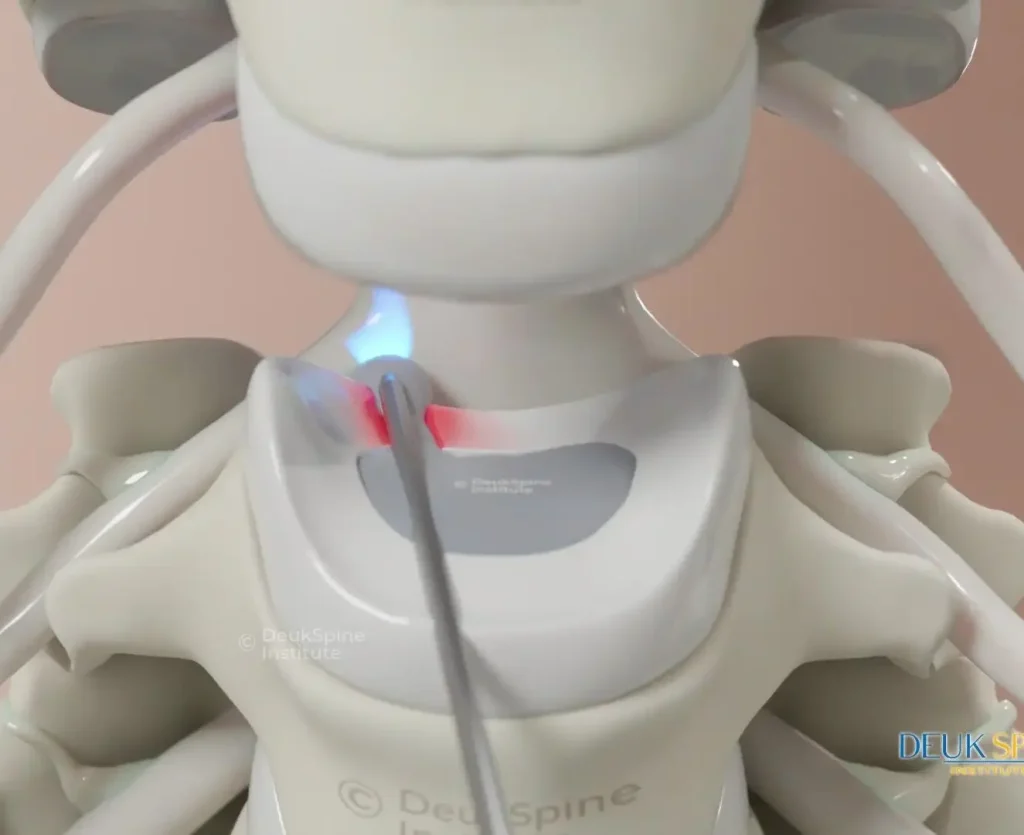
Deuk Laser Disc Repair® (DLDR) is a minimally invasive, endoscopic procedure performed through a skin incision about a quarter of an inch long. A thin tube is passed through a natural opening in the spine called the neuroforamen. In the same corridor the nerve root travels through placing the surgeon directly beside the damaged portion of the disc without cutting a single bone, muscle or ligament on the way in. As Dr. Deukmedjian describes the technique, “this procedure eliminates the need to cut the bone.”²
Inside that tube are two devices. First, the endoscope allows Dr. Deukmedjian to view within the annular tear in real-time. Second, there is a 1 mm laser fiber. That is a glass core enclosed in plastic tubing through which the laser wavelength energy travels about ten feet to reach a 1 mm tip placed within the disc. There, the laser performs two functions. It excises the fragments of herniated nucleus pulposus which have become entrapped in the tear in the back wall of the disc, and it debrides the irritated, calcified and scarred lining of the tear allowing the body to seal the tear. In a peer-reviewed study of 142 consecutive patients who underwent this procedure for cervical discs, the average amount of herniated disc tissue excised per patient was 0.09 ml, showing the precision of this laser excision technique.¹
“Herniations are not one-time events,” Dr. Deukmedjian tells viewers as he works. “You don’t just get a herniation and that’s it. Herniations happen multiple times over the years… they add up and they cause more and more pain until eventually they just hurt all the time.” In the patient on the table, the calcium and scar tissue lining the tear were consistent with an injury that had been there for many years. Once the fragments and scar were cleared, the tear measured roughly 3 mm wide small enough for the body to close on its own over the following months.
Why this approach is different from other endoscopic spine surgery
Endoscopic surgery of the spine has been around for some time; however, how it is done makes all the difference. Transforaminal surgery through the foraminal opening has been developed by Dr. Parviz Kambin, who coined the term “transforaminal” in 1973 using percutaneously placed cannula.⁵ Later on, he would publish the first “discoscopic views” inside the disc and define the safe triangular working zone which is used to date by all endoscopic surgeons.⁵ Dr. Deukmedjian learned this procedure from Dr. Sebastian Ruetten, Dr. Anthony Yeung, Dr. Sang-Ho Lee, Dr. Gun Choy and Dr. Martin Knight, who were the first generation Kambin students and then improved the procedure by including laser annular debridement procedure, which was not done by any other endoscopic surgeon.⁶
Many other endoscopic spine surgeons use a translaminar or interlaminar approach instead: they cut through bone, muscle and ligament on the way to the disc. The result is a familiar operation for surgeons trained in open spine surgery, but a more damaged, less stable spine for the patient and, as Dr. Deukmedjian argues, a shorter road back to a second operation, often a fusion.
Two particular aspects that help to achieve such a low incidence of reherniation are laser cleaning of the tear of the annulus itself and visualization of the entire area from within. Laser cleaning of the tear of the annulus is something unique to the operation, while endoscopic visualization means that the surgeon actually sees what he operates on.
Deuk Laser Disc Repair® vs. fusion, laminectomy, microdiscectomy and injections
Patients arriving at Deuk Spine have often been offered other operations already. The broadcast walked through the most common ones and what each actually does:
- Laminectomy removes bone and ligament from the back of the spine. It is highly invasive, destabilizes the spine, generates significant scar tissue, and frequently leads to the need for a fusion. Dr. Deukmedjian regards it as a poor choice for back pain and notes that patients often remain in chronic pain afterwards, cycling in and out of pain management and physical therapy.
- Microdiscectomy is less invasive than a laminectomy but still removes bone and ligament to reach a herniated disc. It is a treatment for leg symptoms: pain, numbness, weakness, foot drop. Caused by nerve compression, not a treatment for back pain, and should be avoided when back pain is the primary complaint.
- Spinal fusion can be effective at eliminating back pain, but Spinal fusion comes with a big list of costs. Spinal fusion requires hardware such as screws and rods, bone grafts that are often taken from donors and Spinal fusion can lead to risks like blood clots, pulmonary embolism and infection. After the surgery, most people will need pain medication.
- Disc replacement substitutes an artificial disc for the damaged one. Like fusion, it is major hardware surgery with a substantial recovery.
On the other hand, Deuk Laser Disc Repair® is done on an outpatient basis with the help of a small cut, where the average amount of bleeding is about one cubic centimeter of blood per procedure, which equals about twenty drops of blood. There is no need for an overnight stay in the hospital, and there are no narcotics prescribed after the procedure.² It should be emphasized that this procedure differs greatly from spinal fusion, because a study conducted in Ohio State on 24,610 patients who had undergone lumbar fusion revealed that patients who took chronic opioids before the operation had a 19% higher probability of developing postoperative wounds during the first three months.⁷
Recovery: what the first year looks like
Recovery after DLDR is intentionally brief on the side and intentionally careful on the healing side. Patients spend an hour in the recovery area, then return to their hotel for the night. The morning patients come back for a quick postoperative check and then patients fly home.
The limitations that occur within the year are biological in nature and do not relate to ease of the procedure. After the laser surgery is performed, the annular tear is removed. However, it is not yet sealed up. This is done by the body over the course of one year. During this period, the primary threat is forcing the nucleus out again.
Dr. Deukmedjian laid out the baseline guidance he gives patients:
- No bending forward for at least six weeks. That specifically means no bringing the hands below the knees to pick things up from the ground. Bending to sit in a chair, to get into bed and to use the toilet is fine. For badly damaged discs, the restriction can extend to three months.
- Twisting is permitted during recovery; the strain on the tear comes from bending forward rather than twisting.
- Lifting restrictions can differ. For a young and healthy individual who has a good intraoperative outcome, up to 50 pounds of lifting might be permitted; however, if the individual is elderly or has a damaged core muscle system, then he or she should not lift anything heavy.
- Take the whole first year easy. Low-impact aerobic activity: walking, biking, light exercise is encouraged. High-impact activity and contact sports are not.
Even with perfect adherence, a small number of patients re-herniate from everyday events such as rolling over in bed. Dr. Deukmedjian puts that risk at roughly 1 in 300; low, but not zero.
A patient’s story
The bottom line
Deuk Laser Disc Repair® can ease back and neck pain. That kind of pain comes from a tear in the annulus, where the herniation gets stuck. It will not help with pain, SI joint pain, piriformis syndrome or vertebral fractures. Each of those issues has its treatment at Deuk Spine.
In this area, the record is strong. Dr. Deukmedjian has done around 3,000 of these laser surgeries so far. He puts the pain relief at 99.6% for discogenic pain. Deuk Laser Disc Repair® has been done at Deuk Spine Institute since 2006;⁹ the method itself, he says, has not changed in twenty years, because the team has not found a way to improve it. A PubMed study of the cervical version of the procedure, published in Surgical Neurology International, found no problems after surgery in 142 patients in a row.¹
When faced with the choice between undergoing spine surgery, what you should glean from the show is what Dr. Deukmedjian emphasizes time and again: make sure that there is a proper diagnosis prior to undergoing any treatment. If your pain is due to your disc, see if there is a less invasive procedure involving lasers available prior to having to undergo a fusion, laminectomy, or microdiscectomy. Also, if there is no clear way of determining where your pain is coming from, besides your problem disc from an MRI scan…get a second opinion first.
86% of chronic debilitating back pain is disc-driven — yet most patients are offered fusion, laminectomy or opioids before anyone confirms which structure is generating the pain
No bone cut. No hardware. No opioids.
Just a 1 mm laser and the damaged disc.
Deuk Laser Disc Repair reaches the disc through a quarter-inch incision and the spine’s natural foraminal opening — no bone, muscle or ligament is cut on the way in. A 1 mm laser fiber removes the herniated fragments and cleans the annular tear so the body can seal it. Surgery is outpatient, nearly bloodless (~1 cc average blood loss), and requires zero narcotic prescriptions afterward. Dr. Deukmedjian has performed 2,800+ of these procedures since 2006, with a 95%+ success rate and a 0.01% complication rate.
is disc-driven
2,800+ procedures
after surgery
- Bone and ligament removed to reach the disc
- Fusion adds screws, rods and cadaveric bone graft
- Opioid painkillers routinely prescribed post-op
- 5–15% reherniation; 20–40% adjacent-segment disease
- Overnight stay, extended recovery
- No bone, muscle or ligament cut
- 1 mm laser fiber through a quarter-inch incision
- Zero narcotic prescriptions after surgery
- 95%+ success rate, 2,800+ procedures
- Outpatient, ~1 cc blood loss, 0.01% complication rate
Board-certified neurosurgeon review · No insurance approval required · 100,000+ procedures performed
Frequently asked questions
What is Deuk Laser Disc Repair®?
Answer
Deuk Laser Disc Repair® (DLDR) is a minimally invasive, endoscopic spine procedure developed by Dr. Ara Deukmedjian at Deuk Spine Institute. It uses a 1 mm laser fiber passed through a quarter-inch incision and the spine’s natural foraminal opening to remove herniated disc fragments and clean the tear in the back wall of the disc, so the body can seal it on its own.
What conditions does Deuk Laser Disc Repair treat?
Answer
DLDR is designed for discogenic back or neck pain. Pain generated by a herniated, bulging, ruptured or degenerated disc with a tear in the annulus. It does not treat facet joint pain, sacroiliac joint pain, piriformis syndrome or vertebral fractures, each of which has its own targeted treatment at Deuk Spine.
Is Deuk Laser Disc Repair® FDA approved?
Answer
The laser used in the procedure is FDA approved for medical use, and Dr. Deukmedjian has stated publicly that the Deuk Laser Disc Repair® procedure is FDA approved. Candidacy is determined on a patient-by-patient basis after review of imaging and a confirmatory discogram.
How long does the procedure take, and is it outpatient?
Answer
Yes, Deuk Laser Disc Repair® is performed on an outpatient basis. Patients spend about an hour in the recovery area, return to their hotel for the night, come in the following morning for a brief postoperative check, and then fly home.
Will I need narcotic painkillers after surgery?
Answer
No. One of the defining features of DLDR is that no narcotic opioid painkillers are prescribed after surgery. Dr. Deukmedjian typically sends patients home with a muscle relaxant only.
What are the activity restrictions after Deuk Laser Disc Repair®?
Answer
The baseline guidance is no forward bending for least six weeks. Bending to sit, use the toilet or get into bed is fine. Twisting is allowed throughout recovery. Lifting limits are individualized. They can be under 15 pounds for a deconditioned patient. For a healthy one with a clean intraoperative result, lifting can go up to about 50 pounds. The whole first year should stay impacted while the annular tear seals.
How is Deuk Laser Disc Repair® different from spinal fusion, laminectomy or microdiscectomy?
Answer
Fusion, laminectomy and microdiscectomy all remove bone and/or ligament from the spine and typically require narcotic painkillers afterward. Spinal fusion adds hardware and the risks that come with it. DLDR cuts no bone, muscle or ligament, is outpatient, and does not require opioids.
What is the reherniation rate after DLDR?
Answer
As explained by Dr. Deukmedjian, the rate of reherniation is considered the lowest for any disc surgery known by him due to two characteristics that are exclusively present in the procedure of DLDR, which include visual endoscopy within the torn annulus and laser debridement of that torn annulus. However, despite perfect post-surgical compliance with restrictions, some patients might still reherniate during common activities such as turning over in bed. The estimated ratio is approximately 1 in 300.
What is Deuk Laser Disc Repair’s® success rate?
Answer
Dr. Deukmedjian cites an average pain-relief figure of 99.6% for discogenic back and neck pain across roughly 3,000 cases performed at Deuk Spine Institute since 2006. A peer-reviewed cohort of 142 consecutive patients treated with the cervical version of the procedure, published in Surgical Neurology International, reported no postoperative complications.
Who is a candidate for Deuk Laser Disc Repair®?
Answer
Candidates are patients whose back or neck pain is confirmed to be discogenic. Coming from a disc with an annular tear and a herniation.And if the source is from the facet joint, the SI joint they would be a candidate for the Deuk Plasma Rhizotomy. Or the Deuk Piriformis Release for the piriformis muscle. Confirmation is made through the Deuk Spine exam.
Sources
View Sources
- Deukmedjian AJ, Cutright J, Cianciabella A. Deuk Laser Disc Repair® is a safe and effective treatment for symptomatic cervical disc disease. Surgical Neurology International. 2013;4:68.
- Becker’s Spine Review. Deuk Laser Disc Repair: 5 Points on Laser Spine Surgery Without Drilling Bone. Accessed 2026.
- Becker’s Spine Review. 3 Points on Deuk Laser Disc Repair for Symptomatic Cervical Disc Disease. Accessed 2026.
- National Library of Medicine, StatPearls. Lumbosacral Discogenic Syndrome. Accessed 2026.
- Tieber F, Lewandrowski KU. Technology advancements in spinal endoscopy for staged management of painful spine conditions. Journal of Spine Surgery. 2020;6(Suppl 1):S19-S28.
- Choi KC, Lee DC, Shim HK, Shin SH, Park CK. Evolution of endoscopic transforaminal lumbar approach for degenerative lumbar disease. Journal of Spine Surgery. 2020;6(2):424-437.
- The Ohio State University Wexner Medical Center. Study: Chronic Use of Opioids Linked to Complications After Spinal Fusion Surgery. Accessed 2026.
- Wolters Kluwer. For spinal fusion surgery patients, taking opioids before surgery is major risk factor for long-term opioid use. Spine. Accessed 2026.
- Space Coast Living. Dr. Ara Deukmedjian. Accessed 2026.
- Becker’s Spine Review. Spine Surgeon Leader to Know: Dr. Ara Deukmedjian of Deuk Spine Institute. Accessed 2026.
- National Library of Medicine, StatPearls. Lumbar Disc Injuries. Accessed 2026.
- Hasan S, Härtl R, Hofstetter CP. The benefit zone of full-endoscopic spine surgery. Journal of Spine Surgery. 2019;5(Suppl 1):S41-S56.
- Advances and Challenges of Endoscopic Spine Surgery. Journal of Clinical Medicine. 2024;13(5):1439.