
By Dr. Ara Deukmedjian Board-Certified Neurosurgeon, Deuk Spine Institute
Medically reviewed on April 22, 2026
Medical Disclaimer: This content is for educational purposes only and does not constitute medical advice. Individual results may vary. Always consult with your healthcare provider about your specific condition and treatment options.
Key Points
✓ Patent US12290301B1 protects a new treatment for piriformis syndrome — a minimally invasive method that relieves deep buttock pain and sciatic nerve compression without open surgery.
✓ The Deuk Piriformis Release® (DPR) is performed through a ~4 cm incision — a dramatic step forward from the traditional 4–6 inch open approach, with no muscle cutting, no hardware, and no overnight hospital stay.
✓ An electrocautery probe is guided under fluoroscopic imaging directly to the piriformis tendon insertion at the greater trochanter, where the tendon is precisely transected to release the muscle from the hip bone.
✓ Once released, the torn piriformis muscle can finally heal — because it is no longer being pulled apart at the tear site, pain resolves and the muscle is no longer pulling on or irritating the sciatic nerve.
✓ Recovery is fast and opioid-free — most patients walk out the same day, return to normal activity within 24 hours, and avoid the scarring, bleeding, and complications associated with traditional open piriformis release surgery.
✓ This innovation fills a long-standing gap in care — patients with piriformis syndrome have historically cycled through injections, PRP, stem cells, Botox, and physical therapy with only temporary relief. This patent offers a durable, outpatient alternative.
Piriformis syndrome is one of the most frustrating diagnoses in orthopedics and neurosurgery. 1 It causes deep buttock pain, sciatica, numbness down the leg, and an inability to sit, stand, or sleep without discomfort. Worse still, most patients bounce from one failed treatment to the next. Injections wear off. Physical therapy stops working. Muscle relaxers blunt the pain without fixing the problem.
For Dr. Ara Deukmedjian, this cycle represented exactly the kind of gap in care that drives innovation. His third U.S. patent, US12290301B1, introduces a minimally invasive, surgical method for treating piriformis syndrome at its source.
This patent is the foundation of the Deuk Piriformis Release®, a procedure pioneered by Dr. Deuk and currently available only at Deuk Spine Institute.
What Is Piriformis Syndrome
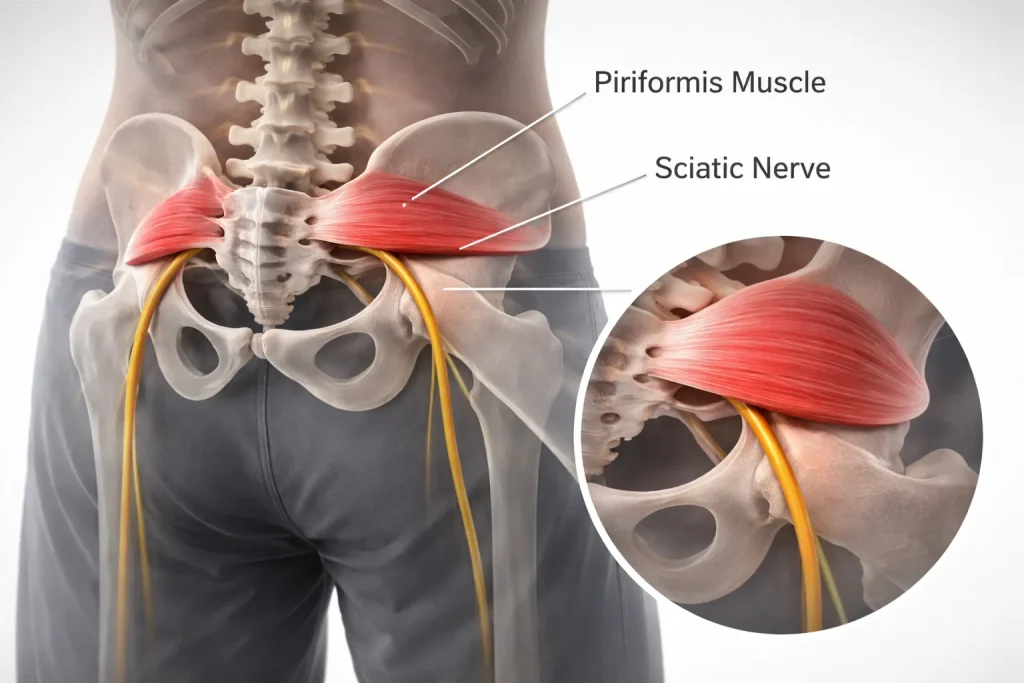
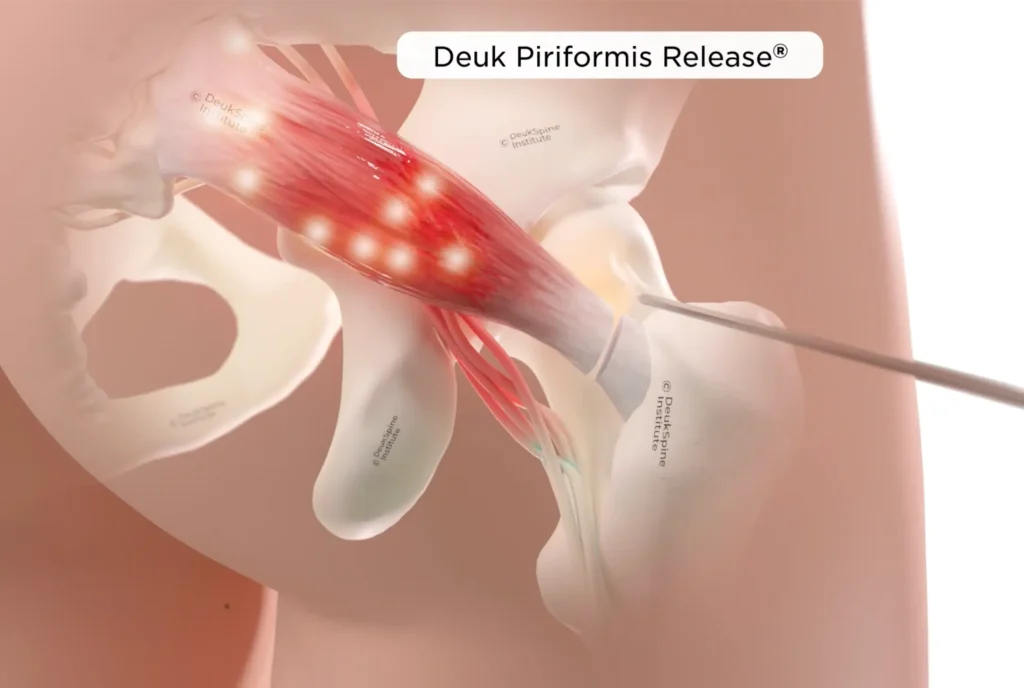
The piriformis is a small, deep muscle in the buttock. It originates at the lateral border of the sacrum and inserts by tendon onto the greater trochanter of the hip. 2 Its job is to rotate the hip outward and help stabilize the pelvis.
Piriformis syndrome nearly always begins with a tear across the belly of the muscle. Often from trauma, prolonged sitting, or repetitive strain. Once torn, the muscle continues to be pulled in two directions every time the hip moves. The tear cannot heal because it is never at rest. Inflammation builds. The sciatic nerve, which runs directly beneath the piriformis, becomes irritated and compressed. 3 The result is what patients know too well: deep pain in the buttock, sciatic pain radiating down the leg, and a quality of life that slowly erodes.
What Patent US12290301B1 Actually Covers
The patent describes a novel surgical method for treating chronic piriformis muscle inflammation. More commonly known as piriformis syndrome.
Core Innovation
According to the patent, the procedure involves:
- Making a very small incision at the back of the buttock (approximately 4 cm)
- Advancing an electrocautery probe through the incision
- Navigating the probe under medical imaging (fluoroscopy) toward the proximal end of the femur, next to the greater trochanter
- Confirming probe placement at the piriformis tendon insertion
- Activating the probe to cut the piriformis muscle or tendon at the greater trochanter
- Releasing the muscle from its attachment on the hip bone to permanently relieve pain and tenderness
The critical insight behind this patent is that the piriformis does not need to be removed, repaired, or reconstructed. It simply needs to be released from the point of tension. Once the tendon is released, the two sides of the torn muscle belly are no longer being pulled apart with every hip movement.
Why This Matters for Patients
- A ~4 cm skin opening instead of a 4–6 inch open incision
- No cutting of the piriformis muscle belly itself: no myotomy, no bleeding, no disfigurement
- No hardware, no implants, and no fusion
- Fluoroscopic image guidance for precise placement of the probe
- Preservation of surrounding anatomy, including the sciatic nerve
- Outpatient recovery with minimal downtime
Why Traditional Treatments Fall Short

Before this innovation, patients with piriformis syndrome cycled through a predictable list of interventions:
- NSAIDs and muscle relaxers
- Physical therapy and stretching programs
- Corticosteroid and trigger point injections
- PRP (platelet-rich plasma) injections
- Stem cell therapy
- Botox injections into the piriformis
- Open surgical piriformis release or myotomy
Each of these treatments has limitations. Injections wear off. 4 Regenerative therapies rarely address the mechanical problem of a muscle that is being pulled apart. And traditional open surgery, while sometimes effective, requires a large incision, general anesthesia, significant muscle damage, a hospital stay, and weeks to months of recovery. With a real risk of damaging the sciatic nerve in the process.
The Deuk Piriformis Release® was designed to break that cycle by directly addressing the mechanical cause of the tear while preserving everything around it.
How the Procedure Works
The Deuk Piriformis Release® (DPR) is performed as an outpatient procedure with twilight sedation. A 4 mm skin incision is made over the hip. Under real-time fluoroscopic (x-ray) guidance, a specialized probe is advanced through the soft tissues of the buttock.
Once the tip of the probe is confirmed at the piriformis tendon insertion, the probe is energized and the tendon is transected. The muscle is released from the hip bone. The procedure is typically completed in about 20 minutes. A single bandage is all that is needed to close the 4 mm incision.
Most patients feel immediate relief of the deep buttock pain they have carried for years. Some procedural soreness may persist for up to two weeks and resolves on its own without narcotic pain medication.
Benefits of the Deuk Piriformis Release®
Targeted Mechanical Fix
Rather than masking symptoms, the procedure addresses the underlying mechanical problem.
Minimally Invasive by Design
A 4 mm incision, no muscle cutting, minimal blood loss, and no hardware left behind.
Same-Day Outpatient Recovery
Patients are typically in and out in a single visit. Most return to normal activities the next day.
Opioid-Free Recovery
Because the procedure preserves the surrounding anatomy and does not involve a large dissection, pain medication is rarely needed.
Excellent Safety Record
To date, Deuk Spine Institute has performed hundreds of Deuk Piriformis Release® procedures without a single complication.
Who Is a Candidate
Patients with chronic piriformis syndrome that has not responded to conservative treatment are typically excellent candidates. This includes people who have tried: injections, physical therapy, PRP, stem cells, Botox, or medication management.
Diagnosis is made through a detailed history, physical examination, and imaging review. The easiest first step is to submit a recent MRI through our Free MRI Review so Dr. Deukmedjian can determine whether the Deuk Piriformis Release® is the right option for you.
How This Innovation Is Changing Hip and Spine Care
The development of the DPR patent represents more than a new surgical technique. It represents a new standard for minimally invasive spine surgery. The new standard in Dr. Deukmedjian’s two other patents US11937869B1 and US12239362B2. Instead of altering the body’s structure with fusions, implants, or large open procedures, these innovations focus on precise, image-guided surgery that preserve natural anatomy and solve the problem at its source.
For piriformis syndrome specifically, that means no more cycling through treatments that only blunt the pain. There is finally a minimally invasive option designed to fix the mechanical cause of the tear and to let the muscle finally heal.
Conclusion
Innovation in medicine begins when a physician refuses to accept that “temporary relief” is the best patients can expect. For Dr. Ara Deukmedjian, that refusal has produced a series of patents aimed at the most common and most under-treated causes of chronic pain. Patent US12290301B1 continues that pattern, bringing the same principles of precision, minimally invasive and a permanent solution to piriformis syndrome discomfort.
For patients who have spent years searching for real relief from deep buttock pain and sciatica, the Deuk Piriformis Release® offers a path forward. One small incision, one outpatient visit, and after the surgery you can experience pain relief for good. Discover your options for minimally invasive back surgery in a quick 10 minute virtual consultation with Dr. Deuk.

Frequently Asked Questions
What is the Deuk Piriformis Release® used for?
It is used to permanently treat piriformis syndrome and the deep buttock pain and sciatica it causes, by releasing the torn piriformis muscle from its attachment on the hip bone.
What does patent US12290301B1 cover?
The patent covers a percutaneous surgical method for treating piriformis syndrome through a small incision using an electrocautery probe guided by medical imaging to transect the piriformis muscle or its tendon at the greater trochanter of the femur.
Is the procedure minimally invasive?
Yes. It is performed through an incision of approximately 4 mm to 1 cm using fluoroscopic image guidance, with no cutting of surrounding muscle and no hardware placement.
How long does the procedure take?
Most procedures are completed in approximately 20 minutes.
Is it permanent?
Releasing the piriformis tendon from the greater trochanter is a permanent anatomic change, and most patients experience immediate and lasting relief of their pain.
What is recovery like?
Most patients go home the same day and return to normal activities within 24 hours. Some procedural soreness can last up to two weeks and typically resolves without narcotic pain medication.
Who is a candidate?
Patients with chronic piriformis syndrome who have not responded to conservative treatments such as injections, physical therapy, PRP, stem cells, or Botox.