
By Dr. Ara Deukmedjian, MD
Board Certified Neurosurgeon
Medically reviewed on Aug 13, 2026
Medical Disclaimer: This content is for educational purposes only and does not constitute medical advice. Individual results may vary. Always consult with your healthcare provider about your specific condition and treatment options.
Key Points
✓ Fibrin sealant is FDA-approved for surgical hemostasis not for intradiscal injection. Discseel is an off-label use. ¹ ²
✓ The Phase III FDA trial (220 patients) found no difference between fibrin and saline placebo at six months and was stopped early. ³ ⁴
✓ A post hoc analysis of four RCTs (50 patients) also found no difference between fibrin sealant and saline at 12 months. ³ ⁵
✓ The largest Discseel study (Pauza et al., 2024; 827 patients) had no control group, a single operator, ~40% dropout, and its authors called for a future randomized controlled trial. ⁶ ⁷
✓ The VA classified Discseel as “investigational and experimental” (December 2025). Most insurers deny coverage; patients pay $15,000–$20,000+ out of pocket. ¹ ⁸
✓ During Deuk Laser Disc Repair® on a prior Discseel patient, Dr. Deukmedjian observed hemorrhagic, necrotic, scar-filled disc tissue consistent with an adverse reaction. ²⁴
Why the Discseel Procedure Deserves Closer Scrutiny
As a board-certified neurosurgeon with more than 30 years of experience and founder of Deuk Spine Institute, I have seen many trends in spine care come and go. I have rarely been as worried as I am about the current trend toward Discseel treatment, which, although heavily marketed, does not have sufficient research and evidence to support spending so much money on it.
This article is not a dismissal of innovation. Progress in spinal medicine has helped a lot of people, and I have spent my professional life trying to make less invasive ways of treating the spine. However, it is their right to know what research has proven and what it has not, before they decide about something which will affect their health and wallet.
What Is the Discseel Procedure?
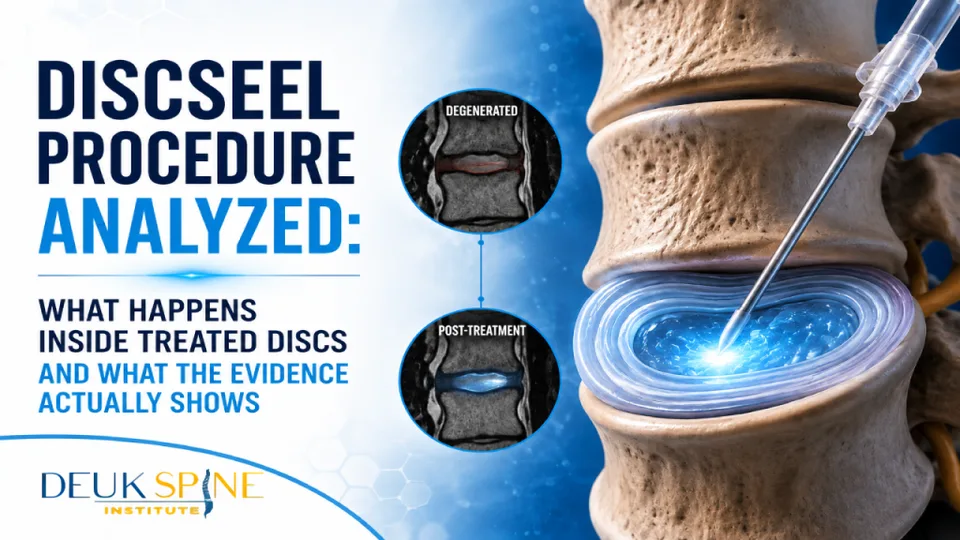
Discseel procedure is a minimally invasive, non-surgical technique invented by Dr. Kevin Pauza. ² The technique comprises of two stages: the first stage involves diagnosing annulogram using fluoroscopy. ² ⁶ Annulogram refers to the introduction of a contrast medium that identifies any tear on the annulus fibrosus. The hard outer rim of the spinal disc. ² ⁶ The second stage entails introducing a fibrin sealant made of fibrinogen and thrombin into the identified tear. ² ⁶
Fibrin is a naturally occurring protein involved in blood clotting and wound healing. ² Commercial fibrin sealants (manufactured by Baxter and Johnson & Johnson) are FDA-approved for specific surgical hemostasis applications. Such as sealing dural tears during spine surgery. ¹ ² However, injecting fibrin sealant into a spinal disc is an off-label use. The FDA has not approved fibrin by injection for the treatment of chronic back pain, annular tears, herniated discs, or degenerative disc disease. ¹
This distinction matters. Off-label use is legal and sometimes clinically justified, but it also means the treatment has not undergone the rigorous FDA review process for the specific condition being treated. ¹
What the Clinical Evidence Actually Shows
Understanding the Discseel procedure requires separating marketing claims from published, peer-reviewed data. Here is what the research shows as of now.
The FDA pilot study (2014)
The earliest human trial was a prospective, nonrandomized, multicenter pilot study approved by the FDA to assess safety. ³ ⁵ Fifteen adults with chronic single- or two-level lumbar discogenic pain received intradiscal fibrin sealant injections. At 24-month follow-up, approximately 40% of subjects reported meaningful improvement, with no complications reported. ³ ⁵ The study’s authors concluded these results warranted further investigation via a randomized, double-blind, placebo-controlled trial. ³
It is important to note: this was a small, uncontrolled pilot study. Without a placebo comparison group, it is impossible to determine whether improvements were attributable to the fibrin sealant or to the natural history of chronic pain, the placebo effect, or the disc puncture itself.
The Phase III FDA trial (failed)
The larger Phase III FDA trial enrolled 220 patients with painful degenerative disc disease and randomized them to receive either intradiscal fibrin sealant or a placebo saline injection. ³ ⁴ The trial was halted after six months because early results were disappointing. There was no statistically significant difference in pain reduction or functional improvement between the fibrin group and the saline placebo group. ³ ⁴
This is arguably the most important piece of evidence in the Discseel conversation. In the gold standard of clinical research a randomized, double-blind, placebo-controlled trial. Fibrin sealant did not outperform a simple saline injection. ³ ⁴
Post hoc analysis of four RCTs (Ju et al., 2022)
A single-center, post hoc comparison drew from four multicenter randomized controlled trials totaling 50 patients with symptomatic degenerative disc disease. ⁵ Both the treatment group (38 patients receiving intradiscal agents including fibrin sealant, growth factor, or stem cells) and the control group (12 patients receiving saline) showed significant decreases in pain and disability scores. However, by 12 months there was no significant difference between the groups. ⁵
At two-year follow-up, 100% of the saline-injected control patients reported sustained improvement without requiring further treatment, compared to 84% of the treatment group. ⁵ The implication is notable: saline alone performed at least as well as fibrin sealant.
The Pauza et al. study (2024)
The largest published Discseel study, and the one most prominently cited by proponents, was a retrospective cohort analysis of 827 patients published in Pain Physician in November 2024. ⁶ ⁷ All patients had chronic low back pain lasting longer than six months (average duration 11 years) and had failed at least four prior invasive treatments. ⁶ Results showed statistically significant improvement across multiple outcome measures at one, two, and three years. ⁶
However, this study has substantial methodological limitations that must be understood. ⁶ ⁷ It had no control group; patients served as their own baseline controls. It was a single-center study with a single operator (the procedure’s inventor). The analysis was retrospective, with outcomes reported prospectively and calculated retroactively. There was approximately 40% patient dropout by 36 months. ⁷ And the study’s own authors explicitly recommended that a future randomized double-blind controlled trial be conducted. ⁶ ⁷
A retrospective, uncontrolled cohort study by the inventor of a procedure is the weakest form of clinical evidence for evaluating treatment efficacy. Without a control arm, it is impossible to separate the effect of fibrin from the placebo effect, regression to the mean, the natural course of the condition, or the effects of concurrent treatments patients may have pursued during the three-year follow-up.
Discseel Clinical Evidence Summary
The published evidence base for the Discseel procedure is small. Here is every significant study, what it found, and what level of evidence it represents. Including the Phase III FDA trial that failed to show efficacy.
The FDA and Insurance Question
One of the most common points of confusion around Discseel involves its regulatory status. While proponents describe it as using “FDA-approved fibrin,” this framing requires clarification. ¹ ²
The FDA has approved the use of fibrin sealants in certain surgical hemostasis applications that involve tissue closure during surgery without using sutures. ¹ ² However, the FDA has not approved the intradiscal injection of fibrin sealant to treat chronic back pain, annular tear, or degenerative disc disease. ¹
The U.S. Department of Veterans Affairs issued a formal clinical determination (CDI 00059, effective December 1, 2025) that explicitly classifies the Discseel procedure as “investigational and experimental” with “insufficient evidence from peer-reviewed medical literature to support the safety and efficacy of this treatment.” ¹ The VA further determined the procedure is “not medically necessary.” ¹
The insurance implications of this regulatory status are significant. Most private insurance plans do not cover Discseel, with approximately 90% of patients paying entirely out of pocket. ⁸ ⁹ Total costs typically range from $15,000 to $20,000 plus additional fees for anesthesia, the annulogram, and facility usage. ⁸ ⁹
For comparison, a microdiscectomy is a well-established, insurance-covered surgical procedure with decades of Level I evidence. Typically costs patients $1,000 to $3,000 out of pocket with insurance. ¹⁰ Even spinal fusion, one of the most expensive spine procedures, commonly results in $4,000 to $8,000 in out-of-pocket costs with insurance coverage. ¹⁰
The Annular Tear Question
A central premise of the Discseel procedure is that annular tears are a primary driver of chronic low back pain and that sealing them with fibrin addresses the root cause. ² ⁶ While annular tears can certainly be symptomatic and clinically significant, there is important context patients should understand.
Annular tears are common findings even in people with no symptoms whatsoever. Research published in Radiology found annular tears present in 56% of asymptomatic volunteers on MRI. Meaning more than half of pain-free individuals had annular tears visible on imaging. ¹¹ ¹² The same study found bulging discs in 81% and focal disc protrusions in 33% of symptom-free volunteers. ¹¹
The StatPearls article on annular disc tears states that “annular fissures may be symptomatic or asymptomatic,”. And that “incidental tears do not necessarily need to be treated as they may heal on their own.” ¹³ They go on to say, “As of now, there is no definitive evidence that the treatment of asymptomatic annular tears offers any benefit.” ¹³
This does not mean annular tears are never clinically meaningful. Some tears are clearly symptomatic and associated with significant pain. The concern is that the Discseel diagnostic process is an annulogram that identifies tears the proprietary provider claims MRI cannot detect. And treat tears that are incidental and not responsible for the patient’s pain. ² ¹³
What I Saw Inside a Discseel Treated Disc
Clinical observations sometimes reveal what studies alone cannot. Recently, we treated a patient from Georgia who had previously undergone the Discseel procedure at two disc levels. During his endoscopic Deuk Laser Disc Repair® surgery, I had the opportunity to directly visualize the interior of a disc that had been treated with intradiscal fibrin sealant.
In thirty years of practice, it was among the most concerning disc interiors I have encountered. ²⁴
Both treated discs showed the same disturbing characteristics: extensive scar tissue formation, active hemorrhaging, and brown, necrotic disc material. The tissue appeared to have undergone a severe adverse reaction to the injected product. This is consistent with what one might expect when a foreign biologic substance is introduced into the relatively avascular disc environment. The disc has limited blood supply and a unique biochemical milieu that may not respond favorably to exogenous fibrin. ²⁴
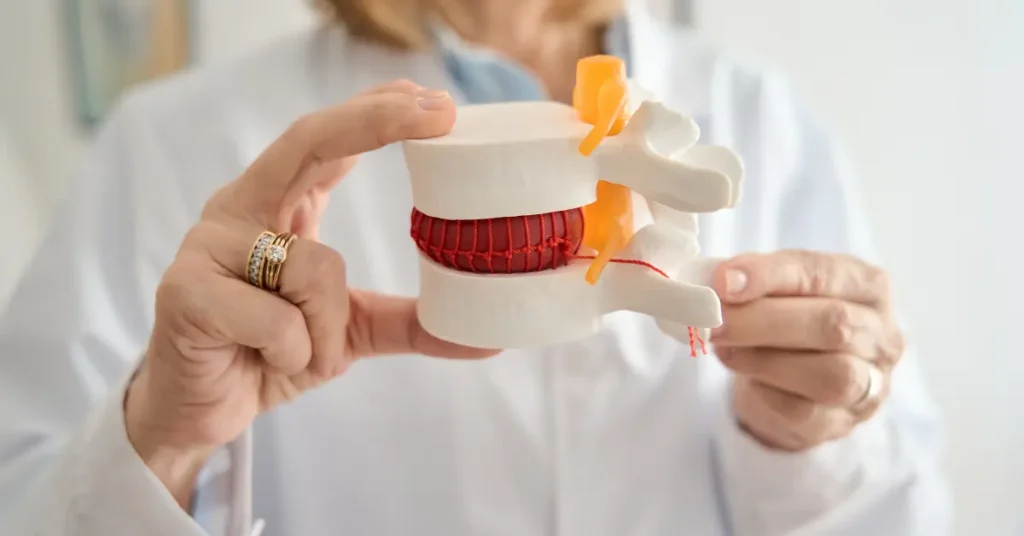
After our team removed this damaged tissue during the endoscopic laser disc repair procedure, the patient achieved complete pain relief and returned home to Georgia symptom-free. ²⁴
I want to be transparent about the limitations of this observation. This is a single clinical case, not a controlled study. However, it raises questions that merit further investigation: What does the interior of a Discseel-treated disc look like at six months, one year, or three years? Are adverse tissue reactions common? Without long-term histological studies, we simply do not know.
What Patients Should Know Before Considering Discseel
1. Understand the evidence hierarchy
The strongest evidence available is a Phase III randomized, placebo-controlled trial. Showed no difference between fibrin sealant and saline injection. ³ ⁴ The supportive evidence comes from uncontrolled, retrospective, single-operator studies by the procedure’s inventor. ⁶ ⁷ Patients should ask their provider to explain this distinction clearly.
2. Clarify the FDA status
When a provider says “FDA-approved fibrin,” ask specifically: Is fibrin approved for injection into spinal discs to treat my condition? The answer is no. ¹ Off-label use is not the same as FDA approval for a specific indication.
3. Get multiple opinions from non-Discseel providers
Seek evaluation from surgeons and spine specialists who do not perform the Discseel procedure and have no financial interest in your decision. ¹⁴ A physician experienced in diagnosing both discogenic pain and other causes of chronic low back pain. Including facet joint disease, sacroiliac dysfunction, and piriformis syndrome is the most important factor in ensuring an accurate diagnosis.
4. Consider the opportunity cost
Patients who spend $15,000–$20,000 on Discseel and do not achieve relief still need treatment. ⁸ ⁹ Many ultimately pursue the proven procedures they likely needed from the start discectomy, laminectomy, or endoscopic laser disc repair. After months or years of continued suffering. The patient from Georgia is one example, but he is far from the only one.
5. Ask about long-term tissue effects
No published histological studies document what happens inside human discs months to years after fibrin sealant injection. ¹ ³ The absence of this data should give patients and clinicians pause.
The Better Way: Deuk Laser Disc Repair (DLDR)
For patients suffering from disc-related chronic back or neck pain, my revolutionary procedure, Deuk Laser Disc Repair (DLDR)®, provides a safer, evidence-supported alternative. DLDR is a minimally invasive endoscopic procedure that directly visualizes and treats the damaged disc tissue. Removing the actual source of pain while preserving healthy disc structure and minimizing collateral damage to surrounding muscles, nerves, ligaments, tendons, and joints.
Unlike the Discseel approach of injecting material into the disc and hoping for biological remodeling, DLDR uses a targeted laser to vaporize the damaged disc tissue that is compressing nerves and generating pain. The procedure is performed through a small incision under endoscopic guidance, allowing patients to return home the same day.
Make Your First Pain-Free Move
If you are seeking relief from lumbar or cervical pain, have been recommended for spinal fusion, or are still dealing with chronic pain after a failed procedure including a failed Discseel. We can help.
Upload your latest MRI for a free review and a personal consultation with myself, Ara Deukmedjian, M.D., founder of Deuk Spine Institute and creator of the Deuk Laser Disc Repair® procedure.
The Phase III trial failed.
Your treatment shouldn’t.
In the only placebo-controlled trial, fibrin sealant performed no better than saline. The VA classified Discseel as investigational and experimental. If you’ve already spent $15,000–$20,000 and you’re still in pain — or you’re weighing the decision now — there’s a proven, insurance-covered alternative.
Board-certified neurosurgeon · 30+ years experience · Thousands of patients treated after failed procedures
FAQs
Is the Discseel procedure FDA-approved?
No. The fibrin sealant used in the Discseel procedure is FDA-approved for certain surgical hemostasis applications (such as sealing dural tears during surgery), but it is not FDA-approved for intradiscal injection to treat chronic back pain, annular tears, or degenerative disc disease. ¹ ² The intradiscal use is considered off-label. The U.S. Department of Veterans Affairs has classified the procedure as investigational and experimental. ¹
Does insurance cover the Discseel procedure?
In most cases, no. Approximately 90% of patients pay entirely out of pocket because insurers classify Discseel as experimental. ⁸ ⁹ Total costs typically range from $15,000 to $20,000 plus additional fees. ⁸ By comparison, established spine procedures such as microdiscectomy are covered by most insurance plans with typical out-of-pocket costs of $1,000–$3,000. ¹⁰
What did the Phase III clinical trial show?
The Phase III FDA trial randomized 220 patients to receive either intradiscal fibrin sealant or a saline placebo injection. ³ ⁴ At six months, there was no statistically significant difference in pain or functional outcomes between the two groups, and the trial was stopped early due to these disappointing results. ³ ⁴ This remains the highest-quality controlled evidence available on intradiscal fibrin sealant.
What about the Pauza 2024 study with 827 patients?
The Pauza et al. (2024) study published in Pain Physician is the largest published investigation of the Discseel procedure. ⁶ It reported significant improvements at one, two, and three years. However, it was a retrospective cohort study with no control group, a single operator (the procedure’s inventor), and approximately 40% dropout by year three. ⁶ ⁷ Its own authors acknowledged the need for a randomized double-blind controlled trial. ⁶ Without a control arm, the observed improvements cannot be separated from placebo effect, regression to the mean, or natural disease course.
Are annular tears always the cause of back pain?
No. Annular tears are common findings even in completely asymptomatic individuals. Research shows they are present in 56% of volunteers with no back pain or sciatica. ¹¹ ¹² While some annular tears are genuinely symptomatic, many are incidental findings that do not require treatment and may resolve spontaneously. ¹³ This raises concern that the Discseel diagnostic process may identify and treat tears that are not the actual source of a patient’s pain.
Can the Discseel procedure cause harm?
While the Pauza et al. (2024) study reported no severe adverse events within its monitored cohort, there is no published long-term histological data on the tissue effects of intradiscal fibrin injection. ⁶ In our clinical experience treating a patient who previously underwent Discseel, we observed hemorrhagic and necrotic disc tissue consistent with an adverse reaction to the injected material. ²⁴ More research, particularly controlled studies with long-term tissue analysis, is needed.
What should I do if my Discseel procedure failed?
If you have undergone the Discseel procedure and continue to experience chronic back or leg pain, you should seek evaluation by a spine specialist who can reassess your condition with updated imaging and determine whether a proven surgical intervention. Such as endoscopic Deuk Laser Disc Repair®, microdiscectomy, or laminectomy is appropriate. Many patients who come to our institute after failed Discseel achieve complete pain relief with the correct procedure. Upload your MRI for a free review.
Sources
View Sources
- U.S. Department of Veterans Affairs. Discseel (Fibrin Sealant Injection) — CDI 00059. Dec 2025.
- Pauza K. Intra-annular fibrin Discseel®. Advanced Procedures for Pain Management. Springer; 2018.
- Yin W, Pauza K, et al. Intradiscal injection of fibrin sealant: prospective multicenter pilot study with 24-month follow-up. Pain Medicine. 2014;15(1):16–31.
- Centeno C. New disc treatment: Discseel to heal? Regenexx Blog. 2025.
- Ju DG, Shin DA, et al. Clinical improvement associated with saline injection for discogenic LBP: comparison of RCTs. NASS poster. 2022.
- Pauza K, Boachie-Adjei K, et al. Annulargrams and intra-annular fibrin for chronic discogenic LBP: 1–3 year outcomes. Pain Physician. 2024;27(8):537–553.
- Annular Fibrin for Veterans. Pauza et al. (2024) study limitations analysis.
- Discseel FAQ — cost and insurance.
- Arizona Center for Pain Medicine. Discseel cost in Phoenix. Dec 2025.
- Total Orthopedics. Herniated disc surgery cost with insurance. 2025.
- Stadnik TW, et al. Annular tears and disk herniation: prevalence in asymptomatic volunteers. Radiology. 1998;206(1):49–55.
- Ernst CW, et al. Annular tears on MR images of symptom-free volunteers. Eur J Radiol. 2005;55(3):409–414.
- Defined A, Varacallo M. Annular Disc Tear. StatPearls. Updated 2023.
- Vancouver Spine Doctor. Biologics — intradiscal modulation.