By Dr. Ara J. Deukmedjian, MD
Board Certified Neurosurgeon
Medically reviewed on September 2, 2026
Disclaimer: The contents provided in this article are for learning purposes only. It is always recommended to speak to a doctor about your personal health condition.
Key Points
✓ Abbott’s Proclaim XR spinal cord stimulator does not fix the structural cause of chronic pain. It masks pain signals with low-level electrical currents sent to the spinal cord.¹ ²
✓ The long-term success rate of spinal cord stimulators sits between 47% and 74%, and outcomes decline the longer the device is implanted.³
✓ Documented side effects include cerebrospinal fluid leaks, epidural hemorrhage, spinal cord compression, infection, device migration, and in rare cases paralysis.¹ ⁴
✓ Mechanical failures, battery depletion, and lead displacement frequently require additional surgeries to reposition or replace the device.⁴ ⁵
✓ Electromagnetic interference from MRIs, defibrillators, and other medical equipment can damage the implant and cause severe burns or serious injury.¹
✓ Deuk Laser Disc Repair® treats the structural source of pain. The damaged disc itself with a 95% success rate and zero complications across more than 1,300 patients over 15 years.⁶
The Device Millions of Chronic Pain Patients Are Offered and Why It Never Actually Fixes Anything
Picture this. You have been living with chronic back pain or neck pain for years. You have tried physical therapy. You have been through rounds of epidural steroid injections. You have taken more medication than you want to think about. Finally, your pain management doctor recommends a spinal cord stimulator. He tells you a small device will be implanted near your spine, it will send electrical pulses to interrupt your pain signals, and the pain will become manageable.
So you go through the trial period. You get the permanent implant. And maybe, for a while, it seems to help. The electrical buzzing or tingling replaces some of the pain. But months later, the coverage shifts. The leads migrate. The battery drains. You are back in the office, talking about a revision surgery. Or worse, the device never worked well in the first place.
Sound familiar?
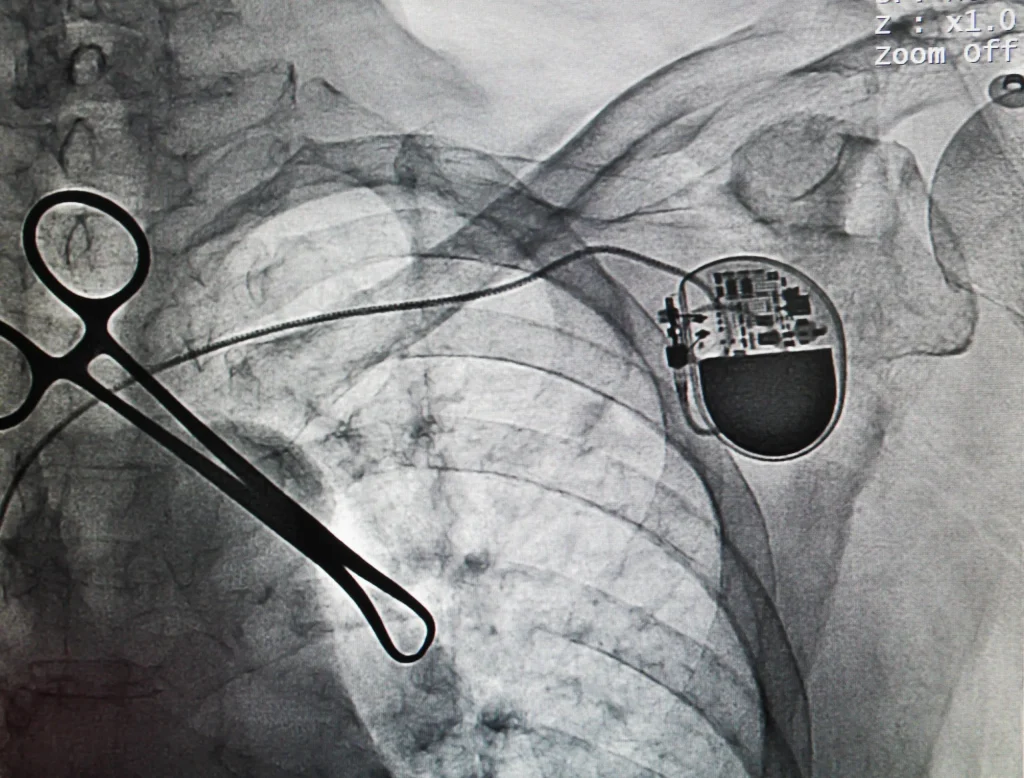
If you are stuck in this cycle, you are not alone. And the reason your spinal cord stimulator is not delivering lasting relief is not a mystery. It is a fundamental design limitation baked into the technology itself.
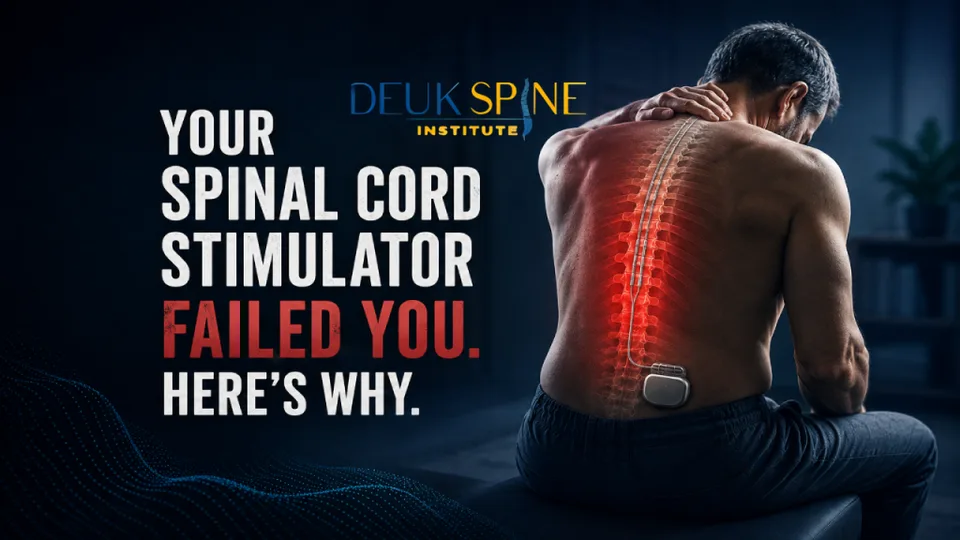
A spinal cord stimulator does not treat the structural problem causing your pain.¹ ² It does not repair a herniated disc. It does not decompress a pinched nerve. It does not close an annular tear. It places a battery-powered device in your body that sends electrical signals to your spinal cord in an attempt to scramble the pain message before it reaches your brain.² That is not a fix. It is a workaround. And workarounds, by definition, have an expiration date.
What Is the Abbott Spinal Cord Stimulator, Exactly?
Abbott’s Proclaim XR is a recharge-free neurostimulation system approved by the FDA for people living with chronic pain.¹ The device delivers low-dose electrical currents to the spinal cord through implanted leads. Abbott markets the system’s BurstDR stimulation technology as an advancement over older stimulation patterns, and the battery is rated to last up to 10 years at low-dose settings without recharging.¹
The company also offers dorsal root ganglion (DRG) stimulation, which targets a specific cluster of nerve cell bodies near the spine for more localized pain conditions like complex regional pain syndrome (CRPS).¹
The system pairs with Bluetooth wireless technology and Apple mobile devices, giving patients a handheld controller to adjust stimulation settings within prescribed limits.¹
Here is what the marketing does not emphasize: none of this changes the anatomy that is generating the pain in the first place. The herniated disc is still herniated. The compressed nerve is still compressed. The degenerative changes in the spine are still progressing. The device simply sits between the pain source and your conscious perception of it, hoping to intercept enough of the signal to make daily life tolerable.
How Does It Actually Work?
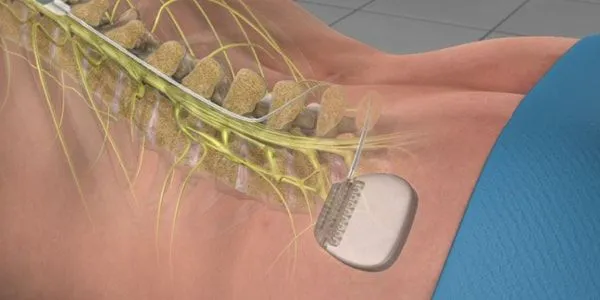
The procedure involves two phases.²
Phase one is the trial. A physician places temporary leads near the spinal cord through a needle inserted into the epidural space. These leads connect to an external generator worn on a belt. The trial typically lasts five to seven days. If the patient reports meaningful pain reduction usually defined as 50% or greater. The physician recommends permanent implantation.²
Phase two is the permanent implant surgery. Under sedation or general anesthesia, the surgeon places permanent leads in the epidural space and tunnels a wire under the skin to a small pulse generator implanted in the abdomen or upper buttock area. The entire system sits inside your body. From that point forward, electrical pulses are delivered continuously or on a programmed schedule to mask pain signals traveling up the spinal cord to the brain.²
The theory is straightforward: if you can override the pain signal with an electrical one, the brain perceives less pain. This is based on the gate control theory of pain, first proposed in 1965.² It is a real neurological phenomenon. But there is a critical difference between disrupting a pain signal and eliminating the condition that produces it.
What Is the Success Rate and What Does “Success” Actually Mean?
This is where the conversation gets uncomfortable.
The long-term success rate of spinal cord stimulators is reported between 47% and 74%.³ That range is wide enough to be concerning on its own. But the more important question is how “success” is being defined. In most SCS studies, success means a 50% reduction in pain scores on a self-reported scale.³ Not pain elimination. Not return to full function. Not resolution of the underlying spinal condition. Just cutting the pain roughly in half, according to the patient’s own subjective assessment.
And even that level of relief degrades over time. Research shows that the effectiveness of spinal cord stimulation is inversely related to how long a patient has lived with chronic pain before implantation.³ The longer you wait, the worse the outcomes. Which raises an obvious question: if the device does not treat the underlying problem, why would earlier implantation produce better results? The answer is that it likely catches patients whose conditions have not yet progressed as far. Not because the device itself is more effective.
Additionally, studies have documented that a significant number of patients who experience initial relief during the trial period do not maintain that relief after permanent implantation.⁵ Lead migration, scar tissue formation around the electrodes, and neurological adaptation to the stimulation pattern all contribute to diminishing returns.⁴ ⁵
The Side Effects and Risks Your Pain Management Doctor May Understate
Every surgical procedure carries risk. But with spinal cord stimulators, the risks are not limited to the implantation surgery. They extend throughout the entire lifespan of the device, which is now permanently inside your body.
Documented side effects and complications include:
Cerebrospinal fluid (CSF) leaks — the placement of leads into the epidural space can puncture the dural membrane, causing spinal fluid to leak. This results in severe positional headaches that can last for days or weeks.⁴
Epidural hemorrhage — bleeding in the epidural space during or after lead placement can compress the spinal cord. In severe cases, this constitutes a surgical emergency.⁴
Infection — any implanted device carries infection risk. Infections associated with SCS systems may require complete removal of the device, additional surgery, and extended antibiotic treatment.⁴
Lead migration — the thin wires that deliver stimulation can shift position after implantation, changing or eliminating the pain relief pattern and requiring surgical revision.⁴ ⁵
Spinal cord compression or nerve damage — in rare cases, improperly placed or migrated leads can compress the spinal cord itself, potentially causing weakness, numbness, or paralysis.⁴
Electromagnetic interference — MRIs, cardiac defibrillators, theft detection systems, and other sources of electromagnetic energy can interfere with the device. In some cases, this can cause unintended stimulation, device damage, severe burns at the lead site, or other serious injury.¹
Battery failure — the generator can malfunction, leak, or deplete earlier than expected, necessitating replacement surgery.⁴
Skin erosion — the implanted generator or lead connectors can erode through the skin over time, particularly in thin patients, requiring removal and reimplantation.⁵
Abbott’s own safety disclosures note that the device is contraindicated for patients who are pregnant, under the age of 18, unable to operate the system, or poor surgical candidates.¹
Masking Versus Fixing: Why the Distinction Between Pain Management and Pain Elimination Is Everything
This is the core issue, and it is the one that most pain management discussions gloss over entirely.
A spinal cord stimulator is a pain management device.² It manages. It does not resolve the structural source of your chronic pain. Whether that is a herniated disc, a bulging disc, spinal stenosis, or a damaged annulus. It remains untreated for as long as the device is in your body. The disc does not heal. The nerve compression does not resolve. The degeneration continues to progress.

And here is the part that does not show up in the brochure: the longer the underlying condition goes untreated, the harder it becomes to treat successfully later. Pain pathways become centralized. The nervous system becomes sensitized. What started as a localized structural problem in the spine becomes a systemic pain processing disorder that is far more difficult to reverse.
This is why masking pain for years with a spinal cord stimulator. Instead of addressing the disc or nerve problem directly. Can actually make your long-term prognosis worse, not better.
The Real Comparison: Spinal Cord Stimulation vs. Spinal Fusion vs. Deuk Laser Disc Repair®
When you are evaluating treatment options for chronic back or neck pain caused by disc pathology, three categories dominate the conversation. Understanding how they differ is critical:
Spinal cord stimulation implants a battery-powered device that masks pain signals. It does not treat the disc, the nerve, or the structural problem. Success rates range from 47–74%, with diminishing returns over time. Revision surgeries are common. The device must eventually be replaced or removed.¹ ² ³
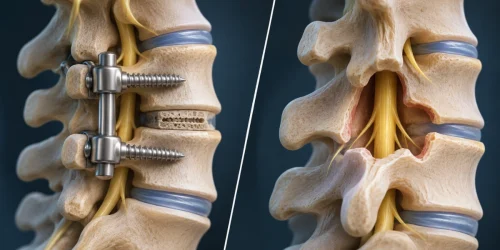
Spinal fusion permanently locks two or more vertebrae together with screws, rods, and bone graft material. It eliminates all motion at the treated segment, accelerates degeneration at adjacent levels (known as adjacent segment disease), and requires months of recovery. It is an irreversible structural alteration to your spine.
Deuk Laser Disc Repair® (DLDR) uses endoscopic laser technology to enter the damaged disc through an incision smaller than a quarter inch. The Holmium YAG laser removes only the damaged, inflammatory disc material that is causing pain with millimeter precision under direct endoscopic visualization. No bones are cut. No muscles are severed. No hardware is implanted. The spine’s natural structure and full range of motion are preserved. The procedure takes about one hour, is performed under sedation in an outpatient surgery center, and patients go home the same day.⁶
In over 20 years and thousands of patients, Deuk Laser Disc Repair® has maintained a 95% success rate with zero complications.⁶
The distinction matters. If your chronic pain originates from a damaged disc, the most logical treatment is one that repairs the disc. Not one that tries to make your brain ignore it.
How Deuk Laser Disc Repair® Works. Step by Step
The procedure begins with a very small incision, less than a quarter inch long. A cylindrical rod called a dilator is inserted through the opening to gently spread the surrounding muscle without cutting it, creating a narrow passage to the spine.⁶
The dilator tip is advanced into the symptomatic disc through the annular tear where the herniation originates. A thin tube called a retractor slides over the dilator and is positioned into the affected disc. The entire surgery takes place through this narrow tube.⁶
An endoscopic camera is then inserted into the retractor, giving the surgeon a direct, high-definition view of the interior of the disc. Unlike traditional spinal fusions, microdiscectomies, or artificial disc replacements, this approach ensures that bones, ligaments, and surrounding healthy tissues are not damaged.⁶
The Holmium YAG laser is then directed with millimeter accuracy by way of endoscopy to excise only the painful, inflamed portions of the disc. Nothing else is affected. Cauterization is achieved during the process to reduce bleeding.⁶
The entire process takes approximately one hour. The incision is closed with a single stitch and a bandage. Patients return home the same day and resume normal activities during a rapid recovery period. No opioids or powerful narcotic painkillers are required after surgery.⁶
What This Means If You Are Living with a Spinal Cord Stimulator or Considering One
If you are currently living with a spinal cord stimulator and your pain relief has plateaued or disappeared, the device is not the problem. The untreated structural condition in your spine is the problem. The stimulator was never designed to fix it.
If you are considering a spinal cord stimulator because your pain management doctor recommended it after injections and physical therapy failed. Ask one question first: has anyone looked at the actual structural source of your pain? Is it a damaged disc, a compressed nerve root, an annular tear? Can it be repaired directly?
If the answer is no, you may be about to implant a permanent device in your body to manage a problem that could have been treated at its source.
Deuk Laser Disc Repair® is the most advanced laser spine surgery in the world, developed and performed exclusively at Deuk Spine Institute. It is designed for patients whose chronic back and neck pain originates from disc pathology: including bulging discs, herniated discs, sciatica, and spinal stenosis.
A free MRI review is the first step toward understanding whether your chronic pain can be treated at its source rather than masked by a device.
Spinal cord stimulators mask pain. DLDR eliminates the source.
Stop managing your pain.
Start repairing the disc.
If your stimulator’s relief has faded, the device isn’t the problem—the untreated disc is. Deuk Laser Disc Repair® treats the structural source of chronic back and neck pain through an incision smaller than a quarter inch.
- 47–74% success rate
- Masks pain signals only
- Revision surgery common
- Battery replacement required
- 95% success rate
- Repairs the damaged disc
- Zero complications in 1,300+ patients
- Same-day outpatient, no hardware
Developed & performed exclusively at Deuk Spine Institute · 20+ years · Thousands of patients
FAQs
Does the Abbott spinal cord stimulator cure chronic back or neck pain?
No. Spinal cord stimulators are pain management devices, not curative treatments.¹ ² They send electrical pulses to the spinal cord to interfere with pain signals before they reach the brain. The structural condition causing the pain. Whether a herniated disc, compressed nerve, or degenerative disc disease remains untreated. This is why many patients experience diminishing relief over time and require revision surgeries or device replacement.⁴ ⁵
What is the actual success rate of spinal cord stimulators?
Published long-term success rates range from 47% to 74%.³ However, “success” in most studies is defined as a 50% reduction in self-reported pain. Not pain elimination or return to full function. Effectiveness tends to decrease over time due to factors like lead migration, scar tissue formation, and neurological adaptation to the stimulation pattern.³ ⁵
What are the most serious risks of the Abbott spinal cord stimulator?
Some of these risks include cerebral spinal fluid leak, epidural hemorrhage, infections that would require the implant to be removed, lead migration that would result in the need for corrective surgery, spinal cord compression, and in some cases, paralysis.⁴ Risks associated with electromagnetic interference include destruction of the implanted device that may lead to very serious burns.¹ The battery of the device may malfunction or deplete early on.⁴
Why does my spinal cord stimulator stop working over time?
Several factors contribute. The implanted leads can physically shift position, changing or losing the stimulation coverage area. Scar tissue can form around the electrode tips, insulating them from the spinal cord and reducing effectiveness. The nervous system can also adapt to a consistent stimulation pattern, requiring higher energy levels or different programming to achieve the same effect.⁴ ⁵ Most fundamentally, the underlying spinal condition continues to progress while the stimulator only manages symptoms.
What is Deuk Laser Disc Repair® and how is it different?
Deuk Laser Disc Repair® (DLDR) is a minimally invasive endoscopic laser spine surgery that directly treats the damaged disc tissue causing chronic pain. Unlike a spinal cord stimulator, which masks pain signals, DLDR uses a Holmium YAG laser guided by an endoscopic camera to remove only the inflammatory disc material with millimeter precision.⁶ No bones are cut, no muscles are severed, no hardware is implanted, and the spine’s full range of motion is preserved. In over 15 years and more than 1,300 patients, the procedure has maintained a 95% success rate with zero complications.⁶
Can I get Deuk Laser Disc Repair® if I already have a spinal cord stimulator implanted?
The best way to determine your candidacy is through a free MRI review with the team at Deuk Spine Institute. Your imaging will be evaluated to determine whether the structural source of your disc pathology is treatable with DLDR, and how your existing implant factors into the treatment plan.
Who is not a candidate for the Abbott spinal cord stimulator?
According to Abbott’s own safety disclosures, the device is contraindicated for patients who are pregnant, under 18 years of age, unable to operate the neurostimulation system, or who are poor surgical candidates.¹ Patients who live or work near strong electromagnetic fields should also exercise extreme caution, as interference can damage the device or cause unintended stimulation.¹
Is a spinal cord stimulator better than spinal fusion?
None of these approaches treats the disc itself. Spinal fusion fuses the vertebrae, stops their movement, and causes accelerated degeneration in the vertebrae adjacent to the affected ones. Spinal cord stimulation uses surgery to implant a device to block the transmission of pain without correcting the anatomy.¹ ² Each of these surgeries poses a considerable risk to the patient. The third option is the treatment of the degenerated disc itself with Deuk Laser Disc Repair®.
Sources
View Sources
- Abbott Neuromodulation. Important safety information: Spinal cord stimulation systems. Abbott.com.
- Deer TR, Mekhail N, Provenzano D, et al. The appropriate use of neurostimulation of the spinal cord and peripheral nervous system for the treatment of chronic pain and ischemic diseases. Neuromodulation. 2014;17(6):515–550.
- Turner JA, Loeser JD, Deyo RA, Sanders SB. Spinal cord stimulation for patients with failed back surgery syndrome or complex regional pain syndrome: a systematic review of effectiveness and complications. Pain. 2004;108(1-2):137–147.
- Eldabe S, Buchser E, Duarte RV. Complications of spinal cord stimulation and peripheral nerve stimulation techniques: a review of the literature. Pain Medicine. 2016;17(2):325–336.
- Hayek SM, Veizi E, Hanes M. Treatment-limiting complications of percutaneous spinal cord stimulator implants: a review of eight years of experience from an academic center database. Neuromodulation. 2015;18(7):603–609.
- Deuk Spine Institute. Deuk Laser Disc Repair®. DeukSpine.com.