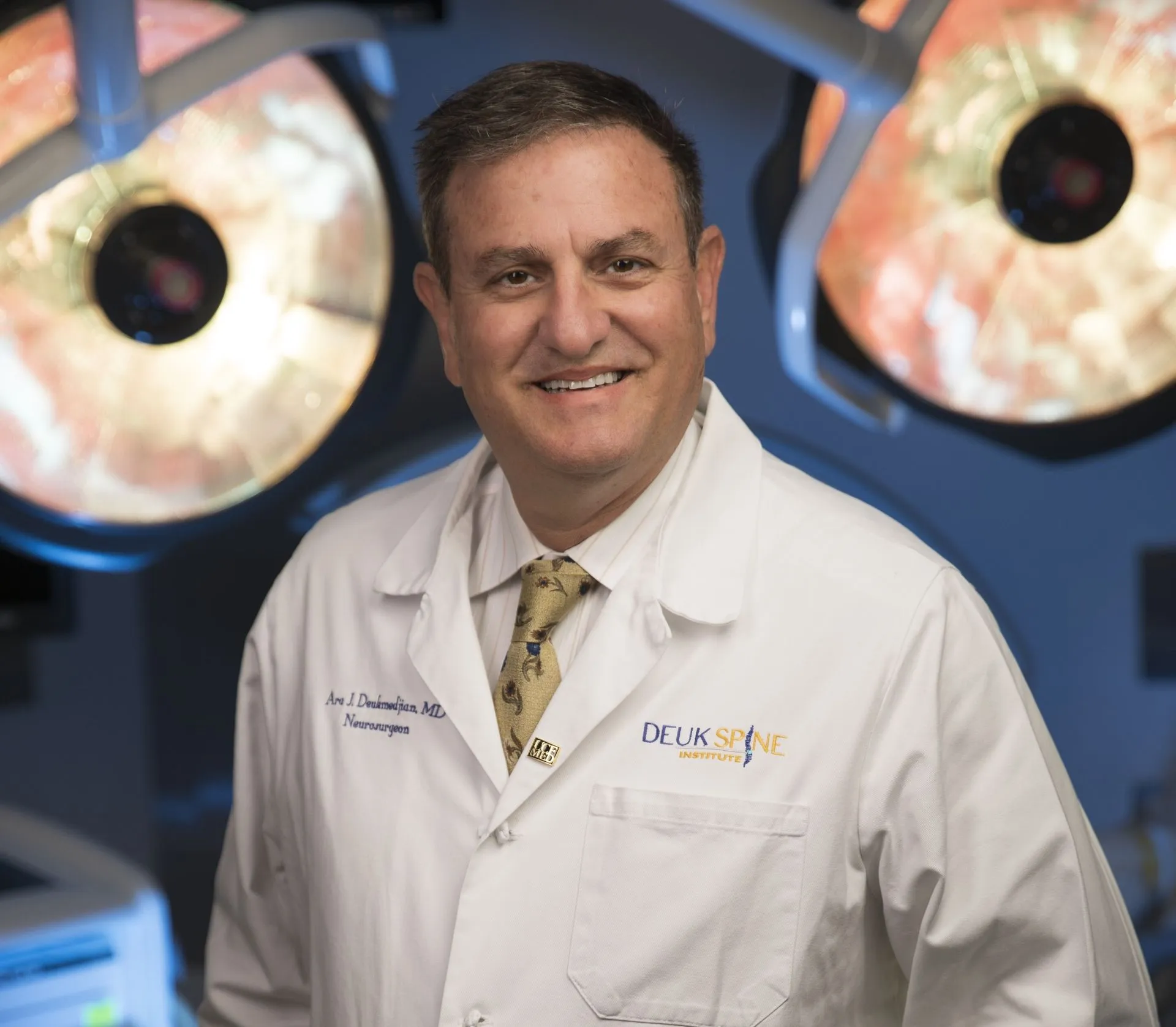

By Dr. Ara Deukmedjian, MD
Board Certified Neurosurgeon
Medically reviewed on: September 22, 2026
Medical Disclaimer: This article is for general educational purposes only and does not constitute medical advice. Consult a qualified physician for guidance specific to your condition.
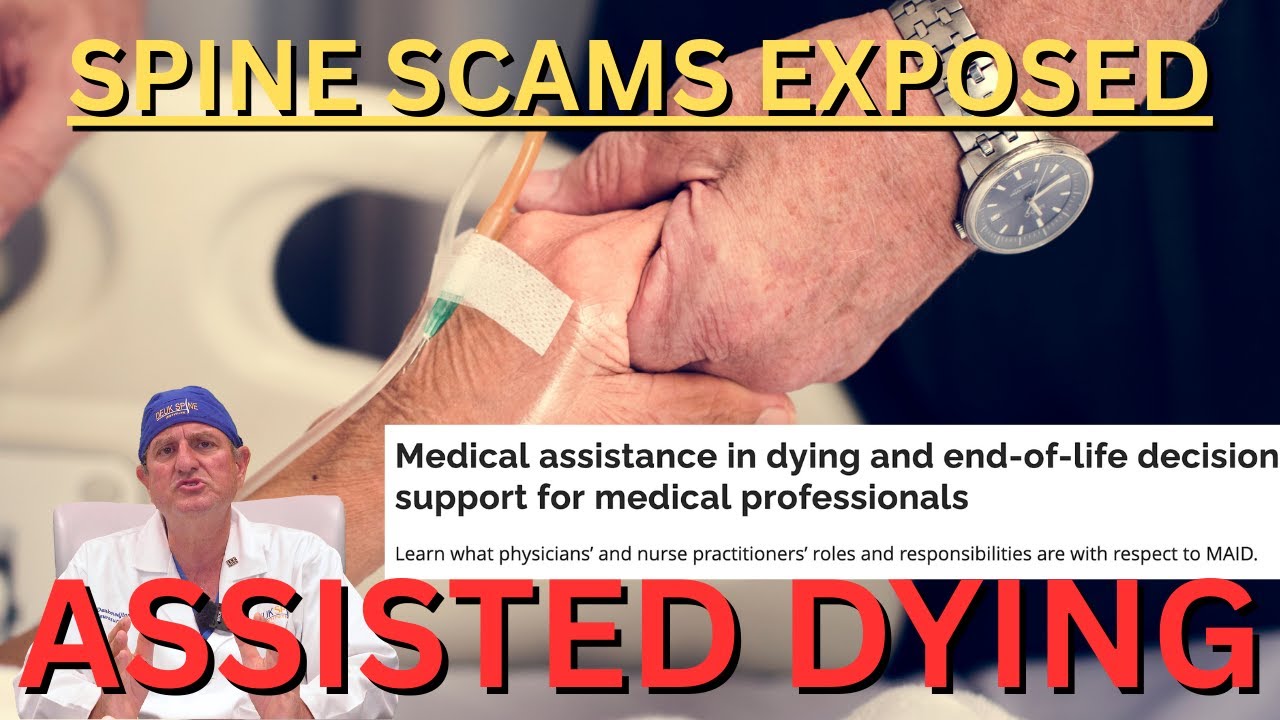
Video Transcription
View Transcript
I’m Dr. Ara Deukmedjian with the Deuk Spine Institute, and we’re here for a Spine Scans session. Back pain is not a death
0:14
14 seconds
sentence. Yet, there are many countries that are jumping on the bandwagon of treating patients with chronic conditions like back pain and neck pain
0:23
23 seconds
as though they should be facing a death sentence. In Canada, for example, you can now die with dignity. They have an
0:31
31 seconds
entire website and program that is set up for people with chronic medical conditions where patients who don’t want
0:39
39 seconds
to live and suffer anymore in pain can actually ask doctors and nurses to help them die. Now, what’s the problem with
0:46
46 seconds
that? There’s nothing wrong with that program. If you have cancer and there is no cure and you’re terminal and you’re going to be dying in the next 3 to 6
0:54
54 seconds
months, and cancer is a horrible disease that doesn’t just kill you at the end of 3 or 6 months, but you suffer the
1:02
1 minute, 2 seconds
entire time. So, it’s understandable that a solution like this would exist for something like cancer. But what about back and neck pain? Deuk Spine
1:10
1 minute, 10 seconds
Institute has figured out that there are 30 things that are specifically responsible for back pain, and we can now
1:17
1 minute, 17 seconds
cure 99% of back pain. Yet, if you live in Canada, you will not get a cure. You will suffer, and you will qualify
1:26
1 minute, 26 seconds
according to the government in Canada for assisted dying. Now, to see if you’re a candidate for assisted dying, all you have to do is go see a doctor or
1:35
1 minute, 35 seconds
nurse who tells you, “Sorry, we can’t cure the back or neck pain that you have, so you can die.” And we’ll help you do that. If you look at this form here
1:43
1 minute, 43 seconds
behind me, this is available to people living in Canada. And by the way, they have to have insurance according to the form. And really, what this is, is this is
1:51
1 minute, 51 seconds
a way for the government of Canada and the insurance companies to basically stop paying for your medical care when
1:58
1 minute, 58 seconds
you have back pain or neck pain. They don’t want to spend the money on you.
2:02
2 minutes, 2 seconds
Instead, they want you to kill yourself so that they don’t have to pay any money to the doctors or practitioners who treat back and neck pain. That’s what
2:10
2 minutes, 10 seconds
this form is all about. According to the requirements, a person is considered to have a grievous and irremediable medical condition when they have a serious and incurable illness, disease, or disability. Lower back pain
2:25
2 minutes, 25 seconds
qualifies for that for most doctors and most patients because they cannot get a cure elsewhere. So, they’re told they have a chronic condition that is not
2:33
2 minutes, 33 seconds
fixable. They have to be in an advanced state of irreversible decline in capacity. Most people living with back and neck pain, they get to a point where
2:42
2 minutes, 42 seconds
basically they can’t do anything they want to do. They have to quit their jobs. They have to quit their hobbies.
2:47
2 minutes, 47 seconds
They have to change the way they live life and really take it easy. So that’s the state of decline they’re talking about. And they have to endure physical
2:56
2 minutes, 56 seconds
and psychological suffering, which people with chronic back and neck pain do, and that’s due to the illness or disability that is intolerable to the person. Let me spell this out for you.
3:06
3 minutes, 6 seconds
If you have chronic back pain or neck pain in Canada and some of the other countries as well that are jumping on board, like Australia and Spain and
3:15
3 minutes, 15 seconds
Austria and New Zealand, and there will be more folks in the future who will treat people with back and neck pain the same way. If you have back or neck pain,
3:23
3 minutes, 23 seconds
this reminds me of a movie I watched as a kid back in the ’70s called Logan’s Run, where the government decided that
3:30
3 minutes, 30 seconds
well, if you live past 30, you start to develop diseases and you become an expense to society. And they didn’t want
3:38
3 minutes, 38 seconds
to pay for your medical conditions after the age of 30. So they created this thing called Carousel, where you basically disappeared from society at
3:46
3 minutes, 46 seconds
the age of 30, on your 30th birthday, and were never to be seen again. And of course, what they really did was they killed those people so that they wouldn’t have
3:54
3 minutes, 54 seconds
anybody over the age of 30 with these chronic diseases that they’d have to pay for. Well, this is the same thing happening right now. It’s no joke. It’s
4:02
4 minutes, 2 seconds
movies were made about it in the past as a, “Wow, can you imagine a society where they actually killed people with diseases?” That’s what’s happening now.
4:11
4 minutes, 11 seconds
If you live in the United States of America like I do, then you might think, well, this would never happen in America. We don’t allow those kinds of things to happen. It’s happening, folks.
4:20
4 minutes, 20 seconds
If you live in the state of California, you can actually ask for end-of-life assistance from the state of California.
4:27
4 minutes, 27 seconds
It’s called the End of Life Option Act, and it’s law. So, if you have a terminal condition like cancer and you have less than 6 months to live, you can actually
4:36
4 minutes, 36 seconds
ask the government to help you kill yourself. Now, I can understand with certain types of cancer where they’re incurable today that that would be
4:43
4 minutes, 43 seconds
reasonable. However, it creates what’s called a slippery slope. And what that means is it’s an opening of the door
4:51
4 minutes, 51 seconds
which will then be opened wider. So today it’s cancer in California, but maybe next year they’re going to pass laws that allow people with back and
5:00
5 minutes
neck pain to be killed as well. Folks, I got news for you. Deuk Spine Institute has discovered the cure to back and neck pain. All you have to do is come here.
5:10
5 minutes, 10 seconds
We offer a free MRI review. Do it from the comfort of your own home. Fill out our form on our website. Send us your
5:17
5 minutes, 17 seconds
MRI images. I’ll review them personally with you, and through a Zoom call within 10 minutes, I’ll tell you exactly what’s causing your back pain
5:26
5 minutes, 26 seconds
and, more importantly, exactly how we can fix it with one of our minimally invasive proprietary techniques. We’ve been performing these minimally invasive
5:34
5 minutes, 34 seconds
surgeries for 20 years. Our success rate is 99.6% for curing back pain from
5:41
5 minutes, 41 seconds
herniated discs, bulging discs, spinal stenosis, and any other condition involving the back or neck. Folks, you
5:49
5 minutes, 49 seconds
owe it to yourself. You owe it to the people who love you and care about you.
5:53
5 minutes, 53 seconds
Check out Deuk Spine Institute. Do the free MRI review. Avoid these horrible programs of assisted dying just because
6:00
6 minutes
Key Points
✓ Assisted-dying laws fall into two broad models: one limited to the terminally ill, and one open to people with non-terminal but “grievous and irremediable” suffering.8
✓ In Canada, a natural death does not have to be foreseeable to qualify; these “Track 2” cases made up 4.4% of the 16,499 assisted deaths recorded in 2024.2
✓ Canada’s own expert panel confirmed that chronic pain conditions are not excluded from eligibility.4
✓ A United Nations committee and Canadian disability advocates have urged Canada to repeal Track 2, warning it offers death where it should offer support.5 6
✓ In the United States, every assisted-dying law. Including California’s still requires a terminal diagnosis of six months or less, so chronic back or neck pain does not qualify.7
✓ The deeper issue for pain patients is the word “incurable.” Most chronic back and neck pain has an identifiable, treatable structural cause once it is diagnosed correctly.9
✓ Deuk Laser Disc Repair® treats back and neck pain from herniated discs by removing the damaged tissue at its source. With published outcomes averaging over 90% pain resolution, helping patients return to pain-free daily life.11
Where this conversation is coming from
Over the last decade, medically assisted death has moved from the margins of medicine into mainstream law across much of the developed world. It now exists, in some form, in Canada, the Netherlands, Belgium, Luxembourg, Spain, Austria, Switzerland, every Australian state, New Zealand, and eleven U.S. jurisdictions.8 For a patient dying of an aggressive, untreatable cancer. Suffering with months to live and no realistic prospect of relief. The case for a peaceful, chosen death is one many thoughtful people find compelling.
But as these laws spread, the eligibility line has been moving. In some countries, you no longer have to be dying to qualify. You only have to be suffering in a way that is judged serious and irreversible. That shift is exactly where people living with chronic back and neck pain should pay attention. Not because anyone is being marched toward a clinic, but because of the quiet assumption buried inside these laws: that some pain is simply incurable, and that the reasonable response is to help the person end their life rather than end their pain.
Two very different models of assisted dying
It helps to be precise, because the public conversation often blurs together laws that are actually quite different. Researchers who compare these regimes internationally describe two dominant models.8
The distinction is not academic. Under the first model, a person with chronic back pain is legally nowhere near eligible, because chronic pain, however severe, is not terminal. Under the second model, the door is at least open and Canada has walked through it further than most.
What Canada’s law actually says
Assisted dying for medical reasons was legalized in Canada in 2016. In 2021, the government took away the need for the natural death of a person to be “reasonably foreseeable.”3 Today, for someone to undergo MAID (Medical Aid In Dying), they must suffer from a “grievous and irremediable medical condition” that is defined as “an incurable illness, disease or disability; an advanced state of irreversible decline in capability; and intractable and intolerable suffering that cannot be relieved under conditions he/she considers acceptable.”3

Cases where death is foreseeable are called “Track 1.” Cases where it is not the newer category are called “Track 2.” In 2024, Health Canada recorded 16,499 assisted deaths; Track 2 accounted for 4.4% of them.2 A separate proposal to extend eligibility to people whose sole condition is a mental illness has been repeatedly delayed, and is currently postponed until March 2027.1
So where does chronic pain fall? Notably, it is not carved out. Canada’s own federal Expert Panel on MAID and Mental Illness observed that “there are conditions that are not primarily within the domain of psychiatry, such as chronic pain conditions, that are not excluded” from eligibility.4 Health Canada’s monitoring data has likewise noted chronic pain among the conditions practitioners have listed in assisted-death declarations.4 In a suffering-based system, in other words, severe chronic pain that has been labeled incurable can put a person within reach of eligibility.
The alarm being raised and who is raising it
This is not a fringe worry. It is being voiced by disability-rights organizations, legal scholars, and international human-rights bodies. In March 2025, the United Nations Committee on the Rights of Persons with Disabilities reviewed Canada and recommended that it repeal Track 2, warning that making assisted death available to people whose deaths are not foreseeable risks discriminating against people with disabilities.5 6
The core objection is about what a society offers people in distress. As University of British Columbia law professor Isabel Grant put it, when a non-disabled person wants to die, the system responds with suicide prevention and support; the concern is that Track 2 responds to disabled and chronically ill people with something else.6
Somebody else who wants to die, we offer them suicide prevention, we offer them supports. We don’t offer them death.
— Isabel Grant, law professor, University of British Columbia, on Track 2 MAID6
Advocates point to cases in which people appear to have chosen an assisted death not because their suffering was truly irremediable, but because the supports that could have relieved it. Adequate housing, income, home care, timely treatment were never provided.6 Reviewers have also noted that Track 2 recipients are disproportionately women with disabilities.6 The through-line of the criticism is simple: when the state finds it easier to approve a death than to fund a life, “choice” starts to look like something else.
What about the United States?
It is worth being clear-eyed here, because this is where public conversation often gets ahead of the facts. Some worry that the U.S. is on the verge of following Canada’s path that a state like California might soon extend assisted dying to people with chronic conditions like back pain. As of today, that is not what the law says.
California’s End of Life Option Act, like every other U.S. assisted-dying statute, requires a terminal disease with a prognosis of six months or less, confirmed by two physicians, with the medication self-administered by the patient.7 California’s law also states specifically that no one qualifies based solely on age or disability.10 Chronic back or neck pain. Which is not terminal does not meet that bar. The “slippery slope” from terminal illness to chronic pain is a genuine subject of debate, and reasonable people watch the trend in Canada with concern; but in the United States it remains a debate about the future, not a description of current law.
The other side of the argument
In fairness, supporters of these laws make a serious case, and it deserves to be represented honestly. They argue that mentally competent adults have the right to decide how much suffering they will endure. Multiple assessments, waiting periods, capacity evaluations are built into the process; and that in jurisdictions with decades of experience, they see a carefully governed medical practice rather than the abuses critics fear.10 The disagreement between these views is real, and it is not going to be settled in a spine clinic’s blog. What we can speak to is the medical premise underneath it all.
The premise worth challenging: “incurable”
Every suffering-based assisted-dying law rests on a medical judgment that a person’s condition is incurable and their suffering irremediable. For chronic back and neck pain, that judgment is often wrong not because the pain isn’t real, but because the underlying cause was never precisely identified or properly treated.
Most back pain is not even a surgical problem. The Mayo Clinic notes that the majority of back pain improves within about three months, and conservative care physical therapy, anti-inflammatory medication, targeted injections. Should almost always be tried first.9 But when pain persists for years and imaging shows a clear structural source that matches the symptoms, “incurable” is frequently the wrong label. It usually means the true pain generator hasn’t been found, or that the only treatments offered were the biggest and most destructive ones and were understandably declined.
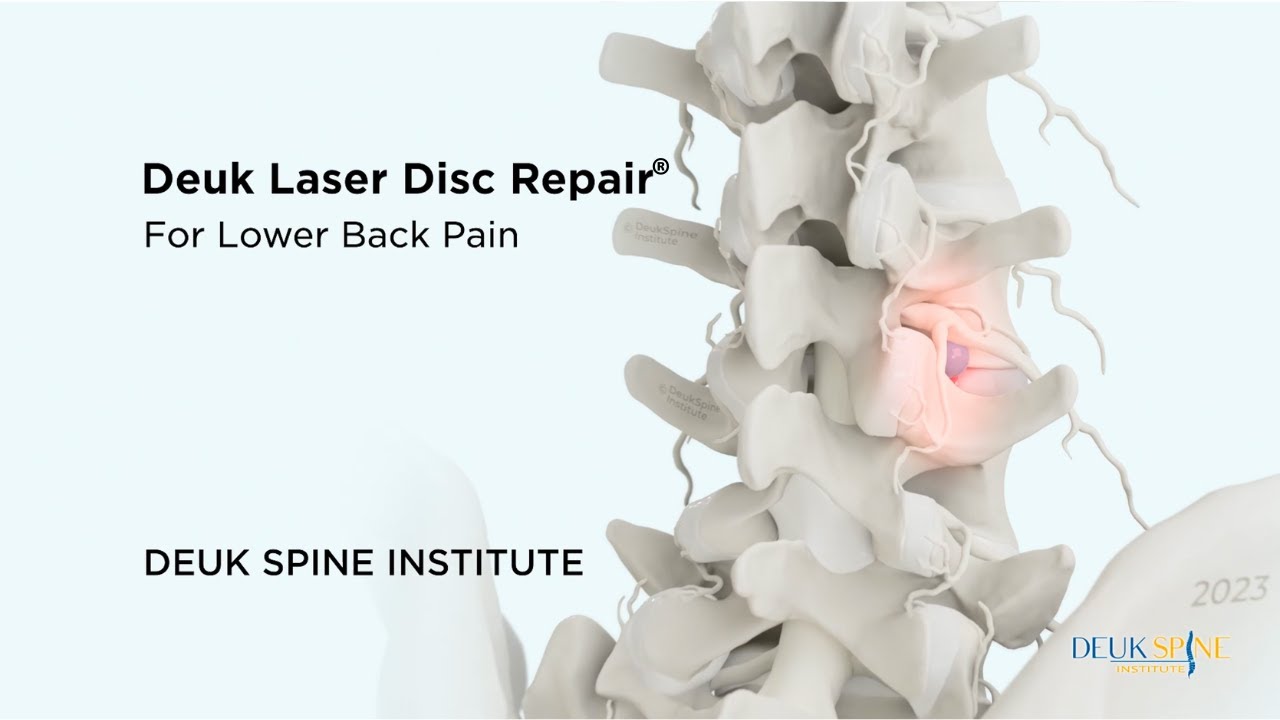
At Deuk Spine Institute, the entire approach is built on diagnosis first. Dr. Deukmedjian personally reviews each patient’s MRI to identify the exact disc or nerve responsible for the pain before any treatment is discussed. When that structural source is found and treated directly, outcomes in our published case series have been strong: in long-term follow-up of lumbar Deuk Laser Disc Repair® patients, average reported resolution was 92% for lower back pain and 93% for radicular (nerve) symptoms, with same-day discharge and no complications recorded in that series.11 Cervical and thoracic results in our published abstracts have been comparable.11
These are outcomes from carefully selected patients with a confirmed discogenic pain source not a promise that every case can be resolved, and not a substitute for a real evaluation. But they make a point that matters enormously in this debate: for a great many people who have been told their spinal pain is permanent, that verdict deserves a second opinion before it is ever accepted as final.
The bottom line
The debate over assisted dying is a serious one, and the strongest version of every position deserves respect. Including the autonomy of a dying patient and the alarm of disability advocates alike. But for the specific population this clinic serves, one message stands above the policy argument: chronic back and neck pain is not a terminal illness, and in the great majority of cases it is not a life sentence either. Before anyone accepts that their pain is permanent and incurable, they owe it to themselves to be sure the diagnosis is right and the real options have been exhausted. Often, they have not been.
Chronic spinal pain is not a life sentence. It is a diagnosis waiting to happen
Before you accept “incurable,”
make sure the cause has been found.
Most chronic back and neck pain has an identifiable, treatable structural source—a damaged disc, a compressed nerve, an annular tear. When the real pain generator is found and treated directly, “permanent” pain often isn’t. A free MRI review by a board-certified neurosurgeon is the place to start.
resolution reported
resolution reported
across 2,700+ cases
- Years of injections, medications, and symptom management
- Pain labeled “incurable” or “irremediable”
- Structural damage continues to progress
- Treatment options narrow over time
- Exact disc or nerve causing pain is pinpointed
- Damaged tissue removed with laser precision
- No fusion, no hardware, no narcotics
- Same-day outpatient, motion preserved
Deuk Spine Institute · Board-certified neurosurgeon · Peer-reviewed published outcomes · Diagnosis first
FAQ
Can someone qualify for assisted dying because of chronic back or neck pain?
Answer
It depends entirely on the country. In the United States, Australia, and New Zealand, assisted-dying laws require a terminal illness with roughly six months or less to live, so chronic back or neck pain does not qualify.8 In suffering-based systems such as Canada’s, a terminal diagnosis is not required, and Canada’s own expert panel has confirmed that chronic pain conditions are not excluded from eligibility.4 That does not mean pain patients are being encouraged toward it, but the eligibility door is open in a way it is not in the U.S.
Does California’s End of Life Option Act apply to back pain?
Answer
No. California’s law requires a terminal disease with a prognosis of six months or less, confirmed by two physicians, and states that no one qualifies based solely on age or disability.7 10 Chronic back or neck pain is not terminal and does not meet that standard.
Why did a UN committee ask Canada to repeal part of its MAID law?
Answer
In 2025, the UN Committee on the Rights of Persons with Disabilities recommended that Canada repeal “Track 2,” which allows assisted death for people whose natural death is not reasonably foreseeable.5 The committee and Canadian disability advocates argued that offering death to people who lack adequate housing, income, care, and support risks discriminating against people with disabilities rather than genuinely relieving irremediable suffering.6
Isn’t there a legitimate case for assisted dying?
Answer
Yes and it should be stated fairly. Supporters argue that mentally competent adults have a right to decide how much suffering to endure, that multiple safeguards and assessments are built into these laws, and that jurisdictions with long experience report a carefully governed practice.10 The concern raised in this article is narrower: that “incurable” is often the wrong description of chronic spinal pain, and that a treatable condition should never be mistaken for an irremediable one.
Is most chronic back pain actually treatable?
Answer
Most back pain improves on its own within a few months, and conservative care should be tried first.9 When pain persists for years, the problem is usually that the specific structural source has not been correctly identified. With an accurate diagnosis, many patients who were told their pain was permanent turn out to have a treatable cause. An MRI review by an experienced spine specialist is the place to start.
What is Deuk Laser Disc Repair, and what results does it report?
Answer
Deuk Laser Disc Repair® is a minimally invasive, outpatient procedure that uses a Holmium YAG laser to remove only the damaged, pain-generating tissue within a spinal disc. Without fusion, hardware, or removal of the disc.12 In Dr. Deukmedjian’s published long-term case series, lumbar patients reported average resolution of about 92% for back pain and 93% for nerve symptoms, with same-day discharge and no complications recorded in that series.11 Individual results depend on an accurate diagnosis and whether a patient is a candidate, which is what the free MRI review is designed to determine.
Sources
View Sources
- Health Canada. Medical assistance in dying: Overview (eligibility for persons suffering solely from mental illness delayed to March 17, 2027). canada.ca ↩
- Health Canada. Sixth Annual Report on Medical Assistance in Dying in Canada (2024 data: 16,499 provisions; Track 1 95.6%, Track 2 4.4%). canada.ca ↩
- Department of Justice Canada. Canada’s medical assistance in dying (MAID) law (grievous and irremediable condition; removal of “reasonably foreseeable death” requirement, 2021). justice.gc.ca
- Health Canada. Final Report of the Expert Panel on MAiD and Mental Illness (chronic pain conditions “are not excluded”). canada.ca
- Inclusion Canada. Canadian Disability Advocates Highlight Canada’s MAiD Program at United Nations Review (March 2025). inclusioncanada.ca
- CTV News. United Nations report says Canada should repeal MAID for people with non-terminal illness (UN CRPD recommendation; Isabel Grant remarks; Track 2 demographics). am800cklw.com
- UCLA Health / Sutter Health. California End of Life Option Act (terminal disease, prognosis of six months or less, two-physician confirmation, self-administration). uclahealth.org
- Cardus / Nuffield Trust. International comparisons of assisted-dying regimes (terminal-only vs. suffering-based models; jurisdictions listed). nuffieldtrust.org.uk
- Mayo Clinic. Back surgery: When is it a good idea? (most back pain resolves within ~3 months; conservative care first). mayoclinic.org
- Compassion & Choices. California End of Life Option Act FAQ (safeguards; no qualification based solely on disability or age). compassionandchoices.org
- Deuk Spine Institute. Peer-Reviewed Publications & Patents (Lumbar DLDR long-term outcomes: 92% axial / 93% radicular resolution; cervical and thoracic series). deukspine.com/publications
- Deuk Spine Institute. Deuk Laser Disc Repair® (procedure description and reported clinical results). deukspine.com