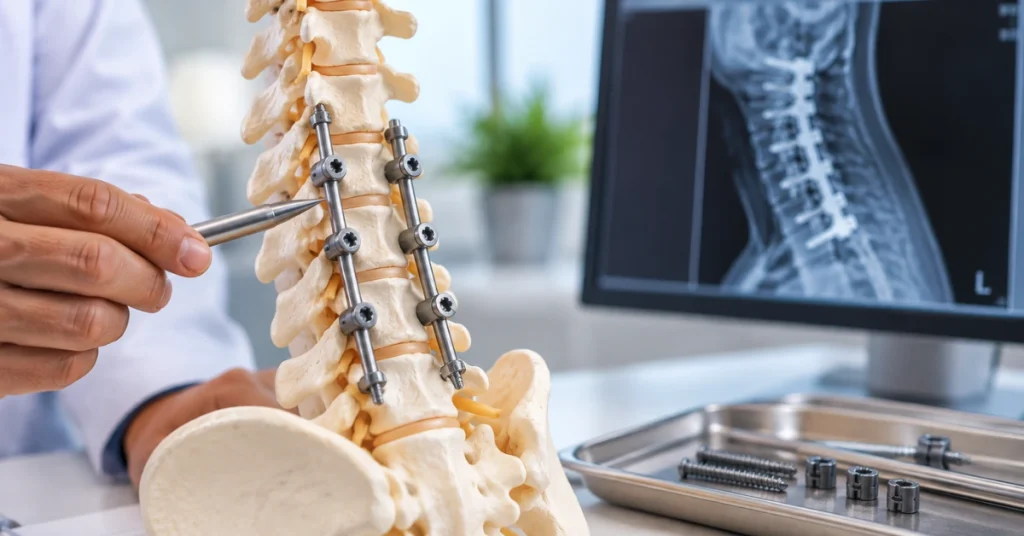
If a surgeon has told you that you need spinal fusion, you have probably already asked the question most patients ask right before they agree to surgery: what is actually going into my back?
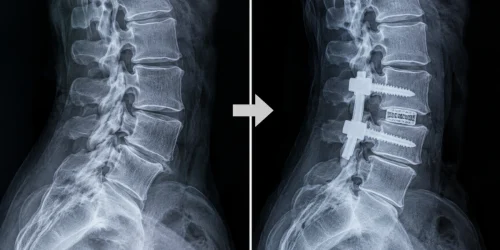
It is a fair question, and most patients do not get a straight answer to it. They hear “fusion” and picture bones growing back together on their own. What actually happens is that a surgeon opens the spine, drills into the bone, and permanently implants metal hardware to hold two or more vertebrae in place while the bone tries to fuse around it. The hardware does not come back out. It stays in your spine for the rest of your life.
As a board-certified neurosurgeon who has spent my career developing an alternative to this exact procedure, I think patients deserve to know precisely what “fusion” means in physical terms before they consent to it.

Diagnosis. Answers. Relief.
Submit your MRI for a free expert review by Dr. Ara Deukmedjian, M.D. —
board-certified neurosurgeon. No obligation. Real answers.
The Three Things That Get Implanted
Every instrumented spinal fusion involves some combination of the following three components.
Pedicle screws. These are threaded screws, typically made of titanium alloy or, less commonly, stainless steel, that the surgeon drives directly into the pedicles, the narrow bony columns at the back of each vertebra. A typical fusion uses at least four screws, two per vertebra being fused, though multi-level fusions require far more.
Rods. Once the screws are in place, the surgeon connects them with metal rods, usually titanium, cobalt-chromium, or occasionally a nickel-titanium alloy called nitinol. The rods span the screws like a bridge, locking the vertebrae into a fixed position relative to each other.
Interbody cages. In many fusions, the surgeon also removes the damaged disc entirely and replaces it with a cage, a small hollow device made of titanium, carbon fiber, or a medical plastic called PEEK (polyetheretherketone). The cage is packed with bone graft material and acts as a spacer that is meant to encourage new bone to grow through it and fuse the two vertebrae together.
Depending on the surgical approach, cross-links, plates, or hooks may be added to the construct as well. All of it is designed to do one job: eliminate motion at that spinal segment permanently.
Why Surgeons Use Hardware in the First Place
Fusion surgery works on a simple mechanical idea. If a segment of your spine is unstable, painful, or degenerated, locking it in place should stop it from moving and, in theory, stop it from hurting. The hardware is not the fusion itself. It is scaffolding. The screws, rods, and cage hold the vertebrae rigidly still while your body attempts to grow new bone across the joint over several months. Once that bone bridge forms (if it forms), the hardware becomes largely redundant. But it is virtually never removed, because a second surgery to take it out carries its own risks with little clinical benefit.
That last point matters more than most patients realize going in. As one instrumented fusion overview puts it, the metal bridge gives your spine immediate strength, but it is a temporary solution wearing a permanent one’s clothes: the hardware is never as strong on the day of your five-year follow-up as it was on the day it was implanted.
What This Actually Means for Your Spine Long Term
This is the part patients are rarely told in the consultation room.
The segment above and below the fusion now absorbs more stress. Your spine moves as a connected chain. When one or more segments are locked rigid, the segments directly above and below have to compensate for the motion that used to be shared across more of the spine. Over years, that added mechanical load accelerates wear on those adjacent discs and joints. This is the mechanism behind adjacent segment disease, one of the most common reasons fusion patients end up needing a second surgery.
Hardware can loosen, break, or migrate. Screws can back out of bone that has not fused solidly. Rods can fatigue and fracture under years of repetitive load, particularly at spinal levels that see constant motion. When this happens, it typically requires revision surgery, meaning you go through recovery a second time to fix a problem the first surgery caused.
The bone drilling itself is not reversible. Once a surgeon has drilled pedicle screw channels into your vertebrae, that bone structure is permanently altered. This is separate from whatever condition brought you to the surgeon in the first place.
Not every fusion successfully fuses. A meaningful percentage of instrumented fusions result in what is called a pseudarthrosis, where the intended bone bridge never fully forms and the hardware ends up doing the load-bearing job indefinitely, well past its intended design life.
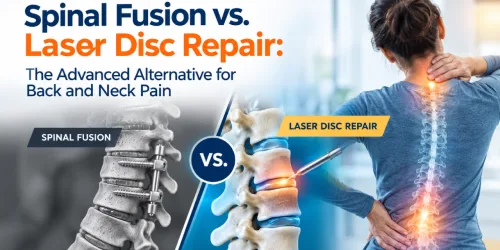
None of this means fusion is never appropriate. For spinal instability, certain fractures, and specific deformities, it can be the right call, and if you have already been through it, that decision may have made complete sense given what you were dealing with. But for the much larger group of patients being routed toward fusion for a single herniated disc, degenerative disc disease, or facet-driven pain without instability, it is worth understanding that you are choosing permanent hardware and permanently reduced motion at that segment, not just “getting the disc fixed.” Our breakdown of what different lumbar fusion procedures actually involve and the full cost picture of spinal fusion go deeper into both the surgical variations and the financial side of that decision.
The Alternative: Treating the Disc Without Hardware
This is exactly the gap I designed Deuk Laser Disc Repair® to close. DLDR treats the herniated or damaged portion of the disc directly through a quarter-inch incision, using laser energy to remove the specific tissue causing nerve compression or pain. There are no pedicle screws, no rods, no interbody cage, and no bone drilling. The disc itself and the surrounding bone stay intact, which means the segments above and below are not left to absorb extra load for the next twenty years.
Patients walk within an hour of the procedure and go home the same day. There is no bone graft waiting to fuse, no hardware to monitor on future imaging, and no adjacent segment disease risk introduced by the surgery itself, because nothing was fused or locked in place.
I have performed more than 2,000 cervical and lumbar procedures with this approach, with zero major complications documented in published clinical outcomes and a 95% success rate in pain elimination. That data is published in peer-reviewed research, not just reported on our own site, specifically so patients evaluating whether this is real can verify it independently rather than take our word for it.
If You Have Already Been Told You Need Fusion
Being told you need fusion is not the same as having no other option. It means one surgeon, using one set of tools, concluded that locking the segment in place was the best answer available to them. A second opinion from a surgeon who treats discs without hardware is not a step backward in your care. It is the missing piece of information you need to make this decision with your eyes open.
The place to start is your MRI, not another consultation. Submit it and we will tell you plainly whether you are a candidate for a hardware-free alternative to the fusion you were recommended, or whether fusion genuinely is the right path for your case. Either answer is useful. What is not useful is agreeing to permanent screws and rods without knowing there was a question worth asking first.
You’ve Done the Research. Now Get a Real Answer.
You already know more about what fusion involves than most patients do walking into surgery. The next step is finding out whether it is actually necessary in your case.
Submit your MRI for a free expert review, no obligation, and get a direct answer from a board-certified neurosurgeon about whether a hardware-free alternative is realistic for your spine.