
Your surgeon has told you that fusion is the answer. Maybe you have already scheduled the date, or maybe you are still turning it over at night, doing spinal fusion recovery research and hoping someone will lay out the full timeline honestly instead of in three reassuring sentences during a fifteen minute appointment.
I am Dr. Ara Deukmedjian, a board certified neurosurgeon, and I have spent more than 30 years treating the exact back and neck conditions that lead surgeons to recommend fusion. I trained in this surgery, performed it early in my career, and later built Deuk Laser Disc Repair® as an alternative after watching patient after patient trade one problem for another. Here is the honest week by week spinal fusion recovery timeline, why the pain sometimes returns months or years later, and what a motion preserving option looks like in comparison.
No cost · No obligation
Live Pain Free
Upload your MRI for a free expert review by Dr. Ara Deukmedjian, M.D. — board-certified neurosurgeon. Ten minutes can change your life.
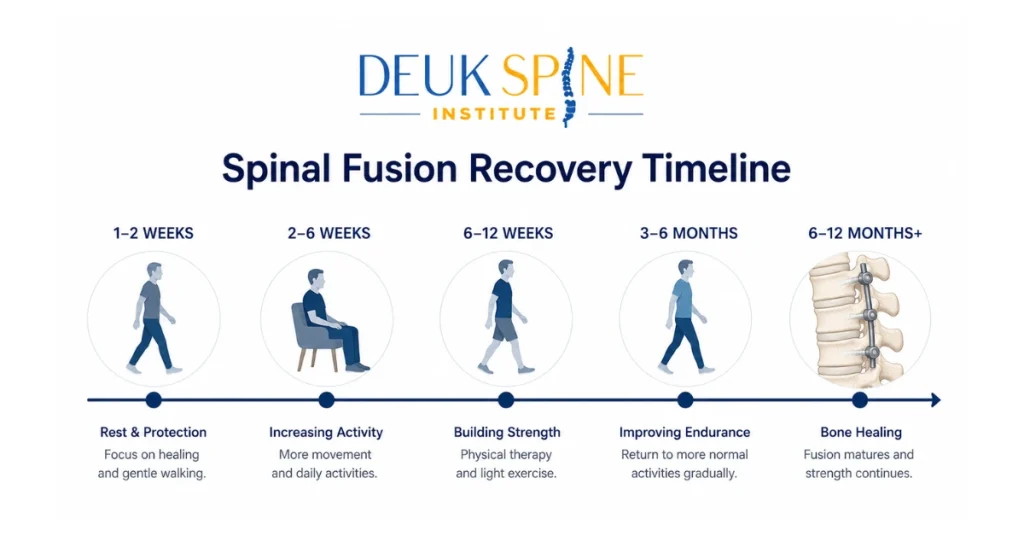
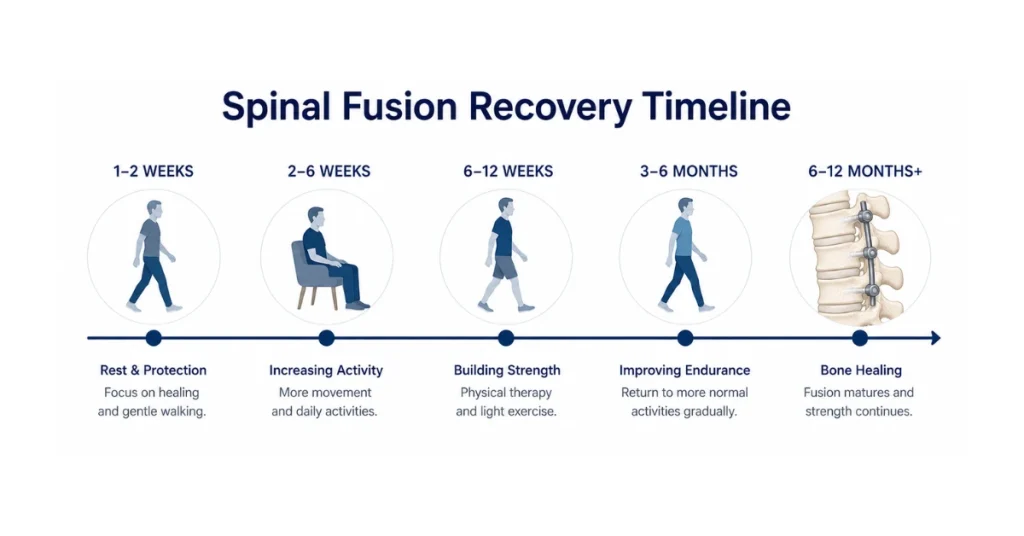
The Spinal Fusion Recovery Timeline, Week by Week
Fusion surgery permanently joins two or more vertebrae together, usually with a combination of bone graft and metal hardware. Your body needs time to grow new bone across that joint and lock it in place. This is a biological process, not a scheduling preference, and it drives every stage of the spinal fusion recovery time you are about to read.
Patients researching “spinal fusion recovery time” are often given a rough estimate of a few months. In practice, the full spinal fusion recovery timeline stretches much longer, and understanding each phase in advance changes how you plan your work, your finances, and your expectations.
I want to walk through that timeline honestly, stage by stage, because a patient who knows what is actually coming can make arrangements for childcare, work leave, and household help well before surgery day. Patients who are only told “a few months” are frequently the ones calling our office a year later asking why they are still restricted.
Weeks 1 and 2, Hospital and Early Home Recovery
Most fusion patients spend one to four nights in the hospital, longer for multi level procedures. You will likely wear a brace, need help walking to the bathroom, and rely on prescription pain medication around the clock. Basic tasks like showering, dressing, or getting in and out of a car require assistance during this stretch. Sleep is often disrupted because comfortable positions are limited while the surgical site is still acutely inflamed.
Weeks 3 through 6, Restricted Activity
You are home, but the restrictions are strict. Most surgeons prohibit bending, lifting anything over five to ten pounds, twisting, and driving. Sitting for long periods is uncomfortable because the fused segment has not yet stabilized. Many patients describe this period as the hardest part of life after spinal fusion, since the acute pain has faded but independence has not returned. Household chores, grocery shopping, and even holding a grandchild often fall to someone else during these weeks.
This is also the stretch where many patients tell me the emotional weight becomes as heavy as the physical restrictions. Losing the ability to drive, cook, or care for family members for six straight weeks affects mood, relationships, and confidence in ways nobody mentioned in the pre-surgical consultation.
Months 2 and 3, Physical Therapy Begins
Once imaging shows early bone growth, formal physical therapy typically starts. The goal is to rebuild core and back muscle strength that weakened during the immobile weeks. This phase often includes two to three sessions per week and can bring its own soreness as the body relearns basic movement patterns. Patients frequently ask why therapy hurts almost as much as the surgery did. The honest answer is that months of guarded movement leave muscles deconditioned, and rebuilding that strength takes real, sometimes uncomfortable, effort.
Months 4 through 6, Partial Return to Normal Life
Many patients return to a desk job somewhere in this window, though lifting and impact activity often remain off limits. Full fusion, meaning solid bone bridging between the vertebrae, has not necessarily occurred yet. Some patients are still wearing a brace part of the day. Athletic activity, physical labor, and anything involving repeated bending are usually still restricted. This is often the stage where patients quietly realize the surgery they were told would take a few months is going to take considerably longer.
Months 6 through 12 and Beyond, Full Assessment
Somewhere between six months and a year, your surgeon will order imaging to confirm whether the fusion has actually taken. If it has, activity restrictions gradually lift, though many surgeons still recommend permanent limits on high impact sports. If the fusion has not solidified, a second surgery may be discussed. This is the point where patients who were told fusion was a simple fix often feel blindsided by how long the full picture actually took to unfold, and by how many permanent restrictions on activity remain even after everything heals.
Why Pain Returns After Fusion Surgery
Even a technically successful fusion does not guarantee lasting relief. In my experience treating patients years after their original surgery, three problems account for most of the pain that returns.
- Adjacent segment disease. Fusing one segment forces the discs and joints above and below it to absorb more motion and load than they were designed for. Over years, those neighboring segments degenerate faster, sometimes requiring another fusion. Published research on adjacent segment disease puts the reported incidence anywhere from 2% to 36% of fusion patients, depending on the spinal level and follow-up period.
- Hardware failure. Screws and rods can loosen, shift, or break, particularly if the bone never fully fused around them. This can reintroduce the original pain or create new mechanical pain at the hardware site.
- Pseudarthrosis. This is the medical term for a fusion that never actually solidifies. The bones remain mobile at the joint, which means the surgery accomplished the recovery burden without accomplishing the goal.
None of these outcomes are rare, and none of them are the patient’s fault. They are the predictable consequences of permanently altering how the spine moves. Patients who searched for “spinal fusion success rate” before their surgery are often surprised, years later, to learn how common adjacent segment disease actually is once you look past the first twelve months of recovery.
There is also a financial and practical dimension that rarely comes up during the consent conversation. A second fusion means a second recovery timeline, a second round of missed work, and a second round of physical therapy. For patients who already spent a year rebuilding their life after the first surgery, discovering that pain has quietly returned is discouraging in a way that goes beyond the physical symptoms themselves.
A Different Recovery Timeline, What Deuk Laser Disc Repair Looks Like
I developed Deuk Laser Disc Repair® because I wanted a way to treat the actual source of disc related pain, the tear and inflammation in the back of the disc, without drilling bone or removing motion. The recovery timeline looks fundamentally different because the surgery itself is fundamentally different.
- Day 1. Patients walk out of our facility the same day, often within an hour of finishing the procedure, and most are back to normal daily life by the next day, without relying on narcotic pain killers.
- Days 3 to 5. Most patients are handling light errands and basic movement around the house without a brace.
- Week 2. A large percentage of our patients return to desk work, and many return to more physical jobs shortly after.
Across more than 2,700 Deuk Laser Disc Repair® procedures, patients report an average of 99% pain relief for the treated disc, with a complication rate of just 0.01%. Because the procedure preserves the disc and does not fuse the spine, there is no adjacent segment being forced to overwork, no hardware that can fail years later, and no fusion mass that can fail to form in the first place. The tear is treated, the inflammation is removed, and the disc heals naturally in place over the following months while you are already back to living your life.
This does not mean fusion is never appropriate. Some patients genuinely have instability, significant deformity, or bone loss that requires a fusion. What concerns me, after 30 years in this field, is how often fusion gets recommended for disc pain that a less invasive, motion preserving procedure could address instead.
Part of the reason that happens is diagnostic. Standard imaging alone often cannot distinguish a painful annular tear from an asymptomatic disc abnormality, since disc degeneration shows up on MRI in a large share of pain free adults as well. That is why every free MRI review includes the Deuk Spine Exam®, which combines physical examination, imaging, and pain history to identify the actual pain generator with 99% diagnostic accuracy, rather than assuming every degenerated disc on a scan is automatically the surgical target.
Questions to Ask Before You Agree to Fusion
If a surgeon has recommended fusion, these are the questions I would want answered before I let anyone touch my own spine.
- Is my pain coming from disc degeneration alone, or is there actual instability, fracture, or deformity that specifically requires fusion?
- What is the realistic spinal fusion recovery timeline for me personally, given my age, health, and the number of levels involved?
- What happens to the segments above and below the fusion over the next ten to twenty years?
- Has anyone reviewed whether a motion preserving alternative could treat the same source of pain?
- What is the surgeon’s own complication rate, not the average cited in a textbook?
- If the fusion does not fully solidify, what is the plan, and how will we know?
A second opinion costs you very little time compared to the recovery timeline you just read. It is worth getting one before committing to a surgery that cannot be undone.
Common Questions About Life After Spinal Fusion
How long until I can return to work after spinal fusion?
Desk work often resumes around three to four months. Physical labor, lifting, and anything involving repeated bending can take six months to a year, and some restrictions may become permanent depending on how many levels were fused.
Will I need physical therapy after fusion?
Nearly all patients do. Months of restricted movement weaken the surrounding muscles, and therapy is necessary to rebuild strength and stability once the fusion has progressed far enough to tolerate it.
Is it normal for pain to return years after a successful fusion?
It happens more often than most patients are told beforehand. Adjacent segment disease, hardware complications, and incomplete fusion can all bring pain back long after the original recovery period ended.
Are there permanent restrictions after spinal fusion?
Many surgeons recommend avoiding high impact activity, heavy lifting, and repetitive twisting indefinitely, even after the fusion has fully solidified. The exact restrictions depend on how many levels were fused and where they are located in the spine.
Find Out If Fusion Is Actually Necessary for Your Case
Before you commit to months of restricted activity, physical therapy, and the long term uncertainty of adjacent segment wear, submit your MRI for a free review. Our team will look at your actual imaging and let you know honestly whether Deuk Laser Disc Repair® could treat your pain without fusing your spine. There is no obligation, and it may be the fastest way to find out if there is a shorter road back to the life fusion is asking you to wait a year for.

Diagnosis. Answers. Relief.
Submit your MRI for a free expert review by Dr. Ara Deukmedjian, M.D. —
board-certified neurosurgeon. No obligation. Real answers.