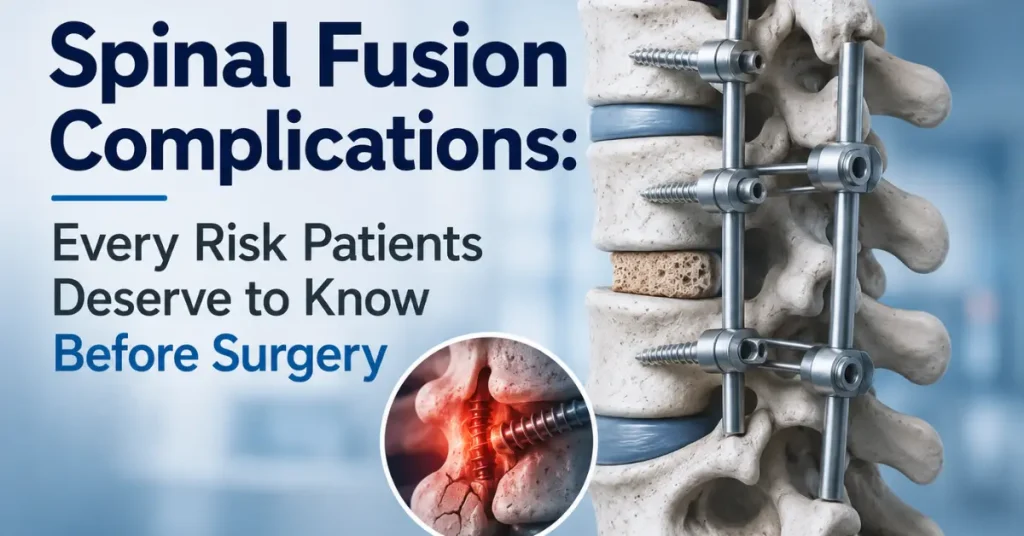
Spinal fusion is a permanent, major surgery. It removes motion from one or more spinal segments, introduces hardware into the spine, and initiates a biological process that takes months to years to complete, with no guarantee it will succeed. Patients being evaluated for fusion deserve a complete picture of what can go wrong, not a reassurance that complications are rare and manageable.
Some are rare. Many are not. After over 30 years performing spine surgery and reviewing cases of patients who came to Deuk Spine Institute after fusion failed them, I have found that most did not fully understand the complication profile before they consented. This article provides what their pre-surgical consultations did not.

Diagnosis. Answers. Relief.
Submit your MRI for a free expert review by Dr. Ara Deukmedjian, M.D. — board-certified neurosurgeon. No obligation. Real answers.
Schedule Yours Today 2,000+ procedures · Zero major complications · No cost, no obligationThis article is for informational purposes only and does not constitute medical advice. Always consult a qualified spine specialist before making any treatment decisions.
Short-Term Spinal Fusion Complications
Infection
Open spinal fusion surgery involves deep exposure of vertebral bone, paraspinal musculature, and implanted hardware. The infection rate in open fusion is approximately 1 to 2 percent, with some studies reporting higher rates in patients with diabetes, obesity, or prior spine surgery. Deep wound infections in fusion surgery are serious. They can involve the implanted hardware, require additional surgical debridement, and in some cases necessitate hardware removal before the fusion has solidified.
By comparison, Deuk Laser Disc Repair® carries a 0% infection rate across over 2,700 procedures and more than 30 years of surgical practice. The 7mm incision, outpatient setting, and absence of implanted hardware eliminate the conditions that drive post-fusion infection risk.
Hardware Misplacement
Pedicle screws, rods, and interbody cages must be positioned with accuracy. Misplaced hardware can compress nerve roots, irritate adjacent structures, or fail to provide the mechanical stabilization the fusion requires. Revision surgery to reposition hardware carries all of the risks of the original procedure plus the added complexity of operating through prior scar tissue.
Nerve Damage
Spinal fusion requires retraction of nerve roots adjacent to the spinal cord. Nerve injury during fusion can produce new radicular pain, numbness, or weakness that was not present before surgery. In some cases this is temporary. In others it is permanent. Patients who undergo fusion for leg pain may find their preoperative nerve symptoms replaced by different ones caused by the surgery itself.
Blood Clots
Deep vein thrombosis is a recognized risk of any major lower extremity or lumbar spine surgery, particularly in patients with reduced mobility during recovery. Pulmonary embolism, where a clot travels to the lungs, is a potentially life-threatening complication. Extended immobilization during the fusion recovery window, which spans three to twelve months for complete bone healing, increases this risk relative to same-day outpatient procedures.
Dural Tear and Cerebrospinal Fluid Leak
The dura mater is the membrane surrounding the spinal cord and nerve roots. It can be torn during the surgical exposure required for fusion. When this occurs, cerebrospinal fluid leaks into the wound, requiring primary repair and potentially extending the operative time, increasing infection risk, and prolonging recovery. Undetected or inadequately repaired dural tears can cause positional headaches, nerve irritation, and ongoing fluid accumulation.
Failed Fusion: Non-Union and Pseudarthrosis
Spinal fusion depends on the body growing bone tissue across the treated vertebral segment to create a solid, permanent bridge. This process is not guaranteed. Non-union, also called pseudarthrosis, occurs when the bones fail to fuse despite the presence of hardware and bone graft material. Published rates range from approximately 5 to 10 percent, with higher rates in multi-level fusions, smokers, patients with osteoporosis, and those with prior failed fusion attempts.
A failed fusion does not always produce symptoms immediately. In some patients it is discovered on imaging during follow-up. In others it manifests as ongoing pain at the surgical site, hardware loosening, or rod fracture. The standard treatment for symptomatic non-union is revision fusion surgery, which carries all of the original risks plus the added surgical complexity of revising a prior construct. Patients who experience pseudarthrosis often face a second major surgery to address the failure of the first.
Adjacent Segment Disease
Adjacent segment disease is one of the most documented long-term consequences of spinal fusion, and one of the least discussed in pre-surgical consultations. When motion is eliminated at one or more spinal levels, the biomechanical load that was previously distributed across those segments transfers to the vertebrae immediately above and below the fusion. Over time, this accelerated stress degrades the discs, facet joints, and ligamentous structures at those adjacent levels.
Research published in the spine surgery literature documents adjacent segment disease developing in a meaningful percentage of fusion patients over five to ten years post-operatively. The progression varies by the number of levels fused, the patient’s pre-existing degeneration at adjacent levels, and activity level during recovery and afterward. For patients who undergo multi-level fusion, the risk compounds with each additional fused segment.
Adjacent segment disease frequently requires additional intervention, including injections, physical therapy, or further surgery. In some cases patients who initially had a one-level fusion find themselves eventually recommended for extension of that fusion to address the adjacent levels that have degenerated under the redistributed load. The fusion that was supposed to resolve the problem creates the conditions for the next problem.
Spinal Fusion vs. Deuk Laser Disc Repair® at a Glance
| Spinal Fusion | DLDR® | |
|---|---|---|
| Infection rate | 1–2% open surgery risk | 0% across 2,700+ procedures |
| Non-union / complication rate | 5–10% revision surgery required | 0.01% over 30 years of practice |
Failed Back Surgery Syndrome After Fusion
Failed Back Surgery Syndrome describes patients who have spine surgery and experience no meaningful improvement, partial improvement followed by regression, or pain that is worse after the procedure than before. It is a clinical reality, not a fringe outcome. Fusion is one of the most common procedures associated with it.
The most frequent underlying cause is a mismatch between the surgical target and the actual pain source. Fusion addresses structural instability, severe disc collapse, or deformity correction. When patients whose primary pain comes from disc inflammation or posterior annular tear pathology are recommended for fusion instead, the surgery modifies the structural anatomy without treating the inflammatory driver. The pain remains because the source remains.
Patients who develop Failed Back Surgery Syndrome after fusion often cycle through pain management, repeat injections, spinal cord stimulators, and additional surgical consultations. Some are told their remaining pain is not surgically addressable and are placed on long-term opioid regimens. The physical and quality-of-life consequences of this trajectory are serious and frequently irreversible.
Hardware Complications
Spinal fusion hardware, including pedicle screws, connecting rods, and interbody cages, is designed to remain in the spine permanently. In practice, hardware complications occur with documented frequency:
- Screw loosening occurs when the bone-screw interface fails to maintain fixation, producing local pain, instability, and sometimes neurological symptoms from screw migration
- Rod fracture develops under the cyclical loading of daily movement, particularly in multi-level constructs or patients with non-union at one of the fused levels
- Cage migration can occur when an interbody device shifts from its implanted position, potentially compressing adjacent neural structures
- Screw pullout is a risk in patients with osteoporosis or poor bone quality, where the bone cannot maintain purchase on the implanted hardware
Each of these complications typically requires revision surgery. Operating through a prior fusion construct, through established scar tissue and around hardware that may have altered local anatomy, is technically more demanding than the original procedure and carries elevated complication risk.
Permanent Mobility Loss
Every vertebral level included in a fusion is permanently immobilized. This is the intended effect of the surgery, and it is also one of its most lasting consequences. Patients frequently underestimate how motion elimination at even a single lumbar level affects their daily range of movement.
Single-level fusion at L4-L5 or L5-S1 may produce changes that are subtle in daily life but noticeable in bending, lifting, and rotational movement. Multi-level fusion compounds this considerably. Patients who undergo two-, three-, or four-level fusion procedures lose meaningful portions of their lumbar range of motion permanently. Activities that required spinal flexibility, from athletic pursuits to occupational demands, may no longer be possible at prior levels of function.
The body compensates for lost motion by recruiting movement from other regions, which contributes to the accelerated wear at adjacent segments described above. The immobility imposed by fusion is not localized to the fused levels. Its biomechanical effects radiate through the entire kinetic chain.
Recovery Complications
Spinal fusion recovery spans three to twelve months for complete bone healing, with restrictions on bending, lifting, and twisting throughout that window. This extended recovery period introduces its own category of complications:
- Opioid dependence is a documented risk during multi-month fusion recovery. Pain management during the healing window routinely involves opioid medications, and patients on these medications for extended periods face dependency risk that may continue beyond surgical recovery
- Physical therapy non-compliance during the healing window can produce muscle atrophy, deconditioning, and adhesion formation around the surgical site that impairs long-term outcomes
- Re-injury during healing occurs when patients return to activity before bone bridging is complete, disrupting the fusion process and potentially requiring revision
- Psychological impact of extended activity restriction, particularly for active patients, contributes to depression and anxiety that complicate recovery outcomes
The recovery window for fusion is not a brief inconvenience. It is a period measured in months where daily life is meaningfully restricted, pain management carries its own risks, and the outcome of the surgical investment remains uncertain until imaging confirms whether fusion has occurred.
The Alternative That Carries None of These Risks
The Deuk Laser Disc Repair® procedure treats disc-driven back pain at its structural source, the posterior annular tear and the inflammation it generates, without removing bone, implanting hardware, or eliminating spinal motion. In over 2,700 procedures, the complication rate is 0.01% and the infection rate is 0%. Patients are discharged the same day with no fusion hardware to loosen, no adjacent segment to overload, and no extended recovery window during which opioid dependence can develop.
The comparison is not between a safe surgery and a risky one. It is between a surgery appropriate for its indication and one applied broadly to patients whose pain source does not require it. Fusion addresses mechanical instability, deformity, and severe structural failure. When recommended for disc pain from annular tear inflammation, it exposes the patient to every complication above while leaving the actual pain generator untreated.
| Complication | Spinal Fusion | Deuk Laser Disc Repair® |
|---|---|---|
| Infection | 1-2% (open surgery) | 0% |
| Non-union | 5-10% of cases | Not applicable |
| Adjacent segment disease | Documented in meaningful percentage over 5-10 years | Not applicable, motion preserved |
| Hardware complications | Screw loosening, rod fracture, cage migration | No hardware implanted |
| Mobility loss | Permanent at all fused levels | Full motion preserved |
| Recovery window | 3-12 months, activity restricted | Same-day discharge, ambulatory within hours |
| Opioid dependence risk | Elevated during multi-month recovery | No opioids required post-operatively |
| Overall complication rate | Multiple documented categories | 0.01% across 2,700+ procedures |
Before You Consent to Fusion
If you are evaluating spinal fusion complications and risks before committing to surgery, the most important question is whether the disc is confirmed as your pain source and whether fusion is the only option that addresses it. For many patients, it is not.
Disc pain originating from posterior annular tear inflammation does not require hardware, bone graft, or permanent motion elimination to treat. It requires a procedure that targets the tear and removes the inflammatory tissue, which is exactly what Deuk Laser Disc Repair® does. Understanding what spinal fusion is, what it changes permanently, and what surgical alternatives exist is the foundation of an informed decision.
Our article on what spinal fusion surgery is covers the procedure in full clinical detail. For patients exploring options that avoid the fusion complication profile entirely, our alternatives to spinal fusion resource explains what motion-preserving procedures offer and who is a candidate.
Request your free MRI review at Deuk Spine Institute. We will tell you which structure is generating your pain, whether Deuk Laser Disc Repair® can address it, and whether the surgery you have been recommended actually corresponds to your diagnosis. You deserve that information before making a permanent decision about your spine.
No cost · No obligation
Live Pain Free
Upload your MRI for a free expert review by Dr. Ara Deukmedjian, M.D. — board-certified neurosurgeon. Ten minutes can change your life.
This content is provided for educational purposes only. It does not constitute medical advice, diagnosis, or a recommendation for any specific treatment. Individual results vary. Outcomes with Deuk Laser Disc Repair® apply to patients whose confirmed pain source matches the treated pathology. Consult a qualified spine specialist to determine appropriate treatment for your condition.