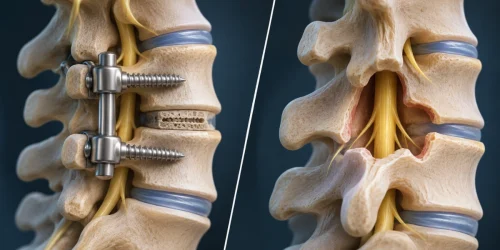
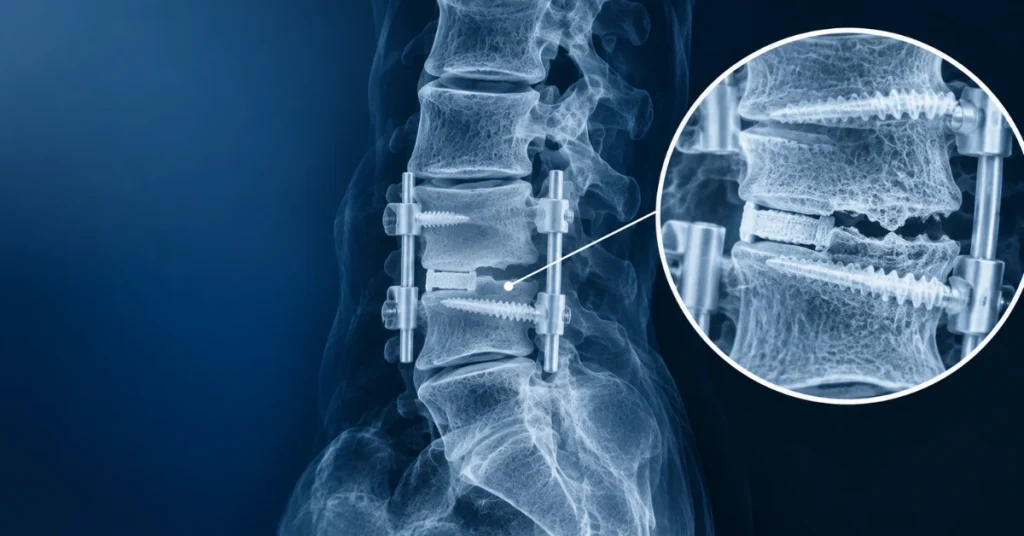
Pseudarthrosis after fusion means the vertebrae that were supposed to grow together into one solid bone never fully joined. The segment keeps moving slightly, the screws and rods carry load they were only meant to hold until the bone healed, and pain can linger or return. It is usually confirmed with a CT scan around a year or more after surgery, and it is not always the cause of a patient’s pain.
This happens to a meaningful minority of fusions, and it is usually not anyone’s mistake. Some nonunions cause no symptoms and never need another operation, while others explain pain that never went away. When surgery is recommended, the standard fix is a second, larger fusion, and there is one question most patients are never told to ask before agreeing to it.
If you have been told your fusion did not take and a revision is being discussed, a Free MRI Review gives you a specialist’s look at your imaging and symptoms before you commit to a second operation. The goal is to confirm what is actually causing your pain. Here is what pseudarthrosis is, how it is found, and what to weigh next.
Key Insights
- Pseudarthrosis, also called nonunion, means the bone graft never formed a solid bridge between the fused vertebrae, so the segment still moves.
- Published estimates put it at roughly 5 to 15 percent after lumbar fusion, and it can also follow neck fusions such as ACDF.
- Smoking, multilevel fusions, older age, diabetes, and poor bone quality raise the risk, and most nonunions are not caused by surgeon error.
- Many nonunions cause no symptoms, and some slow fusions keep healing well past the one-year mark.
- A thin-slice CT scan, usually around 12 months after surgery, is the standard way to confirm whether the bone joined.
- Revision fusion is the usual treatment for a painful, unstable nonunion, but it is a larger operation with less predictable results than the first.
- Before agreeing to a revision, confirm the nonunion is actually causing your pain, not just showing up on a scan.
- New or worsening weakness, foot drop, numbness in the groin or inner thighs, or bowel or bladder changes need emergency care today.
No cost · No obligation
Live Pain Free
Upload your MRI for a free expert review by Dr. Ara Deukmedjian, M.D. — board-certified neurosurgeon. Ten minutes can change your life.
What Is Pseudarthrosis After Spinal Fusion?
Pseudarthrosis after spinal fusion is a failure of the bone graft to bridge solidly between two vertebrae, usually defined as no solid union about 12 months after surgery. The name means “false joint,” because the segment keeps a small amount of motion it was supposed to lose.
A fusion is a bet that two vertebrae will grow into one bone. The surgeon places bone graft between them, and screws, rods, or plates hold everything still while the body builds a bony bridge over several months.
When that bridge never forms, three things follow:
- The segment still moves, even if only slightly
- The hardware keeps carrying load indefinitely instead of handing it off to bone
- Pain at that level can persist or come back
Pseudarthrosis can follow a fusion anywhere in the spine, including neck fusions such as an anterior cervical discectomy and fusion (ACDF). Most research focuses on the lower back, but the biology, diagnosis, and decisions described here apply to both.
Are “Nonunion,” “Pseudarthrosis,” and “Failed Fusion” the Same Thing?
Nonunion and pseudarthrosis mean the same thing: the fused bones did not join. You may also see it spelled pseudoarthrosis, which refers to the same condition.
“Failed fusion” is used in two ways, which causes confusion. Surgeons often use it to mean the bone did not fuse, while patients often use it to mean the surgery did not relieve their pain.
Those are not the same problem. A fusion can heal solidly and still leave you in pain, and that broader situation is known as failed back surgery syndrome, which has many possible causes beyond nonunion.
What Are the Symptoms of a Nonunion?
The most common symptom of a nonunion is back or neck pain at the fused level that never improved after surgery or returned after a period of relief. Many nonunions, however, cause no symptoms and are found only on imaging.
Signs that can point toward a fusion that did not take include:
- Pain that never meaningfully eased in the months after surgery
- Pain that improved, then returned months or years later
- Deep, localized pain at the surgical level that worsens with activity and eases with rest
- A feeling that the spine is unstable or “giving way,” sometimes with clicking or catching on movement
- New or returning leg or arm symptoms if motion at the segment irritates a nerve
After a neck fusion, the typical pattern is neck pain that worsens when you turn or tilt your head and may spread toward the shoulder or arm.
None of these symptoms is specific to pseudarthrosis. Each can also come from other structures, which is why the diagnosis depends on imaging and a careful exam, not on symptoms alone.
When the screws or rods themselves loosen or break, that is a related but separate problem with its own warning signs. This article focuses on the bone, which is usually why the metal fails in the first place.
Which Symptoms Mean You Need Emergency Care Today?
Certain symptoms after spine surgery mean you need emergency care today, not an appointment request or an online form. Go to an emergency department if you notice any of the following:
- Worsening Weakness Weakness in a leg or arm that is getting worse
- Foot Drop New foot drop, where the front of your foot drags or slaps when you walk
- Saddle Anesthesia Numbness in the groin, buttocks, or inner thighs, known as saddle anesthesia
- Bowel or Bladder Change A new change in bowel or bladder control
These can signal serious nerve compression. Waiting to see if they pass can risk permanent damage.
How Often Do Spinal Fusions Fail to Fuse?
Published estimates put pseudarthrosis at roughly 5 to 15 percent after lumbar fusion, with considerably higher rates in some groups of patients. The figure varies with the technique, the number of levels, and how carefully nonunion is looked for.
Risk factors can shift the odds sharply. In one study of two-level fusions with screws, nonunion occurred in 29 percent of smokers compared with 11 percent of nonsmokers.
In most cases, a nonunion is not a sign of surgeon error. The patient’s biology, health, and the size of the operation drive much of the risk. Nonunion is one of several problems that can follow spinal fusion, and it is among the most common reasons for a second operation.
What Stops a Fusion From Taking?
A fusion fails to take when the body cannot build enough new bone across the graft, and several known factors make that more likely. A 2024 review of 12 studies and 1,830 patients quantified the strongest of them.
- Smoking: about three times the odds of nonunion in the pooled data, since nicotine impairs bone formation
- More fused levels: each additional level raised the odds, so multilevel constructs carry more risk
- Older age: risk rose modestly with age
- Diabetes: linked to nearly three times the odds in one study, though too few studies reported it to pool
Other factors are widely recognized, though less precisely measured:
- Osteoporosis, which gives the graft and screws weaker bone to work with
- Long-term steroid use, which slows bone healing
- Poor nutrition, including low protein or vitamin D
- Infection at the surgical site
- Certain anti-inflammatory drugs early in healing, which some evidence suggests may slow bone formation
- Fusion at L5-S1, where loads are high and nonunion is more often reported
Body weight and sex were not significant risk factors in the pooled data. Even with every factor accounted for, individual biology still plays a part, and some patients simply do not fuse.
How Can You Help a Fusion Heal?
You can improve the odds that a fusion heals by protecting the biology of bone growth during the first year after surgery. Most of the risk factors above can be changed, at least in part.
- Stop smoking and avoid nicotine in any form, and ask your surgeon about vaping and nicotine replacement
- Eat enough protein, and ask whether your vitamin D and bone density should be checked
- Keep blood sugar well controlled if you have diabetes
- Follow your lifting, bending, and bracing instructions, even after you start to feel better
- Ask before taking anti-inflammatory pain relievers
- Walk as directed, since gentle activity supports recovery while high-impact activity can disrupt it
- Keep your follow-up visits and X-rays, which show whether the fusion is progressing
If your surgeon says the fusion “isn’t solid yet” at 6 or 9 months, that does not mean it has failed. Fusion is often still maturing at that point, and these steps matter most during that window.
How Is Pseudarthrosis Diagnosed?
Pseudarthrosis is usually diagnosed with a thin-slice CT scan showing no continuous bridge of bone across the fused level. Most surgeons do not call a nonunion until about a year after surgery, because fusion takes time to mature.
A thorough evaluation typically includes:
- A symptom history that maps when the pain started, changed, or returned
- A physical and neurological exam to check strength, reflexes, and sensation
- Flexion and extension X-rays, taken while bending forward and back, to look for motion at the fused level
- A CT scan to see whether bone has actually bridged the gap
- A look for indirect signs, such as a dark halo around screws or broken hardware
Plain X-rays alone can misread fusion status, which is why CT is usually needed. MRI is useful for showing nerves and discs, but metal hardware can blur the image near the fusion.
When CT is unclear, some surgeons add SPECT-CT, which combines a bone scan with CT to show where bone is still actively remodeling or where hardware is loose.
A confirmed nonunion answers one question: did the bone join? It does not, on its own, answer whether the nonunion is causing your pain.
Does Every Nonunion Need Surgery?
No, not every nonunion needs surgery. A nonunion that causes no symptoms is often simply monitored, and a fusion that looks incomplete at one year can keep maturing, so some specialists observe patients without major symptoms for two to three years.
Non-surgical options your surgeon may discuss include:
- Monitoring with periodic X-rays or CT scans
- A bone growth stimulator, an external device that uses electrical or ultrasound energy to encourage bone growth, though evidence for it is mixed
- Bracing to limit motion at the segment
- Physical therapy focused on core and hip strength
- Pain management that avoids medications known to slow bone healing
- Quitting smoking and improving bone health, which can still help a slow fusion
These options can manage symptoms and support healing, but they cannot reliably make an unstable segment solid. When pain is significant and motion is confirmed, surgeons usually turn to revision.
Why Is Revision Fusion the Default Answer?
Revision fusion is the standard treatment for a nonunion that causes significant symptoms, because it directly addresses the motion and the missing bone. It is also a bigger, riskier operation than the first.
A revision may involve removing loose hardware and scar tissue, placing new bone graft, using larger or additional screws and rods, approaching from the front or side of the body, or extending the fusion to more levels. You can read more about how spinal fusion is performed and what it changes.
Recovery after a revision is usually longer than after the first fusion. Many patients return to light activity over the first few months, while the new fusion often takes 6 to 12 months or more to mature, with bracing, activity limits, and physical therapy along the way.
Revision results are less predictable than first-time results. In a study of 4,671 lumbar fusions, revision fusions led to another operation 16.1 percent of the time, compared with 11.2 percent after first-time fusions. Revision patients also improved less at one year.
When a nonunion is clearly symptomatic and the segment is unstable, a revision may well be the right decision. The question is whether that has been established.
What Should You Ask Before Agreeing to a Revision?
The most important question before a revision is whether anyone has confirmed that the nonunion is causing your pain, or only that it shows up on the scan. Those are different findings, and only the first justifies more surgery.
This matters most if your original fusion was planned around an imaging finding that was never confirmed as the source of your pain. If that was the case, a revision can repeat the same error with more hardware.
Questions worth asking your surgeon:
- What evidence shows this nonunion is the source of my pain?
- Does the segment actually move on flexion and extension X-rays?
- Do my symptoms match this level, or could they come from somewhere else?
- How was the pain source confirmed before my first fusion?
- Have non-surgical options been tried, and what happens if I wait?
- What will the revision add, and what are the realistic outcomes for someone in my situation?
What If the Nonunion Is Not the Source of Your Pain?
When the nonunion is not the source of your pain, a revision is unlikely to help, and the real pain generator still needs to be found. Persistent pain after fusion often has another cause.
Other possibilities include:
- Adjacent segment disease, where the levels above or below the fusion wear down under added stress
- A damaged disc at a different, unfused level
- Scar tissue around a nerve root
- Sacroiliac joint pain, which can increase after lumbar fusion
Deuk Laser Disc Repair® is not a treatment for a failed fusion construct. What our team offers patients in this position is diagnostic clarity: a careful look at whether the nonunion, or something else, is driving the pain before another operation is planned.
Bottom Line
Pseudarthrosis after fusion means the bone never joined, so the segment still moves and the hardware keeps carrying load. It affects a meaningful minority of fusions, is usually not anyone’s fault, and does not always need surgery.
Revision fusion is the standard answer when symptoms are significant, but it is a larger operation with less predictable results. Before agreeing to one, make sure the nonunion has been confirmed as the source of your pain, not just a finding on a scan.

Diagnosis. Answers. Relief.
Submit your MRI for a free expert review by Dr. Ara Deukmedjian, M.D. —
board-certified neurosurgeon. No obligation. Real answers.
FAQs About Pseudarthrosis After Fusion
Is Pseudarthrosis Serious?
Pseudarthrosis can be serious when it causes ongoing pain or instability, but it is rarely an emergency on its own. Left untreated, a painful nonunion can lead to hardware loosening or breakage and worsening instability, while a nonunion with no symptoms may never cause problems.
How Long After Fusion Can Pseudarthrosis Be Diagnosed?
Pseudarthrosis is usually diagnosed no earlier than about 12 months after fusion, since bone needs time to bridge. Some nonunions are not found until years later, when pain returns or hardware loosens.
Is Pseudarthrosis the Surgeon’s Fault?
Pseudarthrosis is usually not the surgeon’s fault. Smoking, diabetes, bone quality, the number of levels fused, and individual biology drive most of the risk, and nonunion occurs even after technically sound operations.
Can Pseudarthrosis Happen After a Neck Fusion?
Yes, pseudarthrosis can happen after a neck fusion, including an ACDF, and the risk generally rises with the number of levels fused. It is diagnosed and managed with the same approach used in the lower back.
Can You Live With a Nonunion That Causes No Symptoms?
Yes, you can often live with a nonunion that causes no symptoms. Many are found only on imaging and do not need surgery, though your surgeon may recommend periodic checks of the hardware and alignment.
Does a Broken Screw or Rod Mean the Fusion Failed?
A broken screw or rod often means the fusion failed, because hardware usually breaks when it carries load that solid bone should have taken over. It is not proof on its own, so a CT scan is typically used to check whether the bone has joined.
Medical disclaimer: The information in this article is educational and is not a substitute for personalized medical advice, diagnosis, or treatment. Always consult your surgeon or a qualified healthcare provider about your symptoms and treatment options.