
By Dr. Ara J. Deukmedjian, MD
Board Certified Neurosurgeon
Medically reviewed on September 1, 2026
Disclaimer: The contents provided in this article are for learning purposes only. It is always recommended to speak to a doctor about your personal health condition.
Key Points
✓ Standard RFA creates a ~4 mm² burn and frequently misses the target nerve. Explaining why so many patients get only temporary or no relief.¹ ²
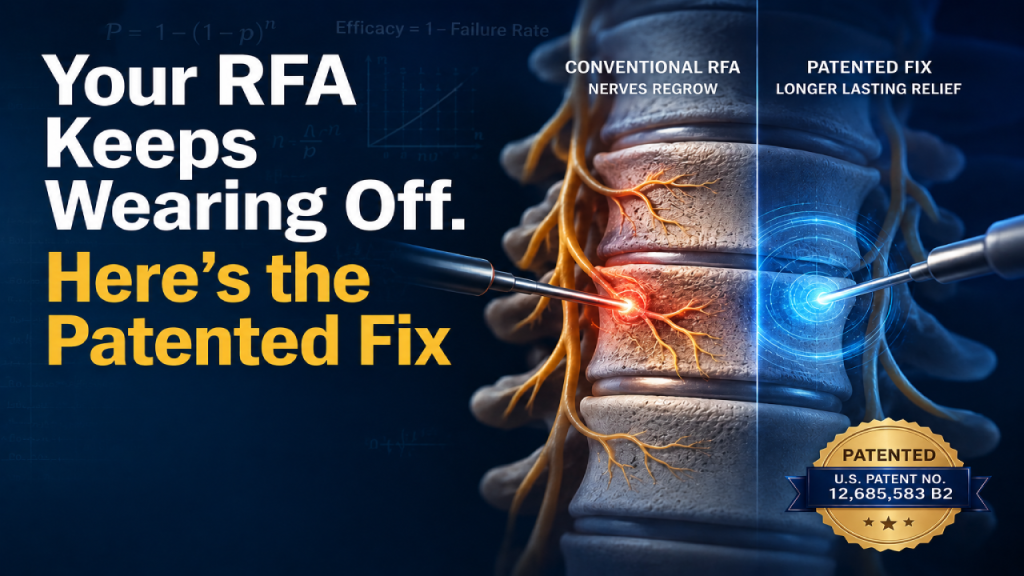
✓ A newly patented electrocautery probe (U.S. Patent No. 12,685,583 B2) is “wanded” across 50–1000 mm² of boney surface, making a miss nearly impossible.³
✓ Wanding means moving the energized tip in every direction along and above the bone. The nerve is destroyed wherever it actually sits.³ ⁴
✓ Higher energy enables full nerve transection, not just temporary lesioning, so the pain stays gone instead of returning in 6–12 months.³ ⁵
✓ One probe, one incision that treats cervical, thoracic, lumbar, SI, shoulder, hip, and knee joints.³
✓ A built-in lumen delivers anesthetic and anti-inflammatory medication directly to the site during the same procedure.³
✓ Deuk Plasma Rhizotomy® uses these patented principles for permanent, motion-preserving facet joint pain relief.
The Procedure Millions of Pain Patients Are Told Will Fix Them and Why It Keeps Failing
Picture this. You have been dealing with chronic neck pain or lower back pain for years. You have tried physical therapy. You have had epidural steroid injections. You have swallowed more ibuprofen than you care to count. Finally, your pain management doctor tells you about radiofrequency ablation (RFA). He explains that a small needle will be placed next to the nerve causing your pain, heat will be applied, the nerve will be “burned off,” and your pain will disappear.
So you go through with it. Maybe it works for a few months. Maybe it barely works at all. And then the pain comes back; right on schedule. Six to twelve months later and your doctor recommends doing the whole thing again.¹ ⁵
Sound familiar?
If you are stuck in this cycle, you are not alone. And more importantly, the reason your RFA keeps wearing off is not a mystery. It is a design flaw baked into the procedure itself.
Traditional RFA uses an extremely thin, flexible needle to deliver energy to a single pinpoint target.¹ ² The burn area it creates is roughly 4 mm². About the size of a grain of rice.³ The entire success of the procedure depends on one assumption: that the needle tip landed directly on top of the nerve. But here is what most patients are never told. The exact location of the targeted sensory nerve varies from person to person, and even from one vertebral level to the next within the same patient.¹ ² There is no way to see the nerve on fluoroscopy. The doctor is estimating.
When the estimate is wrong and it frequently is. The needle misses the nerve entirely. When the estimate is close but not perfect, the energy may stun the nerve without fully cutting through it. The nerve regenerates. The pain returns. And you are right back where you started.
This is not a failure of your doctor’s skill. It is a failure of a 4 mm² target trying to hit a nerve that could be anywhere within a much larger zone.
What If You Could Get A Patented Solution?
That is exactly the question behind U.S. Patent No. 12,685,583 B2, granted in July 2026 to Panacea Spine, LLC. The research and development entity behind the technologies used at Deuk Spine Institute.³
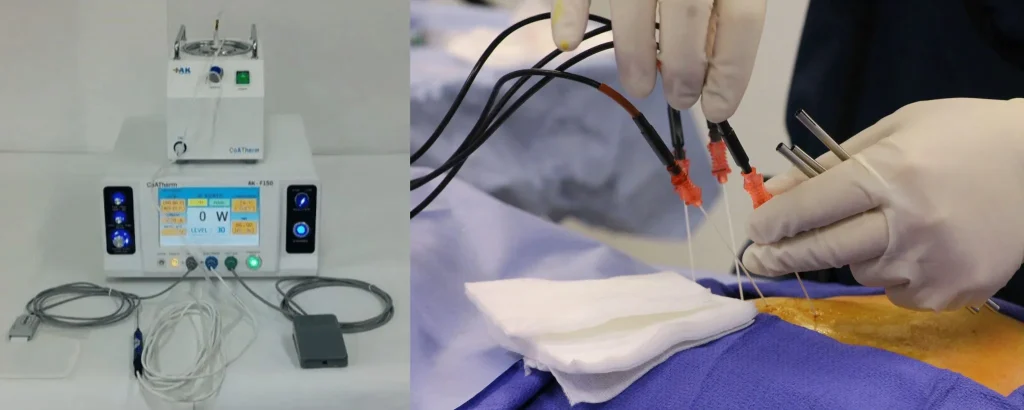
The idea is deceptively simple: instead of trying to place a tiny needle on an invisible nerve and hoping you hit it, use a rigid, high-powered electrocautery probe and move it across the entire area where the nerve could possibly be.³ Do not aim at a pinpoint. Cover the field.
The patent calls this technique “wanding” and the name is fitting.³ The surgeon inserts the probe through a single small incision, navigates it to the bony surface adjacent to the target nerve under fluoroscopic guidance, energizes the probe, and then moves the tip in every direction: laterally, medially, up, down, forward, backward. Both along the bone and above it.³ ⁴
The result is not a 4 mm² pinpoint. It is a burn region of 50 to 1000 mm² or more.³
Read that again. The treatment area can be more than 250 times larger than a conventional RFA lesion.
At that scale, the nerve does not need to be in one precise spot. It simply needs to be somewhere within the treatment zone that large, the probability of the nerve falling within it goes from uncertain to near certain.³ The anatomy stops being the enemy and starts being manageable.
Burning Versus Cutting: Why the Difference Between Lesioning and Transection Is Everything
There is another critical difference between conventional RFA and the patented electrocautery approach, and it has nothing to do with the size of the treatment area. It has to do with what the energy actually does to the nerve.

A standard RFA needle delivers relatively low energy at relatively low temperatures.¹ It creates a thermal lesion; essentially a partial burn. The nerve fibers may be damaged, but the connective tissue layers surrounding them. The epinerium and perinerium often remain intact.⁵ Think of it like scorching the outside of a cable without cutting through the wires inside. The signal is interrupted temporarily, but the infrastructure for regeneration is still there. Given six to twelve months, the nerve regrows through the damaged zone, the signal reconnects, and your pain returns.
The electrocautery probe described in the patent operates in an entirely different energy category. It delivers power in a range of 20 to over 100 Watts and reaches temperatures between 150°C and 1250°C.³ At those levels, the probe does not just damage the nerve. It cuts through it completely. Ablating and transecting the nerve fibers and all surrounding connective tissue layers so thoroughly that the nerve has no remaining structural pathway along which to regenerate.³ ⁵
This is the difference between putting a nerve to sleep and removing it from the conversation permanently.
The targeted nerves and the medial branches of the dorsal ramus are purely sensory.³ They carry pain signals from the facet joints to the brain, but they do not control any movement or provide any structural support. Destroying them does not affect your ability to move, bend, lift, or stabilize your spine. It simply stops the pain signal at its origin permanently.³
One Probe That Also Delivers Your Medication
Here is a detail that most patients appreciate once they understand it: the patented probe is not just a cautery device. It is also a drug delivery system.³
Built into the shaft is a fluid lumen, a thin internal channel that runs from a syringe connector at the proximal end to an exit point right next to the cutting tip.³ This means the surgeon can deliver local anesthetic and anti-inflammatory medication. Such as bupivacaine and methylprednisolone directly to the treatment site through the same device, during the same procedure.³
No separate injection. No second needle. No additional step. The cauterization and the medication delivery happen through one instrument, one incision, one visit.³ The medication provides immediate numbing, reduces the inflammatory response at the treatment site, and supports healing. All precisely where it is needed most.
Not Just Your Back: Every Joint This Technique Can Treat
Chronic facet joint pain in the cervical and lumbar spine is the most common reason patients seek this type of treatment. But pain does not limit itself to the spine, and neither does this technology.
The patent describes wanded electrocautery rhizotomy procedures for joints throughout the body.³ Every procedure follows the same core principle. Target the sensory nerves immediately outside the joint capsule. Use the energized wand probe across the boney surface where those nerves are expected to reside, and transect them to eliminate the pain signal.
Cervical Spine
The medial branch of the dorsal ramus is targeted along the transverse process at the cervical facet joints. The probe is wanded above and below each affected facet joint, covering the full field where the nerve innervates.³ This treats chronic neck pain: including the kind that triggers cervicogenic headaches, nausea, and radiating arm pain.
Lumbar Spine
The probe is advanced to the lateral edge of the lateral mass and wanded across the boney surface, creating large burn regions above and below the affected lumbar facet joints.³ A single incision can address multiple facet levels without removing and reinserting the probe.

Thoracic Spine
The same wanding principles apply to the thoracic facet joints, treating mid-back pain that is often among the most difficult to diagnose and manage.³
Sacroiliac Joint
The dorsal ramus branch nerves extending between the S1–S4 posterior foramen and the SI joint are targeted, along with the L5 dorsal ramus nerve.³ The probe is used along the sacrum lateral to each posterior foramen. Treating one of the most common and most frequently misdiagnosed sources of lower back and buttock pain.
Shoulder, Hip, and Knee
For each of these peripheral joints, the patent identifies the specific sensory nerve branches that innervate the joint and describes the boney surface path along which the probe is wanded.³ Shoulder procedures target branches of the suprascapular, axillary, lateral pectoral, and subscapular nerves. Hip procedures target branches of the femoral, obturator, superior gluteal, and quadratus femoris nerves. Knee procedures target the superolateral, superomedial, and inferomedial genicular nerves.³
The Real Comparison: RFA vs. Wanded Cautery vs. Fusion
When you are evaluating treatment options for chronic joint pain, three categories dominate the conversation. Understanding how they differ is critical:
Conventional RFA creates a 4 mm² lesion at a single estimated point. The needle must be removed and reinserted for each additional target. Relief is temporary. Six to twelve months on average. It is the most commonly performed procedure but carries the highest retreatment rate.¹ ² ³
Wanded Electrocautery Rhizotomy creates burn regions of 50–1000 mm² through a single incision. The probe is moved continuously across the treatment field while energized. Full nerve transection is the goal, offering the potential for permanent relief. Built-in medication delivery eliminates the need for a separate injection.³
Spinal Fusion permanently locks two or more vertebrae together with screws and rods. It eliminates all motion at the treated segment, accelerates degeneration at adjacent levels, and requires significant recovery time. The Plasma wand cautery approach targets only the pain-transmitting nerve. The joint itself is left completely intact and full spinal motion is preserved.³

The distinction matters. If your pain comes from the facet joint’s sensory nerve, you do not need your spine welded together. You need that nerve eliminated. Precisely and permanently.
What This Means If You Are Still in Pain
If you have been through one or more rounds of RFA without lasting relief, there is a reason. And it is probably not that the procedure “just did not work for you.” It is far more likely that the 4 mm² needle missed the nerve, or that the energy was insufficient to fully transect it.¹ ² ⁵ Either way, the underlying nerve is still intact and still transmitting pain.
If you have been told that spinal fusion is your only remaining option, that may not be accurate either. Fusion addresses the joint. The plasma tool cautery approach addresses only the nerve and for facet-mediated pain, that is often all that needs to be treated.
Deuk Plasma Rhizotomy® (DPR) at Deuk Spine Institute applies the principles described in this patent. It is performed as a same-day outpatient procedure, preserves full joint motion, requires no hardware, and targets the pain where it starts at the sensory nerve itself.
A free MRI review is the first step toward understanding whether your chronic joint pain is a candidate for this approach.
RFA stunned the nerve. It grew back.
DPR transects it. It doesn’t.
Standard RFA burns a 4 mm² spot and hopes it hits the nerve. If it misses — or only damages it — the nerve regenerates in 6–12 months and your pain returns. The patented wanding technique sweeps a high-energy probe across 50–1,000 mm² of bony surface, fully transecting the nerve wherever it sits. One probe also delivers anesthetic and anti-inflammatory medication in the same pass.
Board-certified neurosurgeon · Patented wanding technology · Spine · SI joint · Shoulder · Hip · Knee
FAQs
Why does my RFA keep wearing off?
Because the thermal lesion created by a standard RFA needle is small enough. About 4 mm² that the nerve often regenerates through the damaged zone within six to twelve months.¹ ⁵ Additionally, the needle may not have been positioned directly on the nerve in the first place, meaning the ablation only partially affected it.² The wanded electrocautery approach addresses both problems by treating a dramatically larger area at higher energy levels, fully transecting the nerve so it cannot regenerate.³
What does “wanding” actually mean?
Wanding is the technique of moving the energized tip of the electrocautery probe in multiple directions: laterally, medially, rostrally, caudally, anteriorly, posteriorly. Along and above the bony surface adjacent to the target nerve.³ ⁴ Rather than applying energy at a single fixed point, the surgeon sweeps the probe across the entire field where the nerve is expected to reside. This creates burn regions of 50–1000 mm² or more, compared to the ~4 mm² lesion of conventional RFA.³
Will destroying the nerve affect my ability to move?
No. The targeted medial branch nerves are exclusively sensory. They transmit pain signals from the facet joint but do not control movement, stability, or any motor function.³ Transecting these nerves eliminates the pain signal while leaving the joint’s biomechanics and full range of motion completely intact.
How big is the incision?
The incision is as small as 3 millimeters. Roughly the width of a pencil eraser.³ The procedure is performed percutaneously, meaning the probe is advanced through the skin and soft tissues to the boney surface under fluoroscopic imaging without the need for open surgery.³ ⁴
Can this procedure treat joints outside the spine?
Yes. The patent specifically describes procedures for the sacroiliac joint, shoulder, hip, and knee in addition to cervical, thoracic, and lumbar facet joints.³ Each procedure targets the sensory nerves immediately outside the joint capsule using the same wanding technique.
What medication is delivered through the probe?
The built-in fluid lumen delivers local anesthetic such as bupivacaine or Marcaine. Combined with anti-inflammatory agents like methylprednisolone (Depo-Medrol).³ This provides immediate numbing and reduces inflammation at the treatment site, all through the same device in the same procedure.
I have already had RFA that failed. Am I still a candidate?
You may actually be an ideal candidate. If your RFA failed because the needle missed the nerve or because the lesion was too small to achieve full transection, the wanded approach directly solves those problems.¹ ² ³ A free MRI review is the best way to determine whether your condition is appropriate for Deuk Plasma Rhizotomy®.
Is this the same as Deuk Plasma Rhizotomy®?
Deuk Plasma Rhizotomy® (DPR) employs the patented principles described in U.S. Patent No. 12,685,583 B2. It is a same-day outpatient procedure performed at Deuk Spine Institute that uses a high-powered electrocautery probe wanded across the target area to permanently transect the sensory nerves responsible for chronic facet joint pain: without fusion, hardware, or loss of spinal motion.
Sources
View Sources
- Dreyfuss P, Halbrook B, Pauza K, Joshi A, McLarty J, Bogduk N. Efficacy and validity of radiofrequency neurotomy for chronic lumbar zygapophysial joint pain. Spine. 2000;25(10):1270–1277.
- Cohen SP, Bhaskar A, Bhatia A, et al. Consensus practice guidelines on interventions for lumbar facet joint pain from a multispecialty, international working group. Regional Anesthesia & Pain Medicine. 2020;45(6):424–467.
- Deukmedjian AR. Electrocautery rhizotomy using wanding of energized electrocautery probe. U.S. Patent No. 12,685,583 B2. July 21, 2026.
- Deukmedjian AR. Pain treatment using wanding of percutaneous surgical probe over sensory nerve. U.S. Patent No. 12,239,362 B2.
- Kapural L, Mekhail N. Radiofrequency ablation for chronic pain control. Current Pain and Headache Reports. 2001;5(6):517–525.