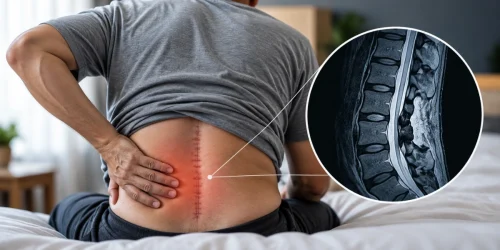

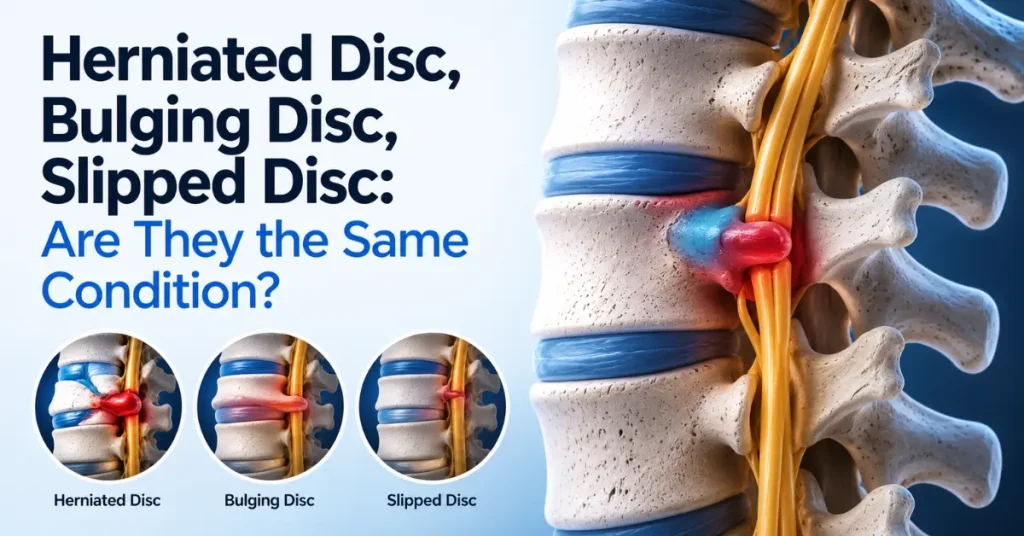
If you have been told you have a herniated disc, a bulging disc, a disc protrusion, a slipped disc, or a degenerated disc, you may have wondered whether these are different conditions requiring different treatments, or whether your doctor and the internet are simply using different words for the same thing. The answer is mostly the latter, with some clinically meaningful distinctions that are worth understanding before you begin researching treatment options.
In over 30 years of spine surgery practice, I have found that disc terminology is one of the leading sources of patient confusion. People arrive at Deuk Spine Institute having read conflicting descriptions of their MRI findings online, uncertain whether their condition is serious, what it means for their treatment, and why the report says one thing while another provider said something else. This article addresses that confusion directly.
This article is for informational purposes only and does not constitute medical advice. Always consult a qualified spine specialist before making any treatment decisions.
No cost · No obligation
Live Pain Free
Upload your MRI for a free expert review by Dr. Ara Deukmedjian, M.D. — board-certified neurosurgeon. Ten minutes can change your life.
The 10 Names for a Herniated Disc
There are approximately 10 terms in common clinical and patient-facing use that refer to the same underlying spinal condition: an abnormal disc seen on MRI that has changed shape, lost integrity, or displaced material from its normal position. These terms include:
- Herniated disc – the most clinically accurate umbrella term for the condition
- Bulging disc – describes the disc’s outer wall extending beyond its normal boundary without rupture
- Disc bulge – alternate phrasing for bulging disc, used interchangeably in radiology reports
- Protruding disc – a herniation where the displaced material remains connected to the disc
- Disc protrusion – alternate term for protruding disc, common in imaging reports
- Slipped disc – a colloquial term with no clear anatomical meaning; discs do not actually slip
- Extruded disc – a herniation where nucleus pulposus material has broken through the outer annulus
- Disc extrusion – alternate phrasing for extruded disc
- Sequestered disc – a fragment of disc material that has separated completely and migrated into the spinal canal
- Degenerated disc – describes disc breakdown associated with aging, drying out, and loss of height
All of these terms describe abnormal discs. None of them tells you whether your disc is causing your pain. That determination requires clinical evaluation, not just imaging terminology.
The Clinical Definitions: What Each Term Actually Means
Herniated Disc
Herniated disc is the correct clinical term for the full category of conditions listed above. A herniation occurs when the nucleus pulposus, the gel-like material at the center of the disc, displaces from its normal position within the annulus fibrosus, the disc’s outer wall. Herniations are classified by how far the nucleus has displaced and whether the annulus fibrosus remains intact.
Bulging Disc
A bulging disc occurs when the annulus fibrosus remains intact but deforms outward, extending beyond the normal disc boundary. The nucleus has not broken through the outer wall. Bulging typically occurs symmetrically around the circumference of the disc and is associated with disc degeneration and aging. Many adults over 45 have disc bulges on MRI with no symptoms whatsoever.
Protruding Disc
A protrusion is a focal herniation where nucleus pulposus material displaces through a weakened area of the annulus but remains connected to the main disc body. The base of the displaced material is wider than its projection. Protrusions are asymmetric and more likely than symmetric bulges to produce localized symptoms.
Extruded Disc
An extrusion is a herniation where nucleus pulposus material has broken fully through the annulus fibrosus. The displaced fragment remains connected to the disc but extends into the spinal canal. Extrusions are more likely to compress nerve roots and produce radicular symptoms than protrusions or bulges.
Sequestered Disc
Sequestration is the most advanced form of herniation. A fragment of nucleus pulposus has separated entirely from the disc and migrated freely within the spinal canal. Sequestered fragments can travel to locations distant from the original disc level, making clinical correlation with imaging more complex.
Slipped Disc
Slipped disc is a colloquial term with no clear anatomical definition. Discs are firmly anchored between vertebrae by the annulus fibrosus and do not physically slip. The term entered common use as a lay description of disc herniation and remains widely used despite being anatomically inaccurate. When a patient says they have a slipped disc, they are describing a herniated disc by another name.
Degenerated Disc
Degenerative disc disease describes the natural aging process of spinal discs. Over time, discs lose water content, decrease in height, and develop micro-tears in the annulus fibrosus. Degeneration does not equal herniation, but the two frequently coexist. A degenerated disc is more vulnerable to herniation because the structural integrity of the annulus has been compromised.
Disc Terminology at a Glance
| Term | What It Means | Annulus Intact? |
|---|---|---|
| Bulging disc | Annulus deforms outward, no rupture | Yes |
| Protruding disc | Focal displacement, connected to disc body | Partially |
| Extruded disc | Nucleus through annulus, still attached | No |
| Sequestered disc | Fragment separated and migrated | No |
| Slipped disc | Lay term, no defined anatomical meaning | Varies |
| Degenerated disc | Age-related breakdown, may include tears | Compromised |
Why Do 10 Names Exist for the Same Condition?
The terminology proliferated for several reasons. Radiology reports use technical descriptors based on morphology, what the disc looks like on imaging, which differ from the terms orthopedic surgeons use in clinical notes, which differ again from the lay terms patients encounter online. A radiologist writing “posterior disc protrusion with annular fissure” is describing the same finding a spine surgeon might call a “herniated disc with annular tear” and a patient might describe to a friend as a “slipped disc.”
The ICD-10 coding system used for medical billing adds another layer, grouping disc conditions under diagnostic codes that use terms like “disc displacement” and “disc degeneration” that do not map cleanly to the imaging vocabulary. Patients who read their explanation of benefits documents, their MRI reports, and their surgeon’s clinical notes may encounter three different terms for the same finding.
None of this reflects clinical disagreement about what is happening in the spine. It reflects the fact that spine medicine developed terminology in parallel tracks, through radiology, surgery, pain management, and lay communication, that never fully converged.
Does the Label Change the Treatment?
For most patients, the terminology used to describe their disc on imaging matters far less than whether that disc is confirmed as the source of their pain. This distinction is the one that determines treatment.
A bulging disc seen incidentally on MRI in a patient with no back pain does not require treatment. A herniated disc at L4-L5 that is confirmed as the pain source through a thorough clinical evaluation does. The imaging finding is not the decision point. The clinical correlation is.
There is one area where the specific term carries some clinical meaning. Extrusions and sequestered fragments are more likely to produce nerve root compression than contained bulges and protrusions, because displaced material in the spinal canal can directly contact nerve roots. Patients with extrusions or sequestered fragments may present with more severe radicular symptoms, numbness, or weakness. But even here, the treatment decision depends on the confirmed pain source, not the morphological label.
The question that matters is not “do I have a herniated disc or a bulging disc?” The question is “is this disc the source of my pain, and what is the most effective treatment for it?”
Where Herniated Discs Most Commonly Cause Pain
Disc injuries are the most common cause of chronic back and neck pain, accounting for approximately 85% of cases based on my clinical experience treating over 250,000 patients. The most frequently affected levels in the lumbar spine are L4-L5, L5-S1, L3-L4, and L2-L3. In the cervical spine, C5-C6 and C6-C7 are the levels most commonly involved in disc-driven neck pain and arm symptoms.
Regardless of which of the 10 terms appears on the MRI report, the pain mechanism at these levels is consistent: a posterior annular tear allows nucleus pulposus material to migrate toward the outer annulus, triggering chronic inflammation. That inflammation, not the displaced material itself, is the primary driver of the pain. Small pain nerve fibers grow into the inflamed tissue over time, a process called neoinnervation, amplifying and sustaining the pain signal.
For level-specific detail on how disc injuries present and are treated at the most common locations, our articles on L4-L5 disc herniation and L5-S1 disc herniation cover the lumbar presentations in depth. Our C5-C6 disc herniation article addresses the most common cervical level.
Deuk Laser Disc Repair® Treats the Disc, Not the Label
Whether the MRI report calls it a herniated disc, a bulging disc, a protrusion, or a disc extrusion, the pain originates from the same structural problem: inflammation at the posterior annular tear. Deuk Laser Disc Repair® treats that problem directly, regardless of the terminology used to describe the disc’s morphology on imaging.
The procedure uses a 7mm incision for lumbar cases to access the disc from a lateral approach. No bone is drilled and no lamina is removed. The surgeon removes the herniated material from the posterior annular tear, debrides the inflamed tissue, and eliminates the pain signal at its source. The tear heals naturally over the following months without bone grafts, hardware, or synthetic material.
In over 2,700 Deuk Laser Disc Repair® procedures, patients report an average of 99% pain relief for treated pain sources, with a complication rate of 0.01% and an infection rate of 0%. Patients are ambulatory within hours and discharged the same day. The procedure applies whether imaging describes the disc as herniated, bulging, protruding, or extruded, because the treatment targets the inflammatory source, not the morphological classification.
For a full overview of candidacy criteria, recovery expectations, and how Deuk Laser Disc Repair® compares to other surgical approaches, visit the Deuk Laser Disc Repair® procedure page.
Getting an Accurate Diagnosis Regardless of Terminology
If your MRI report contains terms you do not recognize, or if different providers have described your condition differently, the terminology itself is not what needs clarification. What needs clarification is whether the disc identified on imaging is actually generating your pain, and if so, what the most effective treatment for that pain source is.
Deuk Spine Exam® combines MRI findings with physical examination and detailed symptom history to confirm the pain source with 99% diagnostic accuracy. Patients who have carried a diagnosis of “herniated disc” or “bulging disc” for years without finding lasting relief often discover through this evaluation that their pain source was correctly identified but never correctly treated.
Request your free MRI review at Deuk Spine Institute. We will clarify what your imaging actually shows, confirm whether a disc is generating your pain, and tell you whether Deuk Laser Disc Repair® is the appropriate treatment for your specific condition.

Diagnosis. Answers. Relief.
Submit your MRI for a free expert review by Dr. Ara Deukmedjian, M.D. —
board-certified neurosurgeon. No obligation. Real answers.
This content is provided for educational purposes only. It does not constitute medical advice, diagnosis, or a recommendation for any specific treatment. Individual results vary. Outcomes with Deuk Laser Disc Repair® apply to patients whose confirmed pain source matches the treated pathology. Consult a qualified spine specialist to determine appropriate treatment for your condition.