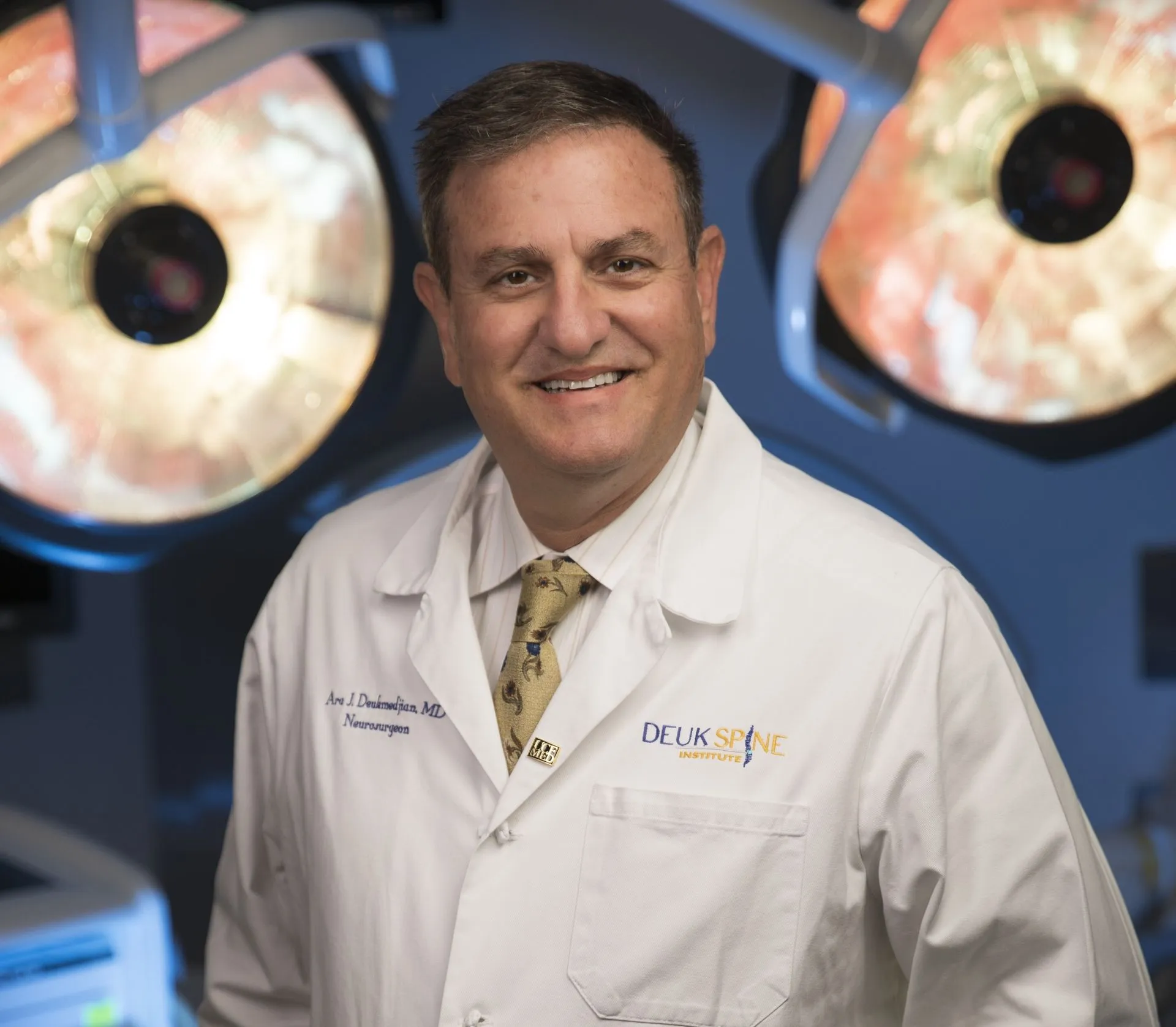
By Dr. Ara J. Deukmedjian, MD
Board-Certified Neurosurgeon
Medically reviewed on June 9, 2026
Medical Disclaimer: This content is for educational purposes only and does not constitute medical advice. Individual results vary. Always consult a qualified spine specialist about your specific condition, imaging, and treatment options.
Key Points
✓ In London and across England, a growing number of clinics advertise “minimally invasive” and “laser” spine surgery. The label has marketing value, so it gets used loosely. In many cases the operation actually being performed is a traditional open decompression or a fusion with hardware, just described with newer language. ¹ ²
✓ “Minimally invasive” is not a single defined operation. It describes a spectrum. A true endoscopic, laser-based disc procedure through a 4–7 mm incision and a tubular retractor “muscle-splitting” fusion that still removes the disc and installs permanent hardware are both sometimes marketed under the same phrase, even though the recovery, tissue damage, and permanence are completely different. ³ ⁴
✓ The published data is consistent: full-endoscopic discectomy produces pain and disability outcomes comparable to open discectomy, with shorter hospital stays, less tissue disruption, and in large case studies a remarkably lower rate of complications (0.6% endoscopic vs 3.4% open). The technique matters. ¹ ²
✓ Deuk Laser Disc Repair® is a Registered Trademark procedure performed only at Deuk Spine Institute in Florida, USA. It is not a generic “laser spine surgery” available from any clinic that uses similar wording on its website. If a London or England clinic is using language that sounds like ours, that does not mean they perform our procedure, because they cannot. ⁵
✓ Before you travel anywhere, or consent to anything, the protection is not the brochure. It is a small set of specific questions about incision size, disc removal, hardware, anesthesia, and personal complication rates that a marketing label cannot answer for you.

Why “Laser Spine Surgery” Means Less Than Patients Think
If you live in London or anywhere in England and you have searched for “laser spine surgery” or “minimally invasive spine surgery,” you have almost certainly seen clinics promising small incisions, fast recovery, and a high-tech alternative to open back surgery. The pages look reassuring. The language is modern. The before-and-after framing is persuasive.

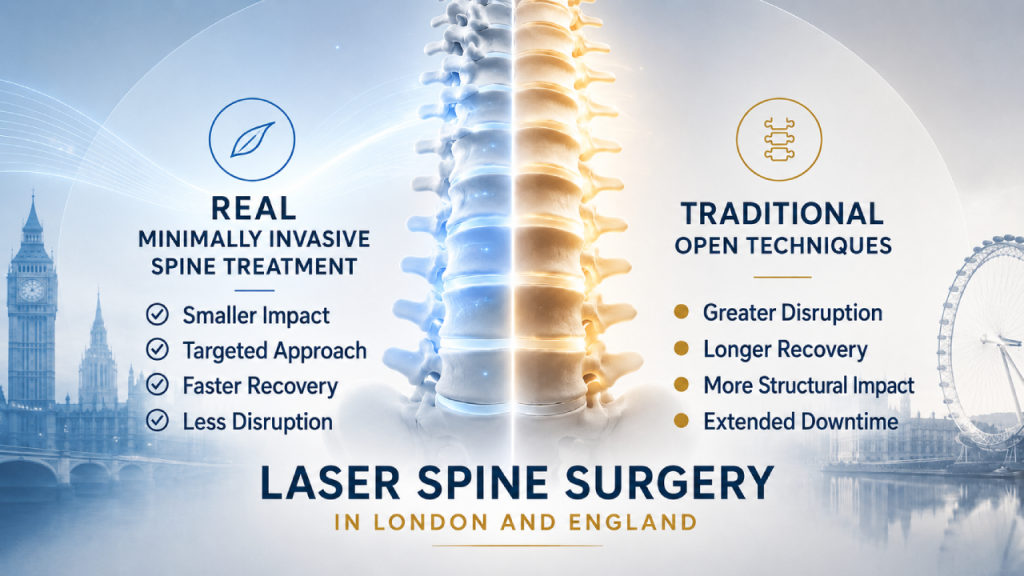
Here is the problem. “Laser spine surgery” and “minimally invasive spine surgery” are descriptive marketing phrases, not regulated, standardized operations. There is no single procedure that the words guarantee. Minimally invasive techniques are used across a wide variety of spine procedures, and the same phrase can sit on top of operations that are worlds apart in how much tissue they damage and what they permanently change in your spine.
That gap is where patients get misled, not always intentionally, but reliably. A clinic can truthfully say a procedure is “minimally invasive” while still removing your disc, cutting bone, and placing permanent fusion hardware, simply because the skin incision was smaller than a traditional open approach. The recovery you were imagining and the operation you actually receive can be very different things.
The Spectrum Hiding Behind One Phrase
It helps to understand that “minimally invasive” describes a spectrum, not a destination.
At one end is genuine full-endoscopic, laser-based disc surgery: a procedure performed through an incision a few millimeters wide, using a camera and laser to treat the disc itself, typically without general anesthesia, without fusion hardware, and without removing the disc. The disc is repaired, and motion is preserved.
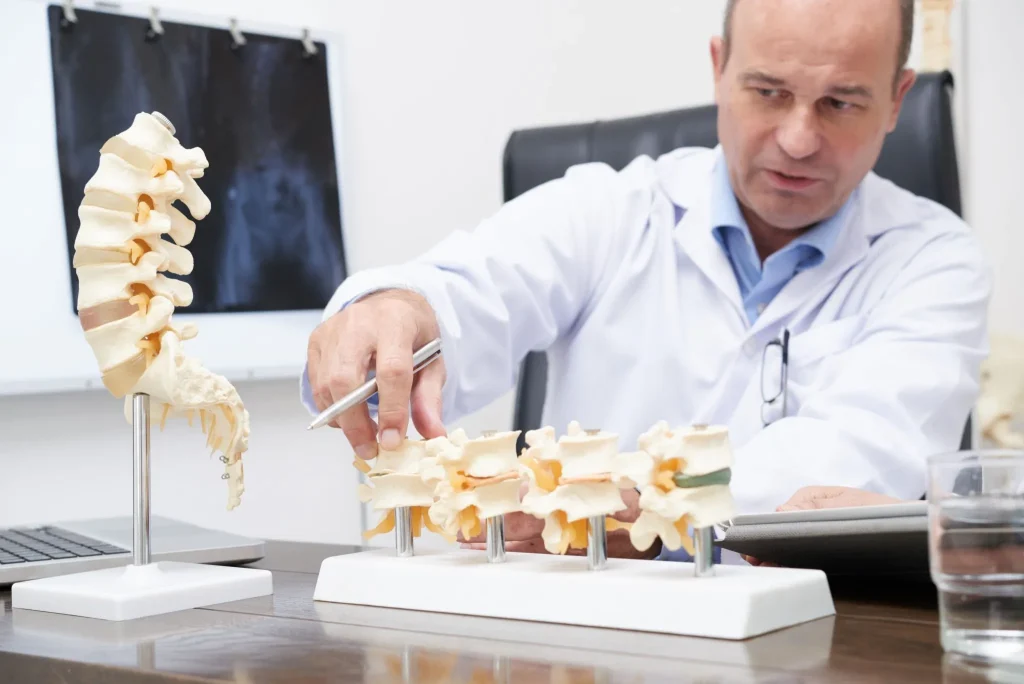
At the other end is “minimally invasive” fusion or decompression, which may use a tubular retractor and a smaller skin incision than traditional open surgery, but still involves removing disc material, cutting bone, and implanting permanent screws, rods, or cages that eliminate motion at that level. This is a major, permanent structural operation. The smaller incision does not change that.
Both can be, and are, advertised with the same words.
The published literature is actually encouraging about the genuinely endoscopic end of that spectrum. Systematic review and meta-analysis comparing endoscopic discectomy to conventional surgical techniques for lumbar disc herniation found similar pain relief, shorter hospital stays, and comparable complication rates, with less tissue disruption and faster recovery. In a large multi-center database analysis, endoscopic discectomy showed a significantly lower rate of total adverse events than open discectomy — 0.6% versus 3.4% — along with a shorter length of stay. A broader review of endoscopic spine surgery similarly concluded that endoscopic discectomy yields shorter operative times, lower infection rates, and comparable pain and functional outcomes versus open microdiscectomy.
The takeaway is not that “laser” or “minimally invasive” is meaningless. It is that the specific technique, not the marketing phrase, is what determines your outcome. A clinic that genuinely performs endoscopic disc surgery and a clinic that performs open fusion under a modern banner are not offering you the same thing, even when their websites read almost identically.
A Word of Caution for Patients in London and England
Because these phrases carry weight with patients, they get borrowed. Across London and England, you will find clinics whose websites lean heavily on language like “minimally invasive laser spine surgery,” sometimes describing procedures, outcomes, and recovery in terms that closely echo specialist centers abroad, including ours.

We want to be direct and fair about what that does and does not mean:
- Similar-sounding language on a clinic’s website is not proof that the clinic performs the same procedure. Words are easy to copy. A specific surgical technique, with its instrumentation, training, and published results, is not.
- A clinic advertising “laser spine surgery” may be performing a laser-assisted step within an otherwise traditional operation, or may be using “laser” loosely. That is a question to resolve directly with the surgeon, not something to assume from the homepage.
- Deuk Laser Disc Repair® is a trademarked procedure developed and performed only at Deuk Spine Institute in Melbourne, Florida. No clinic in London or anywhere else in England performs Deuk Laser Disc Repair®(DLDR). If you are searching specifically for our procedure and you land on a UK clinic that sounds like us, you have not found us. You have found a different clinic using familiar-sounding words. ⁵
We are not telling you that every London or England spine clinic is the same, or that you cannot get good care closer to home. We are telling you that the burden is on the marketing to prove itself, and you hold the questions that make it prove itself.
The Red Flags That a Smaller Incision Is Still a Major Operation
You do not need to be a surgeon to catch the most common mismatches. Watch for these:
- The word “fusion” appears anywhere in your consent paperwork. Fusion permanently eliminates motion at a spinal level and relies on hardware. It can be done through smaller incisions, but it is not a minor procedure, and it is not disc repair. ⁴
- The plan involves removing your disc. “Discectomy,” “microdiscectomy,” and “decompression” all involve taking tissue out. A repair-based approach aims to treat the disc and preserve it. These are different philosophies, not different brand names for the same thing.
- General anesthesia and an overnight hospital stay are required. Genuine endoscopic disc procedures are frequently performed under sedation or local anesthesia on an outpatient basis. A required hospital admission is a signal that the operation is larger than the label suggests. ⁵
- Recovery is described in weeks of restricted activity, but the procedure is sold as “minimally invasive.” The recovery profile should match the procedure. If the recovery sounds like open surgery, it probably is open surgery.
- No one will quote you about their personal complication and reoperation rate. A center confident in its technique can give you numbers, not adjectives.
What Deuk Laser Disc Repair® Actually Is
So patients can compare honestly, here is what our procedure is, in plain terms. Deuk Laser Disc Repair® is a full-endoscopic, laser-based procedure performed through a 4 to 7 mm incision, about the diameter of a pencil eraser. In most cases there is no hospital admission, no general anesthesia, no fusion hardware, and no artificial implant. The herniated, bulging, or torn disc is treated and repaired rather than removed, and spinal motion is preserved.
Deuk Spine Institute publishes its own track record openly: a reported complication rate of 0.01% and more than 2,700 procedures completed. ⁵ Those are the clinic’s published figures, and we state them as such, because honest, verifiable numbers are exactly what patients deserve and what a marketing label can never provide. No responsible surgeon, anywhere, can promise a zero-percent complication rate, and you should be cautious of any clinic, in any country, that claims one.
This is the point of the entire article. The strength of a spine procedure is not in the words on a website. It is in the specific technique, the surgeon’s training, the anesthesia and incision reality, and the published outcomes. Those are the things you can check.
What You Should Do Before Consenting to Any “Minimally Invasive” or “Laser” Spine Surgery
Whether the clinic is in London, elsewhere in England, or abroad, ask these questions and require specific answers:
- What exactly is the operation called, and will you be removing any disc material or placing any permanent hardware? If the answer includes fusion, screws, rods, cages, or disc removal, you are considering a major structural operation, regardless of incision size.
- How large is the incision, and what type of anesthesia is used? A few millimeters under sedation describes a very different procedure than a tubular approach under general anesthesia.
- How many of this exact procedure have you personally performed in the last 12 months, and what is your personal complication and reoperation rate? Ask for numbers.
- Is there a motion-preserving, repair-based alternative for my specific MRI findings? And if there is, why is it not being offered to me?
- If I am searching for a specific named procedure, are you actually performing that procedure, or one with a similar name? For Deuk Laser Disc Repair® specifically, the honest answer from any UK clinic is no, because the procedure is performed only at Deuk Spine Institute in Florida. ⁵
A clinic that answers all of these with specifics has earned your trust. A clinic that retreats to “it’s minimally invasive, you’ll be fine” has told you something important.

Frequently Asked Questions
Is “laser spine surgery” advertised in London and England the same as Deuk Laser Disc Repair®?
No. “Laser spine surgery” is a general marketing term that different clinics apply to different operations. Deuk Laser Disc Repair® is a specific, trademarked, full-endoscopic procedure performed only at Deuk Spine Institute in Florida. A London or England clinic using similar language is offering its own procedure, not ours. Always confirm the exact operation, incision size, anesthesia, and whether disc removal or fusion hardware is involved. ⁵
Can a procedure be called “minimally invasive” and still be a major surgery?
Yes, and this is the central confusion patients face. “Minimally invasive” can describe a true endoscopic disc procedure or a fusion performed through a smaller incision that still removes disc material and installs permanent hardware. The label does not tell you which. Minimally invasive techniques are used in a variety of spine procedures, so you must ask what the specific operation actually does. ⁴
Does the evidence support endoscopic and laser disc procedures over open surgery?
For the right patient, the data is favorable. Endoscopic discectomy produces pain relief comparable to conventional surgery with shorter hospital stays and less tissue disruption, and large database analysis has shown lower total adverse event rates for endoscopic discectomy than open discectomy. The benefit comes from the specific minimally invasive technique, not from the words used to advertise it. ¹ ² ³
A clinic’s website looks a lot like Deuk Spine Institute. Does that mean they do the same thing?
No. Website language can be copied; a surgical technique, the training behind it, and the published outcomes cannot. Similar wording is a reason to ask more questions, not fewer. Confirm exactly what procedure is performed and request the surgeon’s personal outcome data before making any decision. ⁵
Should I be suspicious of a clinic that promises a 0% complication rate?
Yes. No surgery anywhere carries zero risk, and no honest surgeon will promise a zero-percent complication rate. Reputable centers publish real figures. Deuk Spine Institute, for example, publishes a reported 0.01% complication rate across more than 100,000 procedures, stated as the clinic’s own track record rather than as a guarantee. Treat absolute, risk-free claims as a warning sign, not a reassurance. ⁵
Sources
- Khandge AV, et al. A systematic review of full endoscopic versus micro-endoscopic or open discectomy for lumbar disc herniation. PubMed. 2021. https://pubmed.ncbi.nlm.nih.gov/34420416/
- Comparative effectiveness of minimally invasive endoscopic discectomy versus conventional surgical techniques for lumbar disc herniation: a systematic review and meta-analysis. Annals of Medicine and Surgery / PMC. 2025. https://www.ncbi.nlm.nih.gov/pmc/articles/PMC12577904/
- Evaluation of Endoscopic Versus Open Lumbar Discectomy: A Multi-Center Retrospective Review Utilizing the ACS-NSQIP Database. PMC. 2022. https://www.ncbi.nlm.nih.gov/pmc/articles/PMC9213256/
- A Systematic Review and Meta-Analysis of Preoperative Characteristics and Postoperative Outcomes in Patients Undergoing Endoscopic Spine Surgery: Part I Endoscopic Microdiscectomy. PMC. 2025. https://www.ncbi.nlm.nih.gov/pmc/articles/PMC12524356/
- Deuk Spine Institute. Deuk Laser Disc Repair® procedure overview and reported track record. https://deukspine.com/treatment-options/deuk-laser-disc-repair/
- Endoscope-Assisted Spine Surgery: A Comprehensive Review of Clinical Applications. PMC. 2025. https://www.ncbi.nlm.nih.gov/pmc/articles/PMC12285748/