

Your surgeon told you the laminectomy went well. Six weeks later you’re walking further than you could before surgery, and that part is real. But the ache in your low back, the one that made you agree to surgery in the first place, is still there. Sometimes it’s even worse than before. After over 30 years performing spine surgery, I’ve evaluated thousands of patients who came to Deuk Spine Institute asking some version of the same question: why does laminectomy recovery time seem to stall right around the point where back pain should have faded? The honest answer is that the timeline itself isn’t the problem. What the surgery treats, and what it leaves alone, usually is.
This article walks through what recovery actually looks like week by week after a laminectomy, and why so many patients hit a recovery plateau where leg symptoms improve but back pain persists or returns.
No cost · No obligation
Live Pain Free
Upload your MRI for a free expert review by Dr. Ara Deukmedjian, M.D. — board-certified neurosurgeon. Ten minutes can change your life.
What Laminectomy Recovery Time Actually Looks Like
A laminectomy removes the lamina, the bony arch on the back of the vertebra, to create more room inside the spinal canal. That decompression is meant to relieve pressure on the nerve roots or spinal cord. Most surgeons will tell you recovery runs anywhere from six weeks to six months depending on how much bone was removed, whether fusion was added, and how many levels were treated. Here’s the part that gets left out of that estimate: the recovery clock measures healing of the incision, the muscle, and the bone. It doesn’t measure whether the actual source of your pain got treated. Those are two different clocks, and confusing them is where most of the frustration starts.
Your Recovery Timeline, Week by Week
Week 1: Surgical Site Healing
During the procedure, the muscles along the spine are retracted or cut away from the bone to expose the lamina. That muscle trauma, not just the incision, is the main source of pain in the first week. Expect swelling, stiffness, and pain that typically requires prescription medication, including opioids in many cases, for the first several days. Walking short distances is usually encouraged almost immediately to prevent blood clots, but bending, lifting, and twisting are off limits.
Weeks 2 to 4: Early Tissue Repair
The incision closes, but the deeper muscle and ligament damage is still remodeling. Patients in this window often describe a strange combination of relief and frustration. Leg symptoms, if that was the primary complaint, may already feel noticeably better. Back soreness, however, tends to plateau. Most surgeons restrict lifting to under ten pounds and ask patients to avoid prolonged sitting during this stretch.
Weeks 4 to 6: Return to Light Activity
This is typically when driving, light housework, and desk work resume. Physical therapy usually starts here, focused on gentle core activation rather than strength building. If your pain has followed the expected curve, mechanical back pain, meaning discomfort tied to standing, sitting, or specific movements, should be decreasing. If it isn’t, that’s worth paying attention to rather than waiting out.
Weeks 6 to 12: Strength Rebuilding
Formal physical therapy intensifies. Patients work on core stability, hip strength, and gradual return to normal lifting mechanics. Full-time workers with desk jobs are often cleared around this point. Manual laborers usually wait longer. By week 12, most of the tissue-level healing from the surgery itself is complete.
Months 3 to 6: The Honest Assessment Point
By now, the surgical trauma has healed. Whatever pain remains at this stage is rarely still “recovery.” A 2021 case study published in Cureus notes that postlaminectomy syndrome, ongoing pain that continues after spinal decompression surgery, occurs in an estimated 60% of patients who undergo spinal surgery. That’s a substantial number, and it’s the reason so many laminectomy patients end up in long-term pain management rather than pain resolution.
Why Does Back Pain Return After Laminectomy?
This is the question I hear most often, and it comes down to a distinction that gets blurred constantly: nerve compression and axial back pain are not the same problem.
- Radicular pain is the sharp, shooting, or electric sensation that travels down a leg along a specific nerve path. It’s driven largely by chemical inflammation around a compressed or irritated nerve root, not just mechanical pinching. A laminectomy, by removing bone and relieving that compression, can meaningfully reduce radicular pain.
- Axial back pain stays localized to the back itself and typically comes from the disc or facet joints, not the nerve roots. Spinal stenosis, the condition laminectomy most often treats, produces leg heaviness and cramping with walking, not back pain. If a patient has both stenosis and chronic back pain, those are two separate conditions that happen to coexist.
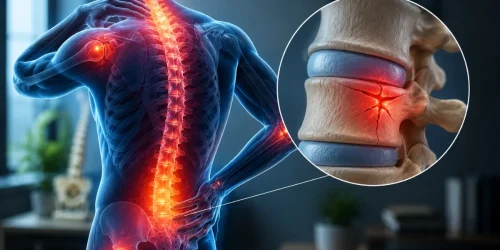
Here’s the piece that explains most of what patients describe as “pain returning”: laminectomy does not treat the disc. If your back pain originates from a posterior annular tear, the injury in the outer wall of the disc where the nucleus pulposus pushes against or through the ring of fibers holding it in place, that tear is still there after the bone is removed. In my clinical experience, disc injuries account for approximately 85% of chronic back pain. Removing the lamina does nothing to address inflammation inside an annular tear. If anything, the loss of stabilizing bone can shift additional mechanical stress onto the disc and facet joints at that level, which is part of why adjacent segment issues are common after laminectomy.
Facet joint pain follows a similar pattern. An injury to the facet joint capsule causes its own kind of tear and chronic inflammation, and a laminectomy performed for stenosis doesn’t treat that capsule. So a patient can walk out of surgery with genuinely improved leg symptoms and an unchanged, or worsened, back pain source.
What a Laminectomy Actually Treats, and What It Leaves Alone
To be fair to the procedure, laminectomy has a legitimate, well-established role. It’s the right call for:
- Spinal stenosis causing neurogenic claudication, meaning leg heaviness or cramping with walking that eases with rest
- Nerve root compression producing numbness, weakness, or radiating leg pain
- Cases where imaging and physical exam findings clearly point to canal narrowing as the driver of leg symptoms
What it isn’t designed to treat is disc-based axial back pain, facet-driven pain, or sacroiliac joint pain. If your surgeon recommended laminectomy primarily for back pain rather than leg symptoms, it’s worth asking directly what structure the surgery is expected to fix. A closer look at what surgeons often leave unsaid about this distinction can save patients from a second surgery down the road.
Is There a Shorter, More Targeted Recovery Path?
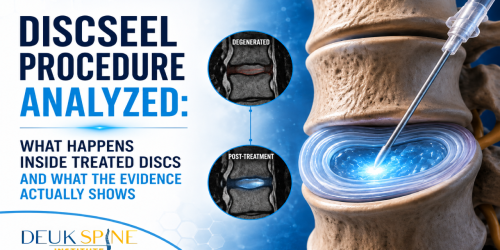
When the pain source really is a disc injury, treating that structure directly tends to produce a very different recovery curve than a laminectomy. Deuk Laser Disc Repair uses an endoscope and laser through a small incision, typically 4mm to 7mm, to remove the inflamed tissue inside the annular tear and clean out the herniated nucleus pulposus material causing it, without removing lamina, facet joints, or other stabilizing bone. Across more than 2,700 procedures, our complication rate has held at 0.01%, with a 0% infection rate, and patients report an average of 99% pain relief for the disc-related pain sources treated. Recovery from this procedure typically runs in hours, not months, since there’s no bone removed and no muscle stripped from the spine to heal.
That doesn’t mean it replaces laminectomy for every patient. Someone with true canal stenosis and leg symptoms may still need decompression. But for the large share of patients whose chronic back pain traces back to a disc injury rather than canal narrowing, treating the disc directly, instead of or in addition to decompression, is worth discussing before signing off on surgery.
Frequently Asked Questions
How long until I know if my laminectomy recovery is on track?
By the 6 to 12 week mark, mechanical back pain tied to daily movement should be trending down, not staying flat. If it isn’t, that’s a signal worth raising with your care team rather than assuming it will resolve with more time.
Is it normal for back pain to be worse after laminectomy than before?
It happens more often than most patients are told going in. Removing stabilizing bone can shift load onto the disc and facet joints, and if either was already the true source of pain, that pain can persist or intensify even as leg symptoms improve.
Can a second surgery fix pain that returns after laminectomy?
Sometimes, but only if the second procedure targets the actual pain generator. Repeating decompression, or moving straight to fusion, without first confirming whether the disc, facet joints, or SI joint are driving the pain, is how patients end up in repeat-surgery cycles.
What disc levels are most commonly involved in chronic low back pain?
In my clinical experience, L4-L5 is the most frequently affected level, followed by L5-S1, then L3-L4 and L2-L3.
If your laminectomy recovery has stalled, or your back pain came back after the leg symptoms improved, the next step is figuring out which structure is actually generating the pain. Our free MRI review gives you a specific answer, evaluated personally, with no cost and no obligation.
This article is for informational purposes only and does not constitute medical advice.

Diagnosis. Answers. Relief.
Submit your MRI for a free expert review by Dr. Ara Deukmedjian, M.D. —
board-certified neurosurgeon. No obligation. Real answers.