
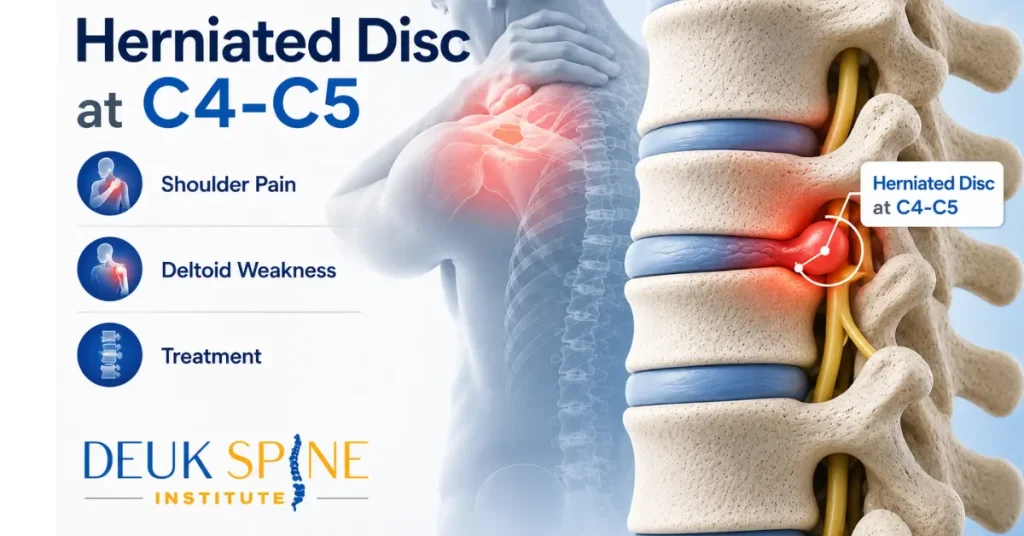
If you’ve been diagnosed with a herniated disc C4-C5, you’re probably dealing with shoulder pain and arm weakness that doesn’t quite match what most people picture when they think of a neck injury. There’s no numbness in your hand. Your grip is fine. What’s failing is your ability to lift your arm out to the side, and your shoulder aches in a way that’s made you wonder if the problem is actually in your rotator cuff. I’ve spent over 30 years as a board certified neurosurgeon treating cervical disc conditions, and C4-C5 herniations produce one of the more distinctive, and more frequently misdiagnosed, symptom patterns in the entire spine.
This level completes what I think of as the cervical trifecta, alongside C5-C6 and C6-C7, the three disc levels responsible for the overwhelming majority of cervical radiculopathy I see in practice. But C4-C5 stands apart because of which nerve root it affects and where that nerve root sends its signals.
No cost · No obligation
Live Pain Free
Upload your MRI for a free expert review by Dr. Ara Deukmedjian, M.D. — board-certified neurosurgeon. Ten minutes can change your life.
What a Herniated Disc at C4-C5 Actually Does
The C4-C5 disc sits between the fourth and fifth cervical vertebrae, and it’s the exit point for the C5 nerve root. When the nucleus pulposus at the center of that disc pushes through a tear in the surrounding annulus fibrosus and compresses or irritates the C5 root, the result isn’t hand or finger symptoms. The C5 root doesn’t reach that far down the arm. It innervates the shoulder region instead, which is exactly why C4-C5 herniations get mistaken for shoulder joint problems more often than any other cervical level.
Compression can come from a contained protrusion, where the nucleus pushes against an intact but weakened annulus, or from a frank extrusion, where disc material breaks through completely into the space around the nerve root. Either way, the nerve responds with inflammation, and that inflammation is what generates both the pain and the weakness patients describe.
Most C4-C5 herniations develop gradually rather than from a single traumatic event. Discs lose water content and structural resilience with age, beginning as early as the third decade of life, which makes the annulus more prone to tearing under everyday load. Repetitive neck extension, prolonged forward head posture from screen use, and previous neck injuries can all accelerate this process. Acute trauma, a fall or a car accident, can herniate a disc that was otherwise healthy, but in my experience that’s the less common path to a C4-C5 diagnosis.
The Full Symptom Picture at C4-C5
Beyond the deltoid weakness and shoulder pain that define this level, patients typically describe several symptoms together.
- Neck pain that radiates toward the shoulder blade, often worse with looking up or turning the head toward the affected side.
- A deep, aching shoulder pain that can be mistaken for rotator cuff tendinitis or bursitis, especially before weakness becomes noticeable.
- Difficulty lifting the arm away from the body, particularly above shoulder height.
- Fatigue in the shoulder with overhead activity, such as reaching into a cabinet or lifting an object above the head.
- Reduced neck range of motion, especially with extension and rotation toward the involved side.
Notice what’s absent from that list, hand numbness, finger weakness, and forearm symptoms. Their absence is as diagnostically useful as the symptoms that are present.
The C5 Dermatome, Why Your Shoulder and Not Your Hand
Understanding C4-C5 disc herniation symptoms starts with understanding exactly where the C5 nerve root sends sensory and motor signals. The C5 root supplies sensation to the outer shoulder and the upper portion of the arm, roughly the area you’d cover with a short sleeve t-shirt cap. It does not extend into the forearm or hand, which is one of the most useful clues in telling a C5 problem apart from lower cervical levels.
On the motor side, C5 provides the primary innervation to your deltoid, the muscle responsible for lifting your arm out to the side, along with a meaningful contribution to your biceps. This is why C5 nerve root deltoid weakness is considered one of the more reliable localizing signs in cervical spine diagnosis. Research on surgically confirmed cases has found that severe C5 motor weakness correctly identifies the C5 level with high consistency, unlike some of the more variable patterns seen at other cervical levels.
In practical terms, patients with C5 involvement often notice they can no longer raise their arm to shoulder height without using their other hand to help, or that reaching overhead has become genuinely difficult rather than just uncomfortable. Deltoid weakness large enough to see, sometimes described by patients as a shoulder that looks like it’s “dropped” or lost its normal contour, is a strong indicator that the C5 root, and therefore the C4-C5 disc, is the source.
Distinguishing C4-C5 from C5-C6, Why the Difference Matters
Patients frequently ask me how their symptoms could possibly pinpoint one disc level over the one right next to it, but the distinction is more reliable than most people expect.
- Pain and numbness location. C4-C5 involves the shoulder and upper arm through the C5 root. C5-C6 involves the thumb side of the hand and forearm through the C6 root, a clearly different distribution.
- Weakness pattern. C4-C5 weakens the deltoid and, to a lesser degree, the biceps. C5-C6 weakens the wrist extensors and biceps, with the biceps reflex often diminished at either level, which is one reason biceps involvement alone isn’t diagnostic on its own.
- Reflex changes. A diminished biceps reflex can appear with either level, but a diminished brachioradialis reflex points more specifically toward C5-C6.
- Functional complaints. C4-C5 patients describe trouble lifting the arm sideways or overhead. C5-C6 patients more often describe weak grip or wrist extension along with thumb side numbness.
- Neck movement response. Both levels typically worsen with neck extension and rotation toward the affected side, so this finding alone doesn’t separate the two, it simply confirms a cervical, rather than a peripheral, source.
This distinction isn’t academic. Treating the wrong level, even by one disc space, means operating on a segment that isn’t actually generating the patient’s symptoms, which is one of the more common and entirely avoidable reasons cervical spine surgery fails to deliver relief.
How a C4-C5 Herniation Is Accurately Diagnosed
Diagnosis starts with a physical examination that maps the specific pattern above, sensation over the shoulder and upper arm, deltoid and biceps strength testing, and reflex testing, before any imaging is reviewed. Research on cervical radiculopathy causing deltoid weakness confirms that this presentation is generally associated with disc herniation at the C4-C5 level compressing the C5 nerve root (Park et al., clinical analysis of cervical radiculopathy causing deltoid paralysis), which is exactly the correlation I look for before recommending any treatment.
MRI then confirms what the exam suggests, showing the size and location of the herniation and the degree of nerve root compression. But MRI alone isn’t the diagnosis. Disc abnormalities at multiple cervical levels are common findings even in people without any arm or shoulder symptoms, so the imaging has to explain the specific pattern the patient is describing, not simply show that something looks abnormal. When the exam and the MRI disagree, or when the presentation is unusual, electrodiagnostic testing can help confirm which root is actually involved.
DLDR® vs. ACDF, Two Very Different Operations for C4-C5
Once conservative treatment, physical therapy, anti-inflammatory medication, and activity modification, has had a genuine trial and hasn’t resolved a significant C5 deficit, patients are typically presented with one surgical option, anterior cervical discectomy and fusion. It’s rarely presented as one option among several.
Anterior cervical discectomy and fusion, ACDF, removes the entire C4-C5 disc through an incision in the front of the neck, then permanently joins the two vertebrae with a bone graft and a plate secured by screws. It’s an effective operation for the level being treated, but fusing one segment changes the mechanical load on the segments above and below it. Research following ACDF patients long term found that symptomatic adjacent segment disease develops at a rate of roughly 2.9 percent per year, with about 25 percent of patients affected within 10 years of surgery. Motion at C4-C5 is eliminated permanently once fusion is performed.
Deuk Laser Disc Repair® (DLDR®) takes a fundamentally different approach for patients whose C4-C5 herniation is confirmed as the pain and weakness source. Through a small incision, I remove only the specific disc material compressing the C5 nerve root and perform a debridement of the surrounding inflamed tissue. No bone is removed, no plate or screws are implanted, and the disc itself remains in place. Because the segment isn’t fused, your neck retains its natural motion at C4-C5, and the mechanical load isn’t shifted onto the discs above and below it the way it is after fusion.
In my clinical experience across thousands of Deuk Laser Disc Repair® procedures, patients report an average of 99 percent pain relief for the treated pain source, with a complication rate of 0.01 percent, and most return to desk work within days rather than the months typical of a fusion recovery.
DLDR® isn’t the right choice for every cervical patient. Significant instability or advanced bony collapse at the segment can still make fusion the more appropriate option. But for a contained or extruded herniation at C4-C5 causing deltoid weakness and shoulder pain, without instability, a motion preserving option deserves to be part of that conversation, not an afterthought after fusion has already been recommended.
Common Questions About C4-C5 Herniated Discs
Can a C4-C5 herniation heal without surgery?
Many patients improve with a genuine trial of physical therapy, activity modification, and anti-inflammatory treatment, particularly when the deltoid weakness is mild. Progressive weakness, however, is a signal that waiting carries real risk, since nerve tissue has limited capacity to recover from prolonged compression.
Is deltoid weakness always from C4-C5?
Deltoid weakness is most commonly associated with C4-C5 involvement of the C5 nerve root, but a small percentage of cases involve adjacent levels or non-spinal causes such as a rotator cuff tear or a peripheral nerve injury. That’s exactly why a physical exam and imaging correlation matter before assuming the source.
Is fusion the only surgical option for a C4-C5 herniation?
No. ACDF is the option most patients hear about first, but it isn’t the only surgical path for a disc-sourced C5 deficit. A motion preserving procedure like DLDR® can treat the same compressed nerve root without removing the disc or fusing the segment.
What This Means If You’re Dealing With Shoulder Pain and Weak Arm Lift
C4-C5 now joins the two other levels I’ve covered in this series, so if your symptoms don’t quite match what’s described here, it’s worth reading about C5-C6 disc herniation and C6-C7 disc herniation as well, since the three levels account for most of the cervical radiculopathy cases that come through my practice.
If your shoulder pain and arm weakness have been dismissed as a rotator cuff problem, or you’ve been told fusion is your only surgical option, the right next step is confirming the actual source before committing to either. I offer a free MRI review for exactly this reason. Send us your imaging, and my team will help you understand whether your C4-C5 disc is truly the cause, and what your realistic treatment options are, before you agree to anything. Reach out to Deuk Spine Institute to schedule your free MRI review and get a clear answer instead of another guess.

Diagnosis. Answers. Relief.
Submit your MRI for a free expert review by Dr. Ara Deukmedjian, M.D. —
board-certified neurosurgeon. No obligation. Real answers.