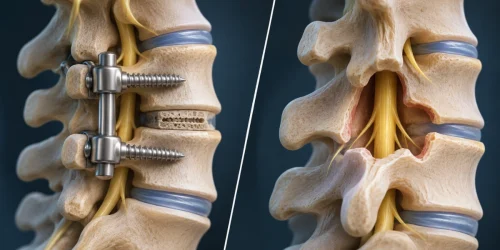


A disc injury is damage to one of the cushioning discs that sit between the vertebrae in your spine. The two common forms are a bulging disc, where the outer ring called the annulus fibrosus pushes past its normal position but stays intact, and a herniated disc, where the inner gel-like core called the nucleus pulposus extrudes through a tear in that outer ring. Either can be a real source of pain, but neither shows up on an MRI as an automatic explanation for why a specific person hurts.
That gap between what an MRI shows and what actually causes your pain is where most patients get stuck. If you have already tried physical therapy or an injection and still hurt weeks later, the useful question is not whether you have a disc finding on a scan. It is whether that finding is the pain generator, and if so, what a person can reasonably do about it.
The Deuk Spine Exam® was built to answer exactly that question by combining your MRI, a physical examination, and your symptom history into one read. If you already have an MRI report mentioning a bulge or herniation, Deuk Spine Institute offers a free MRI review with no obligation, where the practice gives a written answer on whether you may be a candidate for a motion-preserving procedure.
What Is a Disc Injury, in Plain Terms?
Spinal discs sit between the vertebrae and act as shock absorbers. Each disc has two parts, a tough outer ring called the annulus fibrosus, and a softer inner core called the nucleus pulposus.
A bulging disc is when the annulus fibrosus pushes out past its normal edge but does not tear all the way through. A herniated disc is when the nucleus pulposus escapes through a tear in the annulus fibrosus. These are two different structural situations, though people often use the words interchangeably.
Is “Slipped Disc” a Real Thing, and Do Disc Findings Always Mean Pain?
You have probably heard the term “slipped disc.” Anatomically, discs do not slip. They are firmly anchored to the vertebrae above and below them, and the phrase is imprecise shorthand for either a bulge or a herniation.
That imprecision feeds two opposite mistakes. One is treating every disc finding as a catastrophe. The other is dismissing disc injury as a myth.
The evidence sits between those extremes. A peer-reviewed systematic review by Brinjikji and colleagues, published in the American Journal of Neuroradiology in 2015, found that disc bulges, protrusions, and other degenerative findings are common on MRI in adults with no back pain at all, and become more common with age.
What that tells us is narrow but important. An MRI finding, by itself, does not confirm that a given disc is the source of a given patient’s pain. It does not tell us that disc injuries never cause pain.
Plenty of people with disc findings on MRI have no symptoms, and plenty of people with disc injuries have real, identifiable, treatable pain. Both things are true at once. The job of a good diagnostic process is to tell those two situations apart for you specifically, and that requires more than a scan.
What Symptoms Does a Disc Injury Actually Cause?
Disc injury pain does not come from material simply being stuck somewhere. It involves inflammation in and around a posterior annular tear, mechanical stress on pain-sensitive structures in the outer annulus and the posterior longitudinal ligament, and sometimes herniated nucleus pulposus material contacting nearby tissue.
Symptoms commonly include:
- Localized back or neck pain at the level of the injured disc, often worse with certain positions or loading.
- Radiating limb symptoms such as leg pain, arm pain, numbness, or weakness when a nerve root near the disc is irritated.
- Pain that flares and settles over weeks rather than resolving cleanly.
- Stiffness and guarding around the affected segment.
- Symptoms that shift depending on activity, sitting time, or sleep position.
One clarification matters here. A pinched nerve does not cause back or neck pain by itself.
Nerve compression causes radicular pain, numbness, or weakness in a limb, and that limb pain is driven largely by chemical inflammation of the nerve rather than compression alone. So the axial back pain and the leg pain are usually different problems layered on the same disc.
Where Do Disc Injuries Usually Happen?
In Dr. Ara Deukmedjian’s clinical experience, disc injuries account for roughly 85% of the chronic back pain cases he treats. This figure is a practice-based observation, not a published research taxonomy. The most commonly affected lumbar disc levels, in order, are L4-L5, then L5-S1, then L3-L4, then L2-L3.
How Long Does a Disc Injury Take to Heal?
Many disc injuries improve over time with conservative care such as physical therapy. Acute inflammation typically settles a minor injury within about two weeks. That is why most first-episode back pain, even with a disc finding, gets better without a procedure.
Chronic pain is defined as pain on and off for more than two weeks. That is different from the point at which conservative care is considered to have failed, which is generally six to twelve weeks of appropriate non-surgical treatment without meaningful improvement.
When pain does not resolve, the reason is usually an unresolved structural problem driving chronic inflammation. Chronic inflammation does not clear on its own, and over time it can cause neoinnervation, meaning pain nerve fibers grow into damaged disc tissue. That is the pattern behind many long-running back and neck pain cases.
Why Can’t an MRI Alone Tell Me What’s Wrong?
An MRI shows structure. It does not show pain. Because bulges, protrusions, and degenerative changes appear on scans of people with no symptoms, a finding on your MRI cannot, by itself, prove that a specific disc is the reason you hurt.
To answer that question, three inputs have to line up:
- MRI review to identify the structural findings and their location.
- Physical examination to reproduce or localize symptoms and check nerve function.
- Symptom history to match the pain pattern to a specific level and mechanism.
The Deuk Spine Exam® combines these three inputs to identify the structural source of a patient’s pain, and Deuk Spine Institute reports that its own first-party data associates the exam with 99% diagnostic accuracy.
What Are My Options If a Disc Injury Is Confirmed?
If you are reading this, you have probably already worked through physical therapy, activity modification, or an injection, and the pain has outlasted them. Not every confirmed disc injury needs a procedure, and conservative care remains the first step for most people. When it has failed at the six to twelve week mark and pain continues, the conversation shifts to what can address the disc directly.
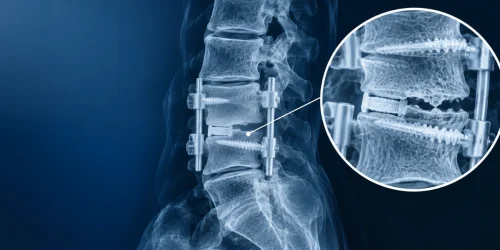
Traditional options include steroid injections, discectomy, and spinal fusion. Fusion has its own body of outcomes data, commonly cited at 70 to 90% success, and those numbers are not comparable to or interchangeable with outcomes from a motion-preserving procedure. Fusion also changes the mechanics of the segments above and below the fused level.
What Is Deuk Laser Disc Repair®?
Deuk Laser Disc Repair® (DLDR®) is an endoscopic laser procedure that removes inflammatory tissue and, where present, herniated disc material from the posterior annular tear. It treats back pain, neck pain, herniated discs, bulging discs, sciatica, radiculopathy, and degenerative disc disease.
Key features of the procedure include:
- About 20 minutes of operating time per disc.
- 7mm incision for the lumbar spine, or a 4mm incision for the cervical spine.
- Same-day outpatient, with most patients walking within about an hour.
- No cadaver bone, metal, or plastic placed in the spine.
- Natural tear healing over 9 to 12 months after the inflammatory tissue is removed.
On average, DLDR® is associated with 99% pain relief for treated pain sources. That figure is attributed to a published peer-reviewed abstract, not a full peer-reviewed journal article. Dr. Ara Deukmedjian, MD, FAANS, has performed 2,732 Deuk Laser Disc Repair® procedures through 2025, over 30+ years of spine surgery experience, with a 0.01% complication rate and a 0% infection rate.
How Do I Know If My Disc Injury Is the Real Pain Source?
You find out by having someone read your MRI in the context of your exam and your history, together, and tell you plainly whether the imaging findings match the pain pattern. If they line up, the disc is a candidate pain source. If they do not, more looking is warranted before any procedure is considered.
This is what the free MRI review is for. You send in the MRI you already have.
The practice reviews it and gives you a written answer on whether you may be a candidate for a motion-preserving procedure. There is no cost and no obligation attached.
Bottom Line
If you have already spent weeks in conservative care and still hurt, the useful next move is not another scan or another opinion in the abstract. It is getting a written answer on whether the disc finding on your existing MRI matches your specific pain pattern, because that answer is what changes what treatment options are actually on the table for you.
The free MRI review at Deuk Spine Institute is designed to give you that answer without cost or commitment. What you do with it is up to you.

Diagnosis. Answers. Relief.
Submit your MRI for a free expert review by Dr. Ara Deukmedjian, M.D. —
board-certified neurosurgeon. No obligation. Real answers.
Frequently Asked Questions
What Happens After I Send in My MRI for the Free Review?
After you send in your MRI for the free review, the practice reviews the imaging and gives you a written answer on whether you may be a candidate for a motion-preserving procedure. There is no cost and no obligation attached to receiving that answer.
What If the Review Suggests My Disc Is Not the Pain Source?
If the review suggests your disc is not the pain source, that is a useful answer on its own, because it means a procedure aimed at the disc would not resolve your pain. The written response tells you whether the imaging findings match your reported pain pattern, and when they do not line up, more diagnostic work is warranted before any procedure is considered.
Do I Have to Travel to Florida Just to Get the MRI Reviewed?
The free MRI review works from the existing MRI you already have, at no cost and with no obligation. The practice reviews that imaging and provides a written answer on whether you may be a candidate for a motion-preserving procedure.
Is a Bulging Disc the Same as a Herniated Disc?
A bulging disc is not the same as a herniated disc. In a bulge, the annulus fibrosus pushes past its normal edge but stays intact. In a herniation, the nucleus pulposus escapes through a tear in the annulus fibrosus, which is a different structural situation with different implications for treatment.
Does Deuk Laser Disc Repair® Require Hardware in My Spine?
Deuk Laser Disc Repair® does not require hardware in your spine. No cadaver bone, metal, or plastic is placed during the procedure, and the annular tear heals naturally over 9 to 12 months once the inflammatory tissue is removed.
How Is Deuk Laser Disc Repair® Different From Spinal Fusion?
Deuk Laser Disc Repair® is different from spinal fusion because it is a motion-preserving endoscopic laser procedure that treats the disc directly without altering the mechanics of the segments above and below. Fusion outcomes, commonly cited at 70 to 90% success, come from a separate body of data and are not interchangeable with DLDR® outcomes.
Can I Get the Free MRI Review If I Have Not Tried Physical Therapy Yet?
You can get the free MRI review whether or not you have tried physical therapy yet, because the review itself carries no cost and no obligation. That said, conservative care such as physical therapy remains the appropriate first step for most first-episode back pain, and non-surgical treatment is generally considered to have failed only after six to twelve weeks without meaningful improvement.
This article is for general educational purposes only. It is not a substitute for professional medical advice or diagnosis. Please consult a qualified physician about your own condition.