You already know that not all spine surgery is the same. You have seen the word endoscopic next to terms like laser and minimally invasive, and you want a straight answer on what it means for your disc, your recovery, and your ability to get back to your life.
This article explains what endoscopic spine surgery actually is, how it differs from open surgery and microdiscectomy, which conditions it treats, and what a realistic recovery timeline looks like.
No cost · No obligation
Live Pain Free
Upload your MRI for a free expert review by Dr. Ara Deukmedjian, M.D. — board-certified neurosurgeon. Ten minutes can change your life.
What Endoscopic Spine Surgery Actually Is
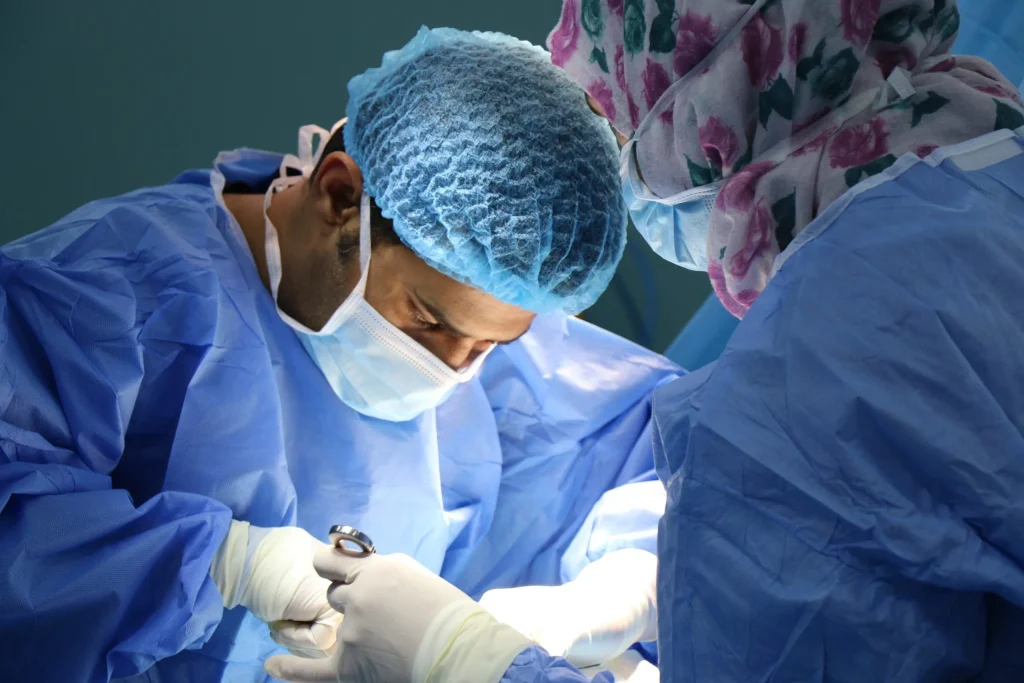
Endoscopic spine surgery is a technique that uses a small camera, called an endoscope, to let a surgeon see and treat spinal pathology through a single incision that is often less than a quarter inch wide. The camera feeds a real time, high definition image to a monitor in the operating room. The surgeon works entirely through this view, without opening the back the way traditional surgery does.
A thin dilator is inserted through the incision to gently create a passage to the spine. A tubular retractor then slides over the dilator, and the endoscope and surgical instruments pass through that same tube. Muscle is spread apart rather than cut, which is the mechanical reason endoscopic technique causes less tissue trauma than an open approach.
This is a category of technique, not a single procedure. Several different surgeons and systems fall under the endoscopic umbrella, and they are not all equal in incision size, visualization, or the instruments used inside the disc. Later in this article we cover where Deuk Laser Disc Repair® fits inside that category.
How is Endoscopic Spine Surgery Performed?
Endoscopic spine surgery is referred to as a type of minimally invasive surgery that is done using an endoscope. An endoscope is a 7mm tube equipped with a high-resolution camera lens and a light source.
During endoscopic spine surgery, the surgeon makes an 8mm incision and carefully separates the muscles to provide a small pathway for the endoscope to get to the spine. The images from the endoscopic camera are projected onto a monitor, which allows the surgeon to visualize the anatomy and pathology.
Once the images are projected, instruments are inserted through the channel to remove any problematic bone spurs, herniated discs, or thickened ligaments. After completing the procedure, the instruments are removed, and the surgeon closes the incision with sutures.
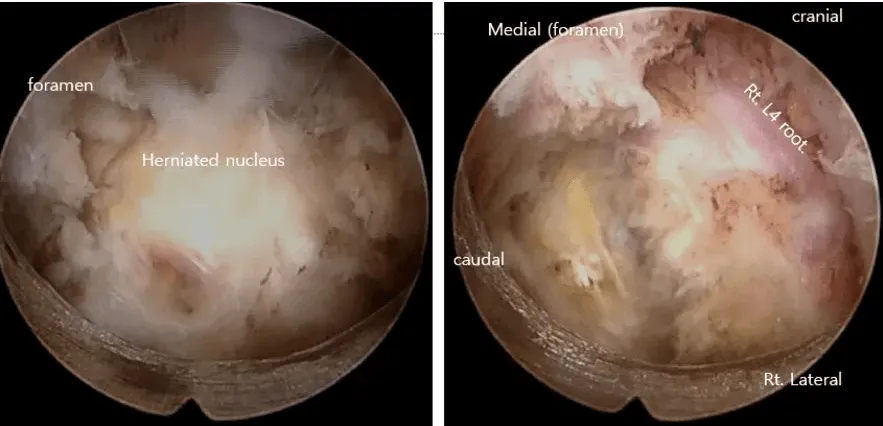
An example of an endoscopic image during spine surgery to remove a herniated disc.
Benefits of Endoscopic Spine Surgery
There are many benefits of endoscopic spine surgery for patients. These include:
Faster Recovery
It provides rapid recovery for patients. Compared to other traditional methods which cause tissue trauma, it has minimal to no tissue trauma. This results in a shorter hospital stay and a quicker return to your regular activities.
Minimally Invasive
The surgery is performed through a very small incision, which means less tissue damage. This results in less pain and scarring for the patient.
Lower Risk of Infection
It has a lower risk of infection because the incision is very small. In addition, it does not require any implants or foreign objects to be placed in the body.
Risks of Endoscopic Spine Surgery
ESS is a minimally invasive procedure with many benefits for patients. However, as with any surgery, there are also risks involved. The most common risks associated with endoscopic spine surgery include infection, bleeding, and nerve damage.
- Infection: The risk of infection is low, but it is always a possibility with any surgery.
- Bleeding: Endoscopic spine surgery involves using small instruments and cautery to stop bleeding. There is a small risk of bleeding associated with this type of surgery.
- Nerve Damage: There is a small risk of nerve damage associated with endoscopic spine surgery. The risk is lower than with other types of spine surgery.
If you are considering this type of surgery, be sure to discuss the risks and benefits with your surgeon.
How Endoscopic Spine Surgery Differs From Open Surgery and Microdiscectomy
Patients often use “minimally invasive” to describe anything that is not a large open fusion, but the three approaches below are mechanically different, and the differences change your recovery.
Traditional open surgery requires a larger incision, several inches long in many cases, and the surgeon retracts or cuts through muscle to see the spine directly with the naked eye. Open procedures such as spinal fusion and laminectomy often involve hardware, bone removal, or both, and typically require a hospital stay.
Microdiscectomy is a step down from open surgery, not a form of endoscopic surgery. The surgeon uses an operating microscope or loupes through an incision that commonly runs 1 to 2 inches, with more muscle dissection than a true endoscopic approach. Microdiscectomy is still the most common surgical treatment for a herniated disc in the United States, and it is often confused with endoscopic technique because both are described as minimally invasive.
Full endoscopic surgery keeps the incision at the width of the tubular retractor itself, generally 7mm or less, and the surgeon works exclusively through the endoscope’s camera feed rather than a microscope or direct line of sight. Less muscle trauma generally means less post operative pain, a faster return to daily activity, and a same-day discharge in most cases.
| Approach | Incision Size | How the Surgeon Sees the Spine | Typical Setting |
|---|---|---|---|
| Traditional open surgery (fusion, laminectomy) | Several inches | Direct vision | Hospital, often with an overnight stay |
| Microdiscectomy | 1 to 2 inches | Operating microscope or loupes | Hospital or surgery center |
| Full endoscopic surgery | 7mm or less | Endoscopic camera feed | Outpatient surgery center, same-day discharge for most patients |
A 2022 randomized controlled trial published in The BMJ compared full endoscopic discectomy to open microdiscectomy in 613 patients with sciatica from a herniated disc. The endoscopic group reported leg pain relief that was non-inferior to open surgery, with a shorter hospital stay. Gadjradj et al., BMJ 2022
Which Conditions Are Treated With Endoscopic Spine Surgery
Endoscopic technique is used across several structural sources of chronic back, neck, and radicular pain. Candidacy depends on which structure is actually causing your pain, confirmed by imaging correlated with a physical exam, not by imaging alone.
- Herniated or bulging discs where torn disc material is inflaming a nearby nerve root and causing radicular arm or leg symptoms.
- Degenerative disc disease where a disc has lost height and hydration and developed a painful annular tear over time.
- Facet joint arthritis in the neck or back, where the small joints connecting each vertebra become a pain source.
- Foraminal narrowing that is compressing a specific nerve root and causing radiating limb pain.
- Recurrent disc herniation after a prior microdiscectomy or open procedure, in select cases.
Endoscopic lumbar surgery is the most common application, since most disc herniations and degenerative changes occur at L4-L5 and L5-S1. Endoscopic cervical surgery follows the same camera-guided principle through a smaller incision, typically 4mm, and treats a herniated or degenerated disc in the neck rather than the low back. The structures differ, but the technique’s core advantage stays the same, a single small opening and continuous visualization instead of a wide surgical field.
Spinal stenosis deserves a direct note. Stenosis causes neurogenic claudication, meaning leg heaviness, cramping, or weakness that builds with walking and eases with rest. It does not, on its own, cause back pain. If you have both leg symptoms from stenosis and a separate back pain complaint, those are usually two different problems that need to be evaluated separately.
The same caution applies to a pinched nerve. A pinched or irritated nerve root causes radiating pain, numbness, or weakness down an arm or leg. It does not cause the back or neck pain itself. If a surgeon tells you a pinched nerve is the source of your back pain rather than your leg or arm pain, ask for a more specific explanation of what an MRI, on its own, cannot diagnose.
Endoscopic Spine Surgery Cost
Endoscopic spine surgery is less invasive and has a shorter recovery time than traditional open spine surgery. It can also be used to treat various conditions, including herniated discs, degenerative disc disease, and spinal stenosis.
The cost varies depending on the severity of your condition and the type of procedure you need. While, it is typically covered by insurance, you may have to pay a deductible or copayment.
Endoscopic Spine Surgery Success Rate
This spine surgery has a high success rate, with patients typically seeing a significant reduction in pain and improved function. Endoscopic spine surgery is generally safe, but as with any surgery, there are risks involved. These risks include infection, bleeding, and nerve damage.
Endoscopic Spine Surgery Side Effects
The side effects are typically mild and resolve on their own within a few days or weeks. The most common side effects include pain, swelling, and bruising at the incision site. You may also experience temporary numbness, tingling, or weakness in your arms or legs.
Endoscopic Spine Surgery Recovery Time
Endoscopic spine surgery recovery time is typically shorter than traditional open spine surgery. Most people can return to their normal activities within a few days or weeks.
Is Endoscopic Spine Surgery Safe?
Endoscopic spine surgery is generally safe, but as with any surgery, there are risks involved. These risks include infection, bleeding, and nerve damage. Endoscopic spine surgery is a minimally invasive procedure, which means that it uses small incisions and requires less recovery time than traditional open spine surgery.
Types of Endoscopic Spine Surgery
The following are types of endoscopic spine surgery:
1. Microdiscectomy
This is a type of endoscopic spine surgery performed on patients who suffer from a herniated disc. Microdiscectomy involves removing the herniated material that causes the pain.
Microdiscectomy was first performed on a herniated disc in the 1970s, and since then, there have been significant advancements in technology and how the procedure is performed.
The procedure for microdiscectomy is straightforward and aims to:
- Remove the excess disc tissue that irritates the spinal nerves.
- Relieve inflammation.
- Treat any symptoms the patient may have.
The procedure is done with the patient lying face down and under general anesthesia. During the procedure, the patient is unconscious and feels nothing.
The process for microdiscectomy includes the following:
- The surgeon makes an incision of 1-2 inches directly over the affected area.
- The surgeon uses an endoscope to inspect the affected area.
- Next, the surgeon will remove the intruding herniated tissue that puts pressure on the nerve using specific surgical tools. They will also remove some of the bone that protects the root nerve if necessary.
- They will then remove the tools and tubes used and close the incision with sutures.
- You will then be moved to the recovery room, where you can gently come around from your anesthesia.
2. Deuk Laser Disk Repair
Deuk Laser Disc Repair is a form of endoscopic spine surgery performed in a state-of-the-art outpatient surgery center under sedation while the patient relaxes. This procedure does not compromise or weaken the health and integrity of the spine.
In over 15 years of performing this procedure and over 1,300 patients treated, there has been a 95% success rate with no complications.
How Deuk Laser Disk Repair Works
To get started, Deuk Laser Disc Repair requires a very small incision, less than a quarter-inch long. A cylindrical rod called a dilator is inserted in the small opening to gently spread the muscle to create a small passage and guide through which the surgery is performed endoscopically.
The tip of the dilator is advanced into the symptomatic disc through the tear in the annulus where the herniation originates, and a tube called the retractor slides over the dilator and is carefully positioned into the painful disc. The rest of the entire Deuk laser disc repair surgery will occur inside this narrow tube.
To access the spine, an endoscopic camera is inserted into the tubular retractor to allow the surgeon to guide the laser inside each symptomatic disc. This process ensures that bones and surrounding tissues are not damaged, unlike traditional spinal fusions, microdiscectomy, and artificial discs.
The Holmium YAG laser used in the Deuk laser disc repair is manipulated accurately with millimeter precision under endoscopic visualization to remove only painful inflammatory tissue from the disc. The laser is precisely used to remove damaged disc material that is causing the pain.
Once the laser has removed the inflamed, painful part of the annular tear and the herniated nucleus pulposus, the endoscope and tubular retractor are removed, leaving less than one-quarter inch incision in the skin, which can be closed with a single stitch and a band-aid.
The total time for the Deuk laser disc repair surgery is one hour, and the patient is in recovery for about 45 to 60 minutes before being released to go home. Hospitalization is not needed, and the risks of hospital-based surgery are avoided.
Also, with the Deuk laser disc repair, there’s no loss of normal movement, and the flexibility of the disc and joint is preserved. With endoscopic Deuk laser disc repair, there is no fusion, metal implants, or biological material added to the spine. The procedure is all-natural, allowing your body to heal the herniated or bulging disc.
After the surgery, the Deuk laser disc repair patient is back home, enjoying life with a speedy recovery allowing normal activities without pain. Another advantage of Deuk laser disc repair is that no opioids or powerful narcotic painkillers are needed after surgery.
Open spine surgeries like microdiscectomy, laminectomy, artificial disc replacement, and fusion cause so much internal trauma that patients are in severe pain after surgery and must take painkillers for weeks after their surgery but not with Deuk laser disc repair.
Here’s what one of our patients had to say one hour after Deuk Laser Disc Repair:
Finding Out if You Qualify
Candidacy for Deuk Laser Disc Repair® starts with the Deuk Spine Exam®, which correlates your MRI with a physical exam and your pain history. This method has a reported 99% diagnostic accuracy in identifying the structural source of a patient’s pain, because an MRI alone cannot diagnose the source of pain on its own.
If a prior surgeon told you that fusion, laminectomy, or an open microdiscectomy is your only option, sending your MRI for review costs you nothing but the time it takes to submit it. Our team looks at your specific disc, level, and history and gives you an honest answer on whether a motion-preserving, endoscopic option like discectomy or Deuk Laser Disc Repair® fits your case. Send your MRI for a free review.
This article is for educational purposes only and does not replace an individualized evaluation by a qualified physician. Outcomes vary by patient, and results described here apply when the diagnosed pain source matches the treated pathology.

Diagnosis. Answers. Relief.
Submit your MRI for a free expert review by Dr. Ara Deukmedjian, M.D. —
board-certified neurosurgeon. No obligation. Real answers.