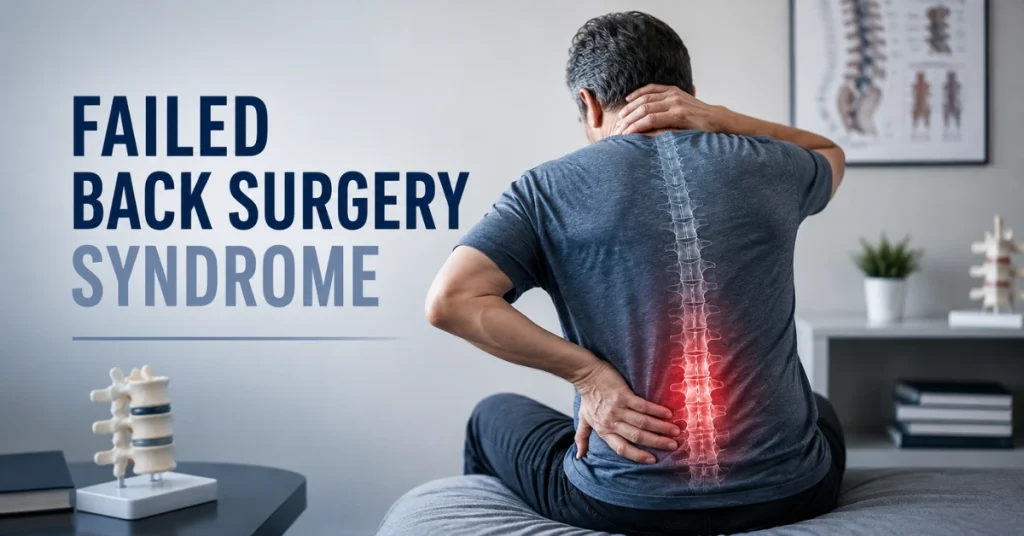
If you had a spinal fusion, a laminectomy, or a discectomy and the pain came back, or never fully left, you are not imagining it. Failed back surgery syndrome describes exactly this pattern, ongoing or new pain after a spine operation that was supposed to fix it. The name is misleading.
It does not mean the surgeon made a technical mistake. In most cases it means the true source of the pain was never correctly identified before the first operation.
That distinction matters because it changes what happens next. A free review of your MRI and surgical history can show whether the original pain generator was ever actually pinpointed, which is the first question to answer before agreeing to anything else.
What Is Failed Back Surgery Syndrome?
Failed back surgery syndrome, sometimes now called persistent spinal pain syndrome, refers to lumbar or cervical pain that continues after spine surgery or appears after surgery in the same general area the operation addressed. The pain can start immediately after the procedure or return months later. Either pattern fits the definition.
The term is a description, not a diagnosis. Saying someone has failed back surgery syndrome tells you the surgery did not resolve the pain. It does not tell you why.
That second question, the actual why, is the one that determines whether a patient needs a different kind of treatment, a different diagnostic approach, or nothing further at all.
Many patients hear the label and assume it means nothing more can be done. In our clinical experience, that assumption is usually wrong. A spine has several structurally distinct sources of pain, and an operation aimed at one of them will not relieve pain coming from another.
How Often Does Pain Return After Spine Surgery?
Pain persisting or returning after back surgery is common enough that it has its own clinical name. Research published by the National Institutes of Health reports that failed back surgery syndrome affects an estimated 10% to 40% of patients following back surgery, with reoperation rates running higher for more complex procedures.
Failure rates are not the same across every type of spinal fusion or decompression. The same research notes failure rates of roughly 30% to 46% for lumbar fusion and 19% to 25% for microdiscectomy. These figures describe pain that continues or returns, not a technical complication during the operation itself.
These numbers describe fusion and decompression outcomes generally. They are separate from, and should never be confused with, Deuk Laser Disc Repair® outcomes, which are 99% pain relief for treated pain sources based on a published peer-reviewed abstract, when the diagnosed disc pathology matches the treated pathology.
Why Does Pain Come Back After a Technically Successful Operation?
A surgeon can perform a fusion, laminectomy, or discectomy exactly as planned and the patient can still hurt afterward. That is not a contradiction. It usually means the operation addressed a real finding on imaging that was not actually the patient’s primary pain generator, or addressed only part of a more complex picture.
The wrong pain source was treated
A disc, a facet joint, and a sacroiliac joint can all sit at the same spinal level and produce overlapping symptoms. An MRI can show a herniation at L4-L5 while the patient’s actual pain is coming from facet joint arthritis one level away. Surgery on the visible herniation leaves the real source untouched.
The real pain source was never diagnosed
MRI alone cannot diagnose a pain source. It has to be correlated with a physical exam and the patient’s actual pain history, because MRI findings and symptoms frequently do not line up. Skipping that correlation step is one of the most common reasons a technically sound operation does not relieve pain.
Adjacent segment disease after fusion
A spinal fusion eliminates motion at the fused level, and the discs above and below it absorb the load that level used to share. Over time this added stress can accelerate degeneration at those adjacent levels, a well documented pattern called adjacent segment disease. New pain after a fusion can come from a level that was never operated on at all.
Scar tissue and epidural fibrosis
Any spine operation creates scar tissue as part of normal healing. In some patients that scar tissue, called epidural fibrosis, forms around a nerve root and becomes a pain source on its own that does not go away with time. This is a separate mechanism from the original problem the surgery was meant to treat, and it can develop even after a well performed procedure.
The disc was decompressed but the annular tear was left behind
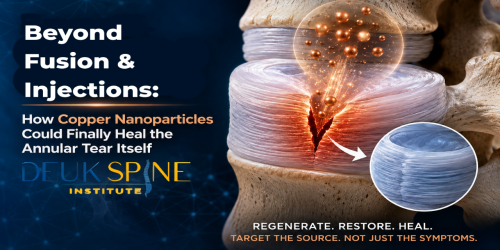
A standard discectomy removes the herniated material pressing on a nerve, which can relieve leg pain. It does not always address the posterior annular tear itself, the actual site of ongoing inflammation and mechanical irritation. When that tear is left untreated, the disc can keep generating pain even after the herniation is gone.
What Symptoms Point to Failed Back Surgery Syndrome?
The symptom pattern after a failed spinal fusion or other spine operation tends to fall into a few recognizable categories. Bringing a clear account of these details to a diagnostic evaluation makes it far easier to identify the actual pain generator.
- Pain that never improved after surgery, rather than pain that improved and later returned
- New pain in a different location than the original symptoms, including a different disc level or the opposite leg
- Leg or arm symptoms such as numbness, tingling, or weakness that persist despite a technically successful decompression
- Back or neck pain without radiating limb symptoms, which points away from a pinched nerve and toward a disc, facet, or sacroiliac source
- Pain that worsens with standing or walking and eases with sitting or leaning forward, a pattern associated with spinal stenosis
- Stiffness or aching above or below a fusion that develops months or years after the original surgery
None of these patterns confirms a diagnosis on its own. They are the starting point for a targeted evaluation, not a substitute for one.
Why a Second Surgery Often Repeats the First Mistake
The most common response to failed back surgery syndrome is another operation, often a revision fusion extending to an adjacent level, or a spinal cord stimulator to manage the pain signal rather than treat its source. Both can have a role for specific patients. Neither one answers the diagnostic question that caused the first surgery to fall short.
A revision fusion planned around the same imaging and the same assumptions that guided the first operation is likely to run into the same problem. If the wrong level was treated, or the real pain generator was never identified, operating again without correcting that diagnostic gap repeats the original mistake at greater surgical risk. A laminectomy or fusion revision carries its own recovery burden, and revision surgery statistically carries a lower success rate than a first operation.
A spinal cord stimulator can meaningfully reduce pain signals for some patients with failed back surgery syndrome, and it deserves consideration where the pain source truly cannot be treated directly. But it manages the symptom. It does not identify or correct a structural problem such as an untreated annular tear, an undiagnosed facet joint, or fibrosis around a specific nerve root.
That distinction should be part of the conversation before agreeing to either path.
How Do You Find the Actual Pain Source?
Identifying the real pain generator after a spine surgery has not worked starts with the same discipline that should have guided the first operation, correlating imaging with a detailed physical exam and an honest pain history, level by level.
The Deuk Spine Exam® is Dr. Ara Deukmedjian’s diagnostic method for this exact situation. It combines a fresh MRI review with a hands-on physical exam and a structured pain history to identify which specific structure, a disc, a facet joint, a sacroiliac joint, or scar tissue, is actually generating the pain.
In our clinical experience, this approach reaches 99% diagnostic accuracy.
This matters most for patients who have already had one operation, because a second procedure aimed at the wrong target carries real cost. A free MRI review is the lowest risk way to find out whether your original pain source was ever conclusively identified before you commit to anything further.
What Is Deuk Laser Disc Repair®?
Deuk Laser Disc Repair® (DLDR®) is an endoscopic laser procedure developed by Dr. Deukmedjian that removes inflamed and herniated tissue directly from a torn disc through a 7mm lumbar or 4mm cervical incision. It treats the posterior annular tear itself rather than only decompressing the nerve around it, which is one reason it can help patients whose original surgery addressed a herniation but left the underlying tear unresolved.
The procedure takes about 20 minutes per disc, is performed as same-day outpatient care, and most patients are walking within about an hour. No bone is drilled, no hardware is placed, and spinal motion is preserved rather than eliminated.
DLDR® is not a fit for every patient with failed back surgery syndrome. It treats disc related pain sources directly. Facet joint arthritis, sacroiliac joint dysfunction, and significant epidural fibrosis each call for a different approach, which is exactly why an accurate diagnosis has to come before any treatment decision, first or second.
Bottom Line
Pain that returns after spine surgery usually points to a diagnostic gap, not a surgical one. The wrong level may have been treated, the real source may never have been identified, or a mechanism like adjacent segment disease or epidural fibrosis may have developed after the fact. A second operation built on the same assumptions as the first is unlikely to end differently.
Before agreeing to a revision fusion or a spinal cord stimulator, it is worth finding out whether your actual pain source has ever been conclusively identified. Send your MRI and surgical history for a free review, and get a clear answer on whether a motion-preserving option like Deuk Laser Disc Repair® fits your situation, or whether the honest answer points elsewhere.
Frequently Asked Questions
What is failed back surgery syndrome treatment?
Treatment depends entirely on the specific cause. Options range from targeted injections and physical therapy to a revision procedure, a spinal cord stimulator, or a disc-specific treatment such as Deuk Laser Disc Repair® when a disc source is confirmed. The right option follows an accurate diagnosis, not the other way around.
What are the symptoms of a failed lumbar fusion?
Common symptoms include pain at the fused level that never resolved, new pain above or below the fusion consistent with adjacent segment disease, and radiating leg symptoms that persist despite the hardware being properly placed. Symptom location and pattern help point toward the underlying cause.
Is scar tissue after back surgery permanent?
Epidural fibrosis, the scar tissue that can form around a nerve root after spine surgery, does not resolve on its own the way ordinary healing tissue does. It can remain a source of pain for years, and its presence and severity are typically confirmed with a gadolinium contrast MRI or physical exam findings.
I am still in pain after back surgery. What should I do first?
Start with a fresh, correlated look at your imaging, your exam findings, and your pain history, ideally from a specialist who was not involved in the original surgery. A free MRI review is a low-risk way to find out whether your original pain source was ever accurately identified.

Diagnosis. Answers. Relief.
Submit your MRI for a free expert review by Dr. Ara Deukmedjian, M.D. —
board-certified neurosurgeon. No obligation. Real answers.
This article is provided for general educational purposes and does not replace a personalized evaluation by a qualified physician. If you are experiencing new weakness, numbness, or loss of bladder or bowel control, go to the emergency room immediately.