By Dr. Ara J. Deukmedjian, MD
Board-Certified Neurosurgeon, CEO
Medically reviewed on June 18, 2026
Medical Disclaimer: This content is for educational purposes only and does not constitute medical advice. Individual results may vary. Always consult with your healthcare provider about your specific condition and treatment options.
Key Points
✓ Spine surgery is rarely an emergency. You almost always have time to question it first. ²
✓ Second spine surgeons disagree with the original plan ~61% of the time, and 75% of those favor conservative care. ¹
✓ High-volume surgeons have significantly lower complication, re-admission, and reoperation rates. ³ ⁴
✓ Failed back surgery syndrome affects an estimated 10–40% of patients, rising with multi-level and fusion procedures. ⁵
✓ Fusion removes motion and drives adjacent segment disease in ~1 in 4 cervical fusions within 10 years. Always ask about motion-preserving options. ⁶
✓ Deuk Laser Disc Repair® treats disc pain through a 4–7 mm incision with no fusion and no implants: 99.6% pain relief, 0.01% complication rate.
✓ A good surgeon welcomes these questions; defensiveness is a red flag. ⁷
Why the Questions Matter
Spine surgery is one of the few medical decisions that is both elective and irreversible at the same time. Once a disc is removed, a level is fused, or hardware is implanted, there is no undoing it. The biomechanics of your spine are permanently changed. You have time to decide, but the decision cannot be reversed. That is exactly why an informed-consent conversation is not a formality to rush through. It is the most important appointment in the entire process.
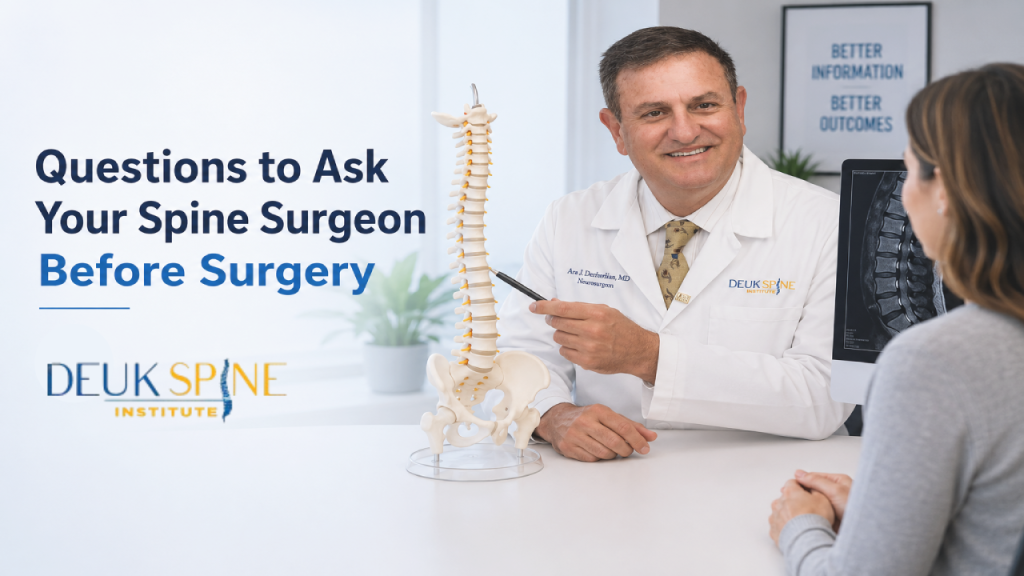
The good news is that, for the vast majority of degenerative conditions, there is no clock forcing your hand. Outside of a handful of true emergencies: progressive neurological deficit, cauda equina syndrome, spinal infection, tumor, fracture, or significant instability. Most neck and back surgery is elective, and surgeons themselves often recommend exhausting non-surgical measures first. ² That breathing room is your leverage. Use it to ask the following questions.
The 10 Questions to Ask Before Saying Yes
1. What exactly is my diagnosis, and how confident are you in it?
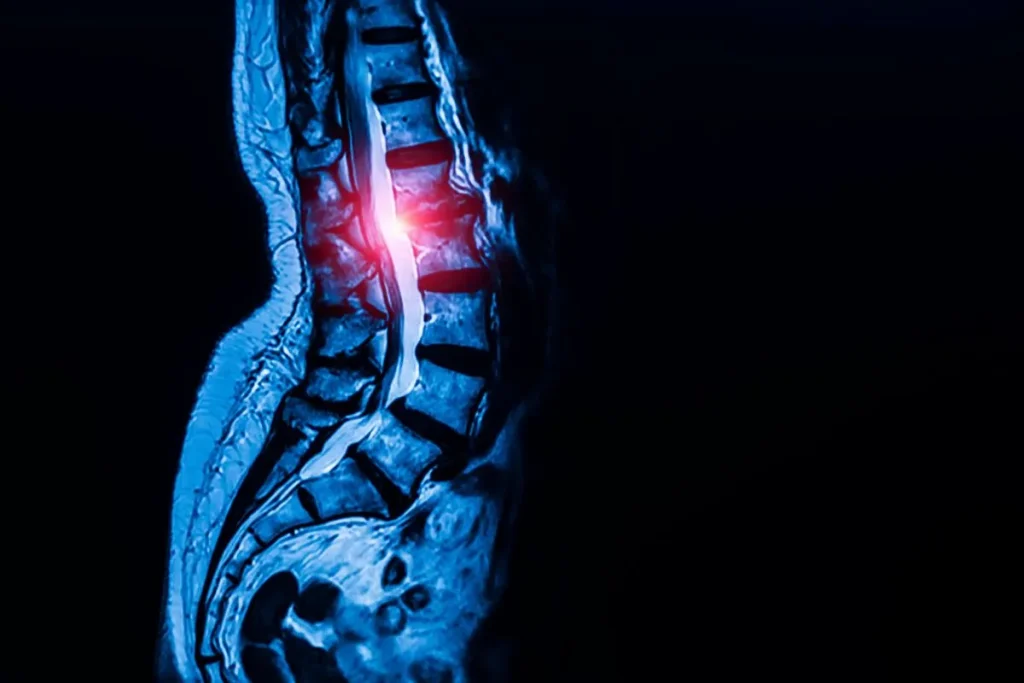
Ask your surgeon to name the specific structure generating your pain. A herniated disc at a named level, spinal stenosis, instability, a facet joint, a pinched nerve root and to explain how they confirmed it. An MRI showing a disc abnormality is common in people with no pain at all, so imaging alone does not prove the source of your symptoms. The diagnosis should connect your imaging to your actual physical exam and your reported pain pattern. If the answer is vague, that is a problem. You cannot fix what you have not precisely identified.
2. Have I truly exhausted non-surgical treatment?
Surgery is rarely the first appropriate step. Most spine surgeons want patients to try conservative measures: physical therapy, activity modification, anti-inflammatory medication, and in some cases targeted injections before operating; because a meaningful percentage of patients improve without ever needing a procedure. ² Ask directly: Which non-surgical options have I not yet tried, and why are we moving past them? The answer should be specific, not a dismissive “those won’t work for you.”

3. Is my problem something surgery can actually fix?
This is the question that prevents the most regret. Some back pain comes from a clearly surgical problem. A nerve compressed by a herniated disc, for example. Where decompression reliably relieves symptoms. Other back pain is diffuse, multifactorial, or degenerative in a way that surgery does not predictably help. Operating on pain that is not mechanically driven is one of the leading paths to a disappointing result. Ask your surgeon to be explicit about whether your specific pain generator is one that the proposed operation is designed to eliminate.
4. What specific procedure are you recommending, and why this one over the alternatives?
There are many ways to treat the same spinal problem, from minimally invasive endoscopic procedures to artificial disc replacement to traditional open fusion. Each carries different recovery times, risks, and long-term consequences. Ask why your surgeon about this particular operation for your case, and ask them to walk you through the alternatives they considered and ruled out. A surgeon who only performs one type of operation may be more likely to recommend that operation. Which is one more reason a second opinion is valuable.

5. Does this surgery fuse or remove motion and is a motion-preserving option possible?
This question deserves its own emphasis. Fusion permanently locks the operated segment, and the discs immediately above and below then have to absorb the load, pressure, and shear strain that segment used to share. Over time, those adjacent discs wear out faster. A well-documented complication called adjacent segment disease, which becomes symptomatic in roughly 25% of cervical fusion patients within 10 years. ⁶ Motion-preserving options: artificial disc replacement, or a targeted procedure that decompresses the nerve without fusing like the Deuk Laser Disc Repair®. Avoid that biomechanical penalty when they are appropriate. Always ask whether you are a candidate for one.
6. How many of these exact procedures do you perform each year, and what is your complication rate?
This is not rude. It is one of the most evidence-backed questions you can ask. Peer-reviewed research consistently shows that higher-volume spine surgeons have significantly lower complication rates, shorter hospital stays, and fewer re-admissions and re-operations than low-volume surgeons doing the same procedure. ³ ⁴ A national analysis of lumbar spine surgery found mortality and complication rates were meaningfully lower when patients were treated by the highest-volume surgeons. ⁴ Ask for the surgeon’s personal numbers for your specific procedure, not the practice’s marketing statistics. A confident, well-qualified surgeon will not be threatened by this. ⁷
7. What are the specific risks and complications, and how often do they happen to your patients?
Every spine surgery carries some risk: infection, bleeding, nerve injury, dural tears, hardware problems, and anesthesia complications among them. You deserve to hear the specific risks of your operation and how frequently they occur in that surgeon’s hands. Vague reassurance (“complications are rare”) is not informed consent. Press for numbers and for how each complication would be handled if it occurred.

8. What does “success” realistically look like, and what are the odds?
Surgery is not a guaranteed cure, and “success” in a surgeon’s outcome data may simply mean a measurable improvement, not complete pain relief. Ask: What percentage of your patients with my condition get significant lasting relief? How much improvement should I realistically expect? Will I still have some pain or activity restrictions? Aligning your expectations with the actual probability of each outcome is what separates a satisfied patient from a disappointed one.
9. What happens if the surgery doesn’t work, or if I need a revision later?
Persistent pain after a technically successful operation is common enough to have its own name. Failed back surgery syndrome and is estimated to affect somewhere between 10% and 40% of spine surgery patients, with higher rates after multi-level and fusion procedures. ⁵ Re-operation rates climb over the years that follow. ⁵ Ask what the plan would be if your pain persists, and critically ask how many levels a future revision might involve. A patient deciding on a three-level fusion at 50 deserves to know that the revision conversation at 70 could be about a much larger operation. ⁶
10. Should I get a second opinion and would you support that?
The answer to the first half is almost always yes. The data here is striking: when an independent spine surgeon reviews the same patient and imaging, the second opinion disagrees with the original treatment plan in about 61% of cases, and roughly three out of four of those disagreements recommend conservative, non-surgical management instead of the proposed operation. ¹ A second opinion is not a delay in care and it is not an insult to your surgeon. If the two opinions agree, you can proceed with far more confidence. If they disagree, you have just been handed the chance to reconsider before anything permanent happens. A surgeon who is offended by your getting a second opinion has told you something important. ⁷
When Surgery Is Urgent
These questions assume you have time, and usually you do. But there are exceptions where prompt surgery is genuinely warranted: cauda equina syndrome (a surgical emergency involving loss of bladder or bowel control and saddle numbness), rapidly progressing weakness or paralysis, spinal cord compression with worsening neurological signs, spinal infection, tumor, or an unstable fracture. If your surgeon explains that you fall into one of these categories then the window to have surgery should be days not months.
How Deuk Laser Disc Repair® Changes the Conversation
Many of the questions above exist because traditional spine surgery so often means fusion. And fusion is what sets up the long-term cascade of lost motion, adjacent segment disease, and the possibility of larger revisions down the road. ⁶
Deuk Laser Disc Repair® was designed around a different principle: treat the source of the pain without sacrificing the spine’s ability to move. It is a minimally invasive, outpatient laser procedure performed through a 4 to 7 millimeter incision. Smaller than a dime under light sedation. Using endoscopic visualization, a Holmium YAG laser removes only the inflamed, pain-generating tissue inside the disc: the torn annular fibers and the herniated nucleus pulposus pressing on the nerve. The disc, the surrounding bone, the ligaments, and the segment’s natural motion are all preserved. Nothing is fused. No metal hardware is implanted. No artificial disc is inserted.
Across more than 2,750 procedures, Deuk Laser Disc Repair® has produced an average pain relief rate of 99.6%, a 0.01% complication rate, and a 0% infection rate. It permanently treats pain from herniated discs, bulging discs, degenerative disc disease, spinal stenosis, sciatica, and radiculopathy at the source, in roughly 20 minutes per disc, with most patients going home within an hour and returning to normal activities within three days with restrictions. For the right candidate. Someone whose pain comes from a contained disc problem rather than true instability, fracture, or deformity. It directly avoids the trade-offs that the ten questions above are designed to discover.
The Bottom Line
Spine surgery is your decision, and it should be an informed one. Outside of genuine emergencies, you almost always have the time to understand your diagnosis, confirm that surgery is truly necessary, vet your surgeon’s experience, set realistic expectations, and explore motion-preserving alternatives. The ten questions above are how you do that. And the single most protective step is getting an independent second opinion. It is the most reasonable thing you can do before agreeing to a permanent change in how your spine moves.
Find out if you can treat your disc pain without the fusion cascade.
Send your MRI for a free review by Dr. Deukmedjian and learn whether a no-fusion, motion-preserving option could treat your condition.
- 99.6%
- Average pain relief
- 0.01%
- Complication rate
- 2,750+
- Procedures since 2004
Frequently Asked Questions
Is it rude to ask my surgeon how many surgeries they’ve performed?
No. It is one of the most evidence-supported questions you can ask. Higher surgeon volume is consistently linked to lower complication, readmission, and reoperation rates for the same procedures. ³ ⁴ A qualified surgeon with good outcomes will answer openly; defensiveness about volume or complication rates is itself a warning sign. ⁷
How many spine surgeries are actually necessary?
Many are, but a meaningful share are not. When a second spine surgeon reviews the same case, they disagree with the original plan roughly 61% of the time, and about 75% of those disagreements favor conservative care over surgery. ¹ This is why an independent second opinion is so valuable before consenting.
Should I always get a second opinion before spine surgery?
For elective degenerative conditions, yes almost always. Outside of true emergencies, a second opinion costs you little and can completely change your treatment path. ¹ If both surgeons agree, you proceed with more confidence; if they disagree, you have a chance to reconsider before anything irreversible happens.
What is failed back surgery syndrome?
Failed back surgery syndrome (FBSS), also called persistent spinal pain syndrome, refers to ongoing pain after a spine operation that was technically completed. Estimates place its frequency at roughly 10% to 40% of spine surgery patients, with higher rates after multi-level and fusion procedures. ⁵ Asking your surgeon what happens if surgery does not relieve your pain is part of informed consent.
Why does it matter whether my surgery is a fusion?
Fusion permanently removes motion at the operated segment and shifts mechanical load onto the discs above and below, accelerating their wear. This adjacent segment disease becomes symptomatic in about 25% of cervical fusion patients within 10 years and can eventually require a larger revision. ⁶ Whenever possible, ask whether a motion-preserving or non-fusion option could treat your specific problem.
What questions should I ask if I’m told I need a spinal fusion specifically?
In addition to the ten above, ask three fusion-specific questions: Is my problem true instability or deformity that requires removing motion, or a disc/nerve problem a smaller procedure could address? What is my personal risk of adjacent segment disease over the next 10 to 20 years? And if I develop it, how many levels could a future revision involve? ⁶
Is fusion ever the right answer?
Yes. For true instability, significant deformity, certain tumors, infections, fractures, and select cases of severe multi-level disease, fusion is a powerful and appropriate tool. The concern is the use of fusion as a default for problems that motion-preserving options could treat just as well with fewer long-term consequences.
Sources
- Gattas S, Fote GM, Brown NJ, Lien BV, Choi EH, Chan AY, Rosen CD, Oh MY. Second opinion in spine surgery: a scoping review. Surg Neurol Int. 2021;12:436.
- Mayo Clinic Health System. 9 questions to ask your spine surgeon. Murphy ME, MD.
- Tarazi N, et al. The impact of surgeon volume on patient outcome in spine surgery: a systematic review. Eur Spine J.
- Farjoodi P, Skolasky RL, Riley LH. The effects of hospital and surgeon volume on postoperative complications after lumbar spine surgery. Spine. 2011;36:2069–2075.
- Sebaaly A, et al. Failed Back Surgery Syndrome. StatPearls. National Library of Medicine.
- Hilibrand AS, Carlson GD, Palumbo MA, Jones PK, Bohlman HH. Radiculopathy and myelopathy at segments adjacent to the site of a previous anterior cervical arthrodesis. J Bone Joint Surg Am. 1999.
- Spine-health. 40 questions to ask your surgeon before back surgery. Parker L, MD.
- MedlinePlus Medical Encyclopedia. Questions to ask your surgeon about spinal surgery. National Library of Medicine.