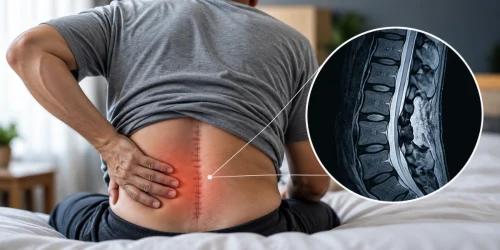
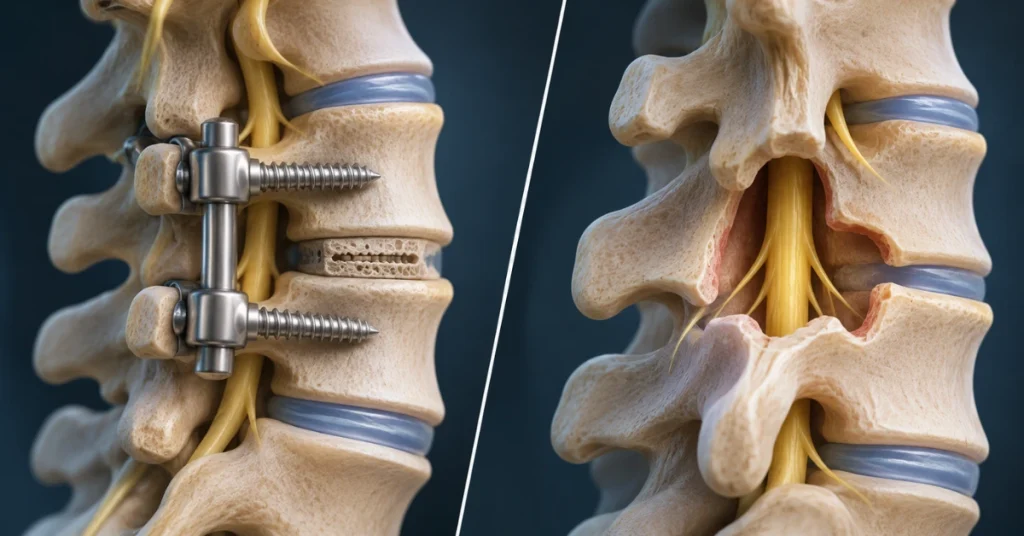
A spinal fusion and a laminectomy solve two different problems. A laminectomy removes part of the bone over the spinal canal to take pressure off compressed nerves, while a fusion joins two or more vertebrae so that a segment moving abnormally stops moving. Which operation fits depends on whether your confirmed problem is compression, instability, or both.
Many patients are offered one of these operations without being told which of those problems it is meant to fix. The two are also frequently performed together, and a third operation, discectomy, targets a different structure again. Below, we compare what each operation does, when each one is recommended, how recovery and long-term trade-offs differ, and how the true source of your pain gets confirmed.
If you have been told you need one of these operations and are not sure which problem it addresses, a Free MRI Review gives you a specialist’s read of your existing imaging before you commit. With that in place, here is how the two operations compare.
No cost · No obligation
Live Pain Free
Upload your MRI for a free expert review by Dr. Ara Deukmedjian, M.D. — board-certified neurosurgeon. Ten minutes can change your life.
What Does Each Operation Actually Do?
Each operation changes a different part of the spine. A laminectomy makes room, a fusion stops motion, and a discectomy removes disc material that is pressing on a nerve.
When people search lumbar fusion vs laminectomy, they often picture two versions of the same surgery. The table shows why that is not the case.
| Feature | Laminectomy | Spinal Fusion | Discectomy or Microdiscectomy |
|---|---|---|---|
| What the surgeon does | Removes the lamina, and often thickened ligament or bone spurs, to widen the spinal canal | Joins two or more vertebrae with bone graft, usually held with screws and rods while the bone heals | Removes the portion of a herniated disc pressing on a nerve root |
| Problem it treats | Nerve compression from a narrowed canal | Instability or abnormal motion at a segment | A disc herniation compressing a nerve |
| Symptoms it targets | Leg pain, heaviness, or numbness when standing or walking | Symptoms tied to a segment that slips or moves abnormally | Leg pain that follows the path of one nerve |
| Motion at the treated level | Preserved | Eliminated | Preserved |
| Hardware | Usually none | Usually screws and rods, sometimes a spacer | None |
| Recovery arc | Usually weeks | Several months for the bone to fuse | Usually weeks |
Compression vs Instability: Which Problem Do You Have?
Compression means something is pressing on a nerve, and instability means a spinal segment moves more than it should. These are separate problems, and they call for separate solutions.
Compression usually comes from a narrowed canal, thickened ligaments, bone spurs, or a herniated disc. It tends to show up as symptoms in the buttocks and legs, such as aching, numbness, tingling, or weakness.
Instability usually comes from a vertebra slipping forward over the one below it, a condition called spondylolisthesis, or from a fracture or deformity. The key question is not whether a slip appears on imaging, but whether the segment actually moves abnormally when you bend.
- Compression is relieved by making space for the nerve
- Instability is addressed by stopping the abnormal motion
- Some patients have both, which is when the two operations are combined
When Is a Laminectomy Recommended?
A laminectomy is most often recommended for lumbar spinal stenosis that causes leg symptoms and has not improved with nonsurgical care. Its job is to decompress the nerves, not to stabilize the spine.
Spinal stenosis narrows the space around the nerves, and the typical result is neurogenic claudication. That means aching, heaviness, numbness, or tingling in the buttocks and legs when you stand or walk, which often eases when you sit or lean forward.
A surgeon may suggest a laminectomy when:
- Imaging shows a narrowed canal at a level such as L4-L5
- Leg symptoms match the level of narrowing
- Walking or standing tolerance keeps shrinking despite therapy and other care
- The segment does not move abnormally on standing X-rays
For genuine stenosis with these features, decompression is often the right answer. Our overview of how a laminectomy is performed explains the procedure and its variations.
When Is a Spinal Fusion Recommended?
A spinal fusion is recommended when a segment of the spine is unstable and needs to be held still. Its job is stabilization, and pain relief follows only if that instability was the source of the pain.
Common reasons a surgeon may recommend fusion include:
- Spondylolisthesis with abnormal motion on flexion and extension X-rays
- Spinal fractures that leave a segment unstable
- Deformities such as scoliosis that are progressing or causing symptoms
- Instability created when a large amount of bone must be removed to decompress the nerves
In published studies of lumbar fusion, roughly 70 to 90 percent of patients report a good or satisfactory result, a range that varies with the condition treated and how success is defined, measured at [CONFIRM FOLLOW-UP WINDOW]. Results are strongest when instability has been clearly identified as the problem. You can read more about what spinal fusion involves and the problems some patients encounter afterward.
Why Are Laminectomy and Fusion Often Combined?
Laminectomy and fusion are combined when a patient has nerve compression and an unstable segment at the same time. The laminectomy relieves the nerves, and the fusion keeps the segment from slipping further.
The common example is stenosis at L4-L5 with a forward slip. Here the question surgeons weigh in laminectomy vs fusion for lumbar stenosis is whether the slip is actually moving, or whether decompression alone will hold.
Evidence shows the answer depends on the patient. In a randomized trial of 247 patients with lumbar spinal stenosis, adding fusion to decompression did not improve disability scores at two years, including in patients with a slipped vertebra. The fusion group stayed in the hospital longer, an average of 7.4 days versus 4.1, and hospital costs were higher.
Other research in patients with a slipped vertebra has found that some who had decompression alone later needed a fusion. That is why the motion seen on standing X-rays, not the slip alone, guides whether fusion is added.
Where Do Discectomy and Microdiscectomy Fit?
A discectomy removes herniated disc material that is pressing on a nerve, and a microdiscectomy does the same through a smaller incision with magnification. Neither operation removes the lamina to widen the whole canal, and neither fuses the spine.
The usual symptom is sciatica, a sharp or burning pain that runs down one leg along a single nerve. Because the problem is a fragment of disc, not a narrowed canal or an unstable segment, the operation is aimed at the disc itself.
This is why spinal fusion vs discectomy is rarely a true either-or choice. The microdiscectomy vs spinal fusion question usually comes up only when a disc problem occurs alongside instability or repeated herniation at the same level.
When a damaged disc is the confirmed source of pain, Deuk Laser Disc Repair® is one minimally invasive, motion-preserving option to discuss alongside microdiscectomy. As with every operation here, the fit depends on the diagnosis.
How Does Recovery Compare?
Recovery from a laminectomy or discectomy is usually measured in weeks, while recovery from a fusion is measured in months. The difference comes from bone healing, since a fusion is not complete until the vertebrae grow together.
- Laminectomy: soreness at the incision and back muscles, with leg symptoms often easing early; activity builds over several weeks
- Spinal fusion: a longer hospital stay, restrictions on bending and lifting while the bone fuses, and a gradual return to activity over months
- Discectomy or microdiscectomy: often a same-day or overnight stay, with a return to light activity in weeks
- Combined laminectomy and fusion: follows the fusion timeline, since the bone still has to heal
Your own timeline depends on the number of levels treated, your health going in, and your surgeon’s protocol. Ask for a written plan before surgery.
What Does Each Operation Cost You Long Term?
Every spine operation has a long-term trade-off, and the trade-offs differ. A fusion gives up motion permanently, while a laminectomy and a discectomy preserve motion but leave open the chance of the original problem returning.
Long-term considerations for a fusion:
- Permanent loss of motion at the fused level
- Added stress on the levels above and below, which can lead to adjacent segment degeneration over time
- Possible hardware problems or a fusion that does not fully heal
Long-term considerations for a laminectomy or discectomy:
- Stenosis can return at the treated level or develop at a neighboring one
- Removing bone can loosen a segment in some patients, occasionally leading to a later fusion
- A disc can herniate again after a discectomy
Because a fusion cannot be undone, many patients also ask whether disc replacement offers a motion-preserving path for their condition.
How Is the Right Operation Identified?
The right operation is identified by confirming which structure is generating your symptoms, not by imaging alone. Disc bulges and degenerative changes are common on MRIs of people who have no pain at all.
A thorough evaluation usually follows these steps:
- Match your symptoms to a structure, such as leg symptoms with walking pointing to stenosis, or pain down one leg pointing to a disc
- Complete a physical and neurological exam to check strength, reflexes, and sensation
- Review the MRI to see where nerves are compressed
- Order standing flexion and extension X-rays to see whether any segment moves abnormally
- Confirm that the imaging findings and the exam point to the same level and the same problem
If a fusion or laminectomy has been recommended and that last step is unclear to you, ask your surgeon to walk you through it. The Free MRI Review mentioned above is another way to get that question answered before you decide.
Bottom Line
Spinal fusion vs laminectomy is not a contest between a better and a worse operation. A laminectomy treats compression, a fusion treats instability, and a discectomy treats a herniated disc.
Each has real indications, and each has a long-term trade-off. The operation that fits you is the one that matches a confirmed diagnosis.

Diagnosis. Answers. Relief.
Submit your MRI for a free expert review by Dr. Ara Deukmedjian, M.D. —
board-certified neurosurgeon. No obligation. Real answers.
Frequently Asked Questions
Is a Laminectomy the Same as a Spinal Fusion?
No, a laminectomy is not the same as a spinal fusion. A laminectomy removes bone to relieve pressure on nerves and keeps the spine’s motion, while a fusion joins vertebrae so a segment stops moving. The two are sometimes done in the same surgery.
Is a Spinal Fusion Better Than a Laminectomy?
Whether a spinal fusion is better than a laminectomy depends entirely on your problem, because they treat different conditions. A laminectomy addresses nerve compression, and a fusion addresses instability. The right choice is the one that matches a confirmed diagnosis.
Can You Have a Laminectomy Without a Fusion?
Yes, you can have a laminectomy without a fusion, and many patients with spinal stenosis do. Fusion is usually added only when a segment is unstable or when decompression requires removing enough bone to loosen the spine. Standing X-rays help your surgeon decide.
Which Has a Longer Recovery, Laminectomy or Fusion?
Fusion has a longer recovery than a laminectomy, because the vertebrae must grow together over several months. A laminectomy recovery is usually measured in weeks. A combined laminectomy and fusion follows the fusion timeline.
Is a Microdiscectomy or a Spinal Fusion Used for a Herniated Disc?
A microdiscectomy, not a spinal fusion, is the usual operation for a herniated disc pressing on a nerve. Fusion is generally reserved for herniation that occurs with instability or keeps recurring at the same level. Other disc-focused options may also be worth discussing with your surgeon.
What Can You Not Do After a Laminectomy?
What you cannot do after a laminectomy is mostly temporary, with surgeons commonly limiting bending, heavy lifting, and twisting during early healing. Most patients return to normal daily activities over time. Your surgeon sets your limits, especially if a fusion was added.
Medical disclaimer: The information in this article is educational and is not a substitute for personalized medical advice, diagnosis, or treatment. Always consult your surgeon or a qualified healthcare provider about your symptoms and treatment options.