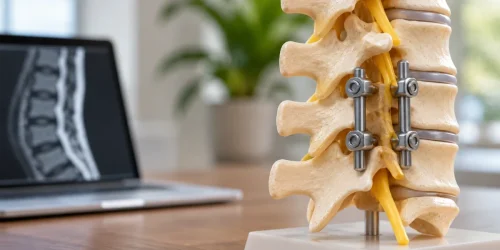

By Dr. Ara J. Deukmedjian, MD
Board Certified Neurosurgeon
Updated November 13, 2026
Sciatica Symptoms: A 30-Second Check Before You Stretch
Run through this quick check first. Sciatica is pain that follows the sciatic nerve’s path, so look for:
- Pain in the buttock and back of the thigh
- Pain that sometimes travels past the knee into the calf or foot
- Symptoms mostly on one side
- Possible numbness, pins and needles, or weakness
Pain that stays in the lower back is general low back pain, which these stretches aren’t aimed at.
For causes, diagnosis, and the full symptom picture, see what is actually causing your sciatica. We won’t cover those here.
Red flags: The NHS advises emergency care for numbness around the genitals or anus, changes in bladder or bowel control, or weakness or numbness in both legs. Sudden weakness in one leg also needs urgent care. Do not stretch.
The One Rule That Tells You a Stretch Is Working
There’s one rule that tells you whether a stretch is helping, and most guides skip it: watch which way the pain moves.
If a movement pulls your pain back up toward the spine or buttock, that’s the direction you want, even if your back feels a bit more sore. Clinicians call this centralization, and a systematic review (Aina et al., Manual Therapy, 2004) linked it with better outcomes.
The opposite is peripheralization. If a movement sends pain further down the leg, toward the foot, stop. The nerve is telling you it’s more compressed, not less.
Notice how much it hurts. Also pinpoint exactly where you feel it. Always do a check right after each stretch. Then again about 20 minutes later. Sometimes the effect doesn’t show up straight away, and the second check tells you more.
Also, two things to keep in mind. Never stretch into sharp or electric pain, and never bounce. Hold steady.
This is a self-monitoring guide, not a diagnosis. If you can’t tell which way the pain moved, stop and get assessed. To understand what may be happening, read about a compressed nerve root.
7 Sciatic Nerve Stretches for Sciatica Relief
Most of these are hip, hamstring, and bending-forward movements. If one sends pain further down your leg, stop and apply the rule above.
Knee to Chest (Single and Double)

Targets: the lower back and glutes.
- Lie on your back, knees bent, feet flat.
- Clasp both hands behind one thigh and gently draw that knee toward your chest.
- Lower it and switch legs.
- For the double version, draw both knees in together.
Hold and reps: 10 seconds, three times per leg, then two double-knee holds.
You should feel it: low in the back and into the buttock.
Modification: If reaching is hard, loop a towel behind the thigh.
Stop if: Pain, numbness, or tingling travels further down your leg, or you feel sharp pain.
Knee to Opposite Shoulder
Targets: the glutes and the piriformis, a deep hip muscle that can press on the nerve.
- Lie on your back with your legs straight.
- Bend one knee and hold it with both hands.
- Guide it gently across your body toward the opposite shoulder, without forcing.
Hold and reps: 15 seconds, twice on each side.
You should feel it: deep in the buttock and outer hip.
Modification: If the straight leg is uncomfortable, bend it and keep that foot on the floor.
Stop if: The buttock pain turns sharp or electric, or tingling spreads below the knee.
Figure 4 / Supine Piriformis Stretch

Targets: the piriformis and outer hip.
- Lie on your back, knees bent, feet flat.
- Rest your right ankle across your left thigh, just above the knee.
- Hold behind your left thigh and gently draw it toward your chest.
Hold and reps: 20 seconds, twice on each side.
You should feel it: in the buttock and outer hip of the crossed leg.
Modification: If reaching is hard, keep your foot on the floor and just cross the ankle.
Stop if: Numbness reaches the foot or pain shoots down the leg.
Seated Spinal Twist
Targets: the lower spine and hips.
- Sit tall, legs straight in front of you.
- Bend your right knee and place that foot flat outside your left knee.
- Put your left arm outside your right knee and slowly turn right, only as far as is comfortable.
Hold and reps: 15 seconds, twice on each side.
You should feel it: a gentle turn through the lower back and outer hip.
Modification: In a chair, sit with feet flat and turn toward the chair back.
Stop if: Turning sends pain down either leg or pinches your lower back.
Supported Hamstring Stretch
Targets: the hamstrings, which tug on the pelvis when tight and can irritate the nerve.
- Lie on your back, one knee bent, a towel looped around the other foot.
- Hold both ends and straighten that leg upward until you feel a mild stretch behind the thigh.
Hold and reps: 20 seconds, twice on each side.
You should feel it: a mild pull behind the thigh, not the calf.
Modification: If lying down is hard, sit on a chair, rest one heel on a low stool, and hinge forward.
Stop if: The pull moves into your calf or foot, or you feel electric tingling.
Standing Piriformis Stretch
Targets: the piriformis, standing up.
- Stand beside a wall or counter, one hand on it for balance.
- Cross your right ankle over your left knee.
- Slowly bend your left knee and sit your hips back, as if lowering into a chair.
Hold and reps: 20 seconds, twice on each side.
You should feel it: deep in the buttock of the crossed leg.
Modification: If balance is a problem, lean your back against a wall, feet about two feet out.
Stop if: Pain travels further down the standing or crossed leg, or you feel unsteady.
Pigeon Pose (Floor or Chair Version)
Targets: the hips and glutes.
- Start on hands and knees.
- Slide your right knee toward your right wrist and angle the shin across your body.
- Stretch your left leg straight behind you, hips level.
- Stay upright, or fold gently forward.
Hold and reps: 20 seconds, twice on each side.
You should feel it: deep in the glute of the front leg.
Modification: If kneeling hurts, sit in a chair, cross your right ankle over your left knee, and lean forward with a straight back.
Stop if: Your front knee hurts, or numbness, tingling, or sharp pain spreads down either leg.
Nerve Glides: How Do You Stretch the Sciatic Nerve Itself?
A stretch lengthens muscle. A nerve glide helps the nerve slide freely through the tissue around it. They aren’t interchangeable.
Here’s how to stretch the sciatic nerve through a seated glide:
- Sit tall on a chair, one foot flat and the other knee straightened in front of you.
- Lift your head to look up as you flex your ankle, toes toward you.
- Lower your chin toward your chest as you point your toes away.
- Move slowly, about two seconds per pump.
Do 10 pumps per leg, then a second round, once or twice a day.
Keep the glides gentle and short. Doing more won’t help, and pushing hard is one of the most common ways people flare things up. Think of it as a slide, not a pull. Spine-health’s physical therapist Darren Riccio describes it as a way to relax and desensitize the nerve, so it should never feel forced. If pain travels further down the leg, stop.
A Simple Daily Routine
The seven stretches and the glide add up to about 10 minutes if you do them in one go. The table shows the holds, reps, rounds and total time. Just work through them in order.
You’ll probably get more out of splitting it up than pushing through one long session. Do the first four when you get up, since a bit of gentle movement first thing helps with morning stiffness, and save the rest for later in the day.
Don’t expect much from the first week. The first thing you’ll likely notice is the pain not reaching as far down your leg, and that usually happens before the overall pain level drops. Doing it regularly matters more than doing it hard.
Done regularly, these double as sciatica pain relief exercises. Once your leg pain settles, move on to general lower back exercises.
Stretches and Movements to Avoid
Knowing what to drop matters as much as knowing what to do. Here’s what to skip, with a swap for each.
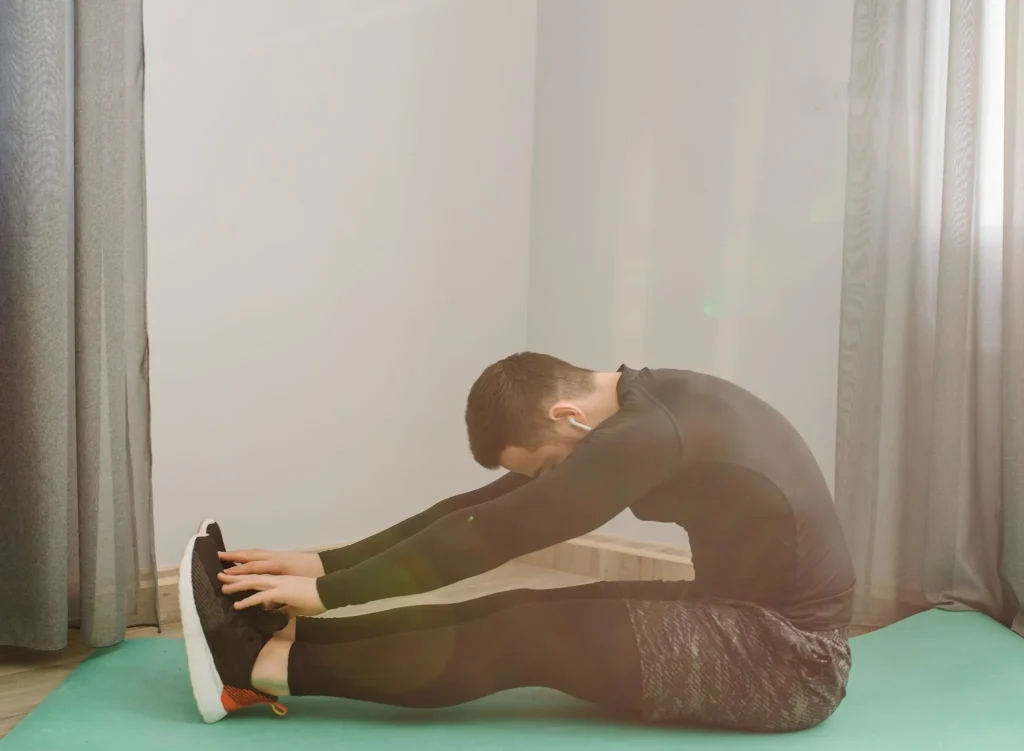
- Standing toe touches: a deep bend can stretch the nerve and load the discs. Swap in the supported hamstring stretch.
- Full sit-ups and crunches: repeated curling can irritate a sore disc. Wait until leg pain settles, then try gentle core work.
- Heavy lifting while symptoms are active: it spikes pressure through the spine. Keep loads light until the flare passes, and read our guide to lifting weights first.
- Deep forward folds: they stretch the nerve and strain the discs. Choose the chair version of pigeon, back straight.
- Aggressive hamstring stretching into pain: pulling a sore nerve harder only irritates it. Stop at a mild pull.
- High-impact running on hard surfaces during a flare: every footstrike jolts the spine. Walk on flat, even ground instead.
Whether extension-type moves like press-ups help or aggravate depends on which way your pain moves, the same rule as above. Read more on back extensions.
Prolonged sitting is the aggravator most people overlook, so stand and move every 30 minutes or so.
Planning leg day? Read about the leg press first.
Why the Same Stretches Don’t Work for Everyone
Sciatica is a symptom, not a single condition. What’s pressing on the nerve decides which stretches help, which is why two people can do the same stretch and only one gets relief.
Piriformis-driven. The piriformis muscle is irritating the nerve, and targeted stretching is often genuinely effective. Learn more about piriformis syndrome.
Disc-driven. A herniated disc, commonly at L4-L5 or L5-S1, is compressing the nerve root. Stretching can ease muscle guarding and improve your tolerance for movement, but it doesn’t decompress the nerve. Read more about a herniated disc at L5-S1.
Stenosis-driven. Symptoms tied to walking and standing, and eased by sitting or leaning forward, usually point to stenosis.
The cause, not your effort, decides the outcome. If six weeks of honest daily work hasn’t changed anything, the cause is worth identifying rather than continuing to guess.
When Stretching Isn’t Enough
If you’ve done the work and your sciatica hasn’t budged, that’s useful information, not a failure of effort. It’s a clue about what’s causing your pain.
Watch for these signals:
- Relief that lasts under an hour
- No change after six weeks of daily stretching
- Pain traveling further down the leg over time
- Any weakness in the leg or foot
If that sounds familiar, there’s a step between “I’ve tried everything” and invasive open-back surgery, and most people never hear about it. Deuk Laser Disc Repair® uses an endoscopic laser to treat the inflamed tissue inside the damaged disc, without removing bone, fusing the segment, or compromising the structure of your spine.
Not every case needs a procedure, and a proper diagnosis comes first. To see how the surgical routes compare, read our sciatica surgery overview.
Conclusion
Don’t try to tackle the whole routine at once. Pick two or three of the stretches instead of all seven, and pay attention to where your pain goes after each one. If it pulls back toward your spine, that’s a good sign. Then stick with it every day for a couple of weeks, which is long enough to get a real sense of how your body responds.
If your stretches keep stopping short of real relief, even after honest effort, a free MRI review is an easy next step. It’s a low-key way to find out what’s behind the pain, with no rush and no pressure.
Stretching eases muscle guarding — but when a herniated disc at L4–L5 or L5–S1 is compressing the nerve root, no amount of reps can decompress it
Stretches manage your symptoms.
DLDR fixes the disc.
Most sciatica starts at the disc. Stretching can loosen tight muscles and improve your tolerance for movement, but it cannot retract a herniation, close an annular tear, or take pressure off a compressed nerve root. If six weeks of honest daily effort hasn’t changed the pain—or the pain keeps traveling further down your leg—the disc itself needs treatment. Fusion removes the disc and locks the segment. DLDR treats only the damaged tissue through a 4 mm incision, preserves motion, and sends you home the same day.
that cause sciatica occur
signals a structural cause
2,800+ procedures
- Loosens muscles; cannot retract a herniation
- Nerve root stays compressed by the disc
- Pain may peripheralize if the wrong stretch is chosen
- Relief often lasts under an hour
- Weeks of effort with no structural resolution
- Treats the herniated fragment directly with laser
- Nerve decompressed; disc and motion preserved
- 95%+ success rate, 2,800+ procedures
- 0.01% complication rate
- 4 mm incision, same-day discharge
Board-certified neurosurgeon review · No insurance approval required · 100,000+ procedures performed
FAQ
Can stretching make sciatica worse?
Answer
- It can. If a stretch is pushing you into real pain, or the pain starts creeping further down your leg, back off. Pain that eases back toward your spine is a good sign. Pain that heads for your foot is your cue to stop. The NHS gives the same advice: stop if your pain gets worse and see a doctor.
How long does it take for sciatica stretches to start working?
Answer
Plenty of people feel something shift within a week or two. Don’t expect the pain to vanish at first. What you’ll notice is that it doesn’t reach as far down your leg as it did. If you’ve stuck with it every day for six weeks and nothing has changed, the stretches probably aren’t the answer, and it’s time to find out what’s behind it.
Should you stretch every day, or rest during a flare-up?
Answer
Staying gently active tends to help more than resting completely, so keep stretching daily, just do less when you’re flaring. Stick with the easy ones you can do lying down and drop anything that sends pain down your leg. Whatever you do, don’t spend days in bed.
Is walking good for sciatica?
Answer
For most people, yes, and the NHS lists walking among the activities that may help back pain. A short, easy walk keeps you loose and stops the stiffness that builds up from sitting too long. Keep to flat ground and take it slowly. If the pain starts moving further down your leg, stop and rest.
Is heat or ice better before stretching?
Answer
The NHS suggests a heat pack wrapped in a towel for stiffness or muscle spasms, so 15 to 20 minutes beforehand works well. A wrapped ice pack may suit fresh pain and swelling better.
Should you stretch the painful leg, both legs, or neither?
Answer
Do both, but be gentle with the sore side. The tightness often isn’t just in one leg, and working both keeps your hips even. If a particular stretch sets off pain down the sore leg, leave it out for now.
How should you sit or lie down to ease sciatica?
Answer
When you’re sitting, tuck something behind your lower back for support and keep both feet flat on the floor. Try not to stay put for too long. Stand up or shift around every half hour or so. For lying down, the easiest options are on your back with a pillow under your knees, or on your side with a pillow tucked between them.
Sources
View Sources
- Aina, A., May, S., & Clare, H. (2004). The centralization phenomenon of spinal symptoms: A systematic review. Manual Therapy, 9(3), 134–143.
- NHS. Back pain.