

By Dr. Ara Deukmedjian, MD
Board-Certified Neurosurgeon
Medically reviewed on Aug 12, 2026
Medical Disclaimer: This content is for educational purposes only and does not constitute medical advice. Individual results may vary. Always consult with your healthcare provider about your specific condition and treatment options.
Key Points
✓ Sciatica is a symptom and not a disease per se. Piriformis syndrome is one of the possible causes of sciatic nerve problems, which starts from the buttocks rather than the spine. ¹ ² ³
✓ Piriformis syndrome causes 5 – 8% of cases of low back and sciatic pain complaints, occurring six times more often in females than males. ² ³ ⁴ ⁵
✓ No golden standard diagnostic tool is available for diagnosing piriformis syndrome, which makes this condition the most frequently misdiagnosed in musculoskeletal field. ² ³ ⁸
✓ Spinal sciatica pain spreads below the knee with reflex changes; while in piriformis syndrome pain is located in the buttock and aggravated by sitting position. ¹ ² ⁶
✓ Misdiagnosis leads to unnecessary spinal surgeries and injections that fail because the pain source is in the gluteal space, not the spine. ² ⁸ ⁹
✓ Deuk Piriformis Release® is a patented, minimally invasive outpatient procedure that cures piriformis syndrome through a 4 mm incision. Delivering 99% pain relief, 0% complications, and only 30 minutes of recovery time. ²⁴
Why Piriformis Syndrome and Sciatica Get Confused
In the case of pain that begins in your lower body and shoots into your leg, there is a term that you must be familiar with and that is ‘sciatica’. When the pain begins deep in the buttocks area, you would be informed that you have a case of piriformis syndrome. The symptoms that both these disorders generate are very much alike and that’s the reason behind their frequent confusion.
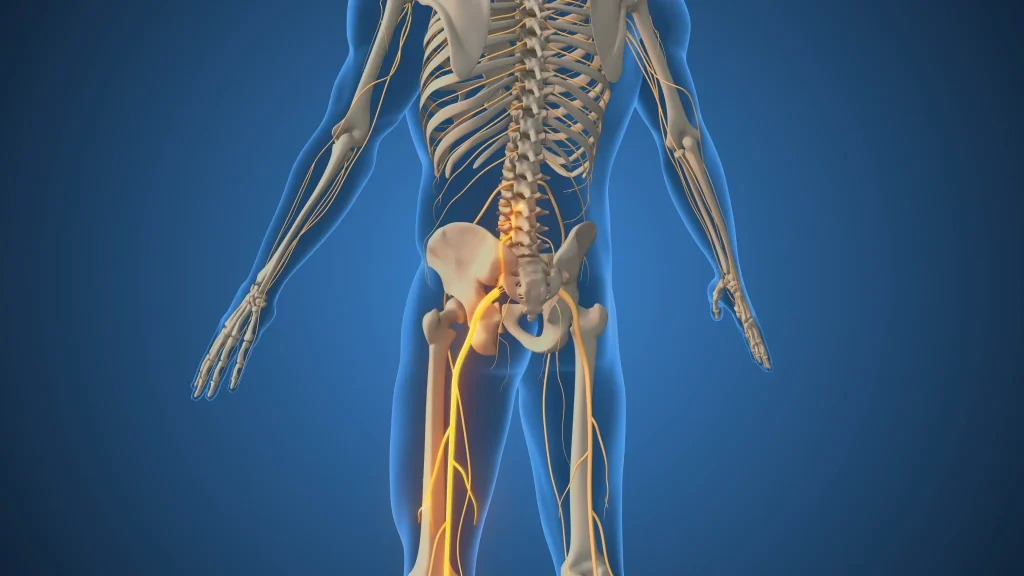
The point here to remember is that the problem sciatica is not a diagnosis but just a clinical description of pain that is associated with the sciatic nerve irrespective of the cause of that pain. ¹ ⁶ Piriformis syndrome is only one particular cause of sciatica. So understanding the difference between both can be quite significant when it comes to your treatment options.
What Is Sciatica?
Sciatica is pain that travels along the pathway of the sciatic nerve starting from the lower back and/or buttock. All the way down the posterior thigh and the calf muscles, and even to the feet. ¹ ⁶ The sciatic nerve is the biggest nerve in the peripheral nervous system. And when there is compression, inflammation, or irritation of this nerve, pain is felt which varies from dull pain to sharp pain and even shock-like pain.
Sciatica is a symptom and not a disease. ¹ ⁶ It occurs due to an underlying pathology. Resulting in irritation or compression of the sciatic nerve or its root. Things that cause sciatica include: disc herniation, spinal stenosis, degenerative disc disease, spondylolisthesis, and piriformis syndrome. ⁶ ⁷
How common is sciatica?
Sciatica is among the most common forms of pain disorders in the world. The lifetime prevalence rate of low back pain varies between 49 and 70%, and sciatica is believed to affect 5-10% of these patients. ¹¹ ¹² The prevalence rates annually for the general population are 9.9% – 25% while discogenic sciatica prevalence is 2.2%. ¹¹ ¹²
What Is Piriformis Syndrome?
Piriformis syndrome is a neuromuscular disease that involves the piriformis muscle. Which is a small pyramidal muscle found deep inside the buttock area. The piriformis muscle causes irritation, compression and entrapment of the sciatic nerve at the ischial tuberosity level. ² ³ ⁴ The attachment point for the piriformis muscle is the anterior part of the sacrum to the greater trochanter of the femur. serving as an external rotator of the hip when extended and an abductor when flexed.

In most people, about 85%, the sciatic nerve courses underneath the piriformis muscle as a monofilament. ⁵ In about 13% of the population, there are anatomical variations where the common peroneal division of the sciatic nerve traverses directly through the muscle. ⁵ This makes the sciatic nerve vulnerable to being compressed due to inflammatory, hypertrophic, and spastic changes in the piriformis muscle.
Piriformis syndrome has also been referred to as deep gluteal syndrome, extra-spinal sciatica, and wallet neuritis. ³ Current literature now recognizes deep gluteal syndrome (DGS) as a broader umbrella term encompassing all forms of sciatic nerve entrapment in the deep gluteal space; with piriformis syndrome representing the most common subtype. ¹⁶ ¹⁷
How common is piriformis syndrome?
The actual prevalence of piriformis syndrome is still under debate due to the lack of a standardized diagnostic tool. ² ³ In various literature sources, piriformis syndrome prevalence varies from 5 to 8 percent in patients suffering from low back and sciatic type pains. ⁴ ⁵ The pooled prevalence of 46.79 percent was determined in a meta-analysis conducted in 2026 in the case of patients with buttock and low back pain. However, the lack of proper diagnosis criteria in 96 percent of analyzed publications requires some caution while interpreting these data. ¹⁸
Piriformis Syndrome vs. Sciatica: The Key Differences
The key difference between these two syndromes is that in spinal sciatica (lumbar radiculopathy), there is compression of the sciatic nerve or its root by a herniated disk, bone spur, or a narrow spinal canal. ¹ ⁶ On the contrary, in the case of piriformis syndrome, compression happens in the peripheral region where the sciatic nerve is entrapped by the piriformis muscle in the deep gluteal space. ² ³
1. Location and quality of pain
Spinal sciatica usually occurs as pain that starts at the lower back and moves to the corresponding dermatomal distribution, generally to below the knee level and even into the foot. ¹ ⁶ The pain from piriformis syndrome usually starts deep within the buttock region as an aching pain that can spread down to the back of the leg; however, it generally does not go below the knee level. ² ³
2. Aggravating factors
This is arguably one of the most important clinical distinctions. The piriformis syndrome has a tendency to be exacerbated by prolonged periods of sitting. This is especially true when seated on hard surfaces, and people often find that they need to stand or change position when seated on the affected side. ² ³ ⁴ “Wallet Sign,” pain due to sitting on the wallet in the back pocket, is a well-known classic. The spinal sciatica tends to get aggravated by prolonged periods of sitting but is usually made worse by forward bending, coughing, sneezing or straining. ⁶
3. Neurological deficits
A true lumbar radiculopathy is often associated with neurologic symptoms, including reduced reflexes, dermatomal loss of sensation, and motor weakness corresponding to the specific nerve root involved. ⁶ ⁷ The presence of neurological abnormalities in the piriformis syndrome is not as frequent and, if present, are more subtle. ² ³ The absence of motor weakness and reflex changes differentiates this condition from the latter one.
4. Physical examination findings
The provocative tests used to identify each condition differ significantly. For spinal sciatica, the straight-leg raise test (reproduction of radiating leg pain when the extended leg is raised to an angle below 70°) is the hallmark physical examination maneuver. ⁶ ⁷ For piriformis syndrome, the FAIR test (Flexion, Adduction, Internal Rotation) is the most widely used provocative test, along with the Pace sign, Freiberg test, and Beatty test. ² ³ ⁴ ⁸ Tenderness on deep palpation of the buttock is found in up to 92% of patients with piriformis syndrome. ¹³
5. Imaging findings
Structural anomalies such as disc herniation, stenosis, or degeneration can be seen in spinal MRI for spinal sciatica. ⁶ ⁷ MRI of the lumbar spine in piriformis syndrome is normally unremarkable, which serves as an important clue by itself in diagnosing patients with sciatica. ² ³ ⁸ Abnormalities in pelvic MRI include piriformis muscle asymmetry or hypertrophy. 93% specificity for piriformis muscle asymmetry and hyperintense sciatic nerve has been found using MR neurography. ⁸ ⁹
Piriformis Syndrome vs. Spinal Sciatica
Both conditions produce sciatic-pattern leg pain, but they originate in completely different structures. One is a muscle problem in the deep gluteal space; the other is a spine problem. Telling them apart changes everything about treatment.
Why Getting the Diagnosis Right Matters
The clinical consequences of misdiagnosing piriformis syndrome as spinal sciatica or vice versa are significant. ² ⁸ ⁹
When piriformis syndrome is mistakenly attributed to a lumbar disc problem, patients may undergo unnecessary lumbar MRIs that reveal incidental disc abnormalities, receive epidural steroid injections into the lumbar spine. That provide no benefit because the pathology is not in the spine, or in the worst cases, undergo spinal surgery. Including discectomy, laminectomy, or even fusion for a condition that originates in the buttock. ² ⁸
Instead, where true lumbar radiculopathy is mistakenly diagnosed as piriformis syndrome, the patient may be subjected to specific piriformis stretching and injections which will not deal with the ongoing compression of the spinal nerve roots.
Piriformis syndrome is one of the most under-diagnosed and misdiagnosed disorders in the field of musculoskeletal medicine. ² ⁸ ⁹ There are several reasons for this, which include the symptoms’ resemblance to those of lumbar disc herniation, the lack of an established test for diagnosis, the minimal coverage in medical education regarding extra-spinal sources of sciatica, negative results from regular imaging, and the fact that the two conditions can exist in one patient.
How Each Condition Is Diagnosed
Diagnosing spinal sciatica
The clinical approach to diagnosing lumbar radiculopathy is a highly organized one. ⁶ ⁷ There is a careful patient history taken, paying particular attention to the characteristics of the pain. ⁷ A thorough neurologic exam is done using a dermatomal distribution. ⁷ The straight leg raise is conducted. If there is a suggestion that the pain arises from the spine, an MRI of the lumbar spine is performed.
Diagnosing piriformis syndrome
Piriformis syndrome is primarily a clinical diagnosis and, to a significant extent, a diagnosis of exclusion. ² ³ ⁸ The diagnostic process involves a comprehensive history focusing on deep buttock pain worsened by sitting, provocative physical examination testing (FAIR test, Pace sign, Freiberg test, Beatty test), ruling out spinal pathology with lumbar MRI (a normal lumbar MRI in the setting of sciatica symptoms raises suspicion for piriformis syndrome), advanced imaging of the pelvis when indicated (MR neurography has shown 93% specificity), ⁹ electrodiagnostic studies looking for prolonged H-reflex during the FAIR position, ⁶ and in some cases, a diagnostic injection of local anesthetic into the piriformis muscle under image guidance to confirm the source of pain. ² ³ ¹⁰
A 2025 study demonstrated that piriformis muscle cross-sectional area on hip MRI can serve as an independent diagnostic parameter, with an area under the curve (AUC) of 0.81 at a cutoff of 611.67 mm². ¹⁴
Treatment: Why the Approach Differs
Both piriformis syndrome and spinal sciatica generally respond to conservative treatment as a first-line approach, but the specific interventions are different. Which is precisely why diagnosis matters.
Treating spinal sciatica
The management of patients with lumbar radiculopathy often involves oral anti-inflammatories (NSAIDs), a short period of oral steroids in cases where pain is acutely severe, physical therapy involving lumbar stabilization and nerve mobilization exercises, modification of activities by avoiding aggravating postures, and lumbar epidural steroid injection when conservative methods are not effective. ⁶ ⁷
Failure to respond to conservative treatment following an adequate trial period of about 6-12 weeks, or the development of progressive neurological deficits, necessitates surgery. Such as microdiscectomy for disc herniation or laminectomy for spinal stenosis; may be recommended. ⁶
Treating piriformis syndrome
Conservative management of piriformis syndrome centers on a different set of interventions. ² ³ ¹⁰ These include targeted piriformis stretching (especially stretches combining hip flexion, adduction, and internal rotation), hip strengthening and core stabilization, activity modification with emphasis on reducing prolonged sitting, NSAIDs and muscle relaxants (cyclobenzaprine or tizanidine), and image-guided piriformis injections with corticosteroids or botulinum toxin. ² ³ ¹⁰ ¹⁵
Systematic review showed the efficacy of botulinum toxin injections in the piriformis muscle for pain relief, with doses of 100-300 units. ¹⁵ CT guided botulinum toxin injection was proven to have better results than non-botulinum toxin injections. ¹⁹
In case of failure of conservative treatment for three months or more or development of progressive neurological symptoms, surgical treatment can be considered. The currently recommended method is endoscopic piriformis release and sciatic neurolysis with minimal incisions, direct visualization of deep gluteal space and less complications than open surgery. ²⁰ ²¹
The Results Of Patients Treated At Deuk Spine Institute
Can You Have Both Conditions at the Same Time?
Yes, and this is probably one of the most crucial clinical facts that are often ignored by patients and even some doctors. Piriformis syndrome might coexist with the lumbar disc disease, sacroiliac joint problem, hip arthritis, or some other pathology of the spine. ² ³ If there are several pain-generating structures in play, then a proper diagnosis is sometimes not enough to describe all of them and separate them from one another.
That is just one of the reasons why diagnostic injections are useful: if a properly administered piriformis injection relieves buttocks pain but does not relieve leg pain, then spinal pathology should be suspected.
When to Seek a Second Opinion
If your symptoms include deep buttock pain that worsens with prolonged sitting, radiating leg pain that does not follow a clear dermatomal pattern, a lumbar MRI that is normal or shows only minimal age-related changes that do not adequately explain the severity of your symptoms, or failure to improve despite lumbar-directed treatments such as epidural injections or even spinal surgery. ² ⁸ ⁹
A physician who is experienced in diagnosing both spinal and extra-spinal causes of sciatic pain is the most important factor in ensuring an accurate diagnosis and an effective treatment plan.
Your sciatica may not be a spine problem.
Find out before you end up in the wrong surgery.
Up to 8% of sciatica originates in the buttock — not the spine. If your lumbar MRI is normal but the pain won’t stop, piriformis syndrome may be the real cause. Misdiagnosis leads to failed epidurals, unnecessary back surgeries, and years of avoidable suffering.
Patented, minimally invasive, outpatient · Board-certified neurosurgeon · Don’t treat the wrong diagnosis
FAQs
Is piriformis syndrome the same as sciatica?
No. Sciatica is a condition involving pain in the distribution of the sciatic nerve. It has numerous causes. ¹ ⁶ The condition known as piriformis syndrome is just one of those causes where the sciatic nerve is compressed by the piriformis muscle found in the buttock. ² ³ Most of the cases of sciatica are found to be coming from the lumbar spine because of disc herniation or stenosis, and only 5–8% of cases have been caused by piriformis syndrome. ⁴ ⁵
How can I tell if my pain is from piriformis syndrome or a disc problem?
The best way would be to consult a doctor who is familiar with such conditions. Some of the clues which help you differentiate the two include piriformis syndrome pain being located deep in the buttock, becoming worse after long sitting periods and improving with piriformis stretching exercises. ² ³ In disc-related sciatica, pain is normally radiating from the lower part of the spine down to below the knee, made worse with flexion and straining of the muscles, with reflex abnormalities or even some weakness. ⁶ Normal MRI of the lumbar spine with sciatica suggests piriformis syndrome. ² ⁸
Will piriformis syndrome show up on an MRI?
The typical lumbar MRI cannot detect piriformis syndrome, which is one of the major causes that the condition is overlooked. ² ³ ⁸ An MRI scan of the pelvic region, however, can detect hypertrophy of the piriformis muscle, muscle asymmetry, or edema on the side affected. ¹⁴ MR neurography is a type of MRI scan. Has been proven to have 93% specificity in detecting piriformis muscle asymmetry. 9
Can piriformis syndrome cause permanent nerve damage?
In case of prolonged and intense compression of the sciatic nerve, piriformis syndrome can cause severe weakness of the leg and foot, even foot drop. ² This condition is rare, since most people get treated long before such complications arise. Progressive motor weakness requires immediate specialist consultation. ² ⁸
Can stretching alone cure piriformis syndrome?
Piriformis muscle stretching is one of the pillars of conservative treatment and can even cure milder cases, particularly when accompanied by modification of activities and the avoidance of long periods of sitting. ² ³ ¹⁰ Nevertheless, for more severe cases, the combination of different methods is necessary, which can include anti-inflammatory drugs, injections under fluoroscopy, as well as, in refractory cases, surgery. ² ³ ¹⁰ ¹⁵ It should be pointed out that piriformis muscle stretching is not an effective treatment for sciatica due to lumbar disc herniation.
What type of doctor diagnoses piriformis syndrome?
A physician experienced with the diagnosis of causes for sciatica pain that lie beyond the spinal area can provide an accurate diagnosis of piriformis syndrome. Such physicians include neurosurgeons, spine orthopedic surgeons, physical medicine and rehabilitation physicians, and sports medicine physicians. ² ⁸ The diagnosis of the problem is under-diagnosed in medical schools, and thus seeing a physician who specializes in the syndrome will make a lot of difference. ⁸ ⁹
Sources
View Sources
- Davis D, Taqi M, Vasudevan A. Sciatica. StatPearls. StatPearls Publishing; Updated Jan 4, 2024. https://www.ncbi.nlm.nih.gov/books/NBK507908/
- Hicks BL, Lam JC, Varacallo M. Piriformis syndrome. StatPearls. StatPearls Publishing; Updated Aug 4, 2023. https://www.ncbi.nlm.nih.gov/books/NBK448172/
- Physiopedia contributors. Piriformis syndrome. Physiopedia. 2024. https://www.physio-pedia.com/Piriformis_Syndrome
- Siddiq MAB. Piriformis Syndrome: Epidemiology, Clinical Features, Diagnosis, and Treatment. Springer. 2023. https://link.springer.com/chapter/10.1007/978-3-031-40736-9_15
- Defined A, et al. Sciatic nerve variants and the piriformis muscle: a systematic review and meta-analysis. Cureus. 2020. https://www.ncbi.nlm.nih.gov/pmc/articles/PMC7746330/
- Physiopedia contributors. Lumbar radiculopathy. Physiopedia. https://www.physio-pedia.com/Lumbar_Radiculopathy
- Lumbar Radiculopathy clinical presentation and disc herniation patterns. StatPearls. https://www.ncbi.nlm.nih.gov/books/NBK507908/
- Piriformis Syndrome Is Often Overlooked as a Cause of Gluteal Pain and Sciatica: Diagnostic Challenges and the Role of Imaging — A Narrative Review. Clinical Medicine Insights: Arthritis and Musculoskeletal Disorders. 2025. https://pmc.ncbi.nlm.nih.gov/articles/PMC12664778/
- Filler AG, et al. MRI of piriformis syndrome. AJR Am J Roentgenol. 2004. https://ajronline.org/doi/abs/10.2214/ajr.183.1.1830063
- Spine-Health editorial staff. Piriformis syndrome treatment. Spine-Health. Updated 2023. https://www.spine-health.com/conditions/sciatica/piriformis-syndrome-treatment
- Sciatica epidemiology and prevalence estimates. Complete Orthopedics. https://www.cortho.org/spine/sciatica-lumbar-radiculopathy/sciatica-epidemiology-and-prevalence/
- Konstantinou K, Dunn KM. Sciatica: review of epidemiological studies and prevalence estimates. Spine. 2008;33(22):2464–2472. https://www.researchgate.net/publication/23387401
- Cholewa J, et al. Piriformis syndrome — anatomical causes, diagnosis, treatment. J Pre-Clin Clin Res. 2024. https://www.jpccr.eu/pdf-189967-114565
- Lim C, Park HB, Kim YU. Diagnosis of piriformis syndrome based on the piriformis muscle cross-sectional area on hip MRI. Medicine. 2025;104(8):e41689. https://pubmed.ncbi.nlm.nih.gov/39993116/
- Al-Hashel JY, et al. Use of botulinum neurotoxin in the treatment of piriformis syndrome: a systematic review. J Musculoskelet Surg Res. 2022. https://pmc.ncbi.nlm.nih.gov/articles/PMC9294329/
- Martin HD, et al. From piriformis syndrome to deep gluteal syndrome. Practical Neurology. 2019. https://practicalneurology.com/diseases-diagnoses/headache-pain/from-piriformis-syndrome-to-deep-gluteal-syndrome/30201/
- Ilizaliturri VM Jr. Editorial Commentary: Piriformis syndrome is a complex condition that requires precise diagnosis. Arthroscopy. 2025;41(11). https://www.arthroscopyjournal.org/article/S0749-8063(25)00559-6/fulltext
- Global prevalence of piriformis syndrome: a systematic review and meta-analysis. ScienceDirect. 2026. https://www.sciencedirect.com/science/article/pii/S2214751926001039
- Piriformis syndrome: pain response outcomes following CT-guided injection and incremental value of botulinum toxin injection. Skeletal Radiol. 2021. https://pubmed.ncbi.nlm.nih.gov/33252337/
- Quesada-Jimenez C, et al. Comprehensive management of piriformis syndrome with endoscopic release and sciatic neurolysis provides favorable outcomes and low complication rate. Arthroscopy. 2025;41(11):4596–4603. https://www.arthroscopyjournal.org/article/S0749-8063(25)00452-9/fulltext
- Ilizaliturri VM Jr, et al. Endoscopic treatment of piriformis syndrome results in a significant improvement in pain visual analog scale scores. Arthrosc Sports Med Rehabil. 2022;4(1). https://www.arthroscopysportsmedicineandrehabilitation.org/article/S2666-061X(21)00192-9/fulltext
- Monteleone G, et al. Piriformis syndrome: a systematic review of case reports. BMC Surgery. 2025;25(1). https://www.ncbi.nlm.nih.gov/pmc/articles/PMC12512919/
- Comparison of pulsed radiofrequency and endoscopic piriformis release for refractory piriformis syndrome: a propensity score-matched retrospective cohort study. Medicina. 2025. https://www.ncbi.nlm.nih.gov/pmc/articles/PMC12387164/