
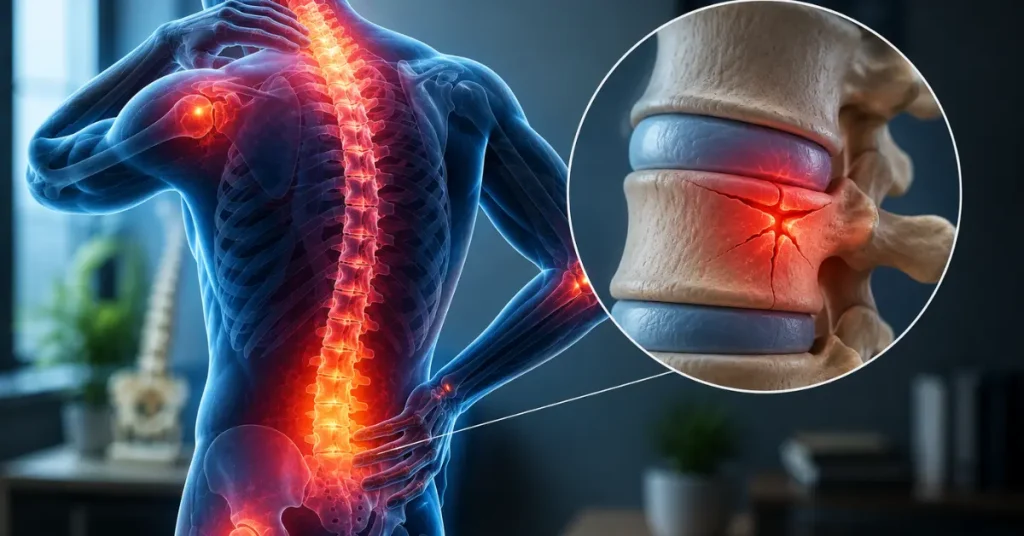
A disc tear can cause pain that shows up far from the disc itself, in the buttock, hip, thigh, groin, or even the shoulder blade. This happens because the torn area releases inflammatory chemicals that irritate nearby spinal nerves, and those nerves carry pain signals along set pathways to areas well outside the back or neck. This referred pain pattern is a documented, mapped phenomenon, not a sign of an unrelated or unexplained illness.
But not every case of widespread pain from a disc tear works the same way. Some patients have one tear doing the work of several complaints. Others have a second pain generator, often a facet joint, firing alongside the tear, and the two get lumped together as one confusing pattern. Most patients also cannot tell the difference between this referred pattern, true nerve root compression, and a separate condition like fibromyalgia, which is exactly the distinction this article walks through.
If you have an MRI showing a disc tear and pain that seems to spread further than the report explains, a Deuk Spine Exam® can help sort out what is actually happening. The exam correlates your MRI with a physical exam and pain history, since MRI findings alone cannot diagnose the source of pain. For many patients, sending in imaging for a free MRI review is the fastest way to find out whether one structure, or more than one, is driving the pattern.
What Is the Hidden Connection Between Disc Tears and Widespread Pain?
The outer layer of a spinal disc, the annulus fibrosus, is wrapped in layers of collagen and shares its nerve supply with other deep structures nearby. When the annulus tears, especially in the posterior portion near the spinal canal, the area becomes inflamed. That inflammation does not stay contained to the disc.
Research on spinal pain physiology published in Pain Medicine describes how deep spinal structures, including discs, refer pain along shared nerve distributions known as sclerotomes rather than staying confined to the tissue of origin. sclerotomal referral in spinal pain (PMC) When one of those structures is irritated, the brain can perceive the pain as coming from anywhere along that shared nerve distribution, not just the actual site of the tear.
This is why a tear at L4-L5 or L5-S1 can produce an ache that feels like it belongs in the hip or buttock. The wiring is shared, so the pain signal is not always accurate about its own address.
How Does a Small Disc Tear Cause Pain in the Hip, Buttock, or Thigh?
A disc tear in the lumbar spine commonly refers pain into the buttock, hip, and thigh because the lower lumbar and sacral nerve roots share sclerotomal territory with those regions. The pain is usually described as deep, dull, and hard to pinpoint with one finger, rather than sharp or electric.
This differs from a herniated disc pressing directly on a nerve root, which tends to produce a narrower, more defined band of pain, numbness, or tingling that follows a specific dermatome down the leg. A lumbar disc tear without herniation can still refer pain broadly, even without direct nerve compression.
Patients often describe this pattern with phrases like these:
- A deep ache in the hip or buttock that does not match a joint problem on X-ray
- Pain that moves from the low back into the thigh depending on the day
- Discomfort that intensifies with sitting, since sitting loads the disc directly
- A vague soreness that outlasts stretching, massage, or heat
None of this means the hip or thigh has its own separate injury. It usually means the low back disc is still the source, and the sclerotome is doing exactly what it is built to do.
Why Does a Disc Tear in Your Back Sometimes Cause Shoulder or Arm Pain?
A cervical disc tear can refer pain into the shoulder blade, upper trapezius, or arm through the same sclerotomal mechanism seen in the lower back. The nerve roots at C5-C6 and C6-C7 share deep tissue innervation with the shoulder girdle.
Patients frequently notice a deep, achy pain between the shoulder blades that will not respond to typical shoulder stretches or a heating pad. This is a common presentation when the actual source is a cervical annular tear rather than a shoulder joint problem.
True nerve root irritation in the neck produces a different picture. It tends to run in a narrower path down the arm toward the hand, often with numbness or tingling in specific fingers. Widespread, poorly localized shoulder blade pain without those defined nerve symptoms points more toward referred discogenic pain than true radiculopathy.
Is It Referred Pain, Nerve Compression, or a Second Pain Generator?
Widespread pain from the spine usually falls into one of three categories, and telling them apart changes the treatment plan. The three are sclerotomal referred pain from the disc itself, true nerve root compression, and a second, independent pain generator working alongside the disc.
A pinched nerve on its own does not cause back or neck pain. It causes radiating symptoms in the limb it serves, while back and neck pain generally trace to the disc, the facet joints, or surrounding soft tissue. That distinction is worth holding onto while sorting through the three patterns below.
| Pattern | What It Feels Like | What Confirms It |
|---|---|---|
| Referred pain from the tear | Deep, dull, diffuse, hard to pinpoint | Matches a sclerotomal distribution, no clean nerve path |
| True nerve root compression | Sharp, defined, often with numbness or tingling | Follows a specific dermatome, may include weakness |
| A second pain generator | Feels layered on top of the first pattern | A facet or SI joint active at the same spinal level |
Facet joint pain is the second most common source of chronic back pain in clinical experience, and it tends to follow disc levels closely. That means a facet problem at the same level as a disc tear can produce a pain picture that looks like one big, spreading issue when it is actually two structures contributing at once. Sacroiliac joint and piriformis-related pain make up a smaller share and can add yet another layer in some patients.
Sorting out which pattern is active, or whether more than one is active together, is the actual diagnostic task. It is also the reason two patients with what looks like the same MRI report can have very different pain patterns.
Could Your Widespread Pain Be Fibromyalgia Instead of a Disc Tear?
Fibromyalgia is a distinct diagnosis from disc-related referred pain, and the two should not be assumed to be the same thing. Fibromyalgia involves chronic pain on both sides of the body and above and below the waist, along with fatigue, sleep disruption, and cognitive symptoms often described as fog.
Disc-related referred pain, by contrast, usually tracks a specific spinal level and a specific sclerotomal distribution, even when it spans several body regions. It typically does not include the fatigue, sleep disturbance, and diffuse tenderness that define fibromyalgia.
Some patients genuinely have both conditions at once, which can make the picture harder to untangle without a structured evaluation. A patient history that separates spinal level, activity-related pain from full-body, fatigue-linked pain is usually enough to start telling the two apart, though a full workup may be needed to confirm either one.
Signs Your Widespread Pain Traces Back to a Disc Tear
A pain pattern is more likely to trace back to a disc tear, rather than a separate condition, when it shares certain features. Consider the following signs together rather than in isolation.
- Pain that worsens with sitting, bending, coughing, or sneezing, since these all load the disc
- A deep, aching quality rather than a sharp, electric, or burning sensation
- A pattern confined to one side or one general region tied to a specific spinal level
- Symptoms that ease somewhat with lying down or a change in position
- No accompanying fatigue, widespread tenderness, or sleep disruption typical of fibromyalgia
- A history that started near the time of a known back or neck injury, or built gradually with activity
None of these signs alone confirms the source. Together, they build a picture that a spine specialist can test against imaging and a physical exam.
How Deuk Laser Disc Repair® Treats the Source Instead of Chasing Each Symptom
Chronic inflammation from a disc tear does not resolve on its own the way a minor, acute injury does, and over time it can drive neoinnervation, meaning new pain nerve fibers grow into the damaged tissue. This is part of why widespread referred pain can persist long after the original injury, and why treating only the referred symptom, such as the hip or shoulder, rarely solves the underlying problem.
Deuk Laser Disc Repair® (DLDR®) is designed to treat the disc tear directly rather than the locations where its pain shows up. The procedure removes the inflamed tissue in and around the posterior annular tear and performs debridement of the damaged area, which then heals naturally over 9 to 12 months. It does not seal the tear. It clears the inflammatory source so the tear can heal on its own timeline.
The procedure itself is built around a few specific details.
- About 20 minutes per disc, done as a same-day outpatient procedure
- A 7mm incision in the lumbar spine or a 4mm incision in the cervical spine
- Most patients walking within about an hour of the procedure
- No bone drilling and no hardware, which preserves the spine’s natural motion
The surgeon’s track record backs up the approach.
- Over 2,700 Deuk Laser Disc Repair® procedures performed
- More than 30 years of spine surgery experience for Dr. Ara Deukmedjian, MD, FAANS
- A 0.01% complication rate, documented across the practice’s case history
- 99% average pain relief for treated pain sources, based on a published peer-reviewed abstract
When a second pain generator such as a facet joint is also active, it is addressed as its own structure. Deuk Plasma Rhizotomy® is a separate, 30-minute outpatient procedure that deactivates the pain-carrying nerves inside an arthritic facet or sacroiliac joint. Treating each confirmed source directly, rather than treating one location and hoping the referred pain elsewhere follows, is the reasoning behind diagnosing before deciding on a procedure.
Bottom Line
A disc tear can cause pain that spreads well beyond the disc itself, through chemical inflammation and shared nerve pathways known as sclerotomal referral, and this pattern is a real, mapped clinical phenomenon rather than a mystery. Widespread pain from a disc tear is not automatically the same as fibromyalgia, and it is not automatically nerve compression either, though either can be layered on top of it.
The most useful next step for a patient with a confirmed disc tear and a spreading pain pattern is a structured evaluation, such as the Deuk Spine Exam®, that correlates the MRI with a physical exam and pain history to confirm exactly which structure, or structures, are involved. Sending your MRI for a free MRI review is a no-cost way to start that process before choosing a treatment path.
Frequently Asked Questions
Can a disc tear really cause pain in my hip or shoulder if the tear is in my back or neck?
Yes, a disc tear can cause pain in the hip or shoulder even though the tear itself is in the back or neck, because the disc shares nerve pathways with those regions through a pattern called sclerotomal referral. The pain is real even though it originates somewhere other than where it is felt.
How is referred pain from a disc tear different from sciatica?
Referred pain from a disc tear tends to be deep, dull, and diffuse, while sciatica from true nerve root compression is usually sharper and follows a narrower, well-defined path down the leg, often with numbness or tingling. Both can occur at the same time in some patients.
Does a pinched nerve cause back pain?
A pinched nerve on its own does not cause back or neck pain. It causes radiating symptoms, such as numbness, tingling, or weakness, in the limb that nerve serves, while back and neck pain typically trace to the disc, facet joints, or surrounding soft tissue.
Could my widespread pain be something other than a disc tear?
Widespread pain could be something other than a disc tear, most notably fibromyalgia, which involves pain on both sides of the body along with fatigue and sleep disruption that disc-related referred pain typically does not include. A thorough history and exam can help tell the two apart.
Can I have more than one source of pain at the same time?
Yes, it is common to have more than one pain source at the same time, such as a disc tear alongside a facet joint problem at the same spinal level, since facet pain tends to follow disc levels closely. This is one reason widespread pain can feel more complicated than a single MRI finding suggests.
Will physical therapy fix widespread pain from a disc tear?
Physical therapy can help when structural damage is minimal, but it is less likely to resolve widespread pain when significant structural pathology, such as an ongoing annular tear with chemical inflammation, is the actual driver. A diagnosis that confirms the source usually comes before deciding whether conservative care is enough.
How do I find out if a disc tear is the actual source of my widespread pain?
Finding out whether a disc tear is the actual source of widespread pain starts with correlating your MRI against a physical exam and detailed pain history, which is what the Deuk Spine Exam® is built to do. A free MRI review is typically the fastest way to get that process started.
The information in this article is intended for general educational purposes only and does not constitute medical advice. Every patient’s condition is different, and a diagnosis should always come from a qualified spine specialist who has reviewed your imaging and examined you directly.