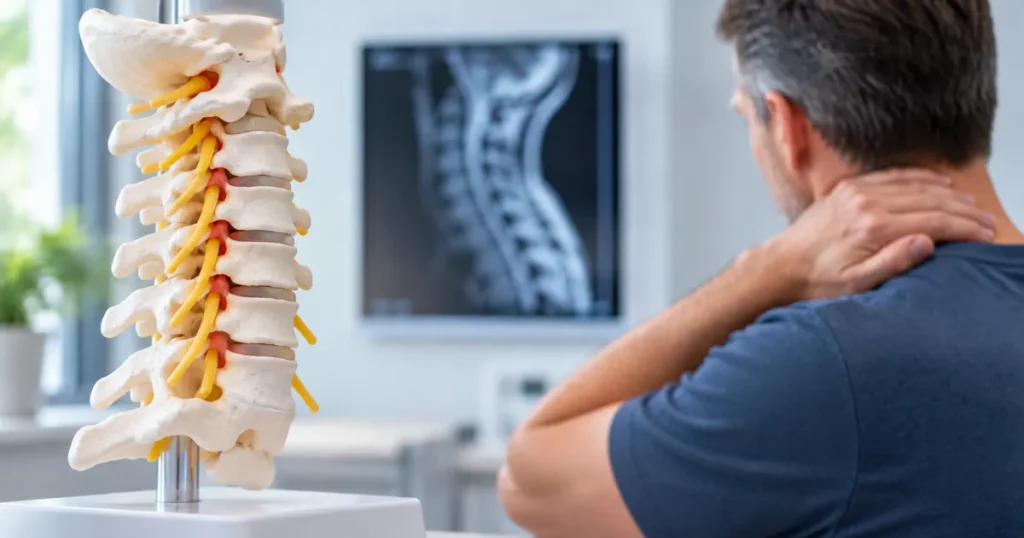
A cervical laminectomy is spine surgery that removes the lamina, the bony roof at the back of one or more neck vertebrae, to take pressure off the spinal cord. Surgeons most often recommend it for cervical myelopathy, a condition in which a narrowed canal squeezes the cord and causes hand clumsiness, balance changes, and arm symptoms. Recovery usually takes weeks to months, and the operation is designed to stop further cord injury rather than reverse damage that has already occurred.
That last point is the one most patients hear too late. What you regain depends on how long the cord was compressed, whether a fusion is added, and whether your symptoms come from the cord at all, because neck and arm pain from a disc injury is a different problem.
If you have been told you need a cervical laminectomy, you can send your MRI for a free review to check whether your imaging, exam findings, and symptoms all point to cord compression before you commit to surgery. Here is what the operation treats and what recovery realistically looks like.
Get Urgent Care First
Progressive hand clumsiness, a new change in your walking or balance, or any new bowel or bladder change can mean the spinal cord is under active compression. These signs call for urgent evaluation by a neurosurgeon or a visit to an emergency department, not an online form. Cervical myelopathy is time-sensitive, and waiting can cost function that timely care may protect.
Medical disclaimer. This article is for educational purposes and does not replace an evaluation by a qualified physician. Only a specialist who examines you can say whether a cervical laminectomy is right for your case.
Key Insights
- It removes bone to free the cord. A cervical laminectomy takes off the lamina at the back of the neck to relieve spinal cord compression.
- Neck compression behaves differently. Cord compression in the neck causes myelopathy, with clumsy hands and unsteady walking, not the leg pain of sciatica.
- A fusion is often added. Removing the back of the vertebrae can destabilize the neck, so many surgeons pair the laminectomy with screws and rods.
- Recovery is real but often partial. In one clinical study of 55 patients, 71% improved after decompression surgery, with hand function recovering most and bladder function least.
- Some damage does not reverse. Established cord signal change on MRI may be permanent, which is why timing matters.
What Is a Cervical Laminectomy?
A cervical laminectomy is a decompression operation performed through the back of the neck. The surgeon removes the lamina, and usually the spinous process attached to it, at each narrowed level so the spinal cord has more room.
The goal is to relieve pressure on the cord, and sometimes on the nerve roots leaving it, so compression stops causing further injury. When the compression sits in front of the cord, surgeons may instead operate from the front of the neck.
How Is the Cervical Spine Different From the Lumbar Spine?
The cervical spine holds the spinal cord itself, while the lower lumbar spine holds nerve roots below the point where the cord ends. That difference changes the symptoms, the risks, and the urgency.
The cervical canal is also narrow relative to the cord it carries. A bone spur that would pinch one nerve root in the lower back can press directly on the cord in the neck, producing myelopathy rather than the radicular pattern of pain running down one leg.
| Feature | Cervical Spine | Lumbar Spine |
|---|---|---|
| What runs through the canal | The spinal cord | Nerve roots below the end of the cord |
| Typical compression pattern | Myelopathy (cord dysfunction) | Radiculopathy or neurogenic claudication |
| Typical symptoms | Clumsy hands, gait and balance change, arm numbness | Leg pain, heaviness, or cramping with walking |
| Main reason for laminectomy | Stop progressive cord injury | Relieve leg symptoms from nerve compression |
| Fusion added | Frequently, to keep the neck from tipping forward | Less often, mainly for instability |
This comparison is general, not diagnostic.
What Causes Cervical Spinal Cord Compression?
Most cervical cord compression comes from age-related wear, a condition called degenerative cervical myelopathy. Several structures can narrow the canal at once, most often at C5-C6 and C6-C7.
- Bone spurs growing from the vertebrae and facet joints into the canal.
- Disc bulges or herniations pushing backward toward the cord.
- A thickened ligamentum flavum, the ligament behind the cord, buckling inward.
- Ossification of the posterior longitudinal ligament, in which the ligament in front of the cord turns to bone.
- A congenitally narrow canal that leaves less spare room from the start.
- Slippage between vertebrae that shifts the canal out of alignment.
Tumors, infection, and injury are less common causes. Narrowing has to match your symptoms and exam before it can be called the problem, and our guide to cervical spinal stenosis and its treatment options covers how that narrowing is evaluated.
What Are the Symptoms, and Why Do They Not Look Like Sciatica?
Cervical myelopathy symptoms tend to be about function, not pain. The change often creeps in so slowly that it is blamed on age or arthritis.
- Clumsy hands, such as trouble with buttons, writing, or picking up coins.
- Dropping objects without meaning to.
- Numbness or tingling in the hands or arms, often in a glove-like pattern.
- Unsteady walking, a wider stance, or new trouble on stairs.
- Balance problems that are worse in the dark.
- An electric sensation down the spine or arms when bending the neck forward.
These signs do not look like sciatica because the cord, not a single nerve root, is being squeezed. Neck pain may or may not be present, and it is not the symptom a cervical laminectomy is designed to treat.
A pinched cervical nerve root, by contrast, causes radiating arm pain, numbness, or weakness in a specific pattern, not neck pain.
For disc-sourced neck pain and radiculopathy, Deuk Laser Disc Repair® is a same-day outpatient procedure through a 4mm cervical incision that preserves motion. DLDR® does not treat cervical stenosis that requires bony decompression, so it is not a substitute for a laminectomy when the cord itself is compressed.
Which Red Flags Mean You Need Urgent Evaluation?
Some symptoms mean you should not wait for a routine appointment. Get urgent evaluation by a neurosurgeon, or go to an emergency department, if you notice any of the following.
- Progressive hand clumsiness or weakness that is getting worse week to week.
- A change in gait or balance, including new stumbling or falls.
- Any new bowel or bladder change, such as urgency, retention, or loss of control.
- Sudden worsening after a fall or any new injury to the neck.
These call for same-day medical care, not an online form.
How Is a Cervical Laminectomy Performed?
The operation is done under general anesthesia with the patient face down and the head held in a frame. The surgeon makes a vertical incision down the back of the neck and moves the muscles aside.
- Confirm the levels with X-ray imaging during surgery.
- Remove the lamina and spinous process at each compressed level.
- Free the cord by removing thickened ligament and bone spurs pressing on it.
- Place screws and rods if a fusion is planned, then close the incision.
Nerve monitoring is often used to watch cord function during surgery. The hospital stay depends on how many levels were treated and whether a fusion was added.
Why Is a Fusion Often Added to a Cervical Laminectomy?
A fusion is often added because the lamina and spinous processes help hold the neck in its normal curve. Removing them across several levels can let the neck gradually tip forward into a kyphotic deformity, which can press on the cord again.
To prevent that, many surgeons add screws and rods to fuse the levels. Fusion trades motion for stability, and the levels above and below take on more load over time.
Laminoplasty, which hinges the lamina open instead of removing it, preserves more motion in some patients. Which option fits depends on your neck’s curve, the number of levels, and existing instability, and our overview of laminectomy and its alternatives compares them.
No cost · No obligation
Live Pain Free
Upload your MRI for a free expert review by Dr. Ara Deukmedjian, M.D., a board-certified neurosurgeon. Ten minutes can change your life.
What Does Recovery Look Like After a Cervical Laminectomy?
Recovery happens in stages and depends on the number of levels, whether a fusion was added, and how impaired you were before surgery. Neck soreness at the incision is common early, because the posterior approach moves more muscle than surgery from the front.
A typical recovery runs roughly like this, though your surgeon’s plan comes first.
- The first days. Walking begins soon after surgery, along with pain control and wound care.
- The first weeks. Light activity, no heavy lifting, and sometimes a soft collar.
- Weeks 6 to 12. Physical therapy for neck strength, posture, and balance.
- Months 3 to 12. Fusion healing, if one was done, and gradual neurological change.
For recovery after surgery at these same levels from the front of the neck, see our C5-C6-C7 neck surgery recovery guide.
What Realistically Improves?
In a prospective study of neurological recovery after surgical decompression, published in International Orthopaedics, 71% of 55 patients with cervical spondylotic myelopathy improved neurologically. Gains became measurable by 3 months and leveled off by about 6 months, with arm and hand function recovering most, leg function less, and bladder function least. Those patients had anterior fusion or laminoplasty rather than laminectomy, so the figures describe decompression in general, not this exact operation.
Decompression usually stops the decline, and many patients regain some function. A full return of normal dexterity or balance is less predictable once myelopathy is well established.
A recognized complication of posterior surgery is C5 palsy, a weakness in the shoulder muscles that often improves over months.
When Can Decompression Not Undo the Damage?
Decompression removes the pressure, but it cannot rebuild cord tissue that has already been injured. Established cord signal change on MRI, sometimes called myelomalacia, may be irreversible, and surgery is aimed at keeping it from getting worse.
The longer and more severe the compression before surgery, the less function may come back, which is why the red flags above matter.
An MRI finding alone cannot diagnose myelopathy or decide on surgery. The images have to be matched to a neurological exam and your symptom history, and no disc procedure reverses existing cord damage.
Bottom Line
For patients with true cervical myelopathy, a cervical laminectomy is a legitimate and often necessary operation. It is designed to stop further injury, a fusion is frequently added, and recovery is real for many patients but not certain to be complete.
If you have any of the red flags above, get evaluated today. If you are weighing a recommendation, submit your MRI through the free review below, and Dr. Deukmedjian’s team will tell you whether your MRI, exam, and symptoms match the operation you were offered.

Diagnosis. Answers. Relief.
Submit your MRI for a free expert review by Dr. Ara Deukmedjian, M.D.,
a board-certified neurosurgeon. No obligation. Real answers.
Frequently Asked Questions
How long does it take to recover from a cervical laminectomy?
Recovery from a cervical laminectomy typically takes several weeks for daily activities and 3 to 12 months for neurological changes and any fusion to settle. Patients with a fusion often have activity limits for longer while the bone heals.
Is a cervical laminectomy major surgery?
A cervical laminectomy is major surgery, performed under general anesthesia through an incision at the back of the neck, usually with a hospital stay. Its risks include infection, spinal fluid leak, C5 palsy, and, without a fusion, a gradual forward tilt of the neck.
Can a cervical laminectomy be done without a fusion?
A cervical laminectomy can be done without a fusion in selected patients, usually when few levels are involved and the neck keeps its normal curve. When more levels are treated or the curve is lost, surgeons commonly add a fusion or choose laminoplasty instead.
Will a cervical laminectomy relieve my neck pain?
A cervical laminectomy is not primarily a neck pain operation, because it is designed to relieve pressure on the spinal cord and nerves. If neck pain is your main symptom, the source may be a disc or facet joint, and that needs its own diagnosis.
What is life like after cervical laminectomy surgery?
Life after cervical laminectomy surgery for many patients includes better hand function and steadier walking than before surgery, with some reduced neck motion if a fusion was added. Follow-up visits track whether gains continue through the first year.
Can Deuk Laser Disc Repair® treat cervical stenosis instead of a laminectomy?
Deuk Laser Disc Repair® cannot treat cervical stenosis that requires bony decompression, so it is not a replacement for a laminectomy when bone spurs or thickened ligament compress the cord. It may be an option when neck pain or arm symptoms come from a disc injury, which an MRI review matched to an exam can help sort out.
Medical disclaimer. The information in this article is for educational purposes only and does not replace a consultation with a qualified physician. Outcome figures come from the published study named in the text and do not predict the result for any individual patient.