

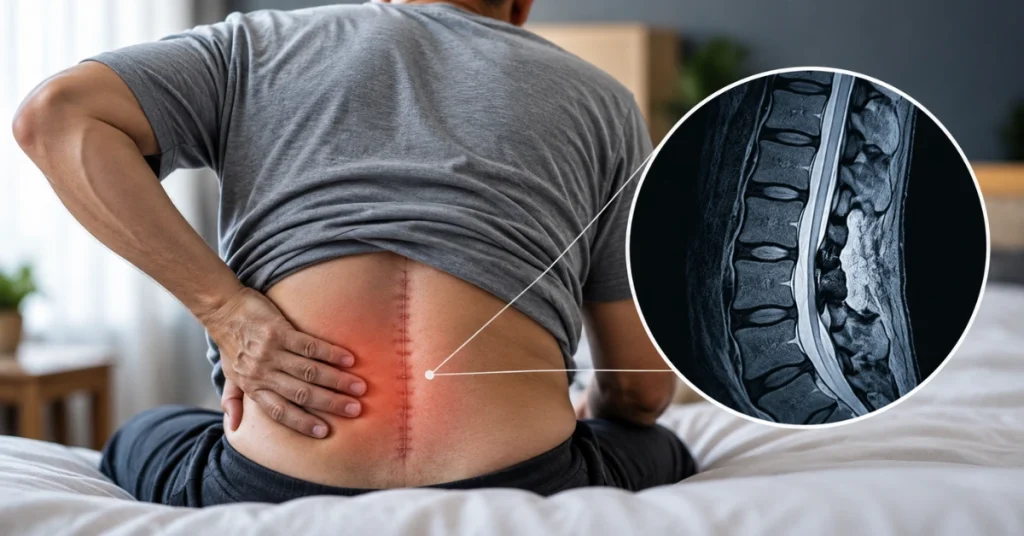
Pain after a laminectomy is real, and it is usually most intense in the first few days, centered on the incision and the back muscles that were moved aside to reach the spine. It is managed with prescribed medication and typically eases steadily over the following weeks. This surgical soreness is a different kind of pain from the leg pain the operation was meant to relieve, and many patients notice that leg pain improve early.
But how hard your recovery feels depends on how many levels are treated, whether fusion is added, and how conditioned you are going in. Many patients are also never told that a sore back paired with calmer legs is often a sign things are going as expected. Below, we walk through what the pain feels like, which signs need a call to your surgeon today, and what separates normal healing from pain that deserves a second look.
If your surgery is not yet scheduled and no one has confirmed which structure is generating your pain, a Free MRI Review can help you go into that decision with a clear diagnosis. If your date is already set, everything below is written to help you prepare.
No cost · No obligation
Live Pain Free
Upload your MRI for a free expert review by Dr. Ara Deukmedjian, M.D. — board-certified neurosurgeon. Ten minutes can change your life.
What Does Pain After a Laminectomy Actually Feel Like?
Most patients describe pain after a laminectomy as a deep, aching soreness across the lower back, sharpest at the incision and worst when changing position. A laminectomy removes part of the lamina, the bony roof over the spinal canal, and the surgeon moves back muscles aside to reach it. Your body responds to that bone and muscle work the way it responds to any surgical injury.
In the first days and weeks, it is common to notice:
- Incision soreness that sharpens with touch, coughing, or sneezing
- Muscle tightness or spasm on either side of the spine
- Stiffness after lying or sitting still, especially in the morning
The pain can be significant in the first few days, which is why your team sends you home with a pain plan. Pain tolerance varies, so your experience may feel lighter or heavier than someone else’s after the same operation.
Red Flags That Mean Calling Your Surgeon Today
Some symptoms after a laminectomy are not part of normal healing and need a call to your surgical team today. Do not wait for a follow-up visit, and do not rely on an online form for these.
- Fever of 101°F (38.3°C) or higher, or chills
- Drainage from the wound, or an incision that becomes more red, swollen, or warm
- Pain that escalates instead of easing from one day to the next
- New weakness, numbness, or foot drop in either leg
- Any change in bowel or bladder control, or numbness in the groin or inner thighs
- Swelling or tenderness in one calf
Call 911 for chest pain or sudden trouble breathing. These warning signs match the spine surgery discharge guidance from the National Library of Medicine. If you cannot reach your surgeon’s office and symptoms are severe, go to the nearest emergency department.
Is Incision Pain Different From the Nerve Pain You Had Before?
Yes. Post-operative pain comes from the incision, muscle, and bone, while the pain that led you to surgery came from compressed nerves. They feel different, they behave differently, and they recover on different schedules.
Spinal stenosis narrows the space around the nerves, which typically shows up as leg symptoms: aching, heaviness, numbness, or tingling in the buttocks and legs when standing or walking. Doctors call this pattern neurogenic claudication. A laminectomy is designed to relieve that pressure on the nerves.
Decompression addresses the nerves, but it does not erase the soreness created by reaching them. That is why many patients are surprised to wake up with a sore back while their legs already feel lighter.
| Feature | Surgical Pain | Nerve Pain |
|---|---|---|
| Location | Incision and low back muscles | Buttock, leg, or foot |
| Feel | Achy, tight, sore | Burning, electric, numb, tingling |
| Trigger | Moving, changing position, coughing | Standing or walking |
In a prospective study of 119 patients who had laminectomy or laminotomy for lumbar spinal stenosis, average leg pain fell from 6.7 to 2.4 on a 10-point scale by six weeks after surgery. Back pain improved less, from 5.1 to 3.0, and its improvement did not track with leg pain. This was a single study without a control group, so treat it as a general picture rather than a prediction for you.
Some tingling or numbness can linger while a nerve recovers. A nerve that was compressed for a long time can take weeks to months to settle.
How Bad Is the Pain in the First Week?
The first week is usually the hardest stretch of laminectomy pain, with the peak typically in the first two to three days. This is when swelling around the incision and muscles is at its highest.
In the hospital or surgical center, pain is usually managed with IV or oral medication. Once home, most patients take prescribed medication on a schedule. Many surgical teams advise taking it before the pain becomes severe rather than waiting.
What tends to help in the first week:
- Take medication exactly as prescribed, and ask before adding over-the-counter pain relievers, since some surgeons limit anti-inflammatories after spine surgery
- Take short, frequent walks as your team allows to keep muscles from stiffening
- Use ice on the low back if your surgeon approves it, keeping the incision dry
- Log-roll to get in and out of bed instead of sitting straight up
- Place a pillow between your knees when lying on your side
Sleep is often the hardest part. Waking when you shift position is common and usually improves as the muscles calm down.
What Happens to the Pain in Weeks Two Through Six?
Between weeks two and six, pain after a laminectomy usually shifts from constant soreness to stiffness and tiredness that come and go. Most patients need less medication each week, and many taper off prescription pain relievers during this stretch.
Progress is rarely a straight line. A good day followed by a sore day is common, especially after doing a little more than usual. The trend across a full week matters more than any single day.
Muscle discomfort, such as tightness after sitting for a long time, often outlasts incision pain. Gentle movement and physical therapy, if your surgeon prescribes it, help the muscles regain tolerance. The calendar side of recovery, including driving, lifting, and returning to work, is covered in our guide to laminectomy recovery time week by week.
Is a Laminectomy Major Surgery?
Yes, a laminectomy is considered major surgery, even when it is done through a smaller incision. It involves removing bone from the spine and working close to the nerves, usually under general anesthesia.
How major it feels depends on the details. A single-level, minimally invasive decompression is a different experience from an open, multi-level laminectomy. Adding a spinal fusion increases both the pain and the length of recovery.
For genuine spinal stenosis with neurogenic claudication, decompression is often the right answer, and many patients do well. Our overview of laminectomy surgery explains how the procedure is performed and when it fits.
What Makes Recovery Pain Harder or Easier?
Several factors shape how hard laminectomy pain feels, and some are within your control. Factors that tend to make recovery harder:
- More spinal levels treated
- A fusion added to the decompression
- An open approach with a longer incision
- Smoking or nicotine use
- Poor sleep and high stress in the weeks after surgery
Factors that tend to make it easier:
- Walking regularly before surgery, if your symptoms allow it
- Stopping nicotine ahead of surgery, as your surgeon advises
- Staying ahead of pain by taking medication on schedule
- Setting up your home in advance with pillows, reachable essentials, and slip-on shoes
- Asking your team for a written pain plan before you leave
None of these promise a specific outcome, but each gives your body a better starting point.
When Is Pain After a Laminectomy Not Normal?
Pain after a laminectomy is not normal when it gets worse over time, changes character, or has not meaningfully improved after several months. Each of these deserves a conversation with your surgeon rather than waiting it out.
- Leg pain returns after an initial period of relief
- New pain appears in a different location or pattern
- Back pain stays the same or worsens long after the incision has healed
- Walking becomes more limited than it was before surgery
Stenosis surgery relieves pressure on the nerves. Back pain driven by a disc or facet joint may persist because those structures were not the target of the operation. When pain continues well beyond expected healing, doctors look closely at persistent pain after spine surgery, and re-evaluating the original diagnosis is the usual next step.
If Surgery Is Not Yet Scheduled, What Should You Confirm First?
If your surgery is not yet scheduled, confirm which structure is generating your pain before committing to an operation with this recovery burden. This is not about doubting your surgeon. It is a reasonable question for any patient to ask.
A laminectomy is designed for nerve compression, which shows up mainly as leg symptoms. If your main complaint is back pain, ask whether your imaging points to the disc, a facet joint, or the narrowed canal. The Free MRI Review mentioned above gives you a specialist’s read of your existing imaging for exactly this question.
When a damaged disc is the source, Deuk Laser Disc Repair® is one minimally invasive option to discuss. When stenosis is the problem, decompression may well be the right path. Questions about your own situation can also go straight to our team through the Deuk Spine contact page.
Bottom Line
So, how bad is the pain after a laminectomy? It is real, it is strongest in the first few days, and for most patients it eases steadily over the following weeks with a clear pain plan.
That soreness comes from the incision and muscles, not from the nerve problem the surgery treats, and many patients notice their leg symptoms improve early. Know the red flags, call your surgical team the same day if any appear, and judge your progress by the week rather than the day.

Diagnosis. Answers. Relief.
Submit your MRI for a free expert review by Dr. Ara Deukmedjian, M.D. —
board-certified neurosurgeon. No obligation. Real answers.
Frequently Asked Questions
How Bad Is the Pain After a Laminectomy?
The pain after a laminectomy is usually moderate to significant for the first few days and then eases steadily over several weeks. Most of it comes from the incision and back muscles, and prescribed medication keeps it manageable for most patients. How intense it feels depends on the number of levels treated and whether fusion is added.
Is It Normal for My Back to Hurt More After a Laminectomy Than Before?
It is common for your back to hurt more after a laminectomy than before, especially in the first weeks, because the surgery creates its own incision and muscle soreness. That soreness should ease week by week. Back pain that worsens over time or persists for months deserves a call to your surgeon.
Why Does My Leg Still Tingle After a Laminectomy?
Your leg can still tingle after a laminectomy because a nerve that was compressed needs time to recover, even after the pressure is removed. Tingling and numbness often fade over weeks to months. New or worsening weakness, however, needs a call to your surgical team today.
How Long Will I Need Pain Medication After a Laminectomy?
How long you need pain medication after a laminectomy varies, but many patients use prescription medication for several days to a few weeks and then taper down. Your surgeon sets the schedule and tells you which over-the-counter options are safe. Never stop or combine medications without checking with your team.
Is a Laminectomy More Painful Than a Discectomy?
A laminectomy is often more painful than a discectomy because it usually removes more bone and may involve more levels. The difference depends on the technique, the number of levels, and whether fusion is added. Your surgeon can tell you what to expect for your specific operation.
Can I Sleep on My Side After a Laminectomy?
Most patients can sleep on their side after a laminectomy, usually with a pillow between the knees to keep the spine aligned. Lying on your back with pillows under the knees is another comfortable option. Follow any position limits your surgeon gives you, especially if fusion was added.
Medical disclaimer: The information in this article is educational and is not a substitute for personalized medical advice, diagnosis, or treatment. Always consult your surgeon or a qualified healthcare provider about your symptoms and recovery.