

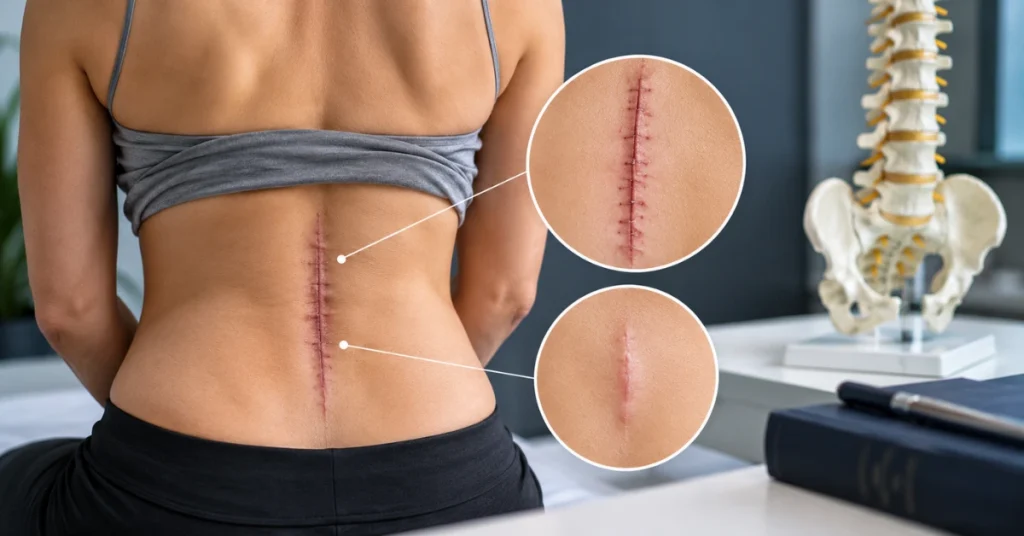
A spinal fusion surgery scar is usually a straight vertical line down the middle of the back or neck, and it gets longer with each spinal level fused. A laminectomy scar looks similar, because an open laminectomy also uses a midline incision over the treated vertebrae, with the back muscles pulled aside to reach the bone. Most scars start pink or red and slightly raised, then flatten and lighten over many months, though results vary with incision length, technique, closure, skin type, and healing.
The line on your back is not the whole story, though. Depending on the approach, a fusion scar can end up on the front of your neck, your lower abdomen, or your side. The scar tissue that forms deep around the nerves is also a separate issue from the one you can see, and it often matters more.
If you have been told you need a fusion or laminectomy, it is worth confirming the source of your pain before you commit to an open incision. Through a Free MRI Review, Dr. Ara Deukmedjian examines your imaging to determine whether your pain comes from a disc problem that Deuk Laser Disc Repair® can treat through a 7mm lumbar or 4mm cervical incision. Below is what each type of incision looks like and what to expect as it heals.
No cost · No obligation
Live Pain Free
Upload your MRI for a free expert review by Dr. Ara Deukmedjian, M.D. — board-certified neurosurgeon. Ten minutes can change your life.
What Does a Spinal Fusion Scar Look Like?
A spinal fusion scar from the most common approach, posterior lumbar fusion, is a vertical line running down the center of the lower back. Its length depends mainly on how many vertebrae are joined, so a single-level fusion leaves a shorter scar than a multilevel one. The incision has to be long enough for the surgeon to move the back muscles off the spine and place screws, rods, and bone graft.
In the first few weeks, the incision usually looks pink or red and slightly swollen. It may be closed with sutures, staples, or skin glue, and staples or stitches can leave small dots along either side of the line. Over the following months, most scars flatten and fade toward a pale line, though some thicken or darken.
Not every fusion leaves a scar on the back. Anterior lumbar interbody fusion (ALIF) reaches the spine through the lower abdomen, and lateral fusion approaches use an incision on the side of the body. Some fusions combine approaches, which means two separate scars.
Common scar types after fusion include:
- Flat, fine-line scars that fade close to your natural skin tone.
- Hypertrophic scars, which stay raised and firm but remain within the original incision line.
- Keloid scars, which grow beyond the incision and are more common in darker skin or with a personal or family history of keloids.
- Widened scars, which can form where the skin is under tension, such as across the lower back.
The skin incision reflects what happens beneath it, and our spinal fusion overview walks through the hardware, recovery, and candidacy factors involved.
What Does a Laminectomy Scar Look Like?
A laminectomy scar from an open procedure is a vertical midline incision over the treated vertebrae, on either the lower back or the back of the neck. The surgeon retracts the muscles to the side and removes part or all of the lamina, the bony roof over the spinal canal, to relieve pressure on the nerves. Because screws and rods usually aren’t placed, a single-level laminectomy scar is often shorter than a comparable fusion scar.
Length still depends on how many levels need decompression. A laminectomy covering several vertebrae for spinal stenosis can leave a scar similar in length to a multilevel fusion. When laminectomy is combined with fusion, the scar reflects the larger exposure the fusion requires.
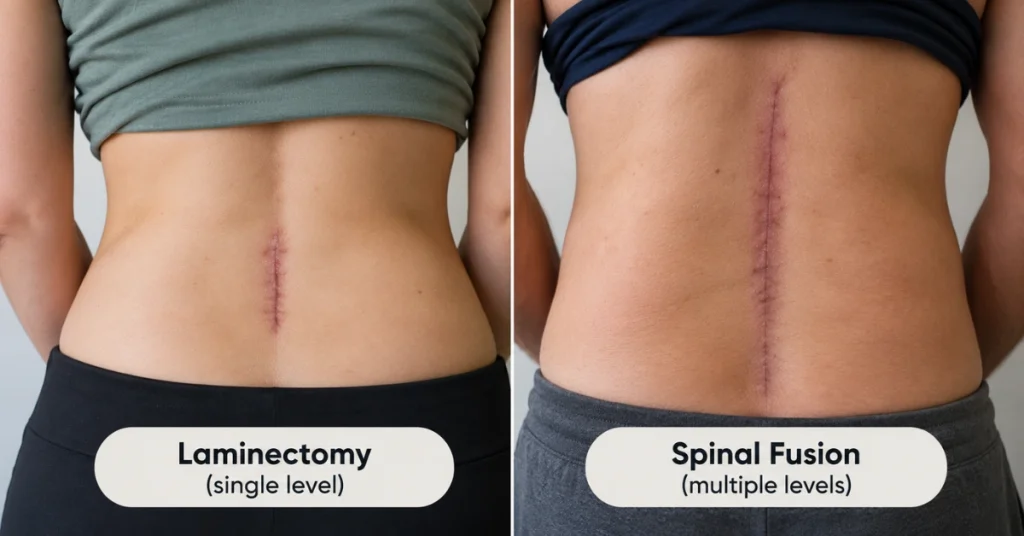
Minimally invasive laminectomy is also performed through one or more smaller incisions using tubular retractors. That approach typically leaves a shorter scar, though candidacy depends on where the compression is and how extensive it is.
If laminectomy has been recommended to you, it helps to understand how the procedure decompresses the spinal canal alongside what the incision will look like.
Cervical vs Lumbar Incisions: Where Will the Scar Be?
Cervical spine scars sit on the front or back of the neck, while lumbar scars sit on the lower back, abdomen, or side. The location depends on which approach gives the surgeon the most direct path to the problem.
In the neck:
- Anterior cervical discectomy and fusion (ACDF) uses a horizontal incision on the front of the neck, often placed in a natural skin crease so it blends in as it matures.
- Posterior cervical laminectomy or fusion uses a vertical incision down the back of the neck, where collars and hair may partly cover it.
In the lower back:
- Posterior approaches, including laminectomy, PLIF, and many TLIF procedures, leave a vertical midline scar, sometimes with small side incisions for screws.
- Anterior approaches (ALIF) leave a scar on the lower abdomen.
- Lateral approaches leave one or more incisions along the flank.
A scar at L4-L5, one of the most commonly treated levels, typically sits near the belt line. Front-of-neck scars are more visible day to day, which is why cervical patients often ask about incision placement first.
How Does Incision Size Differ by Surgical Approach?
Incision size depends on how the surgeon reaches the spine and how much tissue has to be moved to do the work. Open fusion and open laminectomy need substantial midline incisions with muscle retraction, while endoscopic procedures work through a much smaller opening.
| Approach | Where the Incision Sits | Incision Size | What Happens Beneath the Skin | Discharge |
|---|---|---|---|---|
| Open posterior lumbar fusion | Midline, lower back | Several inches, longer with each level | Muscles moved off the spine; screws, rods, and bone graft placed | Hospital stay, length varies |
| Anterior lumbar fusion (ALIF) | Lower abdomen | Several inches | Abdominal contents moved aside to reach the disc; implant placed | Hospital stay, length varies |
| ACDF | Front of neck, often in a skin crease | Varies with levels treated | Neck structures moved aside; disc removed, implant and plate placed | Varies |
| Open lumbar laminectomy | Midline, lower back | Several inches, depends on levels | Muscles retracted; lamina removed | Varies |
| Posterior cervical laminectomy | Midline, back of neck | Several inches, depends on levels | Muscles retracted; lamina removed | Varies |
| Deuk Laser Disc Repair® (lumbar) | Lower back | 7mm | Endoscopic access; no bone drilling or hardware; about 20 minutes per disc | Same-day outpatient |
| Deuk Laser Disc Repair® (cervical) | Neck | 4mm | Endoscopic access; no bone drilling or hardware; about 20 minutes per disc | Same-day outpatient |
Deuk Laser Disc Repair® reaches the damaged disc endoscopically through a 7mm lumbar or 4mm cervical incision, without bone drilling or hardware. The procedure takes about 20 minutes per disc, and patients go home the same day.
A smaller incision still leaves a mark, and how it heals varies from person to person. Incision size also isn’t the deciding factor on its own. The right approach depends on your diagnosis, which is why confirming the actual source of pain matters before choosing any procedure.
How Long Does a Spine Surgery Scar Take to Fade?
A spine surgery scar usually takes 12 to 18 months to mature, and some keep changing for up to two years. The skin closes much sooner, typically within the first two weeks, but the collagen beneath it continues remodeling long after.
A typical timeline looks like this:
- Weeks 1 to 2: The incision is closed but fragile. Sutures or staples are usually removed in this window, and mild redness, swelling, and tenderness are normal.
- Weeks 3 to 8: The scar is often at its most noticeable, pink to red and possibly raised or itchy as new collagen forms.
- Months 3 to 6: Redness begins to fade, and the scar starts to flatten and soften.
- Months 12 to 18: Most scars reach their final appearance, usually paler and flatter than the surrounding skin.
Numbness around the incision is common and often improves over several months. Ask your surgeon before starting silicone sheets, scar gels, or massage, which are generally used only after the incision has fully closed. Protecting the scar from the sun during the first year helps limit darkening.
What Are the Signs a Wound Is Not Healing Normally?
Most spine incisions heal without trouble, but certain changes call for a same-day call to your surgeon. Wound problems caught early are easier to manage than those caught late.
Contact your surgeon if you notice:
- Redness that spreads outward or keeps worsening after the first few days.
- Increasing warmth, swelling, or pain at the incision.
- Cloudy, yellow, or green drainage, or a foul smell.
- Incision edges separating or opening.
- A fever of 101°F or higher, or chills.
- Clear, watery drainage, especially with a headache that worsens when you sit or stand, which can signal a spinal fluid leak.
Seek emergency care for new weakness in your legs or arms, spreading numbness, or loss of bowel or bladder control. These can point to nerve compression and should not wait for an office visit.
Is Internal Scar Tissue the Same as the Visible Scar?
No. The visible scar is on your skin, while internal scar tissue forms deeper, around the muscles, the dura (the protective covering of the spinal cord and nerves), and the nerve roots. The two develop at the same time but behave very differently.
When scar tissue forms around the dura and nerve roots after surgery, it is called epidural fibrosis. Some fibrosis is a normal part of healing after open spinal surgery, and many people never notice it. In some patients, however, it can tether or irritate nerve roots, and it is one of the factors associated with ongoing pain after surgery, often grouped under failed back surgery syndrome.
The size of the skin scar does not tell you how much internal scar tissue has formed. A neat, faded incision can sit above significant fibrosis, and a prominent scar can sit above very little. When pain returns after surgery, an MRI with contrast helps distinguish scar tissue from a recurrent disc herniation, which matters because the two are managed differently.
For patients weighing fusion, the scar is one piece of a larger decision, and our comparison of how laser spine surgery and fusion differ in recovery and long-term outcomes covers the rest.
What Affects How a Spine Surgery Scar Turns Out?
Scar appearance depends on incision length, surgical technique, how the wound is closed, your skin type, and how your body heals. No surgeon can promise how a scar will look, and results vary even between patients who had the same operation.
The main factors include:
- Incision length and tension: Longer incisions and those under tension, as on the lower back, are more likely to widen.
- Tissue handling: How much muscle and soft tissue is disrupted affects swelling and wound healing.
- Closure method: Sutures, staples, and skin adhesives each leave slightly different marks.
- Skin type and genetics: Darker skin is more prone to keloids and pigment changes, and a history of raised scars often predicts more of the same.
- Health factors: Smoking, diabetes, obesity, poor nutrition, and certain medications slow healing and raise infection risk.
- Aftercare: Keeping the incision clean and dry, avoiding strain on the wound, and limiting sun exposure all help.
Surgical approach also affects wound complications. A 2026 meta-analysis of 19 studies and 2,117 patients found that minimally invasive transforaminal lumbar interbody fusion (TLIF) carried a relative risk of 0.30 for surgical site infection compared with open TLIF, meaning roughly 70% fewer infections, along with less blood loss and shorter hospital stays (Spine Deformity, 2026). Fusion and reoperation rates were comparable between the two approaches.
Bottom Line
A spinal fusion scar or laminectomy scar is usually a vertical midline line whose length follows the number of levels treated, though anterior and lateral approaches place it elsewhere. Most scars fade and flatten over 12 to 18 months, but results vary with incision length, technique, closure, skin type, and healing. The scar you can see and the scar tissue that forms around the nerves are separate issues, and the second often matters more.
Before committing to any incision, make sure the diagnosis behind it is clear. A second look at your imaging can confirm whether your pain source calls for open surgery or a smaller endoscopic approach.

Diagnosis. Answers. Relief.
Submit your MRI for a free expert review by Dr. Ara Deukmedjian, M.D. —
board-certified neurosurgeon. No obligation. Real answers.
Frequently Asked Questions
How Big Is a Spinal Fusion Scar?
A spinal fusion scar is typically several inches long for a single-level posterior fusion, and it gets longer with each additional level. The exact length depends on the approach, the number of vertebrae involved, and your anatomy, so your surgeon can give the most accurate estimate.
Does a Laminectomy Leave a Visible Scar?
Yes, a laminectomy leaves a visible scar, usually a vertical line over the treated vertebrae on the lower back or the back of the neck. Minimally invasive laminectomy uses smaller incisions, and most laminectomy scars fade considerably over the first year or two.
Where Is the Scar After Neck Fusion Surgery?
The scar after neck fusion surgery depends on the approach. ACDF leaves a horizontal scar on the front of the neck, often in a skin crease, while posterior cervical fusion leaves a vertical scar on the back of the neck.
Will My Back Surgery Scar Go Away Completely?
Your back surgery scar will not go away completely, but most become much flatter and paler over 12 to 18 months. Sun protection and following your surgeon’s aftercare instructions help, though the final appearance varies by person.
Can Scar Tissue After Back Surgery Cause Pain?
Scar tissue after back surgery can cause pain in some patients when it forms around the nerve roots, a condition called epidural fibrosis. Many people develop some internal scar tissue without symptoms, and an MRI with contrast can help separate scar tissue from other causes of recurring pain.
How Small Is the Incision for Deuk Laser Disc Repair®?
The incision for Deuk Laser Disc Repair® is 7mm for lumbar procedures and 4mm for cervical procedures. It still leaves a small mark that heals differently for each patient, and whether you are a candidate depends on your diagnosis.
Medical Disclaimer: The information in this article is educational and is not a diagnosis or treatment recommendation. Individual results, including scar appearance, vary. Consult a qualified spine specialist about your condition and treatment options.