

A Modern Epidemic Hiding in Plain Sight
You’re reading this right now, and chances are your head is tilted down toward a screen. Whether you’re hunched over your laptop, scrolling through your phone, or sitting at your desk, you’re likely adding 30 to 40 pounds of extra pressure on your cervical spine, without even realizing it.

This is tech neck, and it affects millions of people daily. What starts as minor neck pain or stiffness can progress into chronic headaches, shoulder tension, arm numbness, and even permanent structural damage to your spine. The average person spends 4-6 hours per day looking down at devices, creating a modern epidemic of anterior head carriage that’s silently damaging our necks.
But here’s the good news: Tech neck is reversible with the right approach. Understanding the biomechanics behind your neck pain is the first step toward recovery and actionable solutions, from targeted tech neck exercises to advanced medical interventions. The right approach can help you reclaim your neck health.
The "Bowling Ball" Effect: Understanding the Physics of Tech Neck
The Weight of Your Head
Your head weighs approximately 10 to 12 pounds when properly aligned over your spine. However, for every inch your head moves forward into the anterior head carriage, the effective weight on your cervical spine increases by 10-15 pounds. When your head is positioned just 3 inches forward, a common posture when looking at a smartphone, you are adding 40+ pounds of strain on your neck.
This excessive load doesn’t just cause temporary discomfort; it can also lead to long-term health issues. Over time, chronic anterior head carriage can trigger a cascade of structural changes. The cervical discs can compress and degenerate more rapidly, the natural cervical curve (lordosis) can flatten or even reverse into kyphosis, and the muscles supporting the neck can become chronically strained and imbalanced.
The Chain Reaction Effect
Tech neck can create a domino effect throughout your spine. As your head moves forward, your upper back compensates by rounding (thoracic kyphosis), your shoulders roll inward, and your chest muscles tighten. Meanwhile, the deep neck flexors weaken while the upper trapezius and levator scapulae muscles become overworked and painful.
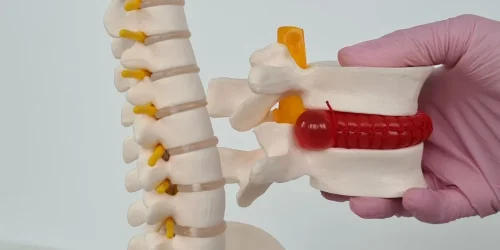
The cervical discs, particularly C5-C6 and C6-C7, bear the brunt of tech-induced stress. Your discs can bulge, herniate, or degenerate prematurely, potentially compressing nerve roots and causing radiating tech neck symptoms into your shoulders, arms, and hands.
The Mechanics Behind Your Neck Pain
Beyond Stiffness: The Surprising Symptoms of Tech Neck
Early Warning Signs
Tech neck symptoms typically start subtly. You might notice mild stiffness after extended device use, a sense of tightness in your upper neck, or temporary discomfort that improves with movement. Many people dismiss these early signs, attributing them to stress or a “bad sleeping position.”
Progressive Symptoms
As anterior head carriage (tech neck) becomes habitual, symptoms intensify. Common progressive tech neck symptoms include persistent neck pain that worsens throughout the day, morning stiffness that takes hours to improve, headaches originating at the base of the skull, and a visible forward head posture when viewed from the side.
The pain often radiates from your neck into your shoulders and upper back, creating muscle knots in the trapezius region. You may find yourself constantly rubbing your neck or struggling to find comfortable sleeping positions.
Advanced Warning Signs
When tech neck progresses to structural damage, symptoms escalate. Advanced tech neck symptoms include numbness or tingling radiating into your arms and hands, reduced grip strength, loss of fine motor control, and persistent neck pain unresponsive to rest or over-the-counter medications. These symptoms suggest that anterior head carriage has caused disc herniation or nerve compression requiring professional evaluation.
Self-Assessment: Do You Have Tech Neck?
Before diving into solutions, assess your current condition with this 4-point checklist:
- Posture check: Stand with your back against a wall. Does your head naturally rest against the wall, or does it hover forward several inches? Forward positioning indicates anterior head carriage.
- Range of motion test: Try looking up at the ceiling. Can you do this comfortably, or do you experience pain, tightness, or restriction? Limited upward mobility is a hallmark of tech neck.
- Symptom evaluation: Review your tech neck symptoms. Are you experiencing headaches, shoulder pain, upper back tension, or radiating arm symptoms? The more symptoms you have, the more advanced your condition.
- Daily habits review: Add up your daily screen time. Include work computers, smartphones, tablets, and television. If you spend 4+ hours a day looking down, you’re at high risk of developing or worsening tech neck.
The Structural Cost: Reversing the Curve and Preventing the "Hump"
Ergonomic Modifications: Your First Line of Defense
Reversing tech neck starts with eliminating the cause. Position all screens at eye level—your monitor should sit so that the top third of the screen aligns with your eyes when sitting upright. For laptops, invest in a laptop riser and an external keyboard to achieve proper positioning.
When using your smartphone, keep the device at eye level rather than bending your head. These simple changes can significantly reduce neck pain over time. An easy way to break the habit of looking down is to use the 20-20-20 rule: Every 20 minutes, look at something 20 feet away for 20 seconds.
Consider workspace modifications like an adjustable standing desk, proper lumbar support in your chair, and adequate lighting to prevent leaning forward to view digital screens.
Counter-Moves: Targeted Exercises for Tech Neck Reversal
Regular exercise is essential for correcting anterior head carriage and reversing symptoms. Here are the most effective exercises:
- Chin tucks (perform 3-4 times daily): The gold standard for correcting forward head posture. Sit or stand with your shoulders back, then gently draw your chin straight backward, creating a “double chin” without tilting your head up or down. Hold for 5 seconds and repeat 10 times. This exercise strengthens deep neck flexors while stretching your posterior neck muscles.
- Doorway pectoralis stretch (hold 30 seconds, 3 times each side): Stand in a doorway with your forearm against the frame at shoulder height. Gently lean forward until you feel a stretch across your chest. This stretch opens the chest muscles that tighten from anterior head carriage and rounded shoulders.
- Wall angels (perform 10-15 repetitions, 2-3 sets): Stand with your back flat against a wall. Raise your arms in a “W” position, then slide them overhead into a “Y” position while maintaining contact with the wall. This is among the most effective kyphosis exercises for strengthening the muscles that counteract upper back rounding.
- Scapular rows (12-15 repetitions, 3 sets): Grab a resistance band or cable (stabilized to an object) with both hands, pull your shoulder blades together, and squeeze for 2 seconds. This addresses muscle imbalances created by tech neck and helps restore proper shoulder positioning.
- Thoracic extension over foam roller (hold 20-30 seconds, repeat 3-5 times): Lie with a foam roller positioned across your upper back. Support your head with your hands and gently arch backward—another great kyphosis exercise for reversing the upper back rounding that accompanies tech neck.
Lifestyle Modifications
Beyond exercises, reducing screen time when possible, taking frequent movement breaks, optimizing your sleeping position with proper pillow support, and managing stress through breathing exercises or mindfulness can all help alleviate neck pain and improve cervical spine health.
Stop guessing about the source of your pain. Get answers from specialists who understand the connection between cervical pathology and shoulder symptoms. Submit your MRI scan to get answers now.

Your Digital Defense Plan: Tech Ergonomics 101
The best treatment for tech neck is early prevention. Create sustainable ergonomic habits, practice postural awareness throughout your day, maintain your tech neck exercises even after symptoms improve, and incorporate kyphosis exercises into your weekly routine. You can also set phone reminders to check your posture and assess your head position regularly. Habits like these can help prevent anterior head carriage from becoming habitual.
Most importantly, to protect your neck and back, avoid prolonged static postures or heavy lifting with poor form. These activities can lead to neck pain and damage.
When Tech Neck Becomes a Structural Issue: When to See a Specialist
While tech neck exercises and ergonomic changes help with muscular strain and early-stage anterior head carriage, they cannot address structural disc problems. If you’ve been diligent with tech neck exercises for 6-8 weeks without improvement, or if you’re experiencing advanced symptoms such as arm weakness, progressive numbness, or persistent pain, it’s time for a professional evaluation.
Red Flags Requiring Immediate Attention
Seek immediate medical evaluation if you experience persistent arm weakness, numbness spreading into your fingers, loss of coordination or balance, bowel or bladder dysfunction, or severe neck pain. These symptoms suggest nerve compression requiring urgent assessment.
The Deuk Spine Institute Approach
Deuk Spine Institute makes getting a second opinion easy. Upload our MRI and schedule a virtual meeting with Dr. Deukmedjian to speak with him, identify the source of your pain, and learn about our minimally invasive treatment options. While MRI scans reveal structural abnormalities, Dr. Deukmedjian emphasizes that “MRI scans don’t tell you where pain comes from; patients do.” This patient-centered approach supports accurate diagnosis.
For cases where tech neck has caused disc herniation or significant structural damage, Deuk Laser Disc Repair (DLDR)® offers a revolutionary solution. This minimally invasive procedure uses a 4-millimeter incision to address the root cause of discogenic neck pain. There is no hardware, no fusion, and no overnight hospital stay. With a 95%+ success rate and zero complications, patients return to their feet within an hour without requiring post-operative narcotics.
For facet joint-related neck pain in the cervical spine, Deuk Plasma Rhizotomy (DPR)® provides complementary treatment when needed.
Take Control of Your Neck Health Today
Tech neck is real, measurable, and increasingly common—but it’s also reversible. Understanding that your head adds 10-15 extra pounds of pressure for every inch of anterior head carriage helps you appreciate why those hours hunched over devices create such significant neck pain.
Start with the 4-point self-assessment, implement ergonomic changes immediately, begin your daily tech neck exercises (aim for 10-15 minutes daily), add kyphosis exercises 2-3 times weekly, and monitor your symptoms. If tech neck symptoms persist beyond 6-8 weeks despite consistent effort, seek professional evaluation.

Make Your First Pain-Free Move
Deuk Spine Institute offers a free MRI review and virtual consultation with Dr. Ara Deukmedjian. Upload your latest MRI to learn more about your symptoms and our minimally invasive procedures for treating chronic neck pain. We’ve helped thousands overcome debilitating tech neck symptoms.
Discover What Patients Are Saying
One man’s neck pain gone!
Can the reversal of my cervical curve caused by Tech Neck be fixed?
Yes. When caught early, tech neck can be reversed through consistent postural correction and targeted exercises. Your cervical curve can return to normal alignment within 3-6 months. The neck responds to mechanical stress through tissue adaptation; proper exercises restore the natural lordotic curve by retraining deep cervical flexors and strengthening posterior neck muscles.
The recovery timeline depends on severity:
- Early stage: Full curve restoration is possible with dedicated exercise compliance
- Moderate progression: Significant improvement achievable, though some structural changes may persist
- Advanced degeneration: Medical intervention required first, followed by therapeutic exercise protocols
Key exercises for cervical curve restoration: Chin tucks retrain deep neck flexors by creating proper head positioning. Cervical extension stretches counter the forward flexion pattern. Scapular stabilization exercises address the upper crossed syndrome that accompanies tech neck. The complete exercise protocol can be found in this article.
Is a standing desk or a laptop riser the best solution for Tech Neck?
Usinga laptop riser provides more direct benefit than a standing desk alone, though combining both optimizes results. The laptop riser addresses the primary mechanical cause by elevating your screen to eye level, eliminating the forward head position that occurs when looking downward. This works in both sitting and standing positions. Pairing the riser with an external keyboard maintains a neutral wrist position while keeping the screen elevated.
Standing desks contribute by:
- Breaking prolonged static postures
- Increasing postural awareness
- Promoting position changes throughout the day
- Reducing compressive loads on lumbar discs
However, standing alone doesn’t prevent tech neck if your screen height remains inadequate. The optimal setup combines a laptop riser, standing desk capability, regular position alternation, and daily corrective exercises. Set hourly reminders to assess head position and perform chin tucks for sustained improvement.
How often should I do the exercises to reverse my forward head posture?
Daily exercise commitment totaling 10-15 minutes produces optimal results. Forward head posture can be reversed through consistent neuromuscular retraining rather than intensive, sporadic sessions.
Your structured daily protocol:
Chin tucks – 3-4 sessions daily
- 10-15 repetitions per session
- Morning, midday, evening, and bedtime
- Retrains deep cervical flexor activation patterns
Stretching routine – 2-3 sessions daily
- Doorway chest stretch releases anterior shoulder tightness
- Neck and shoulder stretches address upper trapezius tension
- Hold each position 20-30 seconds for myofascial release
Strengthening exercises – 3-4 sessions weekly
- Scapular retraction exercises
- Wall slides for shoulder mobility
- Cervical strengthening protocols
- Allow recovery days between sessions for tissue adaptation
Upper back exercises – 2-3 sessions weekly
- Addresses thoracic kyphosis accompanying forward head posture
- Restores proper scapular positioning
Expected progression timeline:
- 2-4 weeks: Reduced pain and improved neck mobility
- 2-3 months: Measurable correction of forward head position
- Maintenance phase: Continue 3-4 weekly sessions to prevent recurrence
Daily consistency produces superior outcomes compared to intensive twice-weekly sessions. Integrate exercises into your routines. For example, you can do chin tucks while brushing your teeth.