
By Dr. Ara J. Deukmedjian, MD
Board-Certified Neurosurgeon
Medically reviewed on June 11, 2026
Medical Disclaimer: This content is for educational purposes only and does not constitute medical advice. Individual cases vary. Always consult a qualified spine specialist about your specific imaging, symptoms, and treatment options before making any decision about surgery or delay.
Key Points
✓ For most non-emergency spine problems, guidelines recommend 4 to 8 weeks of conservative care first. Over 85% of acute disc herniations improve without surgery. ¹ ²
✓ Watchful waiting is not doing nothing. It means active physical therapy, anti-inflammatories, activity modification, and re-evaluation if symptoms change. ²
✓ Early surgery and prolonged conservative care lead to similar one-year outcomes for sciatica but early surgery brings faster pain relief. ³
✓ Once sciatica lasts 4 to 12 months, surgery clearly outperforms more waiting. Long delays are a trade-off, not a safe default. ⁴
✓ Cauda equina syndrome is an emergency. Saddle numbness, new bladder or bowel changes, or rapid leg weakness need decompression within 24 to 48 hours. ⁵ ⁶
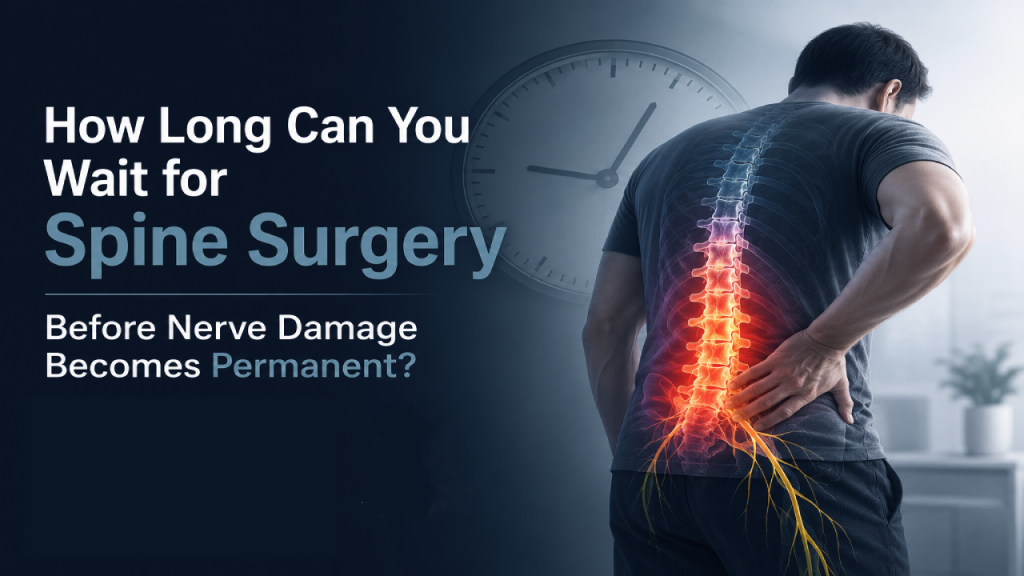
✓ Nerves compressed longer than 3 months are more likely to leave permanent numbness or pain, even after a successful operation. ⁷
✓ Nerves heal slowly about 1 mm per day. Severe, long-standing compression may never fully recover. ⁸
✓ The type of surgery matters as much as the timing. Deuk Laser Disc Repair® treats disc-driven pain; Deuk Plasma Rhizotomy® treats facet-driven pain — both without fusion or hardware. ¹¹ ¹²

Why Timing Is One of the Hardest Questions in Spine Care
If you have been told you may need spine surgery, you are probably hearing two opposite messages at the same time. One voice says, “Wait. Most back problems get better on their own.” Another voice says, “Don’t wait too long, or the nerve damage becomes permanent.”
Both statements can be true at the same time, which is exactly what makes the question difficult. The right amount of time to wait depends on what is wrong, what symptoms you have, and how those symptoms are changing.
This article walks through what the published evidence actually says about timing: when watchful waiting is reasonable, when it is risky, and when it stops being an option at all.

The Default for Most Non-Emergency Spine Problems: 4 to 8 Weeks of Active Conservative Care
For the most common reason patients are told they “need” spine surgery a lumbar disc herniation pressing on a nerve root, causing sciatica. First-line treatment is almost always non-operative, unless there is a significant neurologic deficit or signs of cauda equina syndrome. A 2025 systematic review of treatment guidelines for lumbar disc herniation concluded that conservative treatment is typically recommended for 6 weeks to 2 months before surgery is considered, because more than 85% of patients with acute herniation and radicular symptoms improve over time, and spontaneous reabsorption of the herniated disc material has been documented in more than half of cases managed non-surgically. ¹

Other systematic reviews report a similar consensus: most surgical guidelines use failure of 4 to 6 weeks of conservative therapy, neurologic progression, or worsening imaging findings as the transition criteria from non-operative to operative care. ²
In practical terms, that “waiting period” should not be passive. It typically includes structured physical therapy, short courses of anti-inflammatory medication when appropriate, activity modification, and in selected cases, image-guided epidural steroid injections. Patients who simply rest in bed and wait for the pain to disappear are not following a conservative plan; they are just waiting.
What the Evidence Says About Surgery Sooner vs. Later for Sciatica
A frequently cited randomized trial published in The New England Journal of Medicine enrolled 283 patients with severe sciatica that had already lasted 6 to 12 weeks and randomly assigned them to early surgery or to prolonged conservative treatment with the option of surgery later. Of patients assigned to early surgery, 89% had a microdiscectomy at a mean of 2.2 weeks after randomization. Of patients assigned to conservative care, 39% eventually crossed over to surgery at a mean of 18.7 weeks. ³

The headline result is the one most people miss: at one year, the two groups had similar outcomes for disability and perceived recovery, but the early-surgery group reached those outcomes faster, with quicker pain relief. ³ For a patient deciding between operating now versus waiting, that is the honest framing. Both paths can work; surgery tends to shorten the suffering, while waiting allows a meaningful fraction of patients to avoid an operation altogether.
A separate, more recent NEJM trial looked at a different population: patients whose sciatica had already lasted 4 to 12 months and was caused by a lumbar disc herniation at L4–L5 or L5–S1. Those randomized to microdiscectomy had significantly greater leg-pain reduction at 6 months than those who continued non-operative care. ⁴ The implication: once symptoms have been present for many months, “more waiting” is not a neutral choice. It can mean more months of preventable pain.
The Real Danger Zone: When “Waiting” Is the Wrong Answer
There are situations where the calendar stops mattering and the clock starts. These are not subtle, and they should not be managed at home or through a primary care follow-up two weeks from now.
Cauda equina syndrome (CES) is the most important of these. It occurs when the bundle of nerve roots at the bottom of the spinal canal is severely compressed, typically by a large central disc herniation. Classic warning signs include numbness in the “saddle” area (inner thighs, genitals, buttocks), new urinary retention or incontinence, new bowel dysfunction, and rapidly progressive bilateral leg weakness. CES is a neurosurgical emergency: research consistently supports surgical decompression within 24 to 48 hours of symptom onset, with outcomes particularly bladder and bowel recovery is generally better the sooner surgery is performed. ⁵ ⁶ The 48-hour window is debated in the literature, with some studies finding no sharp threshold, but the clinical standard remains “as soon as humanly possible, not the next morning if it can be avoided.” ⁶
The other situations that compress the timeline include:
- Progressive motor weakness a foot drop that is getting worse week over week, or new weakness in a major muscle group, is a sign the nerve is losing function, not just transmitting pain. Surgical guidelines treat this as an indication to move from conservative care to surgical evaluation. ²
- Spinal cord compression with myelopathy in the neck or upper back. These signs include hand clumsiness, balance problems, gait changes, and hyperreflexia. Once a spinal cord is being squeezed, the question is not “should we wait?” but “how soon can we decompress?”
- Spinal infection, tumor, or unstable fracture each has its own urgency, and none belong in a watchful-waiting protocol.
If any of these apply to you, this article is not the place to make a decision. An in-person evaluation by a spine specialist or an emergency department is.
Can Waiting Cause Permanent Damage? What the Research Actually Shows
Yes, it can and the evidence is more specific than most patients are told.

A study referenced in clinical commentary on lumbar spinal stenosis found that, at two years after surgery, patients who had numbness for longer than 3 months before their operation had worse leg pain and worse quality of life than patients who had surgery earlier. ⁷ The interpretation offered by the authors and treating clinicians: a compressed nerve can tolerate pressure for only so long before some of the damage becomes resistant to even a technically excellent decompression. Surgery after three months still helps. Just not as completely as it would have helped earlier. ⁷
This is consistent with what spine surgeons describe in clinical practice. Mild irritation of an inflamed nerve root can resolve within days or weeks after decompression. Severe or prolonged compression; particularly involving the spinal cord, as in cervical myelopathy. Often leaves residual numbness, weakness, or pain that improves only partially and over many months. ⁸ ⁹
There is also a biological speed limit on the upside. After surgery, peripheral nerves typically regenerate at roughly one millimeter per day, or about an inch per month. ⁸ That is why a patient whose foot has been weak for many months may not see complete recovery for a year or more and may not see complete recovery at all. The longer the nerve was compressed before surgery, the more of that recovery window is lost.
A Canadian prospective study of 166 patients awaiting surgery for lumbar degenerative spinal stenosis found that, although patients’ quality of life deteriorated while they waited, two-year postoperative outcomes were not statistically different between shorter and longer waits, though longer waits did delay recovery during the first postoperative year. ¹⁰ The deterioration happens; the eventual recovery is mostly preserved. That is a different finding than “waiting causes permanent damage”. It is “waiting causes preventable suffering, and sometimes slower recovery, without necessarily changing the destination.”
The two findings only seem to contradict each other. Read carefully, they say the same thing: what damages a nerve permanently is not waiting on a calendar; it is leaving pressure on the nerve while specific warning signs accumulate.
When Surgery Is the Right Call, the Type of Surgery Matters as Much as the Timing
Most of this article has been about when to operate. The other half of the question is what operation. The wrong procedure at the right time can be just as damaging as the right procedure at the wrong time, because a permanent, hardware-based operation that fuses motion segments forever is not interchangeable with a targeted, repair-based procedure that addresses only the actual pain generator. The decision to wait or operate should always include a serious look at whether a less invasive, motion-preserving option fits your specific anatomy.
At Deuk Spine Institute, the two procedures most commonly used to address the underlying drivers of chronic back and neck pain are designed around that principle.
Deuk Laser Disc Repair® is the minimally invasive solution to disc herniations
Deuk Laser Disc Repair® is a proprietary, full-endoscopic laser procedure developed for chronic pain caused by herniated discs, bulging discs, degenerative disc disease, sciatica, radiculopathy, and spinal stenosis in other words, the conditions that cause most people’s back pain. ¹¹ The procedure is performed through a 4 to 7 millimeter incision. Smaller than a dime under light sedation in an outpatient surgery center. A tubular retractor, an endoscopic camera, and a Holmium YAG laser are used to remove only the inflamed, pain-generating tissue inside the disc, specifically the torn annular fibers and the portion of the nucleus pulposus producing the symptoms. No fusion. No screws, rods, or cages. No artificial implant. The disc is repaired rather than removed, and the spine’s natural motion is preserved. ¹¹
For a patient who has already worked through the 4-to-8-week conservative window without improvement, who has imaging that correlates with the symptoms, and who would otherwise be looking at a microdiscectomy or a fusion, this is the kind of motion-preserving alternative worth asking about before consenting to a larger operation. ¹¹
Deuk Plasma Rhizotomy® is the minimally invasive solution to facet pain
Not all spine pain is coming from a disc. A large share of chronic back and neck pain. Particularly in older adults and in patients whose pain is worse with extension, twisting, or standing. Pain comes from the facet joints themselves, the small paired joints that connect each vertebra to the next. When these joints become arthritic, hypertrophied, or otherwise inflamed (facet arthropathy, facet arthritis, facet hypertrophy, sacroiliac joint pain), there is a worn out joint generating pain.
Deuk Plasma Rhizotomy® is designed for exactly that problem. It is a roughly 10-to-20-minute outpatient procedure performed through a 4 mm incision under twilight sedation. Using medical image guidance, the proprietary Deuk Plasma Wand® delivers plasma energy to the small sensory nerve branches that carry pain signals away from the affected facet joint or sacroiliac joint, permanently destroying those pain fibers while preserving the joint’s movement. ¹² No fusion. No implanted hardware. No long recovery.
The clinical question this procedure answers is the one most patients with facet-driven pain are never asked clearly: if the joint itself is the pain generator and the nerves carrying that pain are accessible, why operate on the disc, install hardware, or fuse a level that is not causing the problem in the first place? Deuk Plasma Rhizotomy® treats the actual source. ¹²
The broader point applies regardless of which procedure is on the table: before you accept any timing recommendation, make sure the operation being timed is the right operation for your specific pain generator.
How Long Should I Wait For Spine Surgery?
A reasonable framework, distilled from the guidelines and trials cited above, looks like this:
- Emergency — operate now. Cauda equina syndrome, acute spinal cord compression with new neurological signs, unstable fracture, infection, or rapidly progressive major weakness. Goal: decompression within 24–48 hours when indicated. ⁵ ⁶
- Urgent — weeks, not months. A clear, focal neurologic deficit (such as a foot drop) caused by an identified compressive lesion, especially if it is worsening. Conservative care is reasonable only if the deficit is mild and stable, and only with close re-evaluation. ²
- Elective — 4 to 8 weeks of active conservative care first. Sciatica from a herniated disc without major weakness, mechanical back pain, mild stenosis. Most patients in this category will improve without surgery; for those who do not, surgery becomes a reasonable next step around the 6-week mark, with stronger evidence for surgery the longer severe symptoms persist into the 3-to-12-month range. ¹ ² ³ ⁴ For disc-driven pain that has not resolved, a motion-preserving option such as Deuk Laser Disc Repair® may be a less invasive alternative to fusion or microdiscectomy. ¹¹
- Facet-driven pain follows a different curve. When the imaging and symptoms point to the facet joints rather than to a compressed nerve, the urgency is different. There is no nerve compression clock to beat, but there is no reason to live indefinitely with chronic joint pain when a targeted procedure like Deuk Plasma Rhizotomy® can disconnect the pain pathway without fusion or hardware. ¹²
- Reassess at every step. New numbness, new weakness, new bladder or bowel changes, or pain that is escalating rather than slowly improving any of these should trigger a same-week re-evaluation, not a “wait and see another month.”
The most important sentence in this framework is the last one. Watchful waiting is only safe if someone is actually watching.
Questions to Ask Before You Agree to Wait or Operate
Whether your surgeon is recommending an operation now or telling you to give it more time, ask:
- What exactly is compressing the nerve, or which joint is generating the pain, and how confident are we about that? A clear MRI correlation with your specific symptom pattern is the foundation of any timing decision.
- What neurologic findings would change your recommendation tomorrow? You should leave the visit knowing the specific symptoms that mean “stop waiting and call me.”
- Is my deficit improving, stable, or progressing? A formal exam: strength, reflexes, sensation is the only honest answer to this question.
- If we wait, what is the realistic best-case outcome, and what is the realistic worst-case outcome? Both should be quantified, not described in adjectives.
- If we operate, what is the least invasive procedure that addresses my specific finding and is a motion-preserving, repair-based alternative available? Surgery for a contained herniated disc, surgery for facet-driven pain, and surgery for multi-level instability are not the same operation, and they should not be discussed as if they were.

Frequently Asked Questions
If most disc herniations improve on their own, why does anyone need surgery?
Because not all of them do, and because some symptoms tell us a nerve is being damaged in real time rather than simply hurting. More than 85% of patients with an acute lumbar disc herniation and radiculopathy improve with conservative care, ¹ but the remaining minority can have prolonged disability, progressive weakness, or in rare cases; features of cauda equina syndrome. Surgery exists for the patients who do not get better on the expected curve and for those whose symptoms make waiting unsafe. For that group, motion-preserving options such as Deuk Laser Disc Repair® are worth comparing against larger, hardware-based operations before any final decision is made. ¹¹
How long is “too long” to wait for sciatica?
There is no single number, but the evidence supports a few anchors. Guidelines generally recommend 4 to 8 weeks of conservative care before considering surgery for sciatica caused by a disc herniation. ¹ ² Randomized data show that early surgery shortens the time to pain relief but produces similar one-year outcomes compared to prolonged conservative care, ³ while patients whose sciatica has already lasted 4 to 12 months see significantly better pain reduction with surgery than with continued non-operative care. ⁴ Translating those numbers into a rule of thumb: a few weeks of waiting is usually reasonable, several months is a decision point, and a year of severe symptoms without improvement is not “patient.” It is unaddressed.
What symptoms mean I should stop waiting and seek emergency care?
Numbness in the saddle area (the parts of the body that would contact a saddle), new difficulty starting or controlling urination, new bowel incontinence, or rapidly worsening weakness in one or both legs are signs of possible cauda equina syndrome and require emergency evaluation. Outcomes are best when surgical decompression occurs within 24 to 48 hours of symptom onset. ⁵ ⁶ Do not wait for a scheduled appointment. Go to an emergency department.
Can waiting too long cause permanent nerve damage?
It can, particularly when the compression is severe, when the symptoms include numbness or weakness rather than only pain, and when the duration of compression exceeds about 3 months. Research on lumbar spinal stenosis suggests that patients with preoperative numbness longer than 3 months have worse two-year outcomes than patients operated on earlier. ⁷ Nerves also regenerate slowly after decompression. Roughly one millimeter per day, so any deficit present at surgery may take many months to recover, and severe, prolonged compression can leave residual deficits that surgery cannot fully reverse. ⁸ ⁹
What if my pain is coming from the facet joints rather than from a disc. Does timing still matter?
The timing logic is different for facet-driven pain. Facet arthropathy, facet hypertrophy, facet arthritis, and sacroiliac joint pain do not produce the same nerve-compression clock that drives the urgency for disc-related surgery, so there is no equivalent “operate within X hours” rule. But that does not mean indefinite delay is harmless. Living with chronic facetogenic pain leads to deconditioning, disability, opioid exposure, and a steady decline in quality of life. Deuk Plasma Rhizotomy® is a targeted, outpatient procedure that uses plasma energy delivered through a 4 mm incision to permanently disconnect the sensory nerve branches carrying pain from the affected joint, without fusion or hardware. ¹² When the imaging and physical exam point to a facet source, this is the kind of procedure that addresses the actual pain generator rather than treating the wrong structure.
If I have already been waiting for a long time, is it too late to benefit from surgery?
Almost certainly not. Patients with persistent sciatica lasting 4 to 12 months still showed clear, statistically significant benefit from surgery compared to continued conservative care in randomized trials. ⁴ A Canadian study of patients waiting for lumbar stenosis surgery found that two-year outcomes were similar between shorter and longer waits, though longer waits delayed first-year recovery. ¹⁰ Late surgery for the right patient usually still helps. It just may help less completely, and more slowly, than the same operation done earlier. Which is one more reason that, when surgery becomes the right call, the least invasive, motion-preserving option available is generally the one worth pursuing first. ¹¹ ¹²
What if my surgeon is pressuring me to operate immediately for non-emergency back pain?
Ask for the specific clinical or imaging finding driving the urgency. Outside of true emergencies: cauda equina syndrome, progressive major weakness, instability, infection, tumor, cord compression with myelopathy. Most spine surgery is elective, and the evidence supports a trial of conservative care first in the absence of red-flag findings. ¹ ² A confident surgeon should be able to name the precise finding that makes your case different, should be comfortable explaining what would happen if you waited four to six weeks, and should be willing to discuss whether a motion-preserving, repair-based alternative exists for your specific MRI findings before recommending fusion or hardware.
Sources
- Treatment Guidelines for Lumbar Disc Herniation. Neurospine. 2025. https://www.e-neurospine.org/journal/view.php?number=1714
- Surgery vs. Conservative Treatment for Lumbar Disc Herniations. ScienceDirect. 2025. https://www.sciencedirect.com/science/article/pii/S2772529425014389
- Peul WC, et al. Surgery vs. Prolonged Conservative Treatment for Sciatica. NEJM. 2007. https://www.nejm.org/doi/full/10.1056/NEJMoa064039
- Bailey CS, et al. Surgery vs. Conservative Care for Persistent Sciatica. NEJM. 2020. https://www.nejm.org/doi/full/10.1056/NEJMoa1912658
- Chaudhary R, et al. Cauda Equina Syndrome Beyond 48 Hours. Case Reports in Surgery. 2025. https://www.ncbi.nlm.nih.gov/pmc/articles/PMC12540004/
- Timing of Surgical Intervention in Cauda Equina Syndrome. World Neurosurgery. 2013. https://www.sciencedirect.com/science/article/abs/pii/S1878875013014186
- Carlson JR. Can a Pinched Nerve Cause Permanent Damage? OSC Ortho. https://www.osc-ortho.com/blog/will-my-compressed-spinal-nerve-heal-or-be-damaged-permanently/
- Spine Surgery Recovery: Myths vs. Facts. Florida Spine Associates. 2025. https://floridaspineassociates.com/2025/12/15/mythbusters-spine-surgery-recovery/
- Symptoms of Nerve Damage After Back Surgery. Lanman Spinal Neurosurgery. 2025. https://www.spine.md/insights/symptoms-of-nerve-damage-after-back-surgery
- Wait Time and Outcomes in Lumbar Spinal Stenosis Surgery. CMAJ / PMC. 2016. https://pmc.ncbi.nlm.nih.gov/articles/PMC4933598
- Deuk Laser Disc Repair® procedure overview. Deuk Spine Institute. https://deukspine.com/treatment-options/deuk-laser-disc-repair/
- Deuk Plasma Rhizotomy® procedure overview. Deuk Spine Institute. https://deukspine.com/treatment-options/deuk-plasma-rhizotomy/