

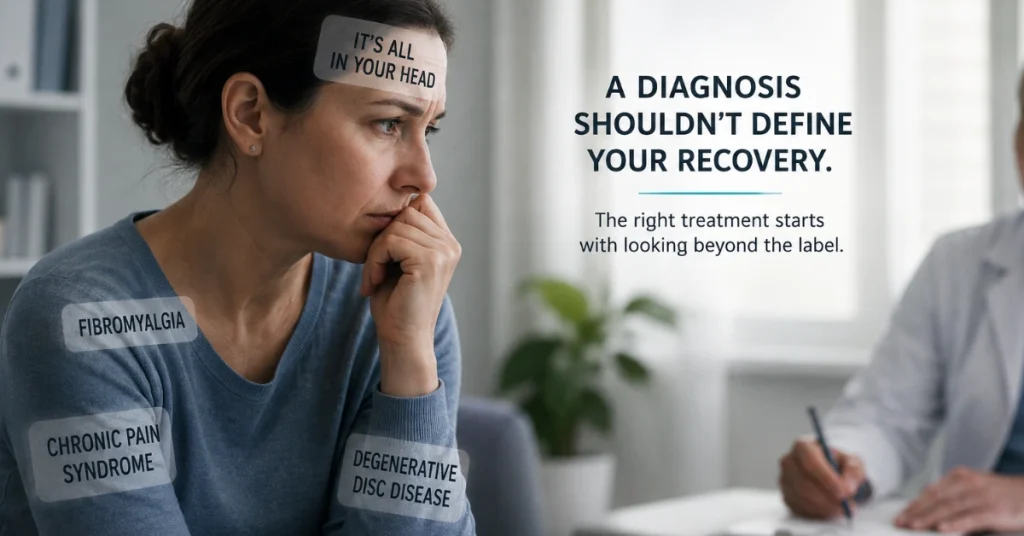
A chronic pain label tells you how long your pain has lasted. It does not tell you what is causing it. When “chronic pain,” “degenerative disc disease,” or “chronic pain syndrome” becomes the end of your workup instead of the start of one, treatment stalls, because no one has pinpointed the specific structural source behind your symptoms, whether that is a torn disc, an arthritic facet joint, or a nerve-specific problem.
But not every broad label means the same thing. Some reflect real diagnostic complexity, while others reflect a workup that stopped short of a physical exam correlating what the MRI showed. This article walks through how to tell the difference, and what a more complete diagnostic process actually looks like.
If your workup stopped at a label like chronic back pain or degenerative disc disease, the Deuk Spine Exam® is built to go one step further. It correlates your MRI findings with a hands-on physical exam and your pain history to identify the actual structural source behind your symptoms, not just describe how long you have had them. Here is what that distinction means for your treatment options.
What Does It Mean When Your Diagnosis Is Just Chronic Pain?
“Chronic pain” is a duration label, not a structural one. In clinical terms, pain that comes and goes for more than two weeks already qualifies as chronic, a much lower bar than most patients assume.
The label tells a provider, and an insurer, how long you have been hurting. It does not name the tissue, joint, or nerve generating that pain. Two patients can carry the exact same “chronic back pain” label with two completely different structural causes underneath it.
Think of it the way you would think of a fever. A fever confirms that something is wrong. It does not name the infection behind it, and no one would stop the workup there.
Why Do Doctors Use Broad Labels Like Degenerative Disc Disease?
Broad labels get used because imaging shows some degree of disc wear on nearly every adult spine, which makes “degenerative disc disease” an easy line to write down, even when it has not been confirmed as the actual pain generator in that patient.
Research by Jensen et al. in the New England Journal of Medicine found that a majority of pain-free adults show disc abnormalities on MRI, and later reviews of pain-free adults confirmed the same pattern. That single finding is why an image on its own cannot confirm that a given disc is the source of a specific patient’s pain.
A few reasons broad labels persist in everyday practice.
- Imaging findings are common. Disc wear shows up on scans of people who have no pain at all, so its presence alone proves little.
- Visit time is limited. A short appointment often does not allow for the physical exam needed to correlate imaging with symptoms.
- The label is billable and defensible. It satisfies documentation requirements without requiring a specific structural answer.
- No single test adds the missing specificity. Identifying the exact source usually takes a combination of exam findings, not one scan.
How Does a Label Delay the Right Treatment?
When a label stands in for a diagnosis, the treatment plan defaults to managing symptoms broadly instead of targeting one structural problem directly.
This is also where two timelines get confused. Chronic pain simply means pain on and off for more than two weeks. Failed conservative treatment is a separate marker, reached only after six to twelve weeks of physical therapy, medication, or injections have not worked.
A patient can be told they have “chronic pain” almost immediately, then spend months in generic management before anyone revisits whether conservative treatment has actually failed.
Common signs the label has replaced the diagnosis.
- Repeat injections that bring short-term relief and nothing lasting.
- Ongoing medication management with no discussion of a structural cause.
- A note that your MRI “showed some degeneration” with no explanation of whether that finding matches your symptoms.
- Advice to keep monitoring the situation well past the point where conservative treatment has failed.
What Is the Difference Between a Pain Label and a Structural Diagnosis?
A structural diagnosis names the actual tissue causing pain, at a specific spinal level, rather than describing how long the pain has lasted.
| Label You May Have Been Given | What a Structural Diagnosis Names Instead |
|---|---|
| Degenerative disc disease | A posterior annular tear at a specific level, such as L4-L5 |
| Chronic pain or chronic pain syndrome | Facet joint arthritis at L4-L5 and L5-S1 |
| Sciatica | Nerve root irritation from a herniated disc at L5-S1, driven largely by chemical inflammation around the nerve |
In Dr. Deukmedjian’s clinical experience across more than 2,700 Deuk Laser Disc Repair® procedures, chronic back pain breaks down into a small set of recurring structural categories, not an undefined single condition.
- Disc injuries account for the largest share, roughly 85%, most often at L4-L5, then L5-S1, then L3-L4, then L2-L3.
- Facet joint pain is the next most common source, following a similar pattern by level.
- Sacroiliac joint and piriformis pain make up roughly 10% combined, a smaller but real category.
- Vertebral body fractures account for less than 0.5%, and the remaining sources make up about 5%.
This breakdown reflects clinical experience with treated patients, not a published research taxonomy, and it is offered as a framework for what to ask about, not a guarantee of what any one patient will find.
Why Isn’t an MRI Enough to Find the Source of Your Pain?
An MRI shows anatomy. On its own, it does not confirm which specific structure is generating your pain.
Two guardrails matter here, because they get confused often. A pinched nerve does not cause back or neck pain; it causes radiating symptoms into an arm or leg. Spinal stenosis causes leg symptoms, heaviness, cramping, or weakness that eases with rest, not back pain itself.
A patient can have both a disc problem and stenosis at the same time, but they are separate findings that need separate correlation.
A complete workup adds several things imaging cannot provide on its own, the kind of correlated diagnostic process a structural finding depends on.
- A hands-on physical exam checking reflexes, strength, and sensation against what the imaging shows.
- A detailed pain history, including when it started, what makes it worse, and what it feels like.
- Correlation between the two, confirming that the structure on the scan actually matches the symptom pattern.
- A check for overlapping conditions, so nerve pain, joint pain, and stenosis are not lumped into one label.
How Does the Deuk Spine Exam® Identify the Actual Source of Chronic Pain?
The Deuk Spine Exam® combines MRI review, a physical exam, and a detailed pain history into one correlated diagnostic process, rather than treating the scan as the answer by itself.
Dr. Ara Deukmedjian, MD, FAANS, a board-certified neurosurgeon with 30+ years of experience, developed the method after seeing how often a broad label left patients without a treatable next step. In his clinical experience, the approach has produced 99% diagnostic accuracy in identifying the structural source of a patient’s pain.
The goal is a named, specific finding rather than a duration-based label, such as a posterior annular tear at L4-L5 or facet joint arthritis at L5-S1, something a treatment plan can actually target.
What Should You Do if You Were Told to Just Live With It?
Being told to manage your pain indefinitely is not the end of the road. It is usually a sign that the workup stopped at a label instead of continuing to a structural diagnosis.
A reasonable next step is a second opinion focused specifically on correlating your existing MRI with a physical exam, not simply repeating the same imaging. Sending your MRI for a free review is a low-cost way to find out, with no obligation, whether a more specific structural cause fits your symptoms and whether a motion-preserving option like Deuk Laser Disc Repair® could be relevant to your case.
Bottom Line
A chronic pain label describes how long you have hurt. It does not name what is causing it.
If your care has stalled at a label like degenerative disc disease or chronic pain syndrome, ask specifically whether your MRI has ever been correlated with a physical exam and pain history. Send your MRI for a free review and get a written answer on whether a more specific, treatable diagnosis fits your symptoms.
Frequently Asked Questions
Is a chronic pain label the same as a diagnosis?
A chronic pain label is not the same as a diagnosis. It confirms that pain has lasted or recurred for more than two weeks, but it does not identify the specific tissue, joint, or nerve causing it.
Is degenerative disc disease serious?
Degenerative disc disease is not automatically serious on its own, since some disc wear shows up on scans of people who have no pain at all. What matters is whether the specific disc shown on your MRI has been confirmed, through a physical exam and pain history, as the actual source of your symptoms.
Why doesn’t my MRI explain my pain?
Your MRI may not explain your pain because imaging shows anatomy without confirming which structure is actually generating your symptoms. A physical exam and a detailed pain history have to be correlated with the scan before a specific structural cause can be confirmed.
What if my doctor told me to just manage my pain?
If your doctor told you to just manage your pain, that advice usually reflects a workup that stopped at a broad label rather than continuing to a structural diagnosis. A second opinion focused on correlating your MRI with a physical exam is a reasonable next step.
Can a specific cause of chronic back pain actually be found?
A specific cause of chronic back pain can often be found when imaging is correlated with a physical exam and pain history. In Dr. Deukmedjian’s clinical experience across more than 2,700 Deuk Laser Disc Repair® procedures, most chronic back pain traces to a small set of recurring structural sources, most commonly a disc injury.
What happens during the Deuk Spine Exam®?
During the Deuk Spine Exam®, your MRI is reviewed alongside a hands-on physical exam and a detailed history of your pain pattern. The goal is to correlate all three so the structural source of your pain can be named specifically, rather than described only as chronic pain.
Is a second opinion worth it if I already have a diagnosis?
A second opinion is worth considering if your existing diagnosis is a broad label rather than a specific structural finding. Bringing your MRI for a correlated physical exam can confirm whether the original label matches an identifiable, treatable cause.
This article is intended for general education and does not substitute for professional medical advice, diagnosis, or treatment. Always talk with a qualified healthcare provider before making decisions about your spine care, and do not delay evaluation based on content you read online.