
Benefits of SI Joint Deuk Plasma Rhizotomy®
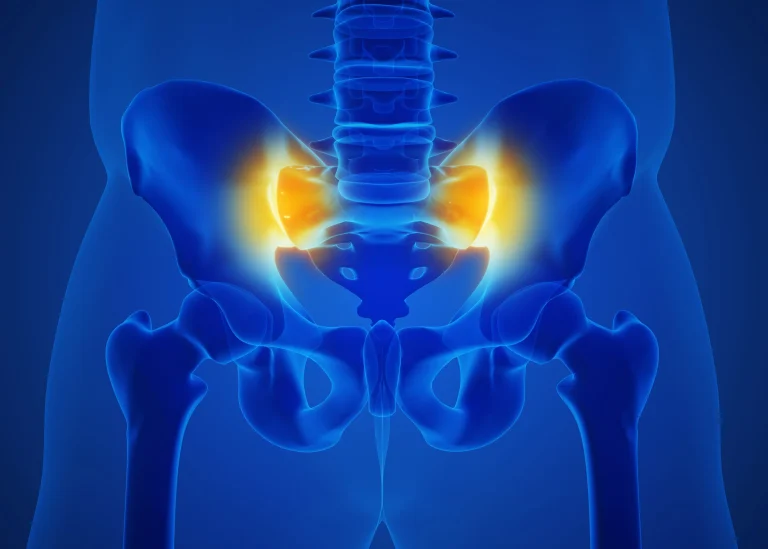
Sacroiliac joint injuries are the third most common cause of chronic lower back pain. In 3% of patients, the main source of chronic lower back pain is the sacroiliac joint.
Chronic sacroiliac joint pain is caused by injuries to the sacroiliac joint, capsule, surrounding tendons and ligaments. Arthritis inflammation of the sacroiliac joint causes overactive nociceptive nerve fibers to send pain signals up to the brain, interpreted as lower back pain.
- Same-Day Discharge
- 99% Pain Relief
- 24-Hour Recovery
4mm
Minimally Invasive Incision
30 Min
Outpatient Procedure
Next Day
Return to Normal Activity
No
Opioid Painkillers Prescribed
How Sacroiliac Joint Pain Leads to Stiffness and Disability
Sacroiliac pain is made worse with activity because movement of the sacroiliac joint causes more inflammation in the sacroiliac joint. Sacroiliac pain itself is a common cause of inactivity and disability among patients with arthritis of the sacroiliac joint. Since sacroiliac pain is made worse with normal movement of the sacroiliac joint, most patients begin to self-limit their activity level to avoid aggravating their sacroiliac pain, a phenomenon known as “fear-avoidance behavior”. Over time the sacroiliac joint stiffens and loses its flexibility because of disuse. It is important to maintain normal activity levels and sacroiliac joint range of motion to avoid permanent disability. Eliminating sacroiliac joint pain can help achieve this goal.
The Deuk Plasma Rhizotomy® Difference
The ultimate goal of rhizotomy is permanent elimination of pain from the arthritic joint while preserving motion. To achieve this goal, the sensory nerves to the painful joint must be transected (cut) and not allowed to “grow” back to the joint. Standard RFA will not accomplish either of these goals as RFA has no way to physically cut the pain nerve nor does RFA stop the nerves from growing back. Deuk Plasma Rhizotomy® was developed at Deuk Spine Institute as the first of its kind, a permanent solution to painful joints made possible by transecting the pain nerves at the joint and preventing them from reattaching. Deuk Plasma Rhizotomy® uses powerful electrical energy to generate plasma (energized electron vapor) at the tip of the Deuk Plasma Wand® which in turn permanently destroys the sensory nerves to painful joints. The result is a joint that moves without pain. Overall, a major benefit in joint pain relief through a minimally invasive procedure with an immediate recovery.
To find out if you are a good candidate for one of our advanced treatments, please complete our Free MRI Review.

Patient Experience
Over 2,750 patients have experienced lasting relief with Cervical Deuk Laser Disc Repair® — 95% success rate, no complications, and most are pain-free by the next morning.
Watch Live Surgery
Watch Dr. Deukmedjian perform Cervical Deuk Laser Disc Repair® live — a 30-minute, minimally invasive procedure that eliminates chronic neck pain through a band-aid incision.
TRUSTED BY PATIENTS
See what patients are saying about their experience, their recovery, and their results with our advanced spine treatments.
Benefits of Sacroiliac Joint Deuk Plasma Rhizotomy®
- Minimally invasive 4-mm incisions
- No or minimal blood loss
- Outpatient 30-minute procedure
- Twilight sedation
- Resume normal activity following day
- Permanent results typically
- No prescribed painkillers
- Fast recovery
- Minimal risk of complications
- Eliminates unnecessary treatments such as injections and invasive surgery
- Avoid sacroiliac joint fusion surgery
- Low cost
- Joint mobility is maintained
- Good for patients with osteoporosis to avoid fusion
Ready to Find Out What's Causing Your Pain?
Upload your latest MRI for a free review and consultation with Dr. Ara Deukmedjian. Most patients receive a precise diagnosis within 48 hours — often for the first time — along with a clear treatment recommendation. No cost. No obligation.
7 Key Benefits
Why Patients Choose Cervical Deuk Laser Disc Repair®
From permanent pain relief to bloodless outpatient surgery, Deuk Laser Disc Repair® offers advantages no other cervical spine procedure can match. Explore each benefit below.
- Most Effective Treatment for Sacroiliac Joint Pain
- Who is a Good Candidate for Deuk Plasma Rhizotomy® for the Sacroiliac?
- How Deuk Plasma Rhizotomy® for the Sacroiliac is Performed
- After the Deuk Plasma Rhizotomy® for the Sacroiliac
- Risks of Deuk Plasma Rhizotomy®
- How to Schedule your Deuk Plasma Rhizotomy® for the Sacroiliac Joint
- Avoid Opioid Narcotic Painkillers
Most Effective Treatment for Sacroiliac Joint Pain
Standard treatments for chronic sacroiliac pain include medications, therapy, injections, and surgery. Medications may provide temporary relief for mild sacroiliac joint disease but do not eliminate the source of pain. Therapy may help preserve motion and prevent deconditioning of surrounding muscles and ligaments but will not eliminate the source of pain. Injections may provide temporary relief of symptoms but do not eliminate the source of pain. Injections into the joint include steroids, anesthetics, lubricants, PRP and stem cells. Injections into the sacroiliac joint become less effective over time as the sacroiliac joint further deteriorates. Surgery for chronic sacroiliac joint pain is becoming more popular among surgeons and patients. Surgery can be very effective at eliminating chronic sacroiliac joint pain. There are two types of surgery for chronic sacroiliac pain including rhizotomy and sacroiliac joint fusion.
Sacroiliac joint fusion is performed with metal and cadaver bone implants into the joint. Joint fusions are highly invasive, can have major complications, long recovery and often cause more problems for the patient. Sacroiliac joint fusions are being pushed onto patients by surgeons and the companies that sell sacroiliac joint metal and cadaver bone implants because they are highly profitable procedures. Fusions are good for surgeons, hospitals and the implant companies but often have disastrous results for the patients receiving these invasive surgeries. Standard occurrence with sacroiliac joint fusion surgery is bleeding, scar tissue, long painful recovery, activity restrictions, time away from work and normal activities, dangerous opioid painkillers, high cost and complication rate. Reported sacroiliac joint fusion complications include loosening of the metal implants, dislocation, osteonecrosis or osteolysis (bone erosion), fractures, infection, loss of function, nerve damage, leg length discrepancy, anemia, blood clots in the legs or lung and death. The seriousness of these poor outcomes from sacroiliac joint fusion has driven doctors to explore less invasive surgical treatments.
Rhizotomy is a new technology introduced to treat chronic degenerative sacroiliac joint pain and loss of function. Rhizotomy is a procedure that targets and destroys the sensory nerves at the sacroiliac joint known to be responsible for sacroiliac back pain. The target nerves are small, so the rhizotomy surgery is “small” or minimally invasive. Most rhizotomies are performed with Radio Frequency Ablation (RFA), a technique using medical imaging to co-localize a probe with the areas where the sensory nerves are found near painful joints. RFA provides a small electrical current that temporarily interferes with nerve signals. Unfortunately, RFA can only provide temporary relief of pain in a small number of patients because the technique has significant limitations. Deuk Spine Institute realized the limitations of RFA’s temporary effects and went on to develop a new, improved rhizotomy technique pioneered by founder neurosurgeon, Dr. Ara Deukmedjian MD.
Who is a Good Candidate for Deuk Plasma Rhizotomy® for the Sacroiliac?
Anyone with sacroiliac joint pain from arthritis lasting greater than 3 months would be an excellent candidate for the Deuk Plasma Rhizotomy®. Patients recommended for sacroiliac joint fusion surgery. Patients with osteoporosis or medical conditions preventing sacroiliac joint fusion.
How Deuk Plasma Rhizotomy® for the Sacroiliac is Performed
Deuk Plasma Rhizotomy® for the sacroiliac joint is only available at Deuk Spine Institute. Patients are put under “twilight” sedation in the operating room where two 4-mm incisions are made in the skin around the painful sacroiliac joint. The Deuk Plasma Wand® is navigated by the surgeon using medical image guidance to 5 pre-selected locations around the sacroiliac joint where articular branches are permanently destroyed. Recovery usually takes 30 minutes then patients are discharged home with an adult driver. Normal activity can be resumed the next day as there are no postoperative restrictions.
After the Deuk Plasma Rhizotomy® for the Sacroiliac
There will be post procedure pain in the treated sacroiliac joint area usually lasting up to 2 weeks. It is important to start walking immediately and stay active with daily walks. Keep your other medical conditions under control. You may return to work the day after the procedure if you are recovered. Some patients heal slower and require additional days of recovery. Maintain a normal diet and avoid alcohol on the day of the procedure. Notify your surgeon if you experience increased pain, swelling, fevers, weakness, loss of sensation. For emergencies call 911.
Risks of Deuk Plasma Rhizotomy®
As with any surgery there are risks to this procedure including but not limited to bleeding, infection, nerve damage, cardiovascular complications, ischemia, loss of life or limb. Ask your surgeon about specific risks unique to yourself.
How to Schedule your Deuk Plasma Rhizotomy® for the Sacroiliac Joint
Schedule a Free MRI Review with one of our physicians to see if you are a candidate for one of our state-of-the-art treatments, mri.deukspine.com.
You can learn more at www.DeukSpine.com
Avoid Opioid Narcotic Painkillers
Spine surgery without post-operative opioid narcotic painkillers is possible with Deuk Laser Disc Repair®. Invasive spine surgery such as laminectomy, discectomy, spinal fusion and disc replacement always require dangerous post-operative opioid narcotic painkillers because these surgeries cause tremendous internal damage to your body. Most invasive spine surgery patients stay in the hospital overnight taking powerful opioid narcotic painkillers and continue taking them for months afterward.
The actual source of post-operative pain is dying muscles, bones and ligaments ripped off of your spine while you are under anesthesia. The invasive surgery destroys muscles along the front of the spine, causing them to “melt” away for months and eventually become hard scar tissue. Liquification of muscles, tendons, bone and ligaments happens in ALL invasive spine surgery — which is why all patients undergoing invasive spine surgery are at high risk of becoming dependent on painkillers.
Deuk Laser Disc Repair® is truly minimally invasive and causes no known internal damage. Patients have no surgical pain the day after surgery and no post-operative painkillers are needed. Most of our patients take one Tylenol the night after surgery and nothing else. Patients can return to work or driving a car the day after surgery.
To see if you are a candidate please complete our Free MRI Review.
Find Out If You're a Candidate
To find out if you are a good candidate for Sacroiliac Joint Deuk Plasma Rhizotomy®, complete our Free MRI Review. Our team will carefully evaluate your imaging and contact you with a personalized treatment recommendation.
Permanent lower back pain relief is possible. Take the first step today.