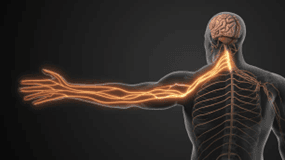
When Hand Symptoms Start in the Neck, Not the Wrist
Symptoms like numbness and tingling going down your arms and into your hands are common signs of carpal tunnel. But what if I told you this is a common misdiagnosis? What if the symptoms were actually coming from your neck?
Pinched nerves in the neck are very common and can cause symptoms like numbness, tingling, and even pain down the arms and into the wrist and hands. This is called cervical radiculopathy, where the nerve root is either irritated or compressed, causing symptoms in the upper extremities.
Several conditions, such as a herniated disc, bone spur, or arthritis, can cause a pinched nerve. When patients experience numbness and tingling, many doctors can misdiagnose it as carpal tunnel rather than radicular symptoms, leading to treatment for issues unrelated to the actual source.
Make Your First Pain-Free Move

Watch Deuk Laser Disc Repair® in Action
Our goal is to be completely transparent about our process and procedures for treating neck issues. We livestream surgeries with our patients’ written consent, allowing you to observe our technique. Watch how the Deuk Spine Institute cures neck pain with advanced endoscopic laser surgery.
How a Pinched Nerve in Your Neck Triggers Arm and Hand Symptoms
Here’s a quick anatomy lesson to paint a better picture of what is potentially going on in your neck. The cervical spine has nerves that branch off the spinal cord and extend into the shoulders, arms, elbows, wrists, and fingers. When one of these nerves becomes “pinched” or compressed, you can experience radicular symptoms. These include pain, numbness, tingling, and weakness. One of the most common causes of a pinched nerve in the neck is a herniated disc.
The good news is that not every pinched nerve causes the same symptoms. Different nerve roots produce specific, recognizable symptom patterns. Identifying the patterns helps physicians determine which nerve root is affected.
When Cervical Compression Looks Like Carpal Tunnel
Carpal tunnel syndrome occurs when the median nerve becomes compressed in the narrow passageway of the wrist. The compression causes numbness and tingling in the thumb, index, and middle fingers. Compression of the C6 and C7 nerve roots can also cause very similar symptoms.
The similarities between the two conditions explain the common misdiagnosis:
- Both present with numbness and tingling
- Both present with weakness
- Both may present symptoms in the index and middle fingers
Because of this overlap, patients are often subjected to months of wearing wrist splints or doing physical therapy for something completely unrelated to their underlying condition, when the symptoms are actually coming from the neck.

Using Dermatome Mapping to Find the Root Cause
A dermatome is a specific area of skin that is supplied by sensory nerves from a single spinal nerve root. Think of your body as a map where each spinal nerve is responsible for feeling in a distinct section of skin. When a nerve root is pinched in the neck, the symptoms it produces will correspond exactly to its dermatome on your arm and hand.
By understanding these maps, physicians can pinpoint exactly which nerve root is being compressed. This is critical for distinguishing cervical radiculopathy from carpal tunnel syndrome, which only involves compression of the median nerve at the wrist.
Is Your "Carpal Tunnel" Treatment Failing?
If you've spent months wearing wrist splints or going to therapy with no lasting relief, the issue might not be your wrist—it could be a pinched nerve in your neck. Upload your MRI for a free review and discover the real source of your numbness and pain.
Distinguishing C6/C7 Symptoms from Carpal Tunnel
We've noted that compression of the C6 and C7 nerve roots can mimic carpal tunnel syndrome because the areas of numbness often overlap. Below are the distinct symptom patterns that a doctor uses to diagnose which condition you have:
C6 radiculopathy:
- Pain and/or numbness in the thumb and index finger
- Weakness in the bicep
- Weakness in the wrist extensors
C7 radiculopathy:
- Pain and/or numbness in the middle finger
- Weakness in the triceps
- Weakness in the tricep reflex
Notice that while C6 and C7 radiculopathy cause numbness in fingers also affected by carpal tunnel, they also cause distinct muscle weakness—like weakness in the bicep (C6) or triceps (C7)—that carpal tunnel does not.
Confirming the Diagnosis
The use of dermatome knowledge combined with a detailed patient history and physical exam is the first step toward a correct diagnosis. The physician is essentially using the patient's symptoms to trace the problem back to the origin point in the cervical spine.
To gather more definitive proof of nerve compression or damage, doctors may order tests such as a Nerve Conduction Study (NCS) and Electromyography (EMG):
- Nerve Conduction Study (NCS): This test measures how fast an electrical signal travels along the peripheral nerves. A slowed signal can indicate compression along the nerve's pathway, whether it's at the neck or the wrist.
- Electromyography (EMG): This assesses the electrical activity of your muscles. It determines whether the muscle is receiving a proper signal from the nerve, helping identify whether the nerve root (radiculopathy) or the peripheral nerve (carpal tunnel) is the source of the disruption.
These tests are invaluable for ruling out carpal tunnel and confirming that cervical radiculopathy is the actual source of your arm and hand symptoms.
Conservative Treatment Helps—But is Often Not the Cure
Many people with cervical radiculopathy try conservative measures to help with the symptoms. These can help, but do not cure the underlying issue. Many people try things like:
- Physical therapy to help strengthen muscles and correct posture
- Pain management injections to help reduce the pain and irritation of the nerves
- Medication management to help with the nerve-related symptoms
It is important to recognize that these are simply “band-aid” solutions. They may temporarily reduce symptoms, but they do not fix the underlying structural cause. Symptoms often return with conservative management alone.
The Gold Standard for Treating Neck and Arm Pain
Here at the Deuk Spine Institute, we offer the most advanced technology and surgical procedures to cure neck and arm pain permanently. Most patients suffering from these symptoms have a herniated disc compressing a nerve in their neck.
Using Deuk Laser Disc Repair®, we can remove the herniation compressing your nerve. DLDR® uses a 4-millimeter endoscopic incision through the front of the neck, and, using a high-powered FDA-approved laser, we precisely remove the disc material causing compression, reducing inflammation and relieving pressure on the nerve root.
We have performed thousands of DLDR® surgeries here at the Deuk Spine Institute with zero complications. The surgery has a 99.6% success rate in curing your neck and arm symptoms. The surgery is done completely outpatient, meaning you get to go home the same day. There is no need for postoperative narcotics after Deuk Laser Disc Repair®, as this surgery is minimally invasive with no scarring and no metal or foreign objects placed in your body. This is the best surgery for neck pain, arm pain, or arm numbness/tingling in the world.
The Better Way: Deuk Laser Disc Repair (DLDR)®
Navigating a postoperative spinal infection is a difficult journey for any patient and clearly reduces your chances of a successful recovery. I want to share that my revolutionary procedure - Deuk Laser Disc Repair® — offers a better way to cure your neck or back pain without the worry of infection. See what our patients are saying:

FAQs
Q: How long does it take for a pinched nerve in the neck to heal on its own?
A: It can take anywhere from a couple of days to a few weeks for a pinched nerve to heal on its own. However, some cases continue with mild symptoms and may worsen later, potentially leading to severe nerve damage if left untreated.
Q: What tests will a doctor use to confirm that the hand numbness is coming from my neck?
A: A doctor will perform a physical exam and may use tests such as the Spurling’s test to determine whether the symptoms originate from the neck or the hand. A more in-depth test that gives quantitative values is the EMG/NCS test. Along with these tests, imaging such as MRIs and CTs can show doctors nerve compression.
Q: I have been told I have "nerve damage"—what is the difference between radiculopathy and myelopathy?
A: Radiculopathy is nerve damage to the nerve root that exits the spinal cord. This typically causes symptoms such as pain, numbness, tingling, or weakness in patients. Myelopathy is usually more severe, as this is damage to the spinal cord itself. This is usually shown to be weakness, balance problems, urinary incontinence, and difficulty with fine motor skills in patients.