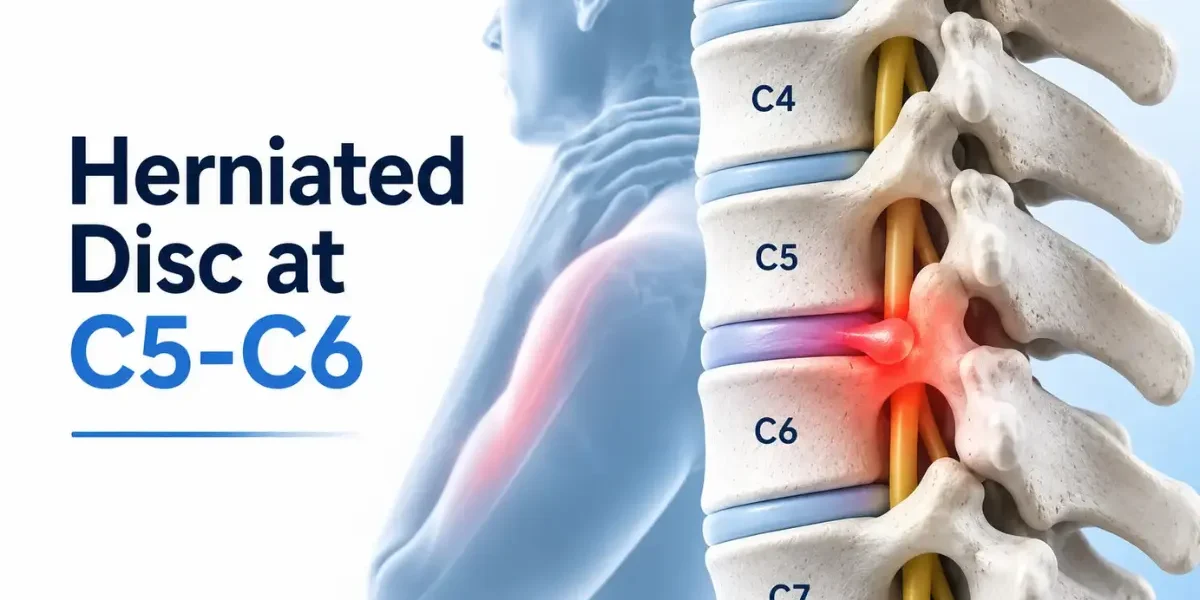
If you have a herniated disc at C5-C6, you already know the pain has a way of taking over your life. The neck stiffness that greets you every morning. The shooting pain down your arm that flares when you turn your head the wrong way. The numbness in your thumb and index finger that makes it hard to grip a coffee cup, type at a desk, or button a shirt. You’ve probably been told you need surgery. And you’re probably terrified of what that surgery looks like.
I’ve evaluated thousands of patients with C5-C6 disc herniations over more than 30 years in spine surgery. This level causes more cervical radiculopathy than any other disc in the neck. It is, without question, the most commonly treated cervical disc at Deuk Spine Institute – and yet it’s also one of the most misunderstood. Patients come in having been told they need a fusion, that their arm pain will only get worse, or that they’ll have to live with it if they want to avoid a major operation. Most of the time, none of that is accurate.
In this article, I’ll walk you through exactly what a C5-C6 herniation is, how to recognize whether the C6 nerve root is involved, what distinguishes your neck pain from your arm symptoms, how we diagnose the true source, and why the Deuk Laser Disc Repair® offers a motion-preserving alternative to ACDF fusion that most spine patients have never been offered.
No cost · No obligation
Live Pain Free
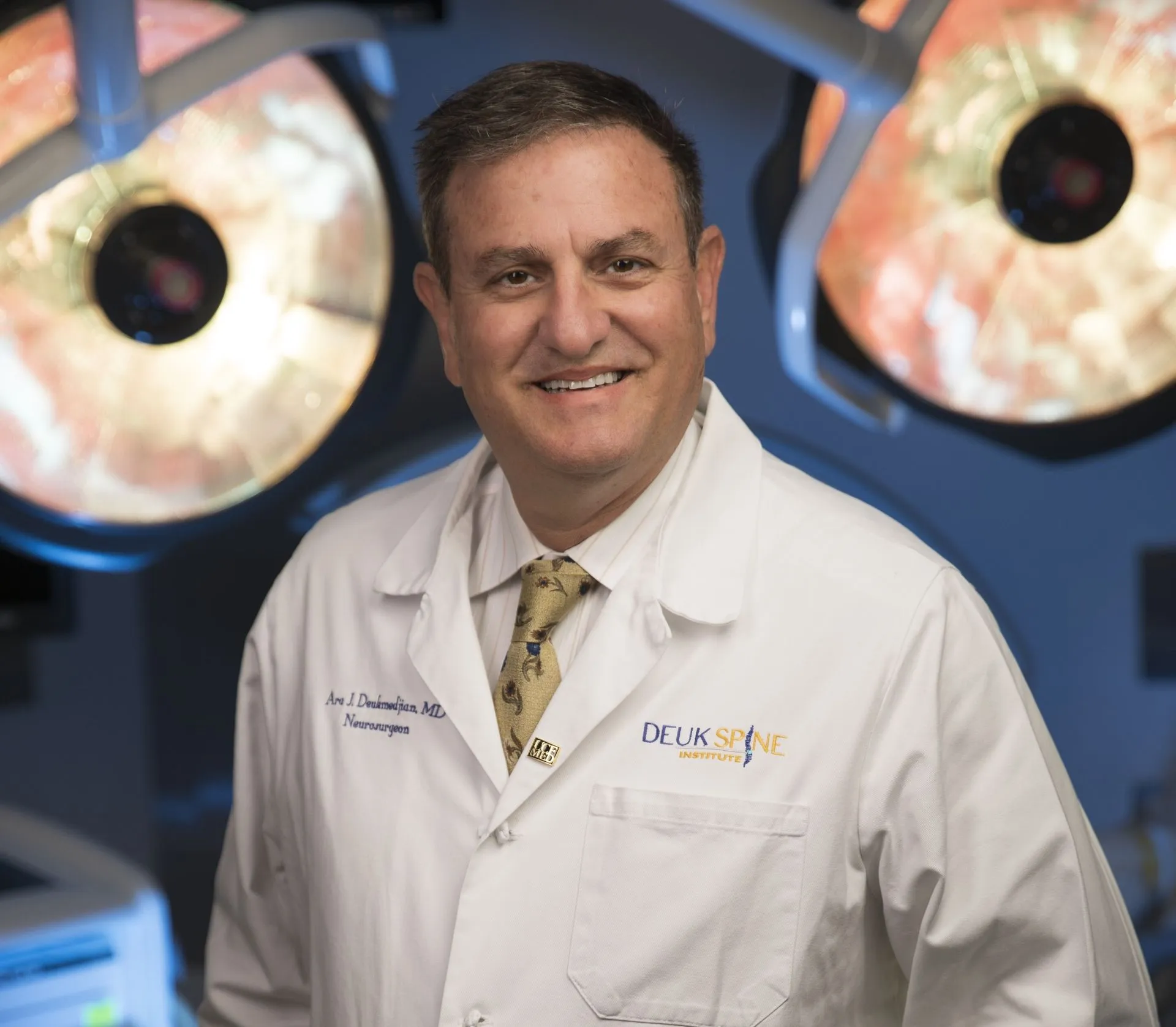
Upload your MRI for a free expert review by Dr. Ara Deukmedjian, M.D. — board-certified neurosurgeon. Ten minutes can change your life.
What Is a Herniated Disc at C5-C6?
Your cervical spine contains seven vertebrae, stacked from the base of your skull down to your shoulders. Between each vertebra sits a disc – a tough outer ring called the annulus fibrosus wrapped around a softer interior called the nucleus pulposus. These discs act as shock absorbers and allow your neck to move in multiple directions.
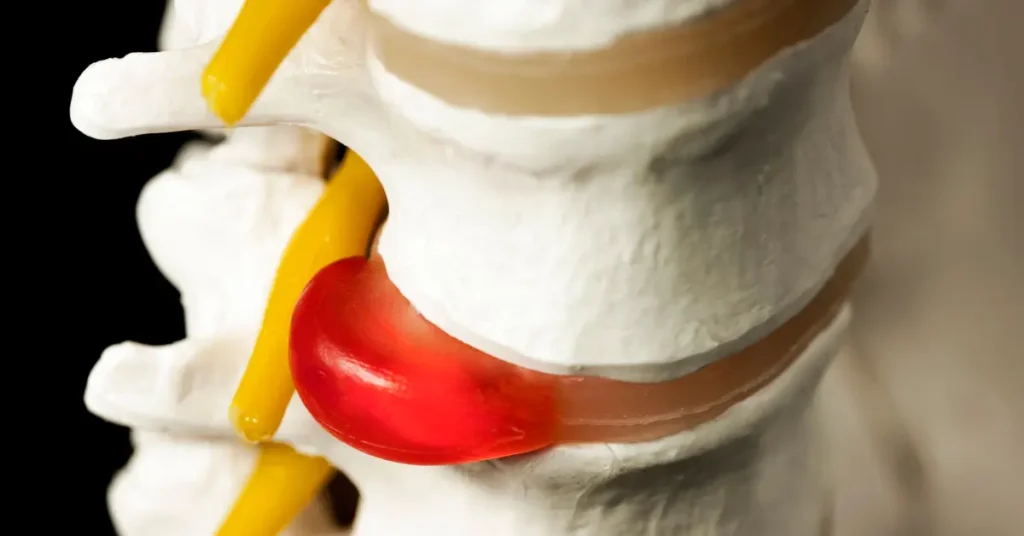
A herniation at C5-C6 means the disc between the fifth and sixth cervical vertebrae has been damaged. The outer annulus has developed a tear – typically in the posterior (back-facing) portion of the disc – and the nucleus pulposus has pushed through or bulged into that tear. This puts pressure on nearby structures and, critically, triggers a chemical inflammatory response inside the tear itself. That inflammation is the primary driver of pain, both locally in the neck and referred down the arm.
C5-C6 sits at one of the most mechanically loaded segments in the neck. It handles enormous flexion and extension forces every day, which is why it degenerates and herniates more frequently than the levels above it. Whether you developed this injury gradually over years of desk work or suddenly after a traumatic event, the underlying mechanism is the same: structural damage to the disc leading to inflammation that your body cannot resolve on its own.
How C5-C6 Herniations Affect the C6 Nerve Root
The C6 nerve root exits the spinal canal through a small opening between C5 and C6. When a herniation occurs at this level, the displaced or inflamed disc material can impinge on or chemically irritate that nerve root. This produces what’s called cervical radiculopathy – a set of symptoms that travel along the specific path the C6 nerve supplies.
The C6 dermatome runs from the neck down through the shoulder, into the bicep, along the forearm, and into the thumb and index finger. When that nerve is affected, patients describe several recognizable patterns:
- Numbness or tingling in the thumb and index finger, often waking patients at night
- Shooting or electric pain that runs from the neck down the arm, often triggered by specific neck positions
- Bicep weakness that makes it difficult to lift or carry objects
- Reduced grip strength in the hand, particularly for fine motor tasks
- Wrist extension weakness that affects everyday activities like typing or pouring
These radicular arm symptoms are driven primarily by chemical inflammation of the C6 nerve – not simply by physical compression. This distinction matters enormously when it comes to treatment. A surgery that removes the inflammatory source at the disc addresses the actual mechanism of pain. A surgery that cuts out bone and fuses the vertebrae addresses none of it directly.
Axial Neck Pain vs. Radicular Arm Symptoms: Two Separate Problems
One of the most important things I tell patients is this: your neck pain and your arm pain are likely coming from two different sources within the same disc injury. Conflating them leads to misdiagnosis, unnecessary fusion surgeries, and patients who come out of ACDF still dealing with one or both types of pain.
Axial neck pain is localized. It stays in the neck and upper trapezius region, sometimes referring to the base of the skull or the shoulder blade. It tends to be a deep, aching pressure – worse with prolonged sitting, computer work, or positions that load the disc. This pain originates from the disc itself, specifically from the inflammation inside the posterior annular tear. The outer disc wall and the posterior longitudinal ligament are richly innervated with pain-sensitive fibers. When they’re exposed to the sustained chemical environment of a herniation, they signal pain continuously.
Radicular arm pain is a different signal entirely. It is typically sharper, more electric, more position-dependent, and it follows the dermatomal distribution of the affected nerve root. Patients describe it as shooting, burning, or like a bolt from the neck to the hand. This symptom tells you the C6 nerve root is involved.
What this means clinically is that a patient with a C5-C6 herniation may have:
- Axial neck pain only (disc inflammation, no significant nerve involvement)
- Radicular arm symptoms only (nerve compression with minimal disc-origin neck pain)
- Both together (the most common presentation)
Accurate diagnosis requires separating these two components. The treatment for the disc-origin pain – debridement and removal of the inflammatory tissue at the annular tear – is different from what addresses nerve root irritation. A surgeon who doesn’t distinguish between these is operating on the wrong problem.
Diagnosing a C5-C6 Herniation Accurately
Most spine patients arrive having had an MRI. That’s a good starting point, but it’s not sufficient on its own. Jensen et al. in the New England Journal of Medicine found that 64% of 98 asymptomatic adults had disc abnormalities on lumbar MRI with no pain, a finding later reinforced by a systematic review and meta-analysis by Brinjikji et al. showing disc degeneration findings are common in people without symptoms. An MRI image of a herniation tells you the disc is damaged. It does not confirm that disc is the source of your specific pain. That determination requires clinical judgment.
The Deuk Spine Exam® combines three elements that most standard consultations leave incomplete:
- Diagnostic imaging review – Careful analysis of MRI findings with specific attention to posterior annular tear morphology, degree of herniation, and any foraminal narrowing affecting C6
- Detailed neurological examination – Dermatomal sensory testing, myotomal strength grading, and reflex assessment to confirm or rule out C6 nerve root involvement
- Symptom history correlation – Mapping the patient’s pain pattern, aggravating positions, and symptom distribution against the anatomical findings
When these three elements are integrated correctly, we achieve 99% diagnostic accuracy in identifying the true structural source of pain. That matters because a surgery that targets the right level, for the right reason, produces dramatically better outcomes than one chosen based on imaging alone.
We’ve also found that identifying whether C5-C6 is producing axial disc pain, radicular C6 nerve symptoms, or both allows us to select the exact procedure that addresses what’s actually wrong – rather than defaulting to the most aggressive option available.
ACDF: What the Conventional Recommendation Looks Like
If you’ve seen a traditional spine surgeon about your C5-C6 herniation, you’ve likely been told about anterior cervical discectomy and fusion, or ACDF. This is the standard surgical approach for cervical disc disease in most hospital systems, and it’s been performed for decades. Understanding what it actually involves is important before agreeing to it.
In an ACDF procedure, the surgeon approaches the disc from the front of the neck, removes the herniated disc material, and fills the empty disc space with bone graft material – either from the patient’s own pelvis, a cadaver donor, or a synthetic cage. Metal plates and screws are then used to fuse the C5 and C6 vertebrae permanently together.
The consequences of fusion at this level are worth understanding clearly:
- Loss of motion at C5-C6 – Once fused, this segment no longer moves. For patients who are active or value full cervical range of motion, this is a permanent change.
- Adjacent segment disease – Fusing one level transfers mechanical stress to the discs above and below, increasing their risk of degeneration over time. This is a well-documented phenomenon in the spine literature.
- Hardware and implant risks – Plates, screws, and bone cages introduce permanent foreign material into your spine that carries its own long-term considerations.
- Recovery timeline – Full recovery from ACDF typically requires several months, with restrictions on driving, lifting, and activity during healing.
None of this means ACDF is never appropriate. For patients with severe instability, multilevel disease, or significant spinal cord compression, it may be the right choice. But for the majority of patients with a single-level C5-C6 disc herniation causing neck and arm symptoms, there is a less invasive option that eliminates the pain without eliminating motion.
Deuk Laser Disc Repair®: Motion-Preserving Surgery at C5-C6
The Deuk Laser Disc Repair® was developed specifically to treat the actual source of disc pain – the inflamed annular tear – without removing the disc, without fusion, and without drilling into bone. I’ve performed over 2,700 of these procedures with a 0.01% complication rate and zero infections. Patients report an average of 99% pain relief for the treated pain source.
Here’s what the procedure involves:
A 4mm incision – smaller than a dime – is all that’s required. Using endoscopic visualization, I access the C5-C6 disc and perform a precise debridement of the annular tear. The inflamed and damaged tissue inside the tear is removed. The herniated nucleus pulposus material that has been driving chemical irritation of the C6 nerve root is addressed at the same time. No bone is drilled. No vertebrae are fused. No hardware goes into your spine.
The procedure takes approximately 20 minutes per disc level. It is performed as an outpatient procedure – you do not stay overnight. Most patients walk out of the surgical center within a few hours of the procedure. There are no opioids required post-operatively. There is no lengthy immobilization or physical therapy regimen before you can return to normal life.
Because the disc is preserved rather than removed, C5-C6 continues to function as a motion segment after surgery. The adjacent levels above and below are not subjected to increased stress. The structural architecture of your cervical spine remains intact.
What heals after the procedure is the annular tear itself. Without the ongoing inflammatory environment inside the tear – which the debridement eliminates – the body can finally begin to repair the damaged tissue naturally over the following nine to twelve months. The pain, however, resolves far sooner. The inflammatory source is gone. The nerve root can recover.
Who Is a Candidate for Deuk Laser Disc Repair® at C5-C6?
Most patients with a single-level C5-C6 herniation causing neck pain, C6 radiculopathy, or both are potential candidates. This includes patients who have:
- Failed conservative treatment including physical therapy, injections, or pain management for six months or more
- Been told fusion is their only surgical option and want to know if that’s accurate
- Significant functional limitations – arm weakness, hand numbness, inability to work or exercise – from the C6 nerve involvement
- MRI findings consistent with C5-C6 disc pathology that correlates with their clinical presentation
The most important first step is an accurate diagnosis. That’s why we offer free MRI reviews – because understanding whether your imaging matches your symptoms, and whether a disc-targeted procedure addresses your specific anatomy, changes everything about the conversation. A patient who has been quoted a fusion surgery based on imaging alone may have a very different path forward once the full clinical picture is evaluated.
Patients who have severe spinal cord compression, significant instability at C5-C6, or multilevel disease may require a different approach. But that determination should be made through a thorough evaluation – not assumed based on the presence of a herniation on an MRI.
What Patients With C5-C6 Herniations Should Know Before Deciding
Cervical spine surgery is a high-stakes decision. The neck houses your spinal cord, your C6 nerve root, your carotid arteries, and every neural pathway that controls your arms and hands. Getting it right the first time matters more here than almost anywhere in the spine.
Before agreeing to any surgical intervention at C5-C6, ask your surgeon these questions directly:
- Is the recommended surgery treating the annular tear itself, or just removing disc material and stabilizing the segment?
- What happens to adjacent levels over the next ten to fifteen years if this level is fused?
- Is there a motion-preserving alternative, and if not, why not?
- What is your complication rate, and what complications have you seen at this level specifically?
You deserve a surgeon who can answer those questions with specific data, not generalities. Over 30 years and more than 2,700 cervical procedures, my answers have stayed consistent because the outcomes data backs them up.
C5-C6 disc herniation is treatable. The neck pain can go away. The arm symptoms can resolve. The numbness in your thumb and fingers can improve. The question is whether that resolution requires sacrificing motion and accepting hardware in your spine – or whether a 4mm incision and twenty minutes of targeted surgery can restore what you’ve lost without taking anything more.
Take the Next Step
If you have an MRI showing a C5-C6 disc herniation and you’re weighing your surgical options, I invite you to submit your scans for a free MRI review. Our team will evaluate your imaging, correlate it with your reported symptoms, and give you an honest assessment of whether the Deuk Laser Disc Repair® is an appropriate option for your specific anatomy. There is no obligation, and no sales pitch – just clinical analysis from a surgeon who has spent three decades treating this exact condition.
Contact Deuk Spine Institute to schedule your free MRI review or a virtual consultation. You don’t have to choose between fusion and living with pain. There is a third option.

Diagnosis. Answers. Relief.
Submit your MRI for a free expert review by Dr. Ara Deukmedjian, M.D. — board-certified neurosurgeon. No obligation. Real answers.
Schedule Yours Today 2,000+ procedures · Zero major complications · No cost, no obligation